In September 2026, the Bank of England held its base rate at 3.75% while UK inflation sat at 3.1%, comfortably above the 2% target. Three of the nine members of the Monetary Policy Committee (MPC) voted to raise rates further, arguing for a move to 4%. That disagreement, inside a single institution, working from a single set of data, is the puzzle worth sitting with.
Most people know that interest rates and currencies are connected. Far fewer understand the mechanism well enough to explain why a central bank statement can move a currency by almost nothing, as Governor Andrew Bailey’s Oxford remarks moved GBP/USD by just 0.15%, yet in other episodes a single sentence sends sterling several percent in a day. That gap is what this piece closes.
Read on, and you will be able to interpret a BoE announcement, an MPC vote split, or a Bailey speech in terms of what it actually signals for the pound, and why, rather than treating each one as noise. Think of it as a practical lens, not a promise of certainty. Currencies never offer that.
What the Bank of England is actually trying to do
Start with the mandate, because everything else flows from it. The Bank of England’s primary job is price stability, defined precisely as 2% annual CPI inflation. Its main instrument for hitting that number is the base rate, the interest rate it charges commercial banks, which ripples out into borrowing costs across the whole economy.
That fixed, public target is exactly what makes the BoE readable to currency traders. Because everyone knows the number the Bank is aiming for, any gap between actual inflation and target creates a predictable direction of policy pressure. Traders can anticipate it.
The Bank of England’s 2% CPI target is the non-discretionary anchor for every decision, and the three BoE policy tools, base rate adjustments, quantitative easing, and quantitative tightening, each transmit differently into sterling depending on whether markets treat them as stimulus, restraint, or crisis response.
Right now, that gap is live. UK CPI stood at 3.1% in the 12 months to August 2026, according to the Office for National Statistics (ONS), with CPIH (which includes owner-occupiers’ housing costs) at 3.3% over the same period.
The policy problem in one number UK CPI at 3.1% against a 2% target is the gap the MPC is actively managing. Every rate decision is an attempt to close it without choking off growth.
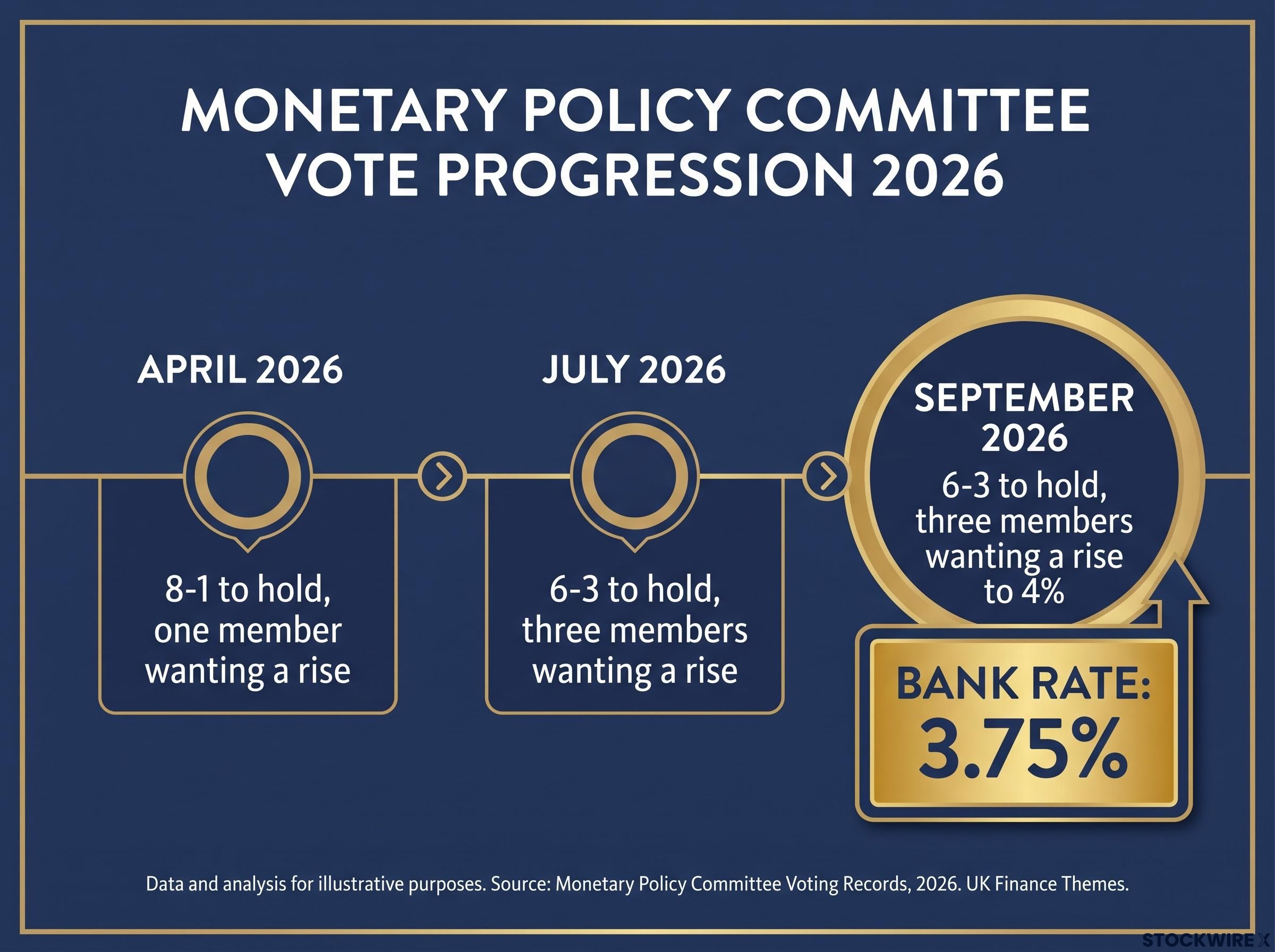
At its September 2026 meeting, published on 17 September 2026, the MPC voted 6-3 to hold Bank Rate at 3.75%, with three members already preferring a rise to 4%. What matters is not just the hold but the drift behind it.
- April 2026: 8-1 to hold, one member wanting a rise
- July 2026: 6-3 to hold, three members wanting a rise
- September 2026: 6-3 to hold, three members wanting a rise
That widening minority tells you the committee’s internal balance of risk has been tilting toward tightening. It also means a “hold” is never the whole story. If the vote split surprises the market by turning more hawkish than expected, sterling can strengthen even when the headline rate does not move. Reading the distribution of views, not just the decision, is where the forward signal lives.
When big ASX news breaks, our subscribers know first
How a rate decision travels from Threadneedle Street to the exchange rate
So how does a number set in a committee room actually reach the exchange rate? The chain is more mechanical than it looks.
A higher BoE rate, relative to rates abroad, raises the expected return on assets held in sterling. That draws capital toward the UK, and to buy those assets, investors must first buy pounds. That demand pushes the exchange rate up. Here is the sequence:
- The MPC sets Bank Rate.
- That changes the yield on sterling assets relative to foreign ones.
- Capital flows toward the higher expected return.
- Investors buy GBP to access those assets.
- Increased demand lifts the exchange rate.
The theoretical scaffolding here is uncovered interest parity (UIP), the idea that exchange rates adjust so that expected risk-adjusted returns are roughly equal across currencies. It is a useful starting point, but the empirical evidence for UIP is mixed, and carry trades, risk premia, and structural factors all muddy the picture in practice. Treat it as a first approximation, not a law.
Federal Reserve research on UIP failure documents how interest-rate differentials explain only a portion of observed exchange-rate movements, with risk premia and term structure factors accounting for much of the residual — precisely why the simple rate-to-currency rule breaks down so often in practice.
The single most important refinement is this: markets trade on surprises, not on the level of rates. If a decision is fully priced in before it lands, the announcement changes nothing, because it told the market nothing it did not already know.
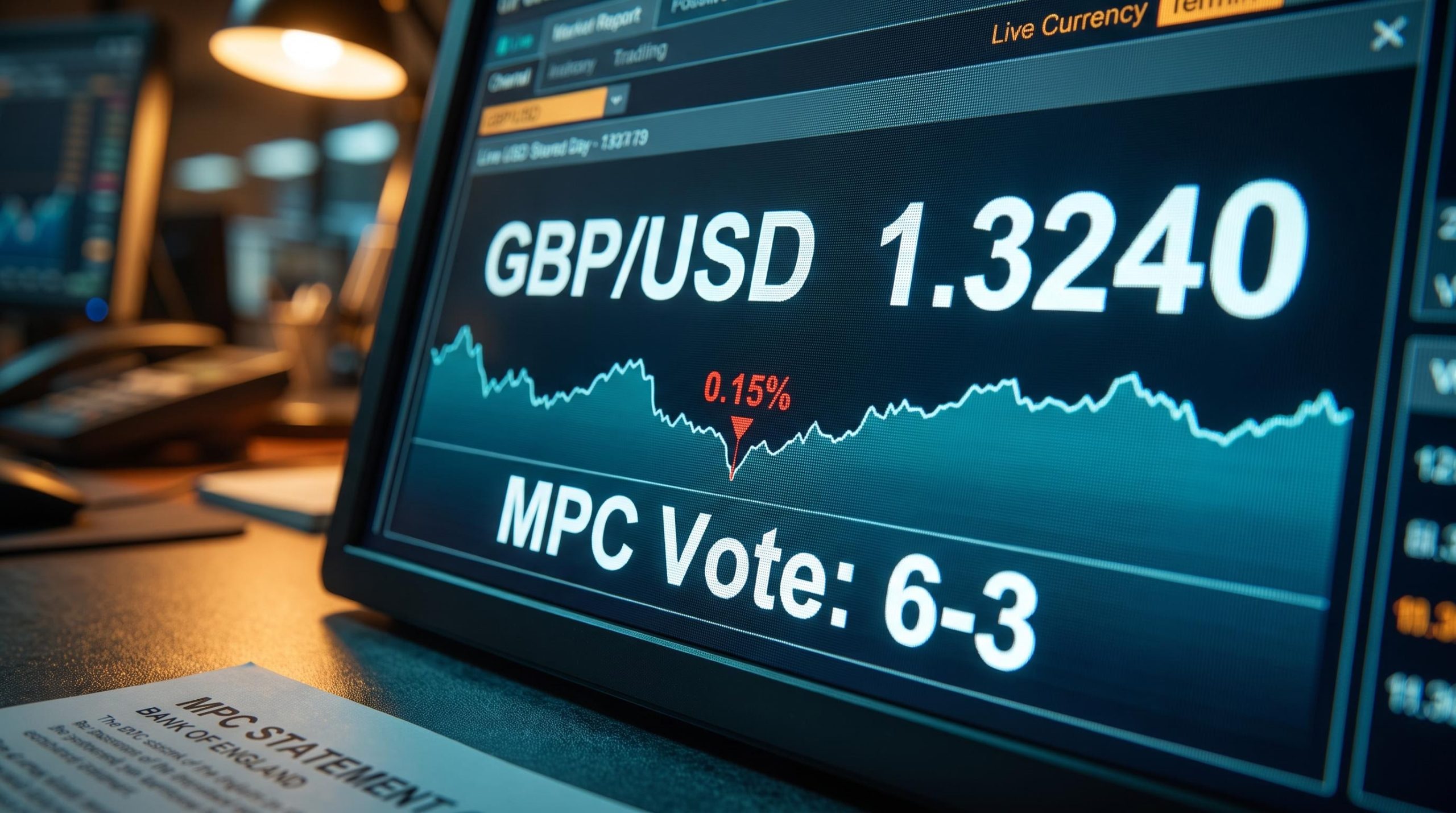
The expectations channel, worked out live When Bailey spoke at Oxford, GBP/USD moved roughly 0.15%, hovering just below 1.3240. His stance was already priced in, so there was no new information to trade on.
That tiny move is not a failure of the theory. It is a confirmation of it. Use it as your mental benchmark: a central bank communication that merely confirms what the market expected will barely register, while one that genuinely surprises can move sterling sharply. In late September 2026, for reference, GBP/USD traded in roughly the 1.32-1.33 range.
There is one amplifier worth knowing. When global volatility is low, a relatively high BoE rate can make the pound a target for carry trades, where investors borrow in low-yielding currencies to buy higher-yielding ones. That can push sterling up beyond what the simple yield gap alone would suggest.
| Signal Type | Market Expectation | FX Reaction |
|---|---|---|
| Expected rate hold confirmed | Fully priced in | Minimal move |
| Unexpected rate rise | Not priced in | Sharp GBP appreciation |
| Dovish surprise | More hawkish path expected | GBP weakens |
The practical upgrade for you is a change of question. Stop asking “did the BoE raise rates?” and start asking “did the BoE surprise the market?” The second question is the one that actually predicts sterling.
Beyond rates: how QE and QT reshape sterling’s trajectory
Most people carry a simple rule in their heads: quantitative easing weakens a currency, quantitative tightening strengthens it. The rule is a reasonable starting point, but the real BoE record shows it breaks more often than you would expect.
First, the definitions. Quantitative easing (QE) is when the BoE buys government or high-grade corporate bonds from financial institutions to inject liquidity into the system. This typically compresses gilt yields and, all else equal, weakens sterling. Quantitative tightening (QT) reverses that: the Bank stops buying and lets its holdings mature without reinvesting the proceeds, which is generally associated with a stronger pound.
That is the textbook version. Now the complication. In several UK episodes, the relationship ran differently, because markets read decisive bond-buying as crisis stabilisation rather than as yield suppression. When the Bank steps in to restore confidence, sterling can strengthen even as the balance sheet expands.
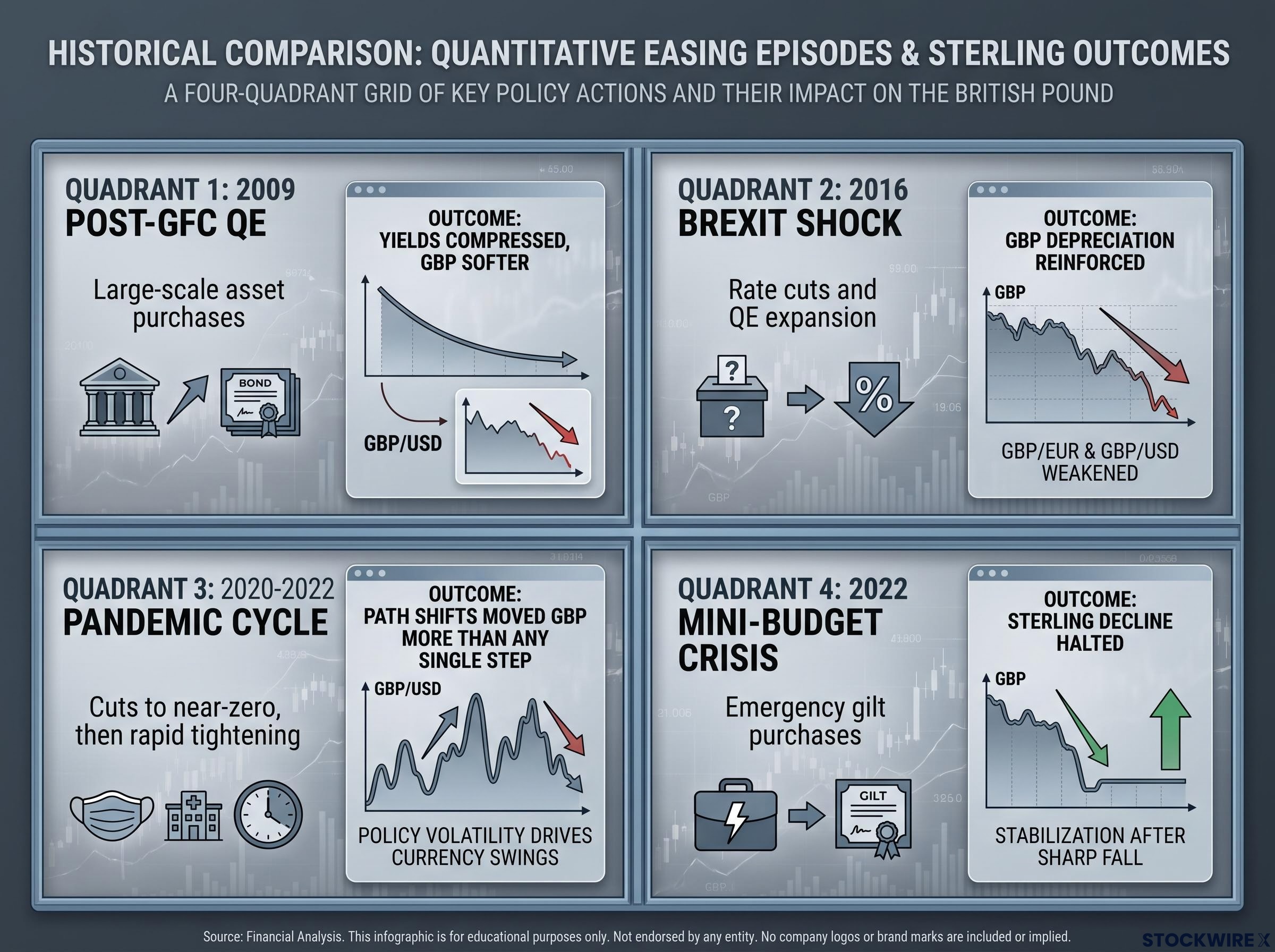
| Episode | BoE Action | Sterling Outcome |
|---|---|---|
| 2016 Brexit shock | Rate cuts and QE expansion | GBP depreciation reinforced |
| 2009 post-GFC QE | Large-scale asset purchases | Yields compressed, GBP softer |
| 2022 mini-budget crisis | Emergency gilt purchases | Sterling decline halted |
| 2020-2022 pandemic cycle | Cuts to near-zero, then rapid tightening | Path shifts moved GBP more than any single step |
The 2016 post-referendum period and the 2009 post-crisis QE rounds both fit the standard pattern, where easing widened the rate differential against the US and weighed on the pound. The pandemic cycle from 2020-2022 shows a different lesson: emergency cuts to near-zero, then massive QE, then rapid tightening, all demonstrating that shifts in the expected policy path moved sterling more than any individual rate decision did.
The 2022 mini-budget: when QE supported rather than weakened the pound
The clearest exception came in September 2022. A large unfunded fiscal package triggered a violent gilt sell-off and a sharp slump in sterling. Long-dated gilt yields spiked, and the market began to question UK fiscal credibility itself.
The BoE responded with emergency gilt purchases aimed at stabilising the long end of the curve. That is QE by any technical definition, an expansion of the balance sheet, yet it helped halt sterling’s decline rather than deepen it.
Why the reversal? Because in a confidence crisis, the Bank’s willingness to act as a market stabiliser mattered more to sterling than the mechanical direction of its balance sheet. The lesson for you is to check the market context before you assume QE is bearish for the pound. In calm times it usually is. In a crisis, the same tool can do the opposite.
How Governor Bailey’s words move markets before rates do
Here is a point many people miss: forward guidance is not a supplement to monetary policy. It is monetary policy. The Bank can move sterling through speeches, MPC statements, and Monetary Policy Reports, well before it changes a single rate, because those words reshape the market’s expectations of the future path.
Bailey’s Oxford remarks are the clearest recent example. He warned that sustained elevation in energy prices could make rate rises harder to avoid, while noting that the pass-through of higher energy costs into broader conditions had been muted so far. That is conditional guidance, and it quietly updates the market’s probability distribution for future moves.
Central bank forward guidance operates as a rate decision in its own right: research on the Riksbank shows that an upward revision to a published rate path drives measurable currency appreciation within the hour, even when the headline policy rate itself is left unchanged.
Naming energy as a potential trigger for tightening is a subtle upside signal for sterling. It raises the market’s estimated odds of future rate rises without the Bank changing anything today. That is precisely how a speech does monetary policy work.
His comments on artificial intelligence point the other way. Bailey was broadly optimistic that AI could act as a favourable supply-side shock at a time of adverse supply disruptions, a scenario in which inflation eases without the Bank needing to tighten. Set the two examples side by side:
- Energy-driven rate risk: sterling-positive if it materialises, because it raises the odds of future hikes
- AI-driven supply optimism: potentially sterling-negative, because it reduces the need for tightening
This institutional guidance also shows up in official communications, not just speeches.
Forward guidance in the minutes In its September 2026 statement, the MPC warned that fallout from Middle East conflict driving energy prices higher could necessitate future rate rises. That is a conditional signal embedded directly in the Bank’s own record.
One caveat keeps this honest. Guidance only works if it is credible. If markets come to see the Bank’s signals as inconsistent or politically constrained, they discount the words and trade on realised data instead. Read a BoE speech for its expectations content, and you will extract more signal than someone waiting only for the headline rate to change.
Where the model breaks down: limits of the rate-currency relationship
Now for some productive discomfort. The rate-to-currency link is well established in theory, but it misfires often enough in practice that treating it as a rule will get you into trouble. Structural forces routinely override it in the short run.
The empirical case against a simple rule is strong. Many studies find that interest-rate differentials explain only part of exchange-rate movements; term premia, risk sentiment, and balance-sheet channels carry much of the rest. UIP, the neat theory from earlier, fails cleanly in a lot of the data.
Experts genuinely disagree here. Some treat monetary policy surprises as the primary driver of FX moves. Others argue that rate changes often codify underlying fundamentals rather than drive them, meaning much of the currency move is already priced by the time the Bank acts. Four forces in particular can override the rate signal on any given day:
Fed-BoE policy divergence adds a layer of constraint that purely domestic analysis misses: research cited by MPC member Megan Greene estimates that global factors, including Federal Reserve policy, now explain roughly 38% of domestic UK rate variation, up from around 10% before 1999.
- Global risk appetite and carry-trade dynamics
- The UK’s current-account balance and fiscal position
- Political risk and perceptions of central bank credibility
- Energy and commodity price shocks
Carry trades deserve special attention. In risk-off episodes, when global volatility spikes, investors unwind carry positions and funding currencies strengthen regardless of domestic rate differentials. Sterling can fall even while the BoE holds a relatively high rate, purely because the global mood soured.
Energy, AI, and the uncertainty at the heart of the current BoE outlook
Energy shocks are not all alike, and the difference matters for policy. A temporary spike can be “looked through”, with no rate response, provided second-round effects like sustained wage growth stay contained. A persistent structural shift, driven by the energy transition or chronic geopolitical risk, can raise the UK’s equilibrium real interest rate and keep policy tighter for longer. Each implies a different path for sterling.
AI adds another layer of ambiguity. Bailey’s optimism is plausible but contested; AI adoption could be inflation-neutral or even inflation-raising in the short term, given the heavy upfront investment and sectoral disruption involved. That means his supply-side guidance may not reduce market uncertainty about the rate path as much as it first appears.
For anyone watching the pound, the practical takeaway is that a BoE rate decision is necessary but not sufficient to call GBP’s direction. The global risk environment, the fiscal backdrop, and energy markets can each override it. Account for all of them rather than treating the rate decision as the whole story.
Reading the next BoE announcement with the full picture in mind
The next MPC decision lands on 5 November 2026, and it is the moment to put this framework to work. Rather than waiting for the headline, run every future BoE communication through four questions, in this order:
- What did the market price in before the announcement?
- What was the vote split, and how did it shift from last time?
- Did the language on energy or AI change materially?
- Did the Bank commit to a forward path, or stay explicitly data-dependent?
The 5 November baseline Bank Rate at 3.75%, CPI at 3.1%, a 6-3 vote to hold with three members favouring 4%, and an MPC already flagging energy-price risk. Any surprise will be measured against this setup.
The decision will not be a binary event for sterling. The market will read the vote split, the tone on energy risk, and any shift on AI-driven supply optimism at least as closely as the rate itself. Apply the multi-signal lens, and you will extract more from it than someone watching only for a rate change.
Sterling reflects many forces at once. Readers who can separate the genuine policy signal from the noise are simply better placed to interpret FX movements than those who wait for headlines alone.
Investors wanting to extend this framework beyond BoE decisions will find our comprehensive walkthrough of reading macro events before they move markets covers OIS curve pricing, CFTC positioning data, and options risk-reversal skew, the tools that reveal whether a trade is already crowded ahead of any scheduled release.
This article is for informational purposes only and should not be considered financial advice. Investors should conduct their own research and consult with financial professionals before making investment decisions. Past performance does not guarantee future results, and forward-looking statements about interest rates, inflation, and currency movements are speculative and subject to change based on market developments.