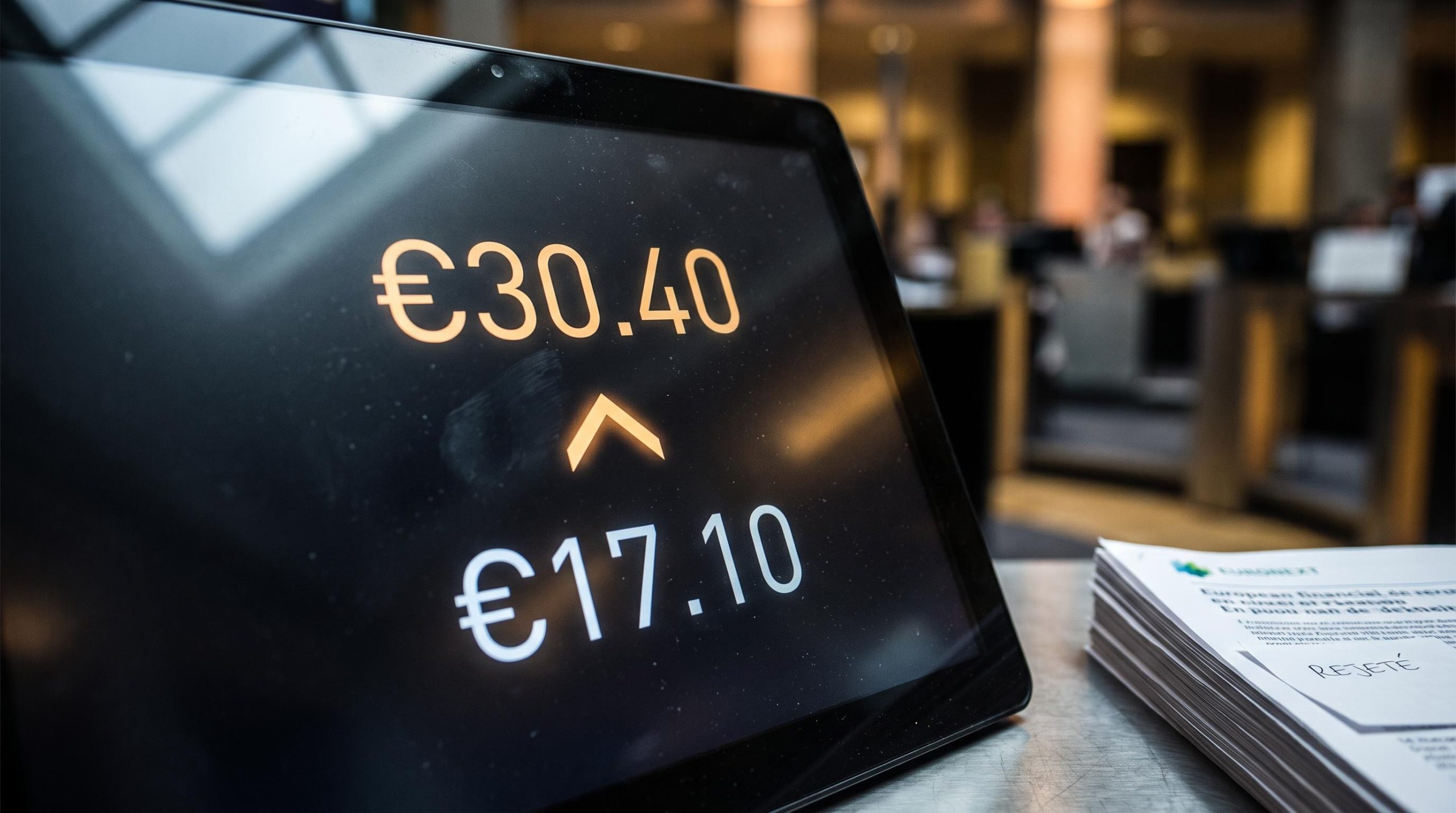
A board turned down a 78% premium. Then the stock fell 7% when the bidder walked away.
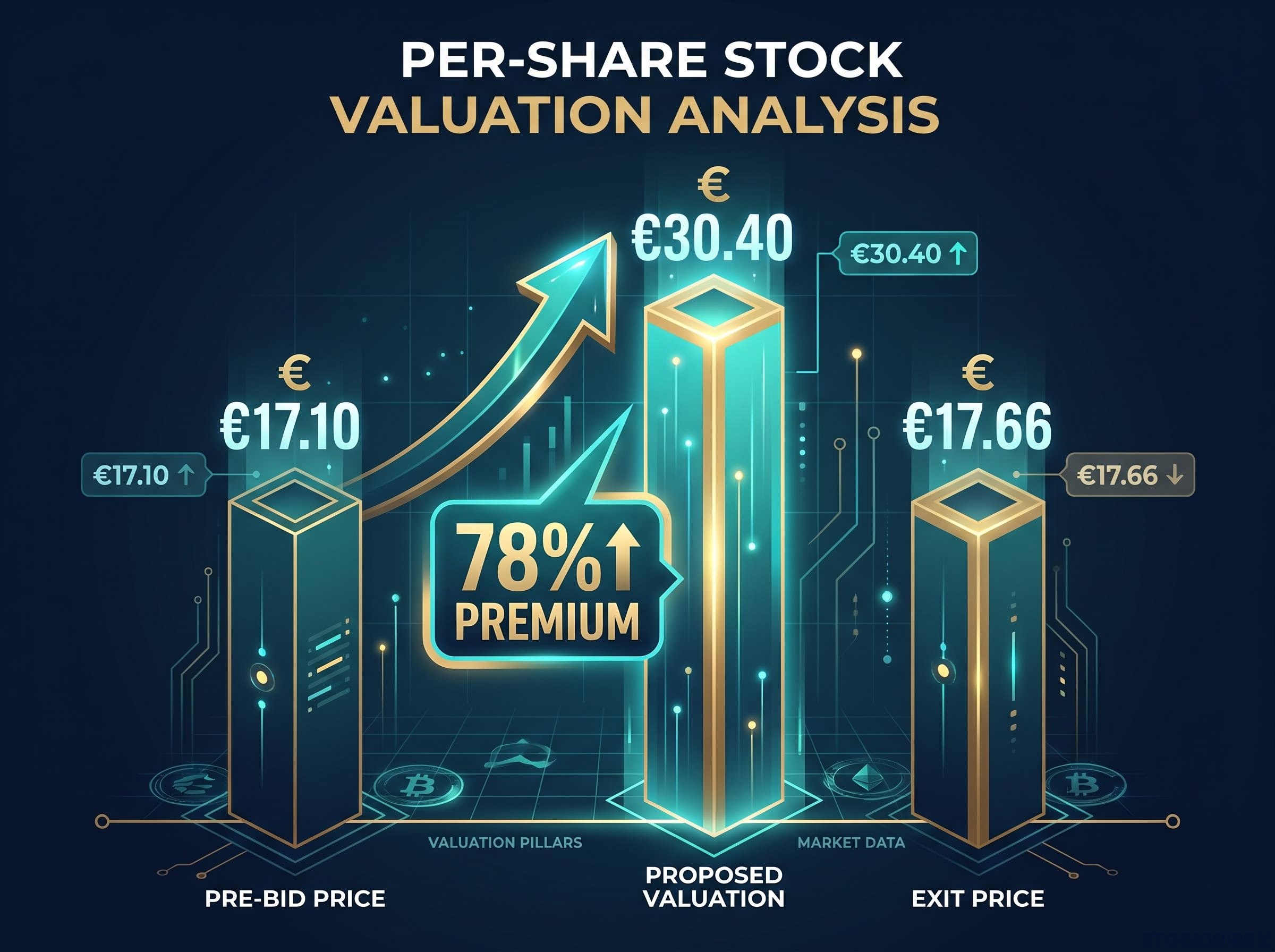
That is the paradox at the centre of Bill Ackman’s failed run at Universal Music Group (UMG). In April 2026, Pershing Square Capital Management valued the world’s largest music company at roughly €30.40 per share, a huge markup on the €17.10 it was trading at. UMG’s board rejected it as still too low. By early June 2026, Ackman was gone entirely.
Two of the most sophisticated parties in the market looked at the same asset and could not agree on what it was worth, or how to get there. The board’s conviction that even a 78% premium undervalued the company is itself the puzzle worth solving.
This episode gives a clear framework for understanding why the same asset trades at fundamentally different multiples depending on where it is listed and who owns it. The implications reach well beyond UMG, into any European media valuation an investor tries to read against its US peers.
What Ackman actually proposed, and why the numbers looked the way they did
The structure is where the thesis lived, so it is worth walking through the plumbing before touching the pitch.
Pershing Square proposed merging UMG with its Pershing Square SPARC Holdings vehicle, redomiciling the combined business as a Nevada corporation branded “New UMG,” and listing it on the New York Stock Exchange (NYSE). The headline valuation landed at approximately €55.75-€55.8 billion, or roughly $64 billion, implying about €30.40 per share.
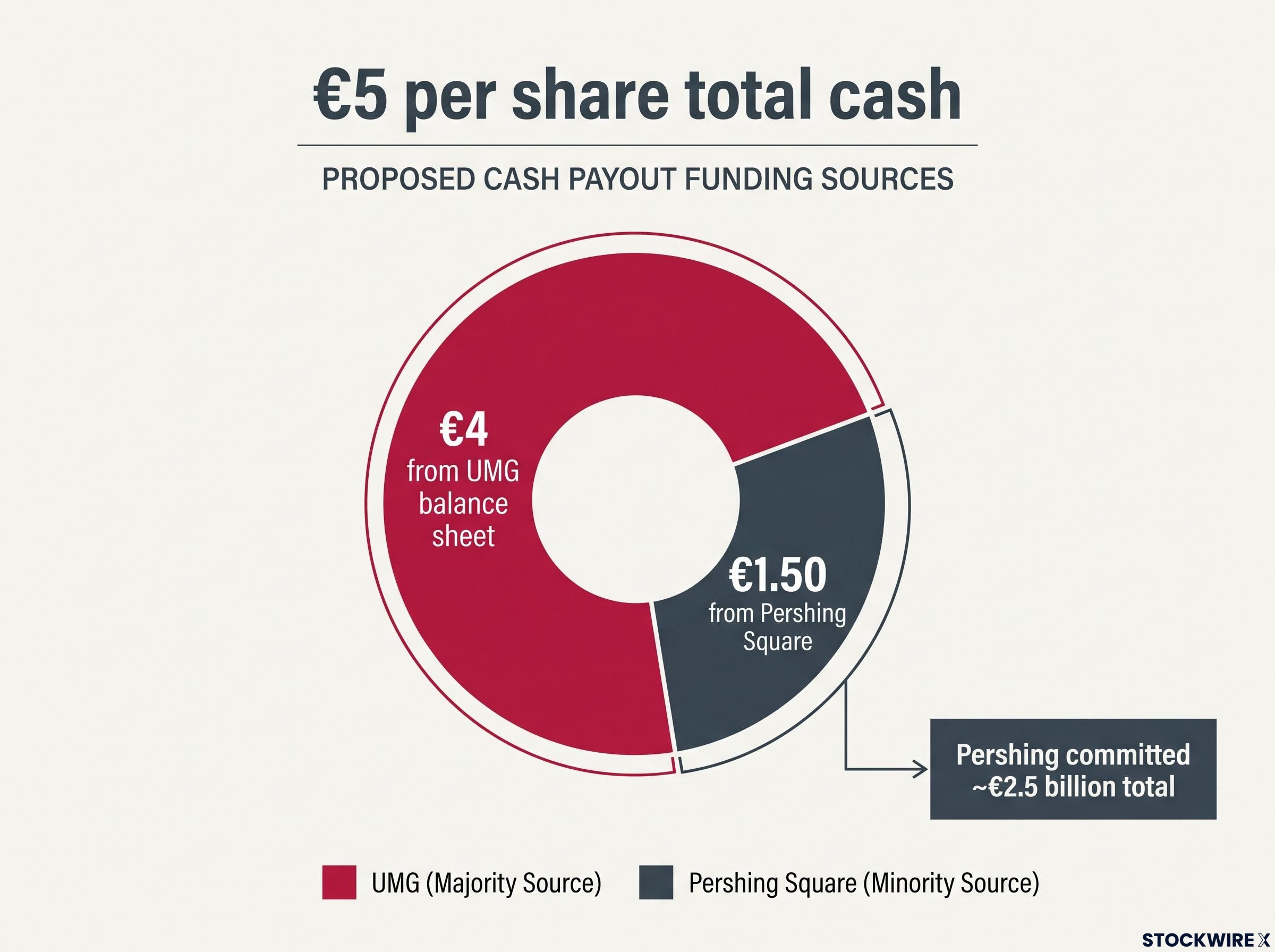
Shareholders would have received €5 per share in cash plus stock in the new entity. Here is the detail that shaped every reaction to the deal: of that €5, approximately €4 would have come from UMG’s own balance sheet, with Pershing contributing only about €1.50 per share in fresh capital. Pershing committed roughly €2.5 billion of its own funds, with the balance sourced from the company itself and a 3% stake sale.
| Component | Amount | Source | Strategic Purpose |
|---|---|---|---|
| Cash portion (majority) | ~€4 per share | UMG’s own balance sheet | Fund most of the headline premium |
| Cash portion (minority) | ~€1.50 per share | Pershing Square (~€2.5B committed) | Provide new external capital |
| Stock in “New UMG” | Residual equity | Merged NYSE-listed entity | Deliver re-rating upside |
| Deal vehicle | SPARC Holdings merger | Pershing Square | Nevada redomiciliation, US listing |
What this structure tells you is that Pershing was engineering something close to a partial self-funded buyout. The company would have paid for most of its own premium. Read that way, the board’s rejection stops looking like a simple valuation quarrel and starts looking like a fight over who captured the upside.
The multiple-expansion thesis: from Amsterdam to the NYSE
The stock component is where the real bet sat. Ackman argued UMG traded at a European multiple of roughly 16x earnings, well below the US-style rating he believed it deserved. His projection had “New UMG” re-rating to approximately 25x on a US listing, with a 2030 scenario stretching that to 30x.
The mechanism was index inclusion. A Nevada domicile and NYSE listing would target eventual entry into the S&P 500 and Nasdaq-100, and the passive flows that come with membership would provide structural buying demand the Amsterdam listing could never generate.
The multiple was only half the story, though. The projected share price of 74 by December 2030, a roughly five-fold return, also leaned on revenue and earnings growth: new streaming platform contracts, subscription price increases, and monetisation of UMG’s Spotify stake. Strip out the operational assumptions and the re-rating alone does not carry the target.
When big ASX news breaks, our subscribers know first
Why European markets structurally undervalue assets like UMG
The gap Ackman was attacking is not unique to UMG. It is a documented, persistent feature of how global capital treats European IP-heavy businesses, and UMG’s ownership simply stacked a second penalty on top of the first.
Start with index composition. US benchmarks are growth-weighted, heavy in technology, communication services, and media platforms, while European benchmarks lean toward financials, industrials, and cyclicals. That trains global investors to treat US indices as growth proxies and European ones as value proxies, compressing multiples for European media even when the underlying business is identical.
NBER research on US-European valuation gaps finds the premium commanded by US-listed firms over European peers has widened significantly since 2008, driven by the concentration of R&D-intensive, high-returns-to-scale businesses in US indices, precisely the structural bias that depresses the multiple assigned to an IP-heavy business like UMG on an Amsterdam exchange.
Then there is the investor base. US institutional and retail money is more willing to pay high multiples for intangible-heavy businesses. European mandates more often prioritise dividends, balance-sheet conservatism, and near-term cash flow, which structurally favours lower multiples for exactly the kind of asset UMG is.
On top of the market-level discount sat UMG’s own ownership overhang. The Vivendi and Bolloré holding-company structure created a further discount, with a related holding entity showing an implied net asset value well above its market value.
The Vivendi and Bolloré holding-company structure imposed exactly the kind of penalty that sum-of-the-parts analysis is designed to quantify: a conglomerate discount that pushes market capitalisation well below the aggregate value of the underlying assets, creating the gap between implied net asset value and observable market price.
Holding company discount in numbers Implied net asset value of approximately €3 billion against a market capitalisation of roughly €1.54 billion, a discount exceeding 50%.
The discrete penalties stacked like this:
- Index composition effect: European benchmarks read as value, not growth
- Investor mandate effect: European capital pays less for intangible-heavy earnings
- Governance and ownership overhang: conglomerate control and holding-company structure
- Liquidity and free-float constraints: thinner turnover than a comparable US listing
What this data tells you is that UMG carried two separate valuation penalties at once, one for being European and one for being owned by European conglomerates. Ackman’s thesis was, in effect, a proposal to remove both in a single move. For any investor eyeing a European company with complex ownership, the lesson holds: the total discount is usually a stack of independent penalties, and the sum tends to be larger than intuition suggests. Cross-listing precedents such as CRH shifting its primary listing to the NYSE, and Flutter Entertainment pursuing a US listing to reflect its FanDuel exposure, show the same strategic logic in action.
How cross-border relistings actually work, and where they fail
Relisting is a repeatable tool, not a one-off gambit. European issuers weighing a US move generally choose from three structural paths.
- Shift the primary listing to the NYSE or Nasdaq while keeping a European secondary listing, the route CRH took.
- Pursue a direct US IPO or dual-listing, as Flutter Entertainment did to reflect its US business.
- Redomicile fully to a US jurisdiction and list anew, the “New UMG” structure Pershing proposed.
The intended payoff is consistent across all three: a deeper pool of growth capital, higher trading liquidity, index inclusion, and a peer group that re-rates the company from European value multiples toward US growth multiples.
| Relisting Path | Example | Key Benefit | Primary Risk |
|---|---|---|---|
| Shift primary listing | CRH | US investor engagement, higher volumes | Domestic stakeholder backlash |
| Direct US IPO / dual-listing | Flutter Entertainment | Peer-group alignment for valuation | Execution complexity, elapsed time |
| Full redomiciliation | Pershing’s “New UMG” | Index inclusion, full re-rating | Venue cannot re-rate weak fundamentals |
CRH and Flutter are generally read as successes on US investor engagement and trading volume, and academic and sell-side work on earlier cross-listings finds that firms with credible growth stories can lower their cost of capital after a US move. The venue premium is real.
It is also conditional. Some cross-border listings since 2020 traded poorly after debut, particularly where the earnings profile did not match the growth story used to sell the relisting. The other risks are familiar: execution complexity during transition, US regulatory and accounting burdens, and backlash from domestic stakeholders.
What the failure evidence tells you is that the listing-venue premium is available only to companies whose fundamentals can credibly sustain US-style multiples. The most dangerous activist pitch is the one relying on the venue to do re-rating work the business itself cannot. When you next see a cross-listing proposal, the test is simple: would the company’s organic growth alone justify the target multiple in the new venue? If not, the thesis is leveraged on execution optimism, not business reality.
Reading the board’s rejection and Ackman’s exit as a valuation signal
Set aside the pitch and treat the sequence as a natural experiment in pricing. Board rejection, full exit, then a decline. Each step reveals something about where professional money believes UMG’s fair value actually sits.
The board did not simply say the price was wrong. It said that even at €30.40, roughly 78% above market, the offer undervalued the company.
The UMG episode is, at its core, a disagreement about margin of safety: Pershing’s 78% premium represented its calculated buffer against intrinsic value estimation error, while the board’s rejection implied that even that buffer was insufficient relative to the standalone value they believed the business could sustain.
The board’s formal position The proposal “is not in the best interests of UMG, its shareholders, artists, songwriters, employees and other stakeholders.”
That framing implies the board’s view of standalone fair value sits above Ackman’s number. Bolloré Group, the largest shareholder, opposed the bid, reinforcing that core insiders believed the company could do better on its own. The board’s substantive concern was almost certainly the cash asymmetry: Pershing supplying about €1.50 per share against roughly €4 from UMG’s own balance sheet.
Then Ackman exited completely at €17.66 per share via a secondary placing and issuer buyback in early June 2026. UMG shares reportedly fell about 7% afterwards, a figure that remains unverified in the source material.
Three signals sit inside that exit:
- The exit price of €17.66, barely above the pre-bid level, not the €30.40 he had argued for
- The clean, full disposal, with no residual stake retained to capture upside if the thesis were even partly right
- The roughly 7% decline, suggesting the market had been pricing in takeover optionality rather than endorsing his standalone valuation
The single most important data point is that clean exit. Walking away entirely from a company he had publicly valued near €30.40 tells you the case was transaction-dependent, not a standalone conviction call. For anyone tracking future activist campaigns, exit behaviour matters as much as the stated thesis. An activist who fully departs after rejection is signalling that the venue and structure, not the business alone, carried the argument.
What the episode actually reveals about European media valuations going forward
Move from this one deal to the durable question underneath it: are European media assets structurally mispriced, and what would actually close the gap?
The framework is a dual penalty. A market-level structural discount from index composition and investor mandates, plus a company-specific overhang from complex ownership. The forward question is which of the two is more tractable. Governance and listing structures can be changed through corporate action. The market-level discount is stickier, because it reflects where global capital chooses to sit.
The European equity valuation gap Ackman sought to exploit at the company level mirrors a market-wide divergence: the STOXX Europe 600 remained roughly 9% behind the S&P 500 as of mid-2026, with sector rotation and macro catalysts, rather than governance engineering, identified as the more likely near-term closure mechanism.
Ackman’s general thesis, that European media trades below its US peers and that governance and listing changes can partly close the gap, could be tested again under several conditions:
- Governance simplification at the holding-company level
- A standalone, UMG-led US listing initiative rather than an activist-driven one
- A sustained streaming growth trajectory that supports higher multiples
- Resolution of AI-related rights and royalty uncertainty
- Evolution of Bolloré Group’s stake, which remains a structural discount factor
CRH and Flutter matter here as the more probable template: companies that pursued structural change on their own terms, without activist pressure.
The business risks that listing-venue change alone cannot solve
Underneath any relisting thesis sit four business risks that a new address cannot fix.
Streaming growth is decelerating in some mature markets, with net subscriber additions slowing at major platforms and continued competition from Sony Music, Warner Music, and independents. Artist bargaining power is rising, letting high-profile talent negotiate better royalty splits or go direct, which can squeeze margins.
AI-generated music and voice cloning introduce unresolved legal and commercial uncertainty over how rights holders like UMG are compensated. As a multi-currency global business, UMG also carries FX and macro sensitivity across streaming, physical sales, and live events.
Each is a conditional, not a rebuttal. All four would need to resolve favourably before US-style multiples could be sustained even after a successful listing change. What this tells you is that the gap Ackman identified is real but not mechanically closable by venue alone.
The verdict a clean exit delivers, and what it leaves open
The clearest lesson is not the activist bid. It is the gap between the board’s implicit fair value, somewhere above €30.40, and the prevailing market price of roughly €17.10 at proposal time, with the exit landing at €17.66. That spread reveals how much disagreement exists among sophisticated, well-resourced parties about what UMG is genuinely worth.
Both sides can be right at once. The board could be correct that standalone value exceeds €30.40, while Ackman is simultaneously correct that European listing and governance structures suppress that value below what US markets would pay. These positions are not mutually exclusive.
The tension in one line A 78% premium, rejected as still too low.
The episode does not settle the European versus US valuation debate. It sharpens it, giving investors a live case with disclosed numbers, competing interpretations, and observable market reactions. The practical takeaway is a two-part diagnostic: identify the stacked discounts, then assess whether the business’s organic trajectory supports the multiple that closing them would imply. CRH and Flutter suggest the more likely path to any re-rating runs through the company’s own initiative, not an outside sponsor. The discount will not vanish because one proposal failed.
For investors wanting to build their own framework for cases like UMG, our full explainer on intrinsic value estimation walks through DCF construction, terminal value sensitivity, and how discount-rate assumptions determine whether a 78% premium can still undervalue a business.
This article is for informational purposes only and should not be considered financial advice. Investors should conduct their own research and consult with financial professionals before making investment decisions. Past performance does not guarantee future results, and financial projections are subject to market conditions and various risk factors. Forward-looking statements are speculative and subject to change based on market developments and company performance.