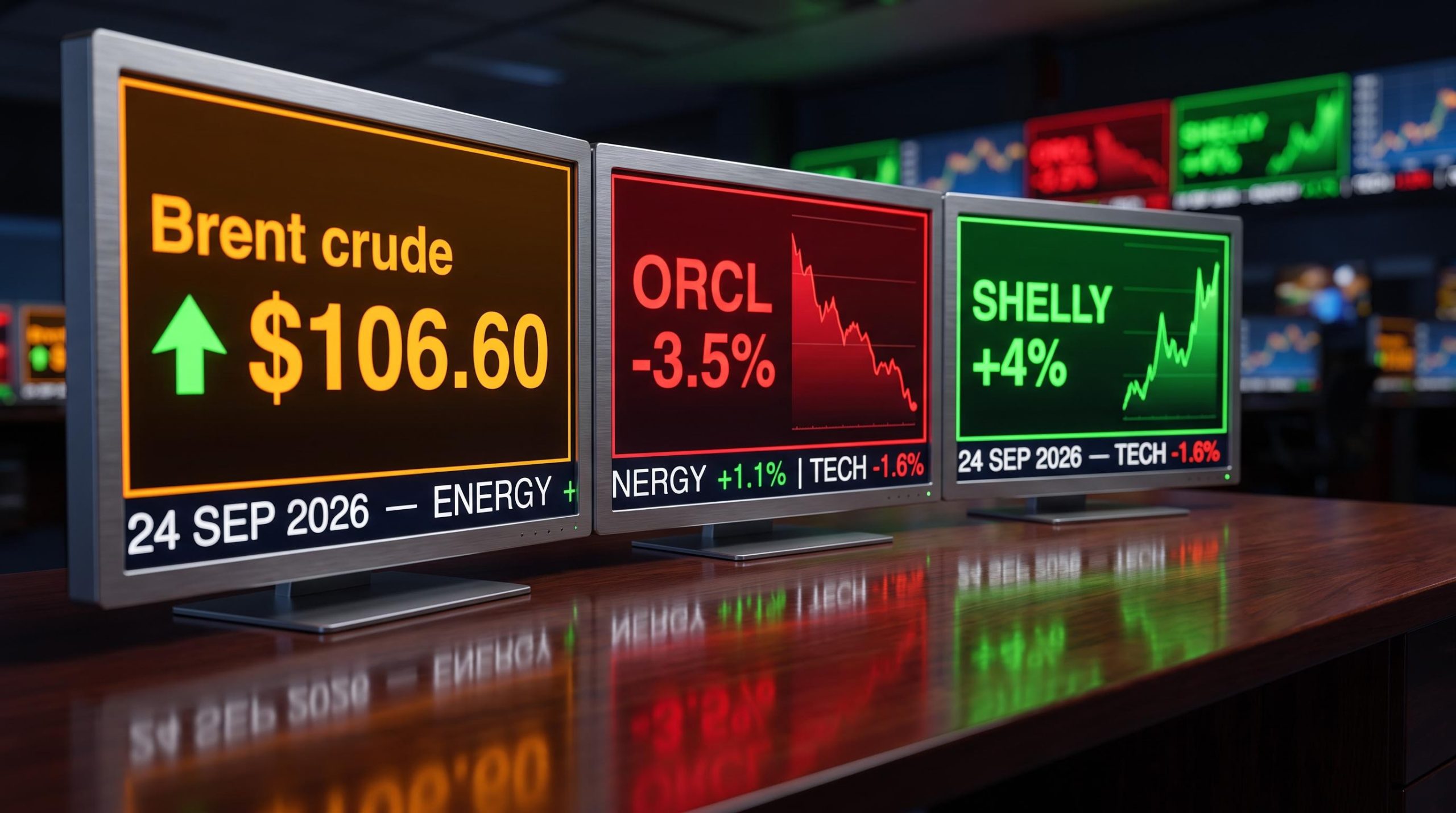
Three unrelated forces hit global markets in a single overnight session, and none of them cared what the others were doing. Oil spiked above $106 per barrel on a reported Houthi missile strike against Saudi Arabia. Oracle filed a force majeure notice on a flagship AI data centre project. And Schneider Electric put €1.2 billion on the table for a Bulgarian smart-home company most investors have never heard of.
This overnight global market recap covers a session that was anything but routine. Geopolitics, AI infrastructure risk, and industrial M&A each moved on their own track, and each carries a signal for how sector positioning should look heading into the next open.
Oil back above $100 rewrites the calculus between energy and growth. Oracle’s notice crystallises a fear that has been circling AI infrastructure for months: that power, not money, is the real ceiling. And Schneider’s bid confirms that traditional industrial groups are buying, not building, their way into software.
Here is what each development means for the sectors you are watching, and which of these three repricings has further to run.
How a Houthi missile strike sent oil above $106 and lit up European energy
Oil jumped more than 3% overnight after a reported Houthi missile strike on Saudi Arabia gave traders a reason to reprice supply risk in a matter of hours.
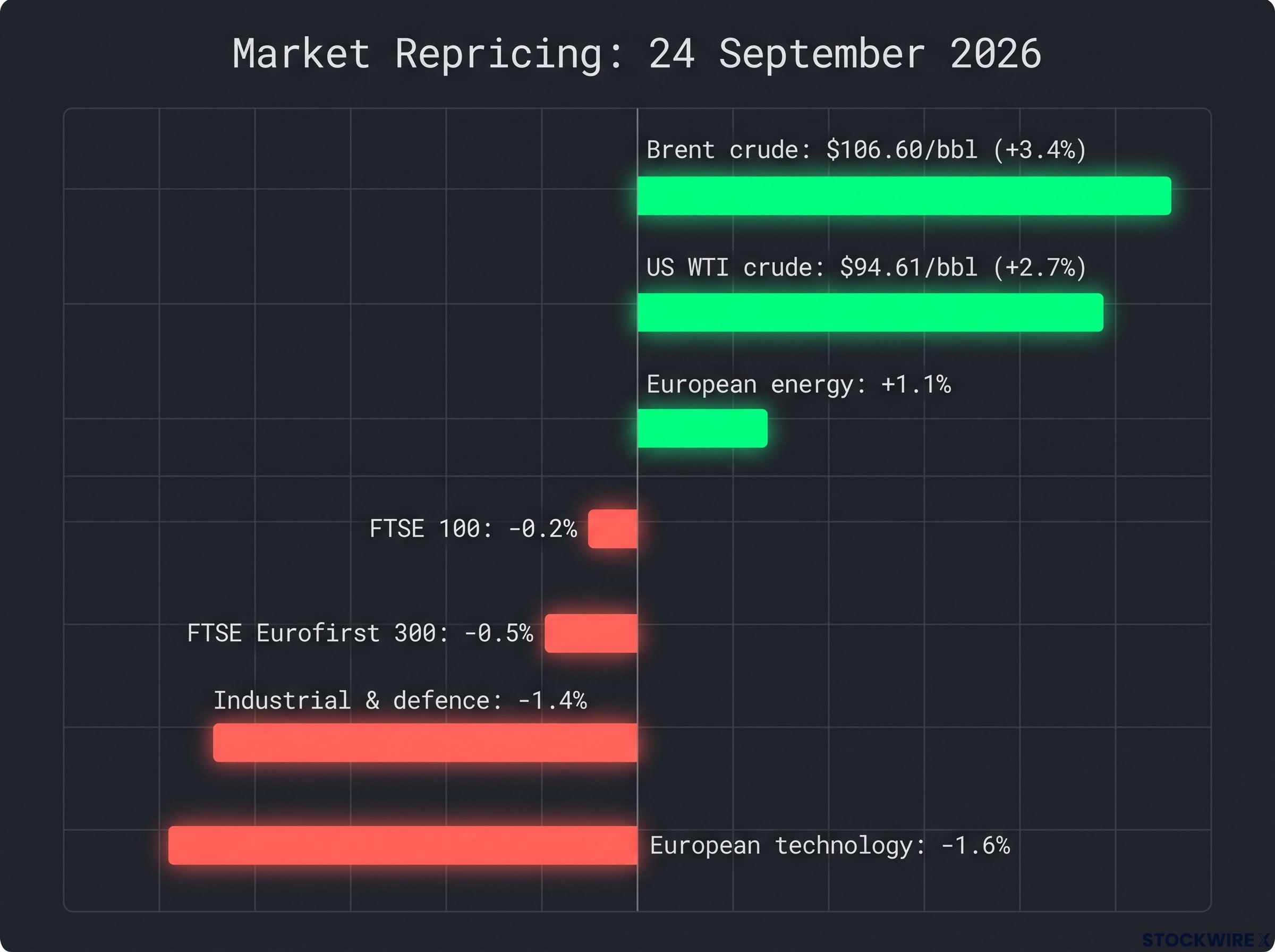
Brent crude settled at $106.60 per barrel, up $3.52 (3.4%).
The move was fast and it was broad. The specific numbers, from commodities coverage on 24 September 2026:
- Brent crude settled at $106.60 per barrel, up $3.52 or 3.4%
- US WTI crude climbed to $94.61 per barrel, up $2.45 or 2.7%
- The European energy sector rose 1.1%, the only sector in positive territory on the FTSE Eurofirst 300
- European technology shares dropped 1.6%
- Industrial and defence shares fell 1.4%
The logic behind a move this quick sits with Saudi Arabia’s role as a swing producer, the country that adjusts output to balance global supply. When a swing producer faces even unconfirmed disruption, markets price the risk premium first and ask questions later. That is why a single strike can reprice an entire asset class before the physical impact is even confirmed.
There are two ways to read it. The near-term view notes that core Saudi infrastructure is built with redundancy and rapid repair capacity, which frames these episodes as short-term tail-risk shocks rather than genuine supply threats. The escalation view watches whether attacks broaden from pipelines toward export terminals, which would force a real reassessment of outage probability.
Prior sessions have demonstrated how quickly a sentiment shift can unwind a geopolitical premium: Brent shed 5.5% in a single session in late July 2026 when a US-Iran military pause was announced, yet Hormuz supply risk remained structurally intact because no additional barrels reached the market and tanker routes stayed constrained.
For now, the oil spike tells you energy equities are the short-term winner from Middle East tail risk. The wider European market fell, with the FTSE Eurofirst 300 down 0.5% and the FTSE 100 off 0.2%. Whether that energy premium holds depends entirely on one thing: whether physical Saudi flows prove resilient or escalation widens toward the terminals that actually matter.
When big ASX news breaks, our subscribers know first
Oracle’s force majeure on Project Jupiter and what power scarcity means for AI infrastructure
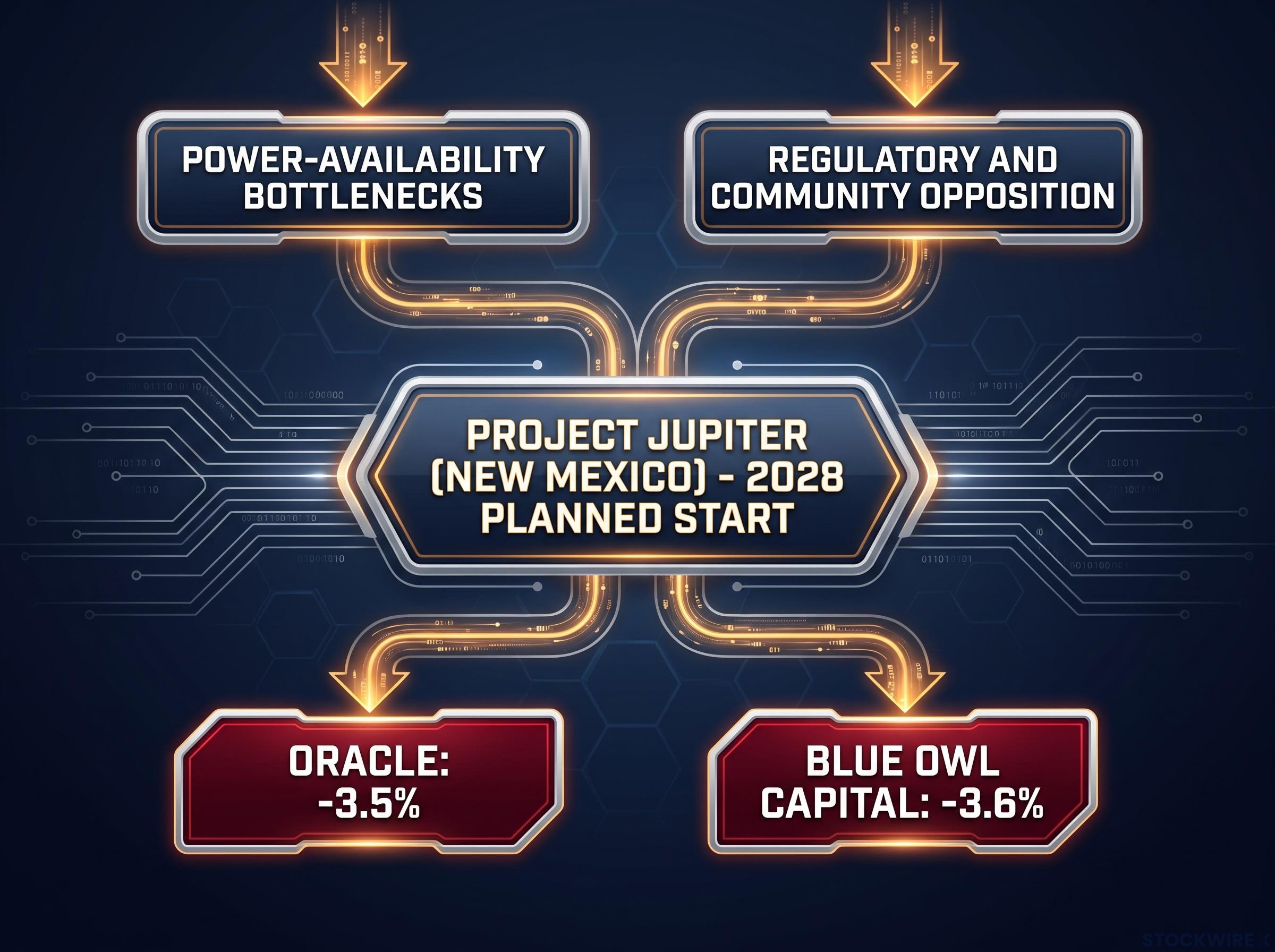
Oracle shares fell around 3.5% after the company invoked force majeure on Project Jupiter, its planned AI data centre campus in New Mexico.
The mechanics matter here, because this is not Oracle walking away. The notice extends the lower development-stage rent period and delays the transition to higher operating rents, with delays securing power to the site and local regulatory setbacks cited as the trigger. Reuters reported the notice on 24 September 2026, describing Oracle as having invoked the clause specifically over power-supply delays.
Both companies have insisted the project is intact. Blue Owl Capital, whose Stack Infrastructure unit is developing the campus, saw its shares fall 3.6% on the day. Both Oracle and Blue Owl stated all parties remain fully aligned on Project Jupiter, framing the notice as a contractual tool for managing timing and cost, not a sign the deal is unravelling.
The market’s verdict sits at odds with the reassurance:
| Party | Market reaction |
|---|---|
| Oracle: all parties “remain fully aligned” | Oracle shares -3.5% |
| Blue Owl: financial commitments unchanged | Blue Owl shares -3.6% |
The notice surfaces four risk themes for anyone holding AI-linked exposure:
- Power-availability bottlenecks: grid access and permitting emerging as the front-line gating factor
- Financing and rent-profile risk: delayed rent transitions altering expected cash-flow timing for investors
- Regulatory and community opposition: local resistance in New Mexico slowing the build
- Investor sentiment toward AI-linked real estate: lenders growing more cautious on hyperscaler build-outs
Reuters described the delay as sending ripples through AI financing, with lenders more wary of funding expansion where construction and power risk are now primary variables. Morningstar commentary noted the force majeure “implies possibility of missing capacity ramp-up timeline.”
Why power, not capital, is becoming the binding constraint for data centre expansion
For years the AI infrastructure debate assumed the constraint was capital or demand. Project Jupiter, with its planned 2028 start now facing delay risk and its OpenAI workloads, says otherwise.
Grid access and permitting are becoming the first thing that limits how fast a campus can come online, ahead of funding or chip supply. The New Mexico opposition is not a one-off; it is the pattern expected to recur across large-scale AI campus proposals. For anyone holding data centre REIT exposure, this is a real-world stress test on the discount rate applied to future capacity. The pace of supply arriving may lag the demand forecasts that valuations depend on.
The New Mexico opposition Oracle encountered is not an isolated planning dispute; AI energy demand is reshaping national-level grid capacity projections, with the IEA estimating data centre and AI electricity consumption will exceed 1,000 TWh by 2026, a doubling in four years that is straining grid access and permitting timelines across every major build-out region.
Schneider Electric’s €1.2 billion Shelly bid and the industrial conglomerate’s pivot to smart-home IoT
Schneider Electric announced a voluntary takeover bid for Shelly Group SE, and the deal reads less like an opportunistic grab than a logical next step for where large industrials are headed.
The terms, announced 24 September 2026:
| Metric | Figure | Note |
|---|---|---|
| Offer price | €70 per share | All-cash |
| Implied equity value | ~€1.2 billion | Full takeover |
| Premium to unaffected price | 27% | vs 28 July |
| Premium to 23 Sept price | 22% | vs €57.5 |
| Expected closing | Q1 2027 | Subject to conditions |
The bid comes through wholly owned subsidiary SE 2026 A SAS for Shelly Group SE, a Sofia-headquartered provider of IoT and smart building solutions. IoT, or the Internet of Things, refers to physical devices such as switches and sensors that connect to the internet to share data and be controlled remotely. Shelly Group shares gained more than 4% on the session.
The offer carries a 27% premium to Shelly’s unaffected reference price of €55.2 as of 28 July 2026.
The strategic logic runs along two lines. First, it deepens Schneider’s residential and small-commercial presence through connected switches, sensors, and controllers that complement its existing building-automation platforms. Second, it hands Schneider more capability at the edge of the grid, supporting demand-side management and the integration of distributed energy like solar, EV charging, and storage.
Step back and the deal fits a wider shift. Traditional electrical-equipment makers are repositioning as software- and platform-centric businesses, now competing with technology companies in home automation and smart energy.
A 27% premium in an all-cash deal tells you Schneider viewed Shelly’s software-rich platform as strategically irreplaceable at the margin. For investors watching the industrial sector, the read is clear: the platform transition is being pursued through acquisition, not organic build, and appetite for IoT targets is live at meaningful multiples.
What the session’s three stories tell you about the state of global markets right now
Read separately, these are three unrelated events. Read together, they are the same tension viewed from three angles.
Each story quietly stress-tested a market assumption. The assumption that AI infrastructure scaling is a funding story met Oracle’s notice, which says it is a power story. The assumption that Middle East risk is priced in met a Houthi strike, which says it is not. And the assumption that industrial M&A is in a holding pattern met Schneider, which says appetite is alive at premium multiples.
The European close carried the rotation signal in a single day where all three catalysts fired at once:
The single-session pattern where energy gained while technology and industrials fell mirrors the sector rotation signals that institutional capital has been sending throughout 2026, with energy up more than 22% year-to-date and the Nasdaq diverging from the Dow as AI valuations face structural headwinds.
Energy +1.1%, technology -1.6%, industrials and defence -1.4%.
The three headline facts, in one line: Brent at $106.60/bbl, Oracle -3.5%, Shelly +4%. Across the Atlantic, the S&P 500 and Nasdaq closed essentially flat, the Dow slipped 0.3%, and Meta bucked the technology weakness on continued AI assistant momentum.
Taken together, the market is repricing the assumptions behind the AI infrastructure trade, energy security, and industrial strategy at the same time. If you are sitting on undifferentiated growth-sector exposure, the question is which of those repricings has the most room left to run.
Three things remain genuinely unresolved:
- Whether the oil spike normalises as physical Saudi flows hold
- Whether other hyperscalers face the same power constraints Oracle just flagged
- Whether Schneider’s move triggers competing bids or a wave of comparable IoT M&A
The pattern underneath all three is the same. Physical constraints, geopolitical risk premiums, and strategic repositioning are each signalling that the next phase of market leadership gets decided by operational reality, not narrative momentum.
Three numbers to watch as markets open on 26 September
The next session will tell you whether each of these stories was a one-day spike or the start of something more durable. Three variables carry the signal.
- Brent crude at $106.60 per barrel. This is the reference level. The direction for energy versus growth positioning depends on whether physical Saudi flows show any disruption or simply hold at prior levels. Flows holding steady would argue the premium fades; any confirmed hit to output argues it sticks.
- Oracle’s next word on Project Jupiter. The 3.5% markdown was priced off a contractual notice, not a confirmed delay. Any clarity on resolving the power-supply issue could partially reverse the move, while silence or a firm push-back from the 2028 planned start would harden the concern.
- European IoT and smart-building deal flow. With Schneider’s Shelly acquisition expected to close in Q1 2027, watch whether comparable targets see unusual volume or price movement. That is the tell for whether this bid stays a one-off or sparks contagion across the sector.
These three signals give you a framework to separate a spike that fades from a shift in sector leadership that warrants a portfolio adjustment.
The session’s tech-versus-energy divergence sits within a broader repricing: market leadership rotation away from US technology has been building since early 2026, with valuation spreads between US tech and international developed markets approaching multi-decade extremes and major institutional managers publishing views that favour a structural reallocation.
This article is for informational purposes only and should not be considered financial advice. Investors should conduct their own research and consult with financial professionals before making investment decisions.
Past performance does not guarantee future results. Forward-looking statements and market projections are speculative and subject to change based on market developments and company performance.