“Most central banks, when they want to influence their economy, buy their own country’s bonds. The Swiss National Bank buys the world’s.\n\nThat single difference explains almost everything unusual about how the Swiss National Bank works. It holds a foreign-currency reserve portfolio larger than Switzerland’s entire annual economic output. It ran the most negative interest rates on the planet for close to a decade. And on 15 January 2015, it triggered one of the most violent single-day currency moves in modern foreign-exchange history. None of these were accidents. They are the products of a coherent, if unusual, institutional logic.\n\nThis is not a conventional central bank, and treating it like one leads you to misread its every move. Its toolkit looks nothing like the Federal Reserve’s or the European Central Bank’s, and the reasons run deep into the structure of the Swiss economy itself.\n\nAfter reading this, you will be able to explain not just what the SNB does but why it does it the way it does, and what that difference means for anyone watching the Swiss franc or global currency markets.\n\n## The mandate and structure that make the SNB unusual from the start\n\nThe SNB has one job, and it is narrower than you might expect. It exists to maintain price stability over the medium and long term, taking economic conditions into account, and it defines price stability precisely: annual growth in the Swiss Consumer Price Index (CPI) of below 2%.\n\nThat is a band, not a point. The SNB aims to keep inflation somewhere between 0% and 2% rather than hitting a specific figure. Every rate decision and every currency intervention traces back to keeping inflation inside that corridor.\n\nThe SNB monetary policy strategy codifies all three of these elements in a single framework: the price stability definition, the medium-term inflation forecast as the primary communication tool, and the policy rate as the operational instrument the Governing Board adjusts at each quarterly assessment.\n\nThe institution runs on a quarterly rhythm. Four times a year, its Governing Board assesses the situation and produces two things: a rate decision and an updated medium-term inflation projection. Those four assessment points are:\n\n- March: rate decision plus updated inflation projection\n- June: rate decision plus updated inflation projection\n- September: rate decision plus updated inflation projection\n- December: rate decision plus updated inflation projection\n\nRight now, the SNB is not fighting overheating. Its most recent assessment, on 24 September 2026, confirmed a hold at a policy rate of 0%, a level maintained since June 2025. With August 2026 CPI running at just 0.8% year-on-year, comfortably inside the corridor, the bank’s problem is the opposite of most central banks’: the constant risk of inflation slipping toward or below zero.\n\n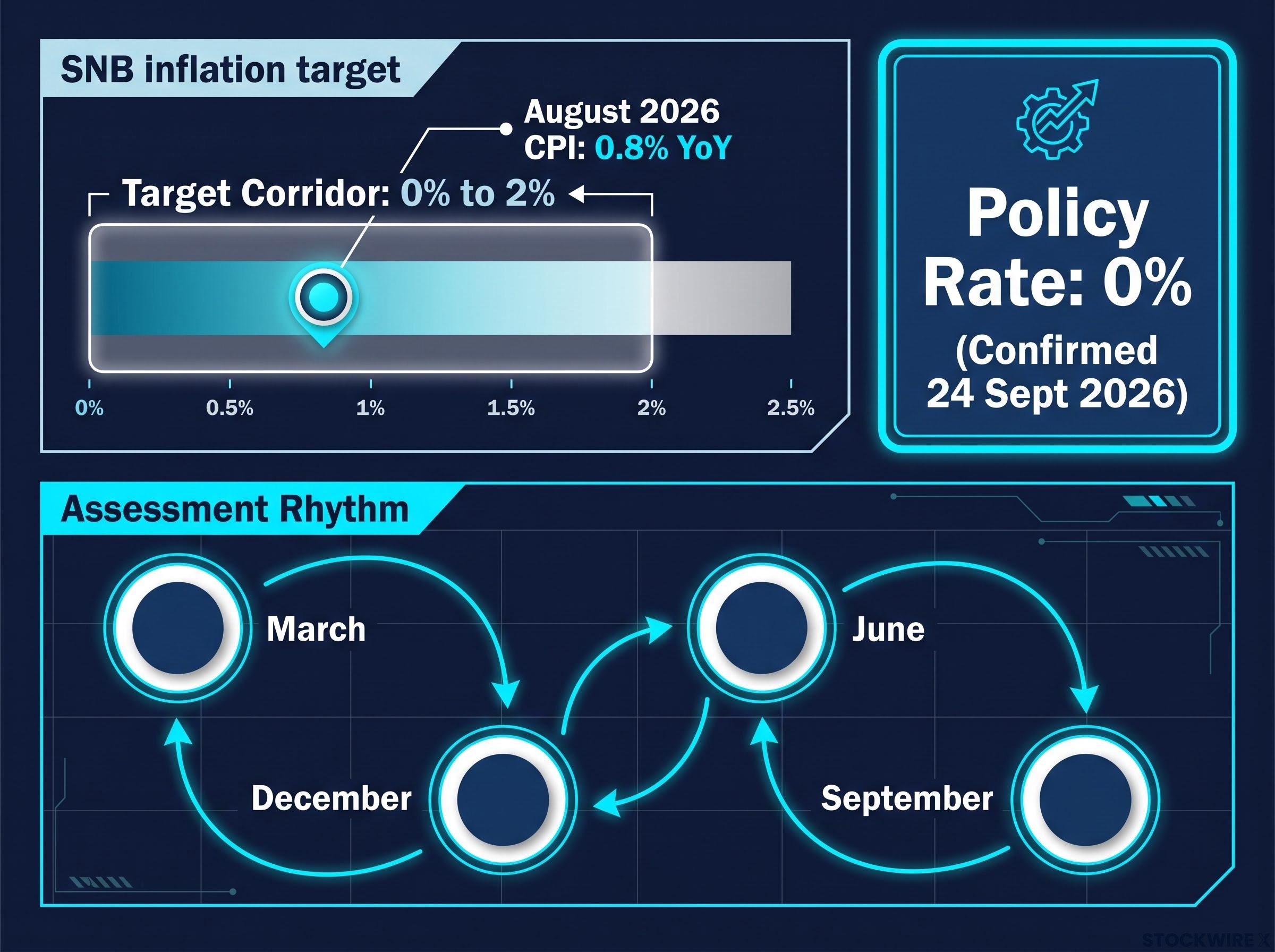 \n\n> \”We have decided to leave the SNB policy rate unchanged at 0%,\” said Chairman Martin Schlegel at the June 2026 assessment.\n\nThat combination, a zero rate and sub-1% inflation, tells you the SNB is managing a structurally low-inflation economy where deflation, not inflation, is the ever-present threat. Everything downstream flows from this.\n\n### Why Switzerland’s economy forces a different central-banking model\n\nThe Fed and the ECB conduct large-scale asset purchases, known as quantitative easing (QE), by buying vast quantities of their own government bonds. The SNB cannot lean on that tool the same way. Switzerland’s domestic government bond market is simply too small to absorb QE at a meaningful scale, so the bank is forced to look elsewhere.\n\nThen there is the currency itself. The Swiss franc is a safe-haven currency, meaning global investors pile into it whenever the world feels risky, regardless of what is happening inside Switzerland. That creates a structural upward pressure on the franc that the SNB cannot ignore, and it is the reason the exchange rate, not just the interest rate, sits at the centre of Swiss monetary policy.\n\n## What the SNB’s toolkit actually looks like, and how it moves the franc\n\nIf you want to understand why the franc moves, stop thinking about levers in isolation and start thinking about a system. The franc’s behaviour is the combined output of three transmission channels operating at once, and the SNB works all three simultaneously.\n\nThe first is interest-rate expectations: the relative yield on franc-denominated assets versus euro and dollar assets. Higher Swiss rates attract yield-seeking capital and support the franc; lower rates weaken it. The second is FX-intervention expectations: the market’s read on how likely and how large future reserve accumulation will be. The third is safe-haven demand, moderated by how credible the SNB’s intervention signals are.\n\nThe mechanics of that intervention are what make the SNB so distinctive. When it wants to weaken the franc, it creates new francs and uses them to buy foreign-currency assets. That expands its reserves and pushes downward on the currency. Over years, this has built a balance sheet unlike anything at the Fed or ECB.\n\n> As of August 2026, SNB foreign-exchange reserves stood at CHF 770.1 billion, up from CHF 768.1 billion in July 2026.\n\nWhere the Fed and ECB hold mostly domestic government bonds, the SNB holds a globally diversified portfolio. As of 30 June 2026, its reserves were allocated roughly 39% in euros, 37% in US dollars, and 7% in yen, spread across foreign government bonds, corporate bonds, and equities.\n\nTo see just how different this is, compare the three institutions directly.\n\n
| Central bank | Primary intervention instrument | Balance-sheet composition | Negative-rate history |
|---|---|---|---|
| SNB | Foreign-currency purchases | Dominated by foreign assets (bonds and equities) | Reached -0.75%, held for years |
| Federal Reserve | Domestic bond purchases (QE) | Dominated by US Treasuries and repos | Never went negative |
| ECB | Domestic bond purchases (QE) | Dominated by euro-area government bonds | Shorter, less extreme negative period |
\n
\n\nA reserve portfolio of CHF 770 billion means the SNB is not a quiet backstop. It is an active participant in global bond and equity markets at a scale few sovereign investors match. That changes how every SNB communication lands, because markets know the bank has the firepower to follow through.\n\n### Why the SNB went further into negative rates than anyone else\n\nNegative interest rates, where you effectively pay to hold cash at the central bank, sound strange until you see what they did for Switzerland. From 2015 through the mid-2020s, the SNB held its policy rate at -0.75%, deeper into negative territory than any major peer.\n\nNegative rates served two purposes at once. They discouraged capital from flooding into Switzerland, and they cut the return advantage of holding franc-denominated assets. Both took pressure off the currency.\n\nContrast that with the Fed, which never went negative, and the ECB, whose negative-rate episode was shorter and less extreme. And this is not just history: in its August 2026 commentary, the SNB signalled it could cut below zero again if conditions demanded. The negative-rate option is live, not retired.\n\n## How the franc works as a safe-haven currency, and what that means for the SNB\n\nHere is what you actually observe as a market participant: when global fear spikes, the franc surges. A crisis erupts somewhere in the world, and money floods into Switzerland regardless of anything happening in the Swiss economy.\n\nThat inflow pushes the franc up and drags import prices down, which compresses Switzerland’s already-low inflation toward or below zero. So the safe-haven status that makes the franc attractive is precisely what creates the SNB’s deflation problem.\n\nThe three transmission channels are worth restating as a reference set, because they are how the SNB translates that pressure into action:\n\n1. Interest-rate expectations, meaning relative yields on franc versus euro and dollar assets\n2. FX-intervention expectations, meaning the probability and scale of future reserve purchases\n3. Safe-haven demand, moderated by how credible the SNB’s intervention signals are\n\nThe COVID-19 period showed the response in action. As global stress drove capital into francs, the SNB leaned on verbal signals of its readiness to intervene, while markets tracked weekly sight-deposit data at the SNB for evidence of actual currency purchases (rising balances suggest the bank has been buying). By contrast, when energy-driven inflation surged, the SNB stepped back and deliberately allowed franc strength, because a stronger currency lowered the cost of imported energy for Swiss households. The June 2022 surprise rate hike carried the same message: with global inflation elevated, the bank showed greater tolerance for a strong franc.\n\n> The SNB tolerates franc depreciation far more readily than appreciation, because in the Swiss context the deflationary risk from a strong franc is more acute than the inflationary risk from a weak one.\n\nCarry trade dynamics compound the safe-haven asymmetry: at a 0% policy rate, the franc becomes a structural funding currency that institutional investors sell regardless of Swiss economic data, adding a layer of downward pressure that operates independently of any SNB action or safe-haven episode.\n\nThat asymmetry tells you something precise. The SNB’s primary fear is deflation, not inflation, and that single fact shapes the franc’s long-term behaviour in a way that sets it apart from every other major currency. Even mild franc weakness earlier in 2026 nudged inflation up to that 0.8% August reading, which the bank welcomed rather than resisted. If you hold Swiss assets or price franc derivatives, this is the reaction function you are trading against.\n\n## The 2011-2015 euro peg: why it was introduced, why it collapsed, and what it revealed\n\nIn September 2011, with the euro-area sovereign-debt crisis driving frightened capital into francs, the SNB drew a line. It set a minimum exchange rate of 1.20 francs per euro and committed to buying foreign currency in unlimited quantities to defend it.\n\nAt the time, the logic was sound. The franc was appreciating so violently that Swiss exporters faced an existential squeeze, and a firm floor gave them certainty. Each subsequent decision to hold the line also made sense in isolation.\n\nThe trap was cumulative. By late 2014 and early 2015, three forces had made the peg impossible to sustain:\n\n1. The ECB’s impending large-scale QE, which threatened to structurally weaken the euro and force the SNB to buy ever more of it\n2. The rapidly expanding SNB balance sheet and its growing concentration risk\n3. The mounting political and credibility costs of an indefinitely expanding reserve book\n\nECB quantitative easing was the proximate trigger for the January 2015 peg collapse: the SNB concluded that defending the 1.20 floor would require buying euros in volumes that would compound its already-outsized balance sheet concentration risk indefinitely as Frankfurt expanded its own asset purchases.\n\nOn 15 January 2015, the SNB abandoned the floor without warning and simultaneously deepened its policy rate to -0.75%. The market reaction was brutal:\n\n- EUR/CHF plunged intraday as the franc surged\n- Swiss equity prices dropped sharply\n- FX brokers and hedge funds holding short-franc positions suffered heavy losses\n\nThe economic aftermath proved less catastrophic than the market violence suggested. Exporters faced an initial slowdown and a margin squeeze, but Switzerland avoided a severe recession, and high-value-added exporters adapted over time.\n\nThe 2015 episode is the clearest demonstration that a central bank can make a technically sound promise, unlimited intervention, that becomes impossible to keep. Not because the mechanics fail, but because the scale required to honour it eventually collides with every other objective the institution holds.\n\n### What the 2015 exit revealed about the limits of any exchange-rate commitment\n\nEconomic historians frame the exit as a choice between two bad options: an ever-expanding, risk-laden balance sheet, or a sharp but manageable revaluation shock. The SNB chose the shock.\n\nBy doing so, it restored its policy flexibility at the cost of short-term market chaos. That trade-off still informs how markets assess SNB credibility today, because everyone now knows the bank will break a commitment rather than let its balance sheet grow without limit.\n\n## The live debate: what the SNB’s unconventional model gets right, and where critics say it goes wrong\n\nReasonable, well-informed people genuinely disagree about whether the SNB’s model is brilliant adaptation or accumulated risk. This is not a settled question with a tidy answer, and the stakes are real.\n\nThe defensive case is straightforward. SNB officials, IMF staff, and mainstream bank analysts argue that FX intervention and negative rates are indispensable given Switzerland’s structural low-inflation tendency, its safe-haven status, and its limited scope for domestic QE. Without intervention, they contend, safe-haven inflows would entrench deflation and crush an export-dependent, high-wage economy. They also argue that a central bank can operate perfectly well even with negative accounting equity, provided its legal backing and credibility hold.\n\nThe critical case is equally serious. Economists including Charles Wyplosz, along with several Swiss academics, warn that CHF 770 billion in foreign assets creates enormous valuation risk. Persistent accounting losses, even if not operationally fatal, can erode public trust and invite political interference. And a reserve pool at this scale effectively functions as a state-run global investment fund, raising governance questions about asset allocation and the politicisation of an independent monetary authority that the SNB has not fully resolved.\n\n> With FX reserves of roughly CHF 770 billion, the reserve book represents an extraordinary concentration of foreign assets. That single number anchors both sides of the debate.\n\n
| The concern | Defensive response | Unresolved uncertainty |
|---|---|---|
| Valuation risk on huge foreign holdings | Long-term returns offset periodic losses | Simultaneous EUR and USD weakness could trigger major losses |
| Accounting losses erode public trust | Central banks can operate with negative equity | Political tolerance for repeated losses is untested |
| Quasi-sovereign-wealth-fund governance | Macro stability outweighs balance-sheet purity | Allocation and independence questions remain open |
\n
\n\nThere is an international dimension too. When heavy reserve accumulation coincides with Swiss trade surpluses, trading partners and the IMF have at times characterised the intervention as a beggar-thy-neighbour policy, complicating Switzerland’s multilateral relationships.\n\nEuro pressure and rate differentials operate in both directions: just as a wide Fed-ECB gap weighs on the euro against the dollar, the same dynamics affect EUR/CHF, and a euro under sustained downward pressure forces the SNB to reassess how much of its reserve accumulation it is willing to absorb in a depreciating currency.\n\nFor you, the reader, the practical takeaway is this: with 39% of reserves in euros and 37% in dollars, the SNB’s annual profit-and-loss is far more sensitive to EUR/CHF and USD/CHF moves than to anything in the Swiss domestic economy. Understanding FX intervention is not optional if you want to understand the bank’s financial position.\n\n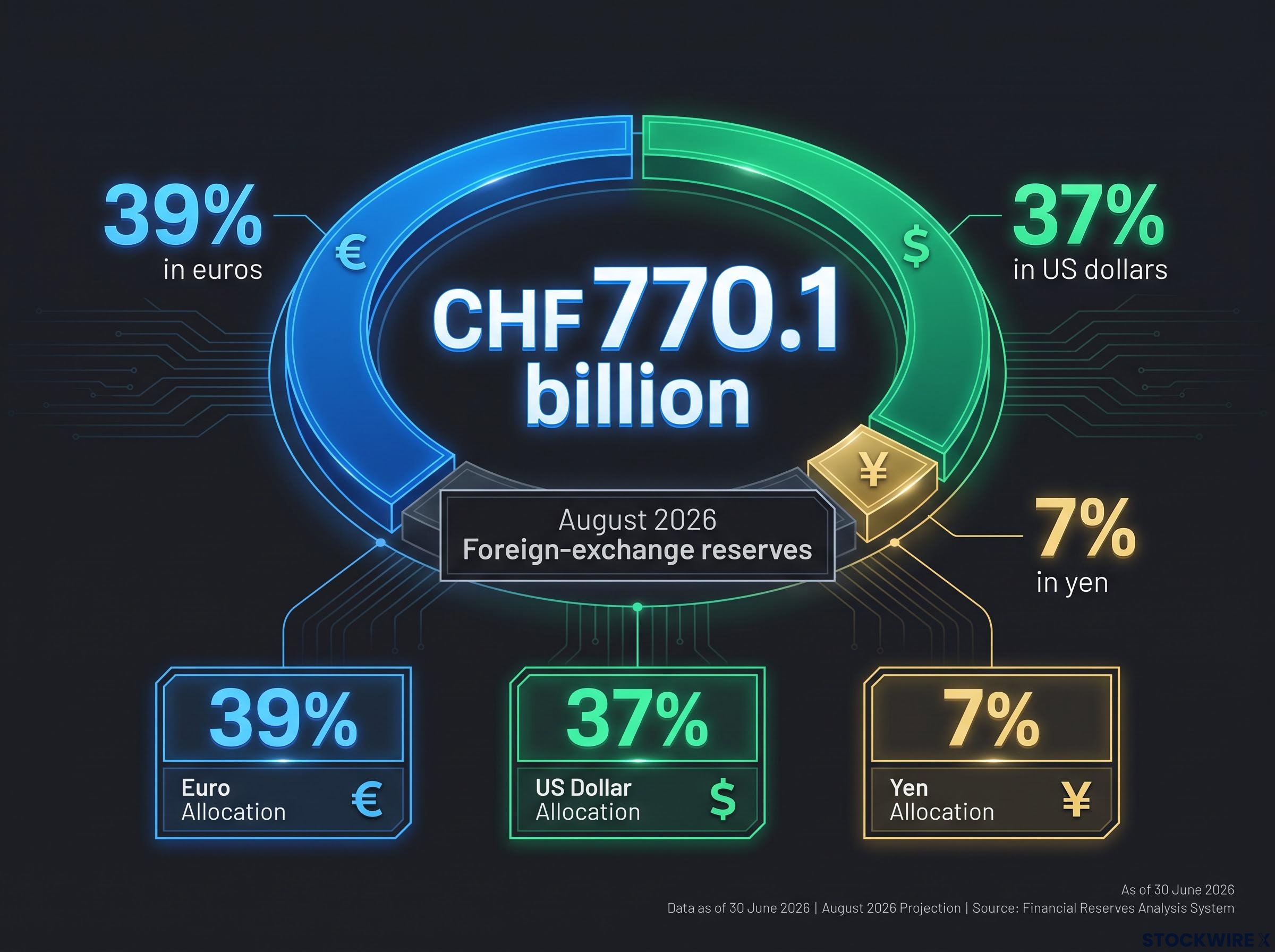 \n\n## What the SNB’s model means for anyone watching the franc today\n\nThe value of all this history and structure is that it hands you a mental model you can apply the next time an SNB assessment lands or EUR/CHF lurches. Three signals do most of the work.\n\n- SNB rate decisions: a surprise move carries far more information than a hold\n- Swiss CPI prints relative to the 0-2% corridor: a reading drifting toward zero is the bank’s core worry\n- Weekly sight-deposit data at the SNB: rising balances point to active FX purchases even when the bank stays silent\n\nThe current picture is a holding pattern. A 0% rate held since June 2025, August 2026 inflation of 0.8% year-on-year, CHF 770.1 billion in reserves, and a September 2026 hold together tell you the SNB is calibrated to keep the franc stable, not to stimulate growth. The next scheduled decision point is December 2026.\n\nEUR/CHF corridor forecasts from major banks, including Commerzbank targeting 0.94 by Q3 2026 and a broader institutional consensus mapped inside the 0.91-0.95 range, translate the SNB’s current holding pattern directly into a medium-term price framework that market participants can position against.\n\nCrucially, the negative-rate option remains on the table. The SNB’s signalled willingness to cut below zero again is active forward guidance, not historical trivia, and it separates the bank from peers that have effectively ruled negative rates out.\n\n### Three signals that tell you the SNB is about to act\n\n1. A rate decision that diverges from consensus: a surprise cut or hike signals a genuine shift, whereas a widely expected hold tells you little.\n2. Swiss CPI trending toward zero: an inflation reading sliding down the corridor is the SNB’s primary trigger for renewed easing.\n3. A significant franc appreciation episode, especially alongside global risk-off flows: this is the classic setup for restarted FX intervention.\n\nWatch for those three, particularly in combination, and you will read the bank’s next move before it announces it.\n\n> This article is for informational purposes only and should not be considered financial advice. Investors should conduct their own research and consult with financial professionals before making investment decisions.\n\n## A distinctive institution shaped by a distinctive set of constraints\n\nEvery unusual feature of the SNB, the massive foreign reserves, the deeply negative rates, the 2015 peg shock, flows from the same starting conditions. Switzerland is a very small, very open, very high-wage economy with a safe-haven currency and a structural tendency toward inflation below global norms. Given those constraints, the SNB’s toolkit is not eccentric; it is logical.\n\nThat same lens helps you read other small open economy central banks facing their own currency pressures, even where their solutions differ:\n\n- Reserve Bank of New Zealand\n- Riksbank (Sweden)\n- Norges Bank (Norway)\n\nThe key thing to hold onto is this: the SNB’s unconventional model is not a temporary crisis response that will one day normalise toward the Fed’s approach. It is the permanent operating logic of a bank whose constraints are structural, not cyclical.\n\nThe 24 September 2026 hold at 0% is not a destination. It is a pause in an ongoing management challenge, and every tool the SNB has used before, including negative rates, remains firmly on the table.”