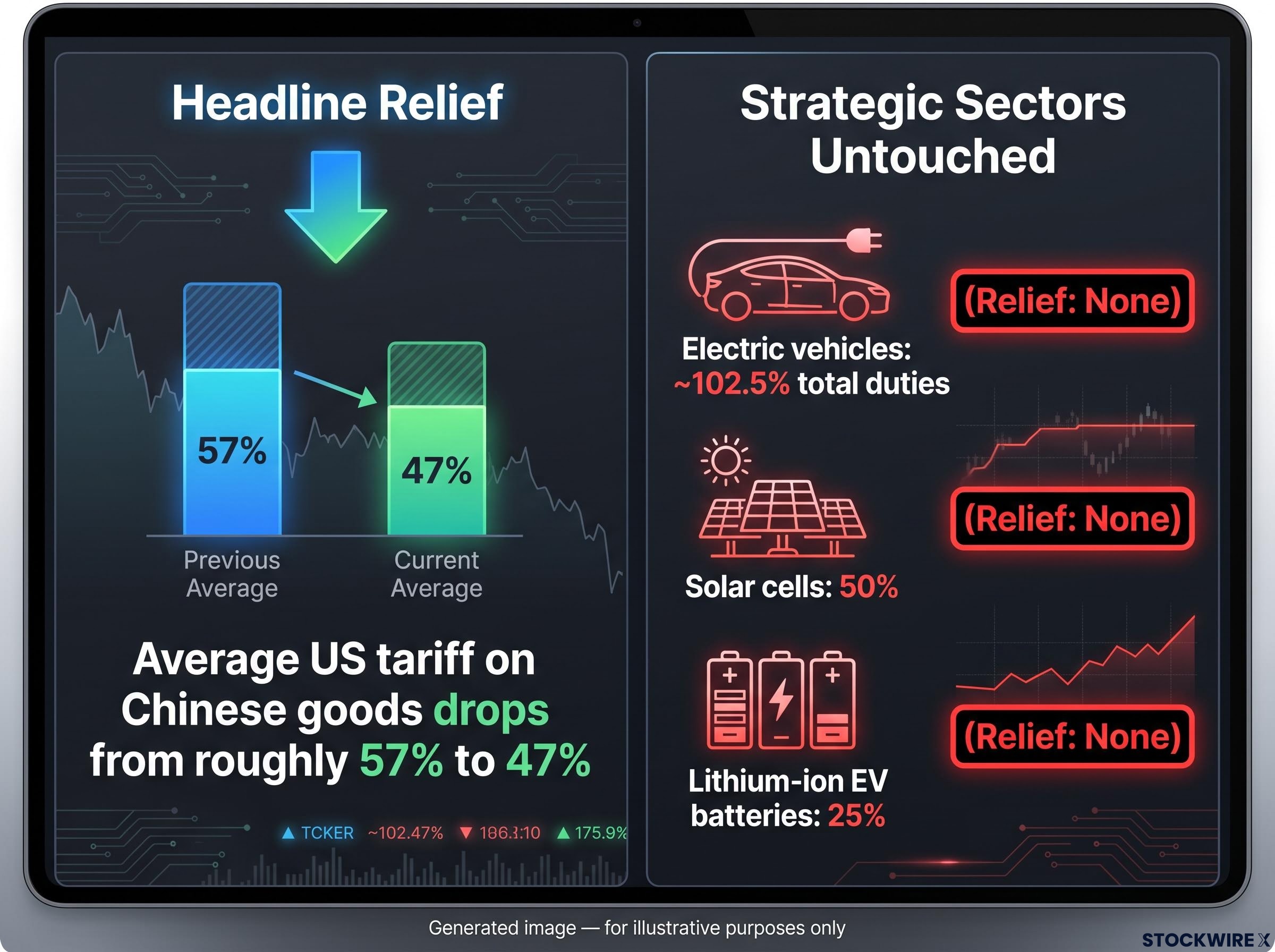
The extension buys 61 days. That is the first thing worth knowing about the deal announced this week, because the arithmetic tells a different story from the diplomacy. The average US tariff on Chinese goods drops from roughly 57% to 47%, yet Chinese electric vehicles still face total duties of approximately 102.5%.
Read those numbers together and the US-China trade truce, extended on 23 September 2026, looks far narrower than its language of détente suggests. This is not a settlement. It is a countdown.
The dispute itself has run without interruption since 2018, surviving a change of US administration, a global pandemic, and two collapsed de-escalation attempts before both sides reached the Busan Agreement in October 2025. The extension announced by Treasury Secretary Scott Bessent stretches that truce from its original 10 November expiry to 10 January 2027. It matters not because it resolves anything, but because it hands global supply chains and capital markets a new cliff edge.
What follows here separates what the extension actually protects from what it leaves exposed, and lays out what the January deadline means for portfolios and business planning.
A tactical pause, not a structural reset: what the extension actually delivers
The diplomatic framing around this week’s announcement was warm. A “productive” summit, an economic “detente,” a US side “open to a larger deal.” Xi Jinping landed at Joint Base Andrews and expressed confidence the visit would deliver results.
Strip away the optics, and the mechanics are modest. The extension does one thing: it moves the truce’s expiry from 10 November 2026 to 10 January 2027. Bessent confirmed it on Fox News following an unplanned bilateral meeting with Chinese Vice Premier He Lifeng, held to prepare for the leaders’ summit.
“We will extend what we call the ‘Busan Agreement,’ the economic detente between the two countries that was scheduled to end on November 10, that is going to be extended until January 10,” Bessent said, framing the move as a way “to give us more time to see what we can do on the economic front.”
Notice what he did not say. There was no confirmation of a rollover, no confirmation of a larger deal. Both remain options, neither is settled.
That ambiguity is the point. The New York Times characterised the original October 2025 arrangement as a “yearlong truce” reached only after repeated failed attempts to calm a dispute in which tariffs on both sides had climbed above 100%. Reuters, by April 2026, was already calling it “fragile.” The extension does not change that description; it simply pushes the same fragility forward by two months.
The muted AUD/USD reaction on 23 September fits a broader pattern of professional investors treating diplomatic atmospherics as distinct from underlying risk, a gap that summit market pricing had already begun widening well before Bessent confirmed the extension on Fox News.
Three outcomes now sit on the table for 10 January:
- Full rollover: the existing terms extend again, preserving the status quo without deepening it.
- Larger deal: a broader agreement negotiated through the leader-level meetings expected across 2026 (up to four in total).
- Expiry: the truce lapses, suspended tariffs and export controls snap back, and escalation resumes.
The two-month runway signals something specific. Neither side is ready to escalate, but neither has the political room to offer the concessions a durable deal would demand. That leaves 10 January 2027 not as a resolution date, but as a risk date. Anyone with supply-chain or market exposure to this relationship should treat the diplomatic optics as exactly that, and watch the calendar instead.
When big ASX news breaks, our subscribers know first
The tariff architecture underneath the truce: what the numbers reveal
The headline reduction, 57% down to 47%, is real. It is also misleading if read as a single number, because the US tariff regime on China is not one rate. It is a layered system.
The base layer is the Section 301 framework, imposed from 2018 onward, covering more than $300 billion of Chinese imports at rates mostly between 7.5% and 25%. Sitting on top of that is a second layer: the strategic-sector hikes announced in May 2024. The Busan Agreement reversed none of it.
That second layer is where the decoupling pressure concentrates. These are the sectors the truce leaves almost entirely untouched.
| Sector | Pre-May 2024 Rate | Current Rate | Busan Relief |
|---|---|---|---|
| Electric vehicles | 25% | ~100% (total duties ~102.5%) | None |
| Solar cells | 25% | 50% | None |
| Lithium-ion EV batteries | 7.5% | 25% | None |
| Steel and aluminium | Varies | ~25% | None |
| Fentanyl-related | 20% (under Busan) | 10% | Cut from 20% to 10% |
The pattern is stark. The clean-energy and technology supply chains, EVs, batteries, solar, semiconductors, remain outside the relief entirely. The 10-percentage-point average reduction is drawn almost wholly from areas the two sides agreed to soften. Where strategic competition is hottest, the tariffs did not move at all.
The tariff architecture underneath the truce carries a separate layer of legal fragility that the diplomatic framing obscures: Supreme Court and lower-court rulings since February 2026 have progressively narrowed the statutory authority on which the Section 301 framework and its sectoral hike layers rest, meaning the headline rates are simultaneously the product of political pressure and active litigation.
What China gave back
China’s side of the ledger is where the truce becomes operational, and where its terms are most explicitly time-bounded.
On agriculture, Beijing suspended the retaliatory tariffs it had imposed since March 2025 on a broad list of US farm goods: chicken, wheat, corn, soybeans, cotton, pork, beef, and aquatic products. It committed to buying 25 million metric tons of US soybeans annually, with at least 12 million metric tons pledged for late 2025.
On critical minerals, China agreed to suspend export controls and grant general licences on rare earths, gallium, germanium, antimony, and graphite for one year. These are the inputs electronics, aerospace, EV, and defence manufacturers depend on.
Here is the essential qualifier. Every one of these concessions is explicitly one-year, now extended to 10 January, and every one is revocable. China has stated the agricultural suspensions can be reversed if Washington backslides on technology controls. The relief is genuine. It is also a lease, not a sale, and the lease is due for renewal on the same cliff-edge date as everything else.
Which sectors face the most from a January 10 breakdown
Not all exposure is equal. If the truce lapses without a successor, the damage will land unevenly, and the map of where it concentrates is worth having before the deadline arrives.
| Sector | Current Tariff Exposure | Truce Protection Status | Key Risk if January 10 Fails |
|---|---|---|---|
| Clean energy (EV/battery/solar) | Very high (EVs ~102.5%) | Largely unprotected | Rare-earth controls reactivated on top of existing tariffs |
| Agriculture | Suspended retaliation | Actively protected | Chinese tariff suspensions lifted; export flows redirect |
| Critical minerals | Export controls suspended | Conditionally protected | Gallium, germanium, antimony controls immediately available |
| Maritime/logistics | Section 301 probes paused | Temporarily protected | Investigations resume; tougher measures revived |
| Semiconductors/tech | Elevated, partially paused | Barely protected | Structural tech tensions persist regardless of truce |
Ranked by breakdown risk, the order runs roughly as follows:
- Clean-energy supply chains carry the highest stakes. EVs, batteries, and solar already face the steepest remaining rates, and a breakdown would layer reactivated rare-earth export controls on top.
- Critical minerals rank next. China’s toolkit, export controls on gallium, germanium, antimony, and graphite, sits fully intact under the truce and becomes available the moment it expires.
- Agriculture is the sector where the truce has been most concretely operational. A collapse would rapidly redirect global commodity flows back toward Brazil and Argentina, both of which gained Chinese market share during the peak trade war.
- Semiconductors and technology face persistent structural tension that the truce only partially paused.
- Maritime and logistics benefit from a Section 301 investigation freeze that analysts describe as delaying, not removing, tougher measures.
There is a real-time reading of how markets weigh all this, and it came on announcement day.
Reuters described the truce as “fragile” back in April 2026. On the day the extension was confirmed, AUD/USD traded down 0.06% at 0.7034, a small decline rather than a rally.
Australia’s commodity trade exposure to China makes the currency a rough proxy for trade-war sentiment. A decline on ostensibly good news tells you the market read the extension as risk management, not resolution. For anyone calibrating exposure to commodity and trade-sensitive assets, that muted response is a more honest signal than the summit photographs. Meanwhile, the “China+1” sourcing trend, firms adding a second supplier base across Southeast Asia, continues to accelerate as corporates hedge the breakdown scenario in advance.
Why the truce keeps breaking down before a real deal forms
Fragility is one thing. Understanding why a durable settlement is structurally out of reach is another, and it explains why the same cycle keeps repeating.
Start with Washington. Trump needs a visible trade win and progress on fentanyl to show his base, but he cannot concede on technology, industrial policy, or strategic sectors without inviting political attack. The truce’s narrow architecture, real relief on agriculture and fentanyl, none on EVs or semiconductors, is therefore a feature rather than a flaw.
Beijing faces the mirror-image constraint. Xi Jinping will offer targeted, reversible concessions on agriculture and rare earths because they buy macroeconomic stability. He will not concede on technology transfer, industrial subsidies, or state support for strategic sectors, because those sit at the centre of a national-security narrative tied to domestic legitimacy.
That leaves three disputes entirely outside the Busan framework, and therefore certain to persist regardless of 10 January:
The structural fault lines on Taiwan and AI chip export controls sit entirely outside the Busan framework, meaning the technology-sector risk premium does not move with the truce, and investors who priced the extension as broader de-escalation are incorporating relief the agreement was never designed to deliver.
- Technology transfer and intellectual property
- Industrial subsidies and state-sector support
- Semiconductor and advanced-technology export controls
The Atlantic Council captured the doubt directly.
“Trump and Xi brokered a truce in the trade war. Will it hold?” the think tank asked in its October 2025 analysis, pointing to ongoing strategic rivalry as the fundamental obstacle to anything more permanent.
The precedent reinforces the point. The Phase One agreement signed in January 2020 was a formally structured deal with purchase commitments, and it still failed to deliver full enforcement before renewed escalation overtook it. When Trump was inaugurated on 20 January 2025, new tariffs took effect almost immediately, showing how fast domestic political cycles translate into trade policy. The Observer Research Foundation frames Busan the same way: a tactical instrument, not a durable framework, with all commitments time-limited and revisable.
The enforcement gap: where the truce is most vulnerable
The nearest-term threat is not the deadline itself. It is compliance between now and then.
Four vulnerabilities stand out:
- Agricultural purchase lag: China has been running behind on some soybean pledges, and any shortfall generates immediate US political pressure.
- Fentanyl chemical controls: verifying that precursor chemical flows have genuinely stopped is difficult to monitor, making this an easy commitment to dispute.
- Rare-earth licence compliance: Washington has already pressed for fuller implementation of the export-control suspensions.
- Snapback tariff triggers: reimposing suspended tariffs is explicitly available to both sides, and both have used the mechanism before.
For investors, the lesson from Phase One is that even structured agreements with purchase targets can erode faster than the diplomatic tone suggests. That argues for treating 10 January as a risk-management date rather than a policy-resolution date.
What the January 10 deadline actually means for investors
The uncertainty is real, but it is not formless. It resolves into three scenarios, and knowing their shape is what turns a geopolitical story into a positioning framework.
| Scenario | Analyst Characterisation | Key Market Impact |
|---|---|---|
| Rollover | Most likely near-term outcome | Status quo preserved; short-term relief, underlying risk unchanged |
| Broader deal | Limited probability | Potential positive surprise for clean-energy and commodity sectors |
| Expiry with escalation | Lower probability, highest impact | Rare-earth controls reactivated; agricultural suspensions lifted; fentanyl tariff snapback |
The dominant analyst posture across the Atlantic Council, Reuters, and finance-oriented commentary is not a bet on stable détente. It is hedging and diversification. The “China+1” sourcing shift is the corporate expression of that posture, already being executed rather than planned.
For investors wanting a portfolio-construction framework rather than a scenario analysis, our dedicated guide to geopolitical fragmentation and portfolio positioning covers how to monitor revenue geography, supply-chain affiliations, and policy-regime exposure across diverging regional blocs as US-China decoupling continues.
The AUD/USD reaction on 23 September fits the same reading. A decline of 0.06% to 0.7034 on extension news, rather than a rally, confirms that professional investors are pricing delay, not resolution. That distinction carries weight: any enforcement failure or political shock between now and January carries more downside asymmetry than the settled tone of the truce implies.
Three variables will decide which scenario lands:
- Enforcement compliance on agricultural purchases and fentanyl commitments over the coming months.
- Domestic political developments in both countries, particularly US pressure around technology and industrial policy.
- Leader-level meetings, with up to four expected in 2026 as the mechanism through which any larger deal would be built.
This article is for informational purposes only and should not be considered financial advice. Investors should conduct their own research and consult with financial professionals before making investment decisions. These statements are speculative and subject to change based on market developments and policy decisions.
Reading the Busan extension for what it is, not what it sounds like
The core finding holds throughout. The extension is a risk-management instrument, not a turning point. The 61 days it buys neither resolves the structural disputes over technology, subsidies, and IP nor removes the cliff edge; it relocates it to 10 January 2027.
The near-term value is genuine, and worth stating plainly. The truce protects US agriculture, suspends rare-earth export controls, trims the average tariff rate, and hands negotiators time to test whether a January scenario can be constructed. These are real stabilisers, and a rollover remains more likely than escalation in the immediate term.
The three variables to watch are enforcement compliance, domestic political signals, and the leader-level meetings still to come. Informed caution is the posture the evidence supports, neither pessimism nor complacency. The truce is fragile but functional, and the distance between those two words is precisely where risk-aware investors position themselves.