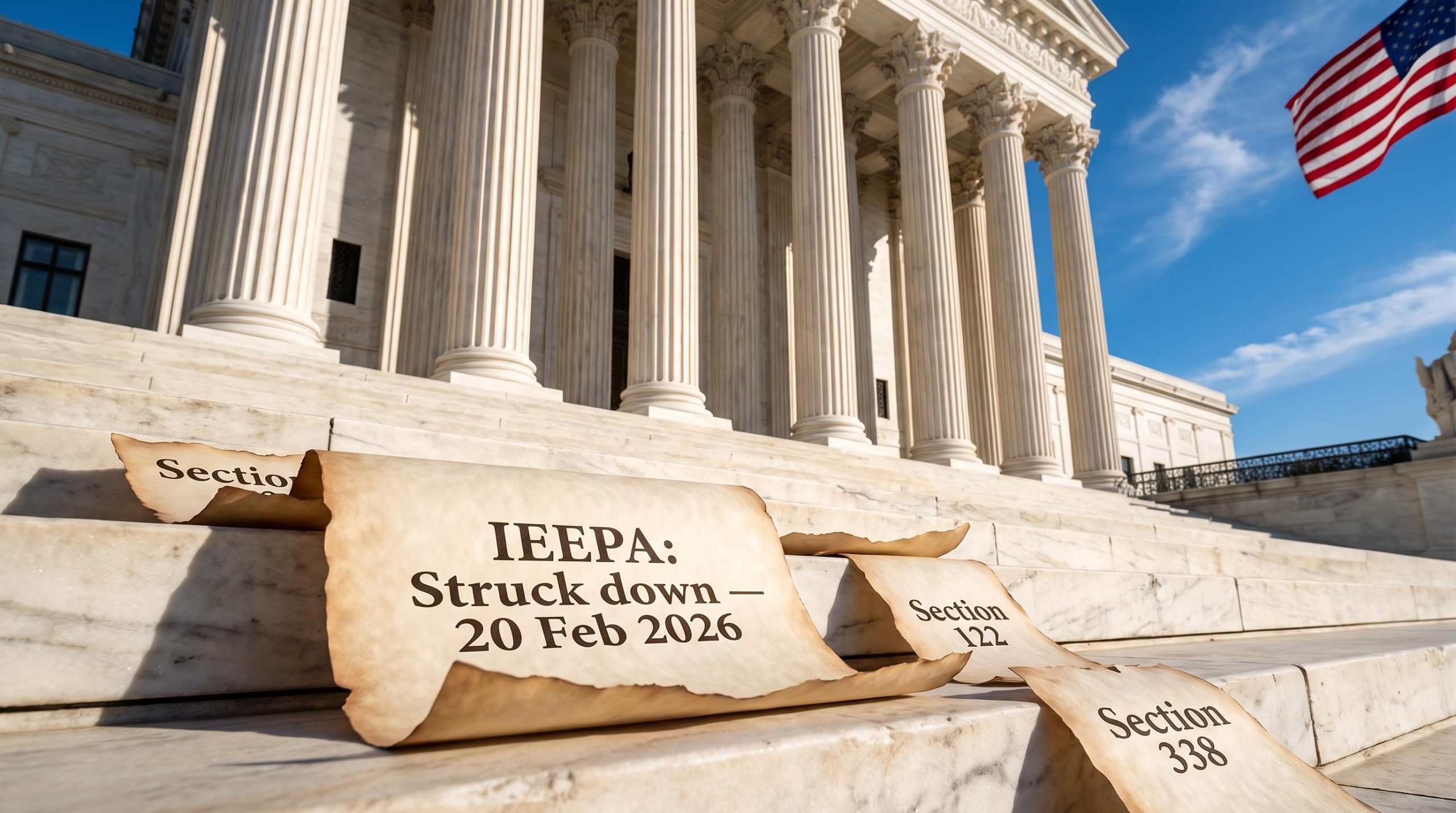
On 20 February 2026, the Supreme Court of the United States did something no political coalition had managed in over a year of debate: it dismantled the legal foundation of the Trump administration’s tariff programme. The ruling held that the International Emergency Economic Powers Act (IEEPA) does not authorise economy-wide tariffs, stripping the White House of its fastest, broadest, and most frequently deployed trade weapon.
What followed was not a retreat. It was a substitution strategy. The administration cycled through Section 122 of the Trade Act of 1974, Section 338 of the Smoot-Hawley Tariff Act of 1930, and Section 301 of the Trade Act of 1974, each one narrower, older, and more legally exposed than the last. The current tariff regime is not a stable policy architecture. It is a litigation-dependent patchwork running on court calendars rather than congressional authority.
The question most investors and businesses are actually asking is straightforward: are today’s tariff settings a durable structural shift in US trade policy, or a house of cards with a timer running? Here is the framework for answering that question using the legal record and economic data rather than political commentary.
How the Supreme Court dismantled the foundation of Trump’s tariff regime
The Court’s reasoning was constitutional before it was economic. The majority held that IEEPA, a statute designed to give the president emergency powers over financial transactions and asset freezes, does not extend to the imposition of broad, economy-wide import duties. That power, the Court affirmed, belongs to Congress.
Congress retains the power to impose “Taxes, Duties, Imposts and Excises.”
That single constitutional anchor collapsed the administration’s entire IEEPA tariff structure: the baseline 10% across-the-board rate applied to virtually all trading partners, plus country-specific top-ups that pushed effective rates far higher on targeted economies.
The scale of what the ruling invalidated is difficult to overstate. IEEPA was not one tariff. It was the vehicle for the administration’s broadest trade measures, the instrument that could be deployed overnight, without congressional approval, and without the procedural constraints that older trade statutes impose.
The refund order and its limits
The Court ordered approximately $200 billion in collected IEEPA tariffs to be refunded, with broader theoretical exposure running into the hundreds of billions and potentially significantly more depending on how claims are calculated and pursued. But the refund number, while politically striking, overstates the relief consumers will actually see.
Importers and businesses that passed tariff costs through to customers via higher prices face no legal requirement to return any portion of a refund to those end buyers. The money flows back to the companies, not to the households that paid elevated prices at the point of purchase.
What the ruling removed matters more than the refund it ordered. The administration lost its only broad, fast, emergency tariff lever, and every replacement it has reached for since carries more judicial exposure than the one before it.
When big ASX news breaks, our subscribers know first
The administration’s scramble for new tariff authorities
The pattern that emerged after the IEEPA ruling tells you more than any single statute. Each step the administration has taken represents a move toward narrower legal ground with less judicial tolerance, producing a trajectory of increasing fragility rather than stabilisation.
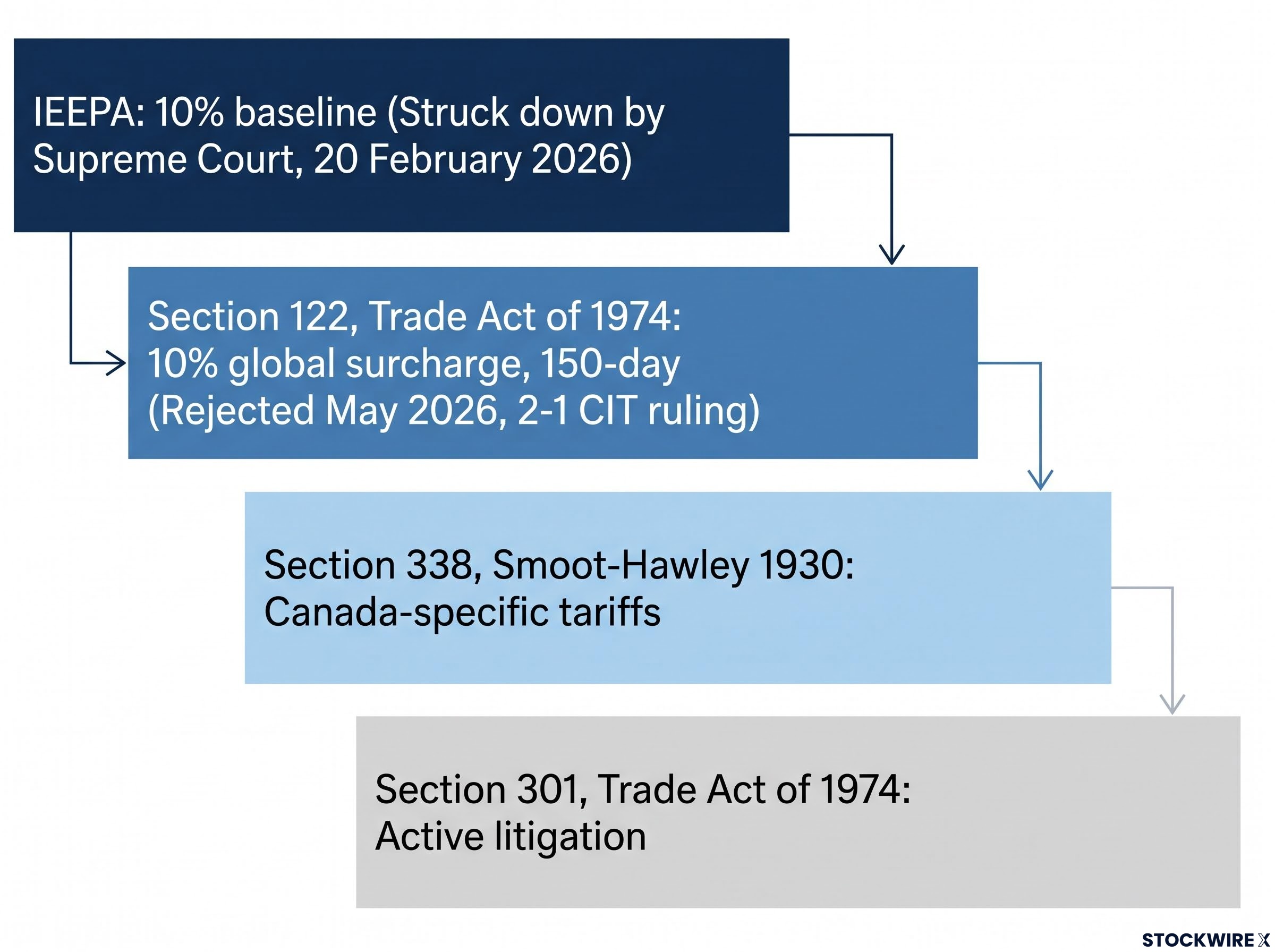
First came Section 122 of the Trade Act of 1974. This statute was designed for genuine balance-of-payments crises, situations where the dollar faces imminent depreciation or international payments problems require emergency import measures. The administration imposed a temporary 150-day tariff under Section 122, applying a 10% global surcharge.
In May 2026, the Court of International Trade rejected that application in a 2-1 ruling, holding that the statute was not intended to address normal trade deficits arising from imports exceeding exports. The administration appealed. Relief is currently limited to the specific plaintiffs, though a broad affirmation by appellate courts would extend the implications considerably.
Second came Section 338 of the Smoot-Hawley Tariff Act of 1930. This is a retaliatory statute from an era before modern trade law, and subsequent legislation tightened the definitions of what constitutes discriminatory treatment of US commerce, leaving the provision in legally precarious territory. Court rulings interpreting how the statute applies in contemporary trade disputes are virtually non-existent. The administration has nonetheless deployed it for Canada-specific tariffs, staking out a position that sits on minimal judicial foundation.
Section 338 exposure is particularly difficult to hedge because the statute requires no formal investigation, carries no sunset clause, and permits escalation to a full import ban without additional procedural steps, features that make the Canada-specific tariff regime structurally different from the balance-of-payments and emergency frameworks the courts have already struck down.
Third came Section 301 of the Trade Act of 1974. Originally designed for narrow, investigation-based trade actions, Section 301 has been pushed considerably further than its drafting history supports. Active litigation claims the administration’s deployment runs beyond what Congress originally authorised, though no appellate ruling has yet imposed a definitive check on how the statute can be used.
Phillip W. Magness, Senior Fellow and David J. Theroux Chair in Political Economy at the Independent Institute, has described this sequential move through progressively older and narrower statutes as statute shopping, a characterisation that holds up analytically when you trace the path the administration has followed. Magness has also pointed to Howard Lutnick, US Commerce Secretary, and the US Trade Representative as the figures within the administration who pushed this approach rather than accepting the Supreme Court’s ruling as a signal to change course.
| Statute | Intended scope | Administration’s application | Current legal status |
|---|---|---|---|
| IEEPA | National emergency economic powers | Economy-wide baseline tariffs | Struck down by Supreme Court, 20 February 2026 |
| Section 122 (Trade Act 1974) | Temporary measures for serious balance-of-payments crises | 10% global surcharge targeting trade deficits | Partially invalidated by CIT, May 2026; under appellate review |
| Section 338 (Smoot-Hawley 1930) | Retaliation against discriminatory treatment of US commerce | Canada-specific tariffs | Contested; sparse modern case law; challenges anticipated |
| Section 301 (Trade Act 1974) | Narrow, investigation-based trade actions | Broad deployment beyond original intent | Active litigation; major merits decisions pending |
Why the administration’s trade agreements may not outlast this presidency
No published legal text for the trade arrangements the administration has described as agreements with various countries appears to exist on the White House website. These deals are structured as executive orders rather than Senate-ratified treaties, which means they carry no binding force in law beyond the current administration. Any incoming president could dismantle or renegotiate them unilaterally, without needing congressional approval.
What the economic data actually shows after 16 months of tariffs
The tariff programme was sold on three promises: shrink the trade deficit, revive manufacturing, and rebalance trade in America’s favour. Sixteen months after the April 2025 Liberation Day announcements, the data answers each one directly.
The trade deficit, the cleanest test of the policy’s stated rationale, has shown no meaningful improvement and in several months has widened beyond the levels recorded before the tariffs took effect. This fits mainstream trade economics.
Trade balances respond to savings, investment, and fiscal conditions, not to isolated tariff measures. This is standard macroeconomic orthodoxy, not a contested claim.
Output growth in the manufacturing sector has run below the pace recorded during both the Biden administration and Trump’s own first term, a result that runs directly counter to what the policy promised.
The costs, meanwhile, have landed precisely where trade economics predicted they would:
- Consumers have faced price increases across goods affected by tariffs, with the burden showing up in everyday retail purchases. In construction, duties on lumber, aluminium, and steel feed through directly into higher costs for new homes.
- Exporters operate as price-takers on world markets and have no mechanism to shift the cost of US import duties onto overseas buyers, meaning the tariff burden compresses their margins without any offsetting gain.
- Domestic manufacturers reliant on imported inputs face higher production costs without a corresponding ability to raise prices in competitive markets.
The automobile sector illustrates the exposure most clearly. Cross-border supply chains link US and Canadian vehicle production at almost every stage, with American manufacturers drawing heavily on parts assembled in Canada. Imposing tariffs on those components adds to production costs for US carmakers without improving the competitiveness of the finished vehicle in export markets.
Survey data cited by analysts at the Independent Institute puts opposition to the current tariff regime at roughly 60-65% of Americans, a level of disapproval that reflects how directly the cost burden has fallen on ordinary households rather than on the trading partners the policy targeted.
The household tariff burden the policy has produced runs from roughly $1,830 to $2,600 per family annually, with vehicles, electronics, and pharmaceuticals absorbing the steepest increases, a distribution that reflects how import-dependent consumer goods categories transmit tariff costs more quickly and completely than industrial supply chains.
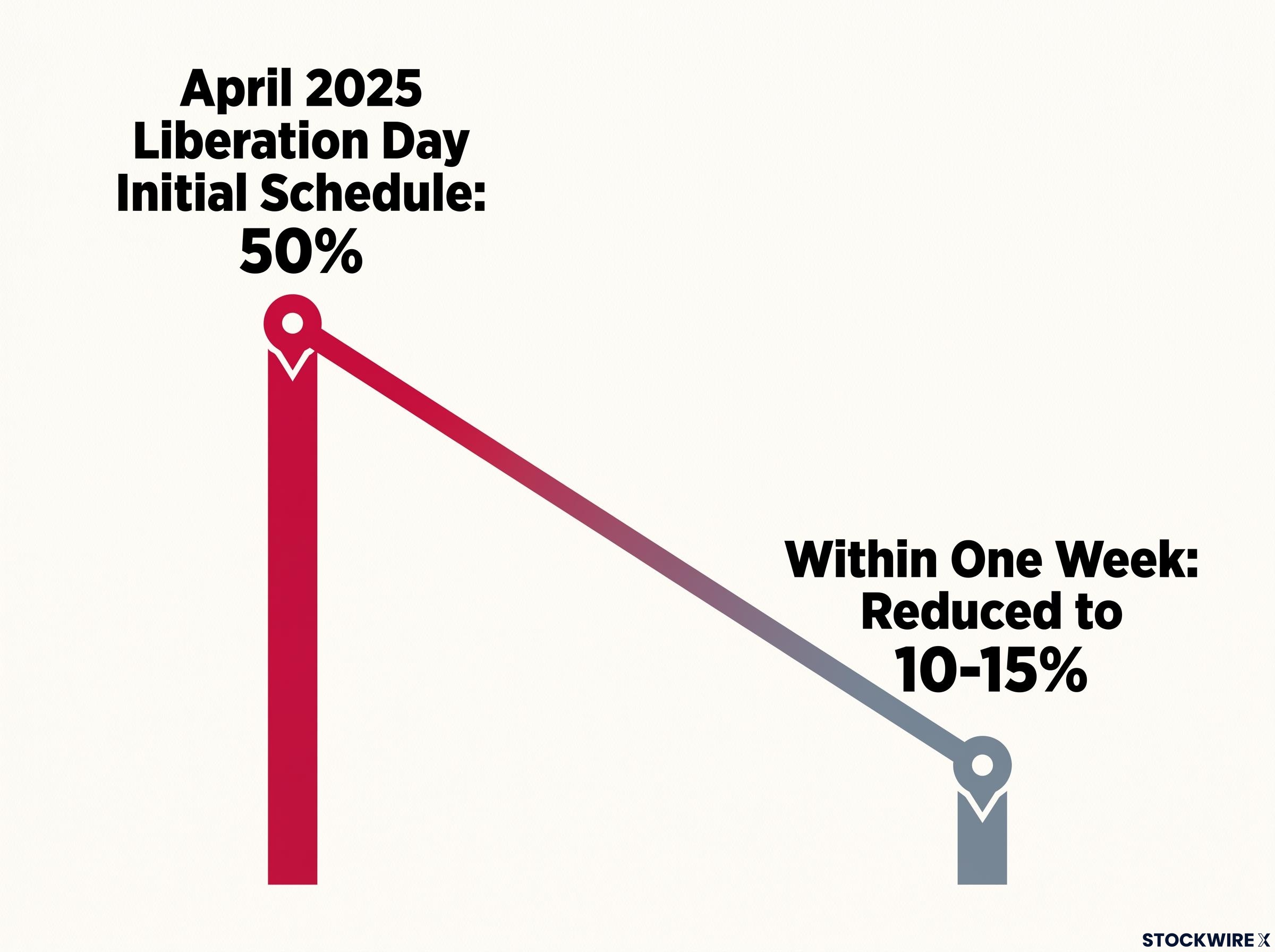
The Liberation Day sequence itself revealed the policy’s fragility. A tariff schedule that initially reached as high as 50% across broad swaths of global trade was reduced to roughly 10-15% within approximately one week of the April 2025 announcement, after equity markets sold off sharply and dislocations emerged in bond markets. The administration’s own retreat under market pressure tells you how much tolerance the economy has for the rates the policy originally envisioned.
This article is for informational purposes only and should not be considered financial advice. Investors should conduct their own research and consult with financial professionals before making investment decisions.
Court-ordered refunds, consumer prices, and the gap between legal relief and real-world costs
The Supreme Court’s refund order sounds like relief. Approximately $200 billion in collected IEEPA tariffs ordered returned. Analyst estimates suggest broader theoretical exposure could involve three-quarters of roughly $2 trillion in IEEPA-collected tariffs, though that figure has not been independently verified and should be treated as an upper-bound estimate rather than a confirmed number.
The gap between that legal outcome and real-world consumer relief is where the story gets uncomfortable.
| What the court ordered | What consumers can expect |
|---|---|
| Refund of approximately $200 billion in IEEPA tariffs to importers | No automatic price reductions; companies are not legally required to pass refunds through |
| Cessation of future IEEPA tariff collection | Price increases already embedded in retail costs are sticky and likely to persist |
| Potential broader refund claims as litigation proceeds | Relief accrues to litigants and importers, not to end consumers who paid higher prices |
Legal victories against tariffs do not automatically produce the price relief that would validate the policy reversal. An importer that lifted prices by 8% to cover tariff costs and subsequently receives a government refund is under no obligation, and faces little competitive pressure, to reduce what it charges customers. Price increases introduced under a tariff regime tend to outlast the regime itself, leaving consumers with a bill that court rulings do not cancel.
For readers who view the court rulings as economic relief, the distinction matters: legal relief accrues to importers and litigants, not to the consumers who paid higher prices throughout the regime.
What this legal fragility means for investors assessing the tariff environment
The legal and economic threads converge on a single investor problem: the administration’s fastest and broadest tariff lever is gone, at least two replacement statutes are in active litigation, and the regime runs on court timelines rather than stable statutory authority. Law firms and trade-risk analysts advising clients after the IEEPA ruling consistently frame current tariff settings as fragile rather than a durable new baseline.
Three forward risk variables deserve specific attention:
- Section 122 appellate outcome: If appellate courts broadly affirm the Court of International Trade’s May 2026 ruling, relief extends beyond the current plaintiff group, potentially invalidating the global surcharge for all importers.
- Section 301 and Section 338 merits decisions: Both statutes face active litigation, with appellate judges already displaying increasing scepticism about executive tariff authority. Major merits rulings could arrive within the next 12-18 months.
- Executive-order agreement durability: Trade deals constructed as executive orders rather than ratified treaties have no legal standing beyond the current administration and could be unwound by a successor president without any act of Congress.
What can investors treat as relatively stable? Section 301 authority over specific, investigation-based actions retains the strongest statutory grounding. Bilateral agreement frameworks, in principle, have durability if formalised through congressional processes.
What remains genuinely contested? Broad-based surcharges, Canada-specific retaliatory tariffs under Section 338, and any future attempts to invoke emergency tariff authority after the IEEPA precedent. As Magness and other analysts have observed, each move toward more obscure statutory authority produces more strained legal interpretations and more judicial exposure.
For investors wanting to understand how the Sanctioning Russia Act is specifically engineered to survive the Supreme Court’s February 2026 reasoning, our dedicated guide to presidential tariff authority examines how explicit statutory tariff language at up to 100% creates a new litigation-resistant template that sits entirely outside the statutes this article covers.
The variables most likely to determine whether this regime holds
The Section 122 appellate ruling is the nearest-term legal catalyst. A broad affirmation of the CIT’s decision would open refund and relief claims well beyond the current plaintiff group, with systemic implications for the global surcharge structure. Section 301 and Section 338 merits decisions represent the medium-term variables, with appellate court scepticism already on the record. The sequencing matters: each ruling builds precedent that shapes the next.
Past performance does not guarantee future results. These statements are speculative and subject to change based on market developments and legal proceedings.
Reading the legal clock on Trump tariffs before the next court ruling changes the picture
Beginning from the widest statutory authority available, the administration saw that foundation stripped away by the Supreme Court and has since relied on a succession of statutes that are progressively older, narrower, and more legally exposed. The direction of travel since February 2026 has been toward greater judicial vulnerability, not consolidation, and nothing in the current litigation landscape suggests that trajectory is about to reverse.
The economic damage is real and largely fixed regardless of what courts do next. Retail prices rose to reflect the tariff burden and have not come back down. Exporters absorbed margin compression they could not pass on. The trade deficit remained stubbornly wide. Those outcomes are baked in whether the remaining tariffs hold up in court or not.
Global trade realignment has accelerated in parallel with the domestic legal battles, with global non-US trade share rising from 72% to 75% in a single year, three major trade agreements ratified without US participation, and international ETFs absorbing $26.3 billion in net inflows between January and April 2026 as capital began pricing structural rather than cyclical US isolation.
The legal record as of August 2026 supports a clear, non-hedging read: treat current tariff settings as contested rather than stable. The appellate calendar on Section 122 is the most immediate signal. Portfolio and supply chain decisions built on the assumption that today’s tariff rates are permanent carry legal-timeline risk that most market pricing does not yet fully reflect.
—