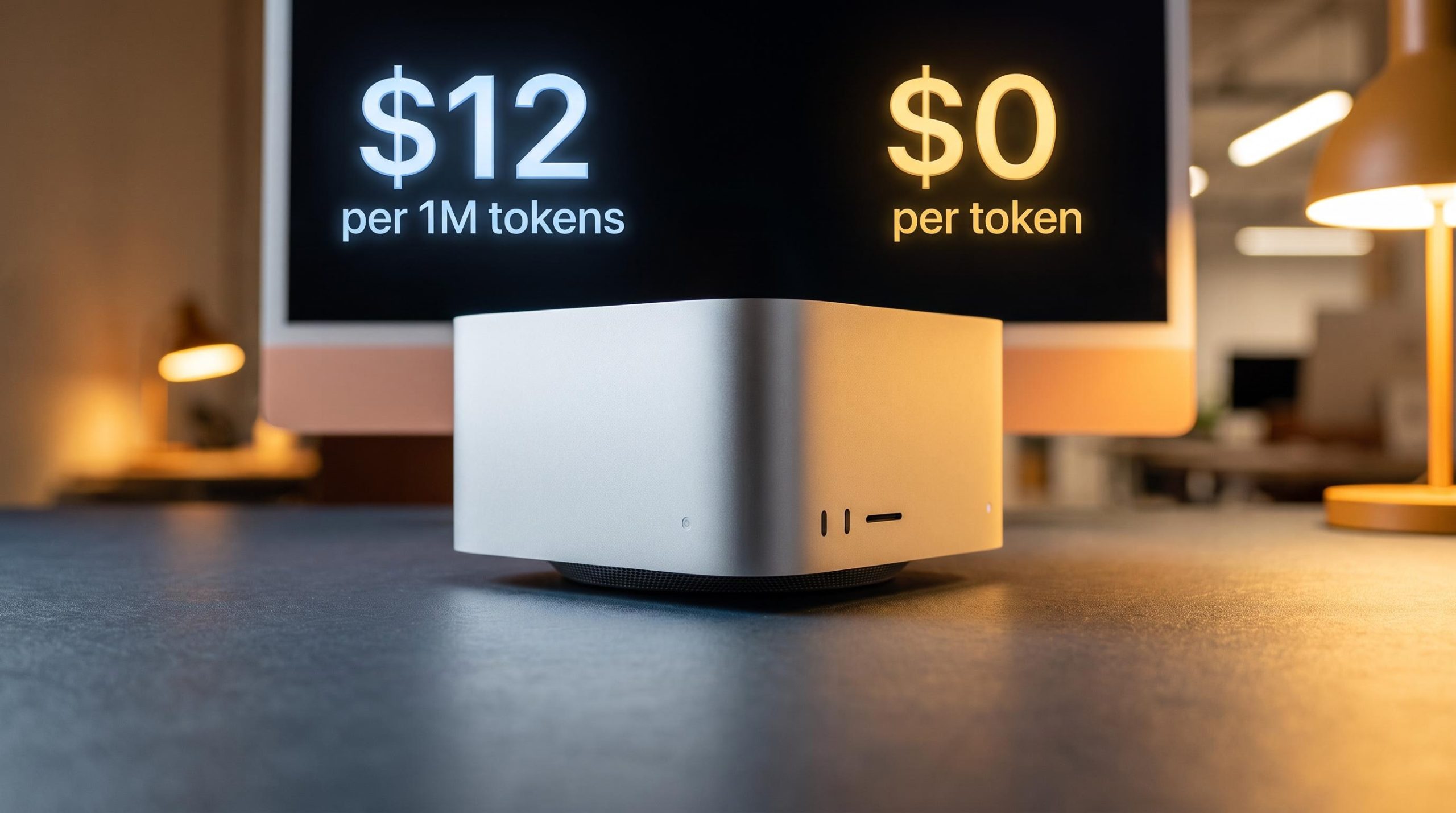
A desktop computer that can cost nearly $20,000 is being sold to businesses as a way to save money. That is the trade Apple put on the table this week, and it deserves a hard look before any budget owner takes it at face value.
At its September 2026 launch event, Apple refreshed its Mac Mini (M6) and Mac Studio (M5 Max and M5 Ultra) lines and pitched them explicitly to businesses as on-premise AI infrastructure. Johny Srouji, Apple’s chief hardware officer, gave the argument its clearest form: “There’s no cost per token. You’re just using the machine again and again.” The thing being displaced is the per-token billing model that cloud providers such as OpenAI and Anthropic charge for every unit of AI processing.
The question for anyone holding an AI budget is not whether Apple’s pitch sounds good. It is whether the arithmetic holds for your specific workload. What follows breaks down the numbers, the architecture, and the workload conditions that determine which choice wins for your operation.
The numbers behind Apple’s “no per-token fee” pitch
Start with what the cloud actually costs, because that is the baseline Apple is trying to beat. OpenAI’s official pricing puts GPT-4 Turbo at $10 per 1 million input tokens and $30 per 1 million output tokens. A token is the unit of text the model reads or writes, roughly a fragment of a word.
Independent cost analyses from ArtificialAnalysis.ai and CloudZero settle on a blended effective rate of about $12 per 1 million tokens for a typical mix of input and output. That blended figure is the one worth carrying forward, because it reflects real-world usage rather than a single price line.
Open-weight token pricing has already pulled the blended market rate downward, with open-weight APIs carrying a median of approximately $0.53 per million tokens versus $2.41 for proprietary models, a dynamic that compresses the gap Apple’s breakeven arithmetic depends on staying wide.
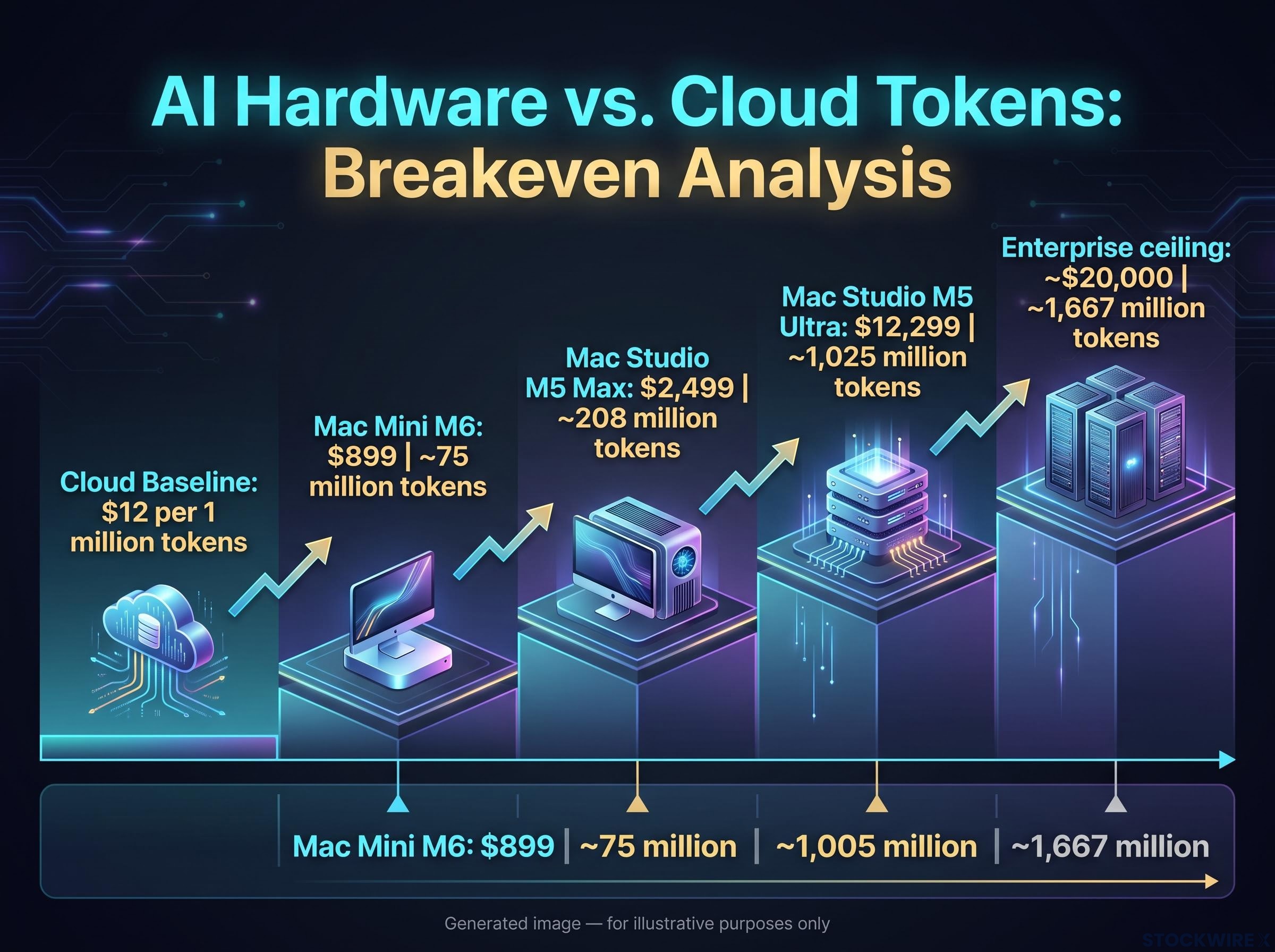
Now the hardware. The Mac Mini M6 starts at $899. The Mac Studio climbs steeply from there, with the top tested M5 Ultra configuration (256GB unified memory, 4TB SSD) landing at $12,299, and the highest enterprise-targeted builds reaching close to $20,000.
Put the two numbers together and the breakeven arrives on its own. Divide the $12,299 hardware cost by the $12 blended rate per million tokens, and you recover the machine’s price after roughly 1,025 million tokens of inference served. Call it one billion tokens.
Johny Srouji, Apple’s chief hardware officer “There’s no cost per token. You’re just using the machine again and again.”
| Configuration | Price | Breakeven Tokens |
|---|---|---|
| Mac Mini M6 | $899 | ~75 million |
| Mac Studio M5 Max (base) | $2,499 | ~208 million |
| Mac Studio M5 Ultra (top tested) | $12,299 | ~1,025 million |
| Enterprise ceiling | ~$20,000 | ~1,667 million |
That one-billion-token figure is the dividing line. For enterprises whose monthly usage climbs into that territory, the pitch is compelling. For those well below it, it is not, and the only way to know which side you sit on is to run your own current or projected token usage against the number, not just your hardware budget.
When big ASX news breaks, our subscribers know first
Why Apple Silicon is architecturally suited to this job
Here is what unified memory looks like in practice for an AI workload: a single 256GB or 512GB Mac Studio can hold an entire large model in one memory space, no splitting required. A comparable setup built from discrete graphics cards cannot do that without carving the model into pieces across devices.
The reason sits in the architecture. Apple Silicon places the CPU, GPU, and Neural Engine on one shared memory pool, so every compute unit draws from the same high-bandwidth memory rather than shuttling data back and forth across the PCIe connections that link separate components.
This was not built for AI. When Apple moved to its own chips in 2020, unified memory was a battery-efficiency decision for mobile devices. AI turning out to favour that design was a happy accident, and it is an approach Nvidia and others have only more recently started to chase.
The contrast with Nvidia’s method is worth making concrete:
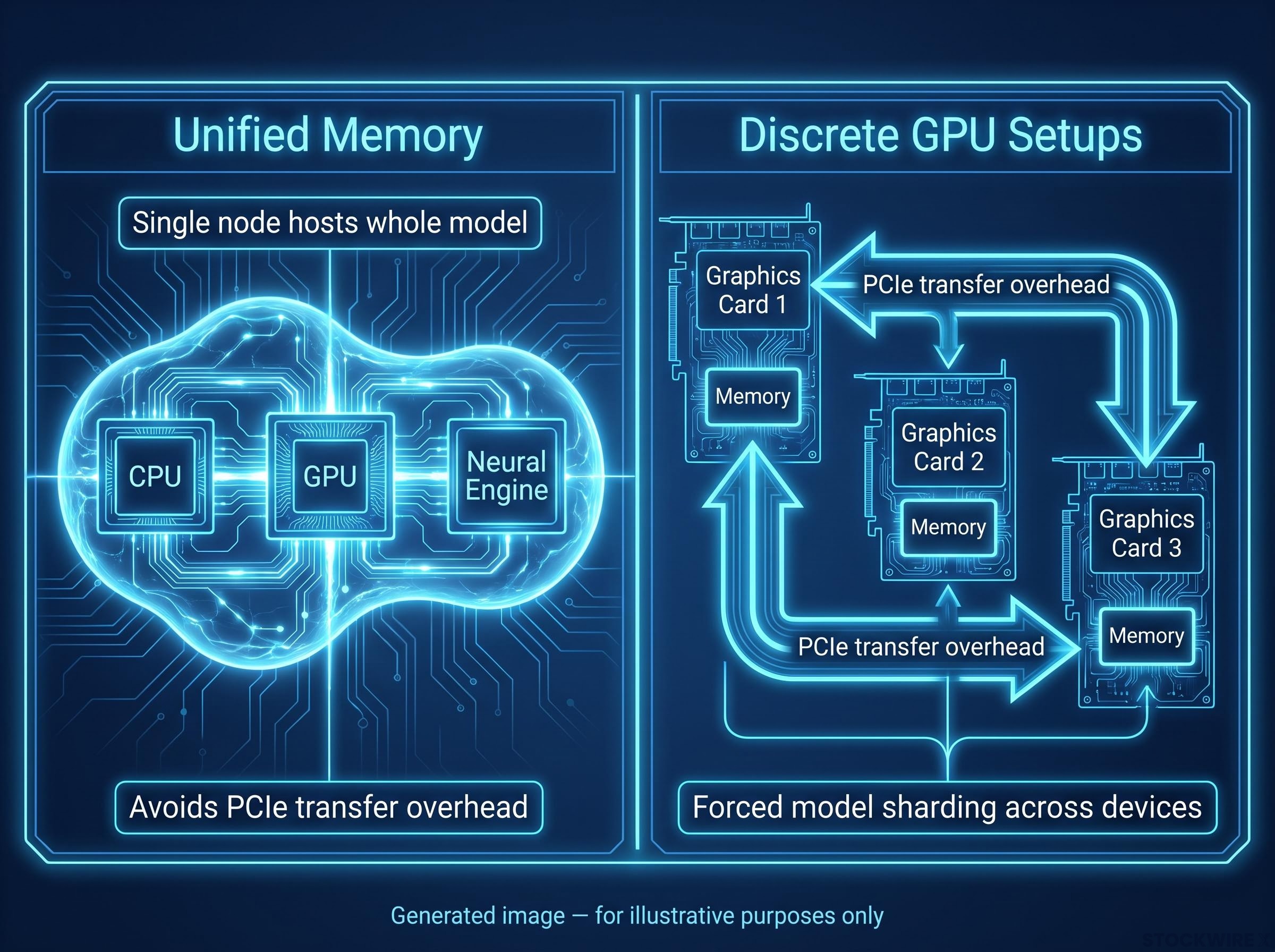
- Unified memory: one shared pool, one address space, a single node hosts the whole model
- Discrete GPU setups: high-bandwidth memory attached per card, forcing models to be sharded across devices
- Data movement: unified memory avoids the PCIe transfer overhead that multi-GPU systems incur constantly
- Deployment complexity: multi-GPU inference layers on tensor and pipeline parallelism, added engineering that unified memory sidesteps
- Practical ceiling: Nvidia clusters still win on peak throughput and the very largest frontier models
Unified memory configurations run from 96GB on the M5 Ultra base, to the 256GB top tested build, with a 512GB option arriving in late October 2026. Tom’s Hardware called the result “as close to frontier-grade as you’re going to get right now on edge computing.”
What the trillion-parameter demo actually showed
At the launch, Apple ran a cluster of four Mac Studios executing a model with one trillion parameters, all powered from a single standard electrical outlet. That is the RDMA over Thunderbolt interconnect working in practice, a chip-to-chip clustering technology Apple developed over roughly the two years before September 2026.
The demo model type and its specific outputs were not disclosed in public reporting. The point was never the task; it was the parameter scale and the power draw, which together signal that the plumbing for serious enterprise inference is genuinely present.
The training vs inference split matters here because Apple’s Mac Studios are inference-only infrastructure; they run models trained elsewhere, and that distinction directly determines which portion of an enterprise AI budget they can realistically displace.
Read the Tom’s Hardware phrasing carefully, though. “Edge computing” is doing quiet work in that sentence. It marks the ceiling: this is capable local hardware, not a data centre replacement, which means workloads that depend on the largest frontier models may still need cloud access alongside anything you run locally.
Which workloads justify the hardware and which do not
The strongest case for Apple’s argument is high-volume, predictable inference. Once the machine is bought, the marginal cost of each additional token is effectively zero, which suits coding copilots, document analysis tools, and internal knowledge assistants working on sensitive data that you would rather not send off-site.
Data sensitivity sharpens the case further. Sectors including finance, healthcare, and defence already run on-premise AI to control data residency, latency, and cost, and Apple’s desktops slot into that established practice rather than inventing a new one.
Enterprise on-premise AI deployments have already become a leading revenue source for Nvidia, with sovereign governments and AI labs joining large enterprises as buyers, a structural shift that confirms Apple is entering a market with measurable and growing institutional demand rather than an unproven segment.
The clearest case against it is bursty, low-utilisation demand. If your workload spikes occasionally and sits idle the rest of the time, cloud elastic scaling means you pay only for what you consume, and an idle Mac Studio becomes pure sunk cost.
Then there is the friction that headline comparisons tend to skip. Enterprises built around CUDA, Nvidia libraries, or Kubernetes-based machine learning platforms face real porting work to move onto Apple’s ARM-based, macOS-centric environment.
| Strong fit for Apple on-prem | Poor fit for Apple on-prem |
|---|---|
| High, predictable token volume | Bursty, low-average utilisation |
| Sensitive data needing residency control | Data comfortably processed off-site |
| Medium-to-large models that fit one node | Frontier-scale models and training |
| Light CUDA or Nvidia-library dependency | Heavy CUDA or Kubernetes ML tooling |
| Stable, long-lived workloads | Rapidly evolving requirements |
Remember too that the sticker price is not the whole bill. IT support, hardware maintenance, power, cooling, and macOS infrastructure management all sit on top of it.
The CUDA question is the one most likely to be underestimated. If you run in an Nvidia-heavy environment, migration complexity has to be priced in before the breakeven arithmetic means anything at all. There is early evidence of genuine uptake, though: an adoption spike in the open-source agentic tool OpenClaw has driven Mac Mini demand in markets including China.
The risks the breakeven calculation does not capture
You have seen the arithmetic and the architecture. This is where the headline economics give way to the harder considerations that the breakeven formula quietly ignores.
The three risks below are distinct and worth taking in sequence:
- Model currency. Cloud vendors update their frontier models centrally, so you inherit each capability jump automatically. Run models locally on Mac Studios and you must manage version upgrades yourself, risking a slide behind the capability curve without periodic hardware refreshes.
- Capital refresh. The top M5 Ultra configuration carries roughly a $3,800 premium over the prior generation. Every refresh cycle adds capital that the simple one-time breakeven number never amortises.
- Total cost of ownership. Cloud inference bundles reliability, scalability, security patching, and uptime into that per-token fee. On-premise, all of it transfers to your internal IT team, and none of it is free.
CloudZero adds a wrinkle Apple’s pitch tends to gloss over: variable token pricing is not fixed. Careful architecture and caching can pull cloud costs down, partially closing the gap the “no per-token fee” argument assumes stays wide open.
Tom’s Hardware on the M5 Ultra Mac Studio “as close to frontier-grade as you’re going to get right now on edge computing”
That line is praise and caveat in one breath. It positions the hardware as genuinely strong for local AI while marking the ceiling that separates it from data-centre-scale frontier models.
One more gap belongs in the risk column. As of the September 2026 launch, no enterprise customers or pilot deployments have been publicly named. That does not invalidate the economics, but it means you are evaluating the pitch without third-party validation, and that uncertainty should be priced into the decision as its own line item.
Making the call on Apple’s hardware in your AI budget
The verdict is conditional, not blanket. Apple’s argument holds up under a specific and definable set of conditions, and it falls apart outside them.
- High and predictable token volume, comfortably past the roughly one billion token breakeven on the $12,299 configuration
- Stable workloads that will not churn through hardware refreshes
- Genuine data-residency or latency requirements
- Low dependency on CUDA and Nvidia-specific tooling
There is an accounting dimension too. For organisations whose IT budgets favour operating expenditure over capital expenditure, the cloud model can win on the books even when the raw token economics point toward hardware.
Reuters framed the launch as Apple’s Macs going “head-to-head” with Nvidia and PC makers on AI cost. That competitive pressure is itself the takeaway. Even if you never buy a single Mac Studio, Apple’s arrival, backed by early OpenClaw-driven demand and a 512GB memory option landing in late October 2026, shifts the negotiating context with cloud providers in your favour. The right move is not “buy or don’t buy” but run your own numbers against these tests, and revisit the comparison as the market moves.
Apple Intelligence architecture routes data through on-device models or Apple-controlled Private Cloud Compute servers, meaning the Mac Studio push into enterprise on-premise inference sits within a broader ecosystem strategy whose financial payoff is not expected to surface in reported metrics until the 2027-2028 services revenue window.
This article is for informational purposes only and should not be considered financial advice. Investors should conduct their own research and consult with financial professionals before making investment decisions. Past performance does not guarantee future results, and figures cited reflect pricing and configuration data current as of September 2026, which is subject to change.