Crude oil has logged its fifth consecutive losing session, sliding to its lowest level since September 8 after unconfirmed reports emerged from the United Nations General Assembly that Iran offered to reopen the Strait of Hormuz within seven days in exchange for US sanctions relief.
The stakes explain the reaction. The Strait of Hormuz closure ranks as the largest oil supply disruption on record, cutting off roughly 20 million barrels per day and fuelling a near-20% rally that left the market loaded with heavily long positioning. Any credible signal of a reopening carries enormous reprice potential, which is why unconfirmed diplomatic chatter alone has been enough to move prices this week.
The trouble is that the market moved on a rumour, not a signed deal. This piece maps where the diplomacy actually stands, what a real agreement would do to prices, and where all of it leaves US investors exposed to energy through Chevron and the broader Dow Jones Industrial Average.
Five sessions down: how diplomatic rumors repriced a market built on fear
The selling this week had nothing to do with physical supply. Not a single extra barrel has moved through Hormuz. What changed was sentiment, and in a market this stretched, sentiment was all it took.
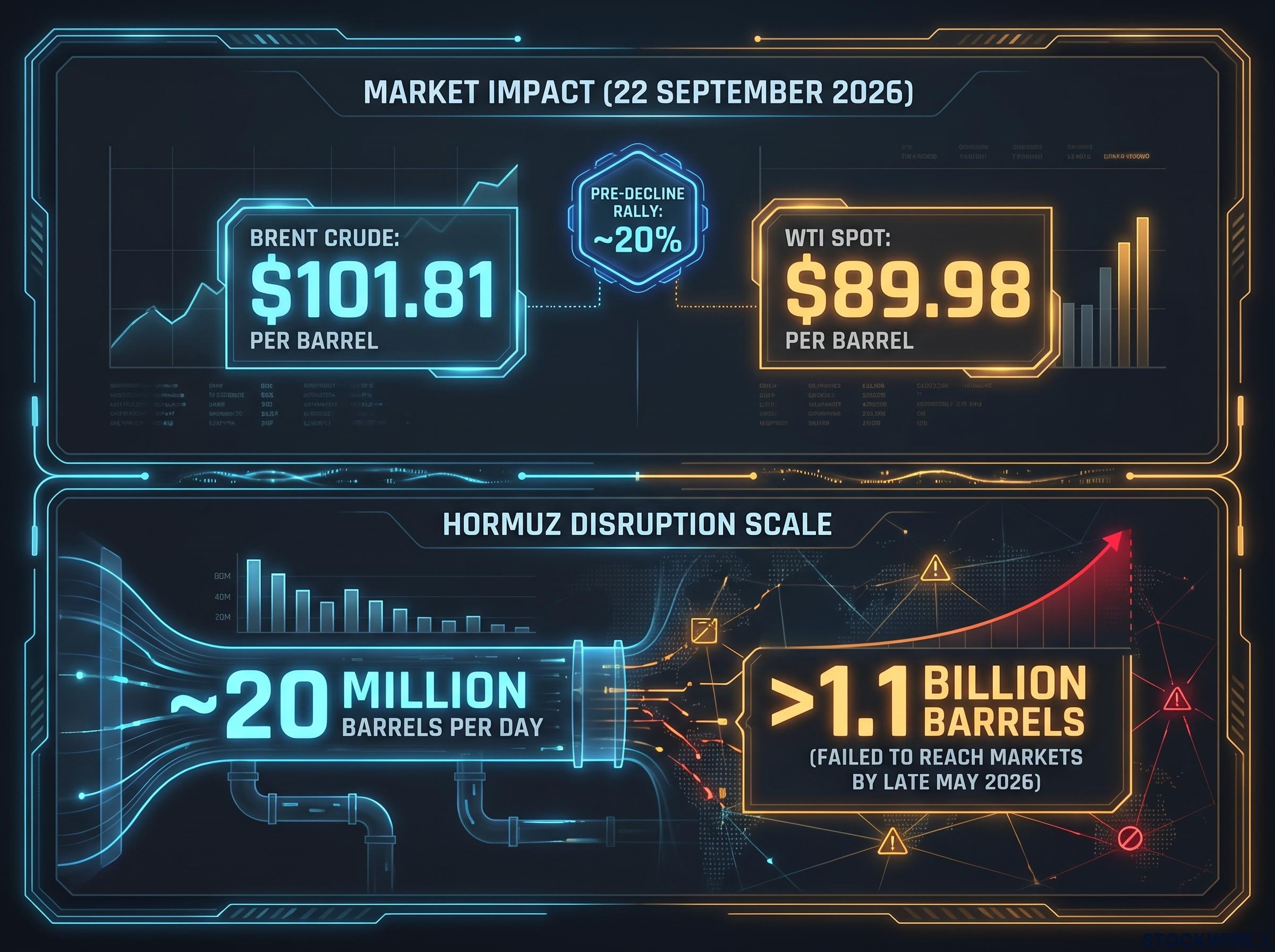
Here is where prices sit as of 22 September 2026:
- Brent crude at approximately $101.81 per barrel
- WTI spot close at $89.98 per barrel
- Brent’s five-session slide to an 11- to 12-day low, its weakest since September 8
- A near-20% pre-decline rally driven by Hormuz supply fears
- A roughly 2% partial rebound after President Trump signalled distance from the earlier June framework
A market carrying that much rally gain and that much long positioning is structurally primed to sell on any de-escalation signal, confirmed or not. When traders are collectively betting on scarcity, the exits get crowded the moment scarcity looks less certain.
The rebound tells you the same thing in reverse. Prices recovered roughly 2% once reports suggested Trump was not interested in reviving the specific terms of the June Memorandum of Understanding. One counter-signal, and the market snapped back.
The World Bank notes that in periods of high geopolitical risk, even a 1% change in production can drive a peak price move of more than 11%.
That sensitivity is the whole story. For anyone holding energy exposure, the read is this: the geopolitical risk premium baked into oil right now is both enormous and unstable, so sharp swings in either direction are the base case until the diplomatic picture clarifies. This week’s decline set a marker for how far prices could fall on a real deal, and how fast they could snap back if the talks collapse.
The geopolitical risk premium embedded in Brent reflects not just current disruption but a structural repricing of transit-route security: VLCC daily hire rates tracked approximately $110,000 per day during the acute phase of the Hormuz closure, a physical-market signal that moves independently of diplomatic headlines and tends to decompress slowly even after ceasefires are signed.
The World Bank geopolitical oil supply shock research identifies disruptions of this scale as historically rare, finding that even a 1% production change can drive peak price moves exceeding 11% during periods of elevated geopolitical risk, which explains why unconfirmed diplomatic signals alone have been sufficient to reprice Brent by multiple percentage points this week.
What Iran actually offered, what the US has agreed to, and what a deal would do to prices
The rumour that moved markets and the negotiation on paper are two different stories. Traders repriced on the seven-day reopening chatter. Diplomats are working from something far more modest.
The documented framework is a 60-day Memorandum of Understanding (MoU), extendable by mutual consent, not a one-week reopening. Its terms include a ceasefire extension, toll-free passage through Hormuz, the lifting of the US naval blockade, sanctions waivers allowing Iran to sell oil, and the potential release of up to $24 billion in frozen assets during negotiations.
What the US has actually done is narrower still. The Office of Foreign Assets Control (OFAC) issued General License X on 22 June 2026, authorising transactions for Iranian crude, gas, and petrochemical products through 21 August, since extended. The broader primary and secondary sanctions regime remains fully in force.
| MoU Term | Current Status |
|---|---|
| Strait of Hormuz passage | Agreed in principle, toll-free |
| US naval blockade | Lifting included in framework |
| Oil-sector sanctions | Temporary OFAC waiver only |
| Comprehensive sanctions relief | Conditional on verified nuclear concessions |
| Frozen assets release | Up to $24 billion, contingent |
Secretary of State Marco Rubio has drawn the hard line in congressional testimony, tying all sanctions relief to verifiable nuclear concessions and explicitly rejecting a straight Hormuz-for-sanctions swap.
Rubio testified that all sanctions relief remains strictly conditional on verifiable concessions regarding Iran’s nuclear program. The path to durable relief runs through a nuclear negotiation that has not yet begun in earnest.
Trump, for his part, framed the timeline at the UNGA as a deal arriving shortly after the 3 November midterm elections, a binary choice between agreement and military action.
Now the supply arithmetic. The disruption removed roughly 20 million barrels per day, and by late May 2026 over 1.1 billion barrels had failed to reach markets. Prices initially spiked as high as $119-121 per barrel before stabilising in the $90-100 range as commercial inventories were drawn down. The World Bank projects a 24% rise in overall energy prices for 2026.
A durable deal would move real barrels, but not to pre-crisis pricing. Analysts broadly expect Brent to settle toward the $80-90 per barrel range, held up by depleted inventories and war-damaged infrastructure. Much of the anticipated supply is already priced into forward markets, which makes a gradual grind lower more likely than an abrupt collapse.
The gap between official declarations and physical reality is stark: Hormuz shipping data from August 2026 showed commercial transits running at just 5-12% of pre-war capacity, with war-risk insurance premiums at roughly 30 times normal rates, conditions that a diplomatic announcement alone cannot reverse.
Chevron CEO Mike Wirth offered the counterweight to the optimism, warning that global oil price buffers are “played out” and that risks remain skewed to the upside. For anyone holding energy positions, the takeaway is that even a successful deal is unlikely to snap prices back quickly, because the physical repair takes time regardless of what diplomats sign.
What this means for Chevron, the DJIA, and the Fed’s next move
One diplomatic development splits the Dow in two. Chevron, the sole energy producer among the 30 components, faces direct revenue pressure from falling crude. The other 29 constituents gain immediate relief on fuel costs.
For Chevron holders, the resilience picture is stronger than the headline decline suggests. Moderate price falls within the $80-90 range do not threaten the dividend or the credit rating. S&P Global Ratings reaffirmed Chevron’s ‘AA-‘ rating with a stable outlook in June 2026, and the company is expected to hold funds-from-operations-to-debt above 90% even at WTI $50 and Brent $55.
| Brent Price Scenario | Free Cash Flow Impact | Dividend Coverage Status |
|---|---|---|
| $95+ Brent | Full dividends and buybacks covered | Fully covered |
| $70 Brent | ~$10 billion incremental FCF | Covered |
| $55 Brent | ~$9 billion at $60; pressure below | Dividends covered, buybacks at risk |
Chevron needs roughly $95 Brent to cover both dividends and buybacks, against the mid-$50s required for dividends alone. Prolonged prices below $70 Brent would pressure free cash flow and valuation, so the level to watch is Brent relative to that breakeven, not the deal headlines themselves.
The Fed, Goldman Sachs, and a 10-day window of compounding risk
On 16 September, the Federal Reserve raised its benchmark rate by 25 basis points to 3.75-4.00%, its first increase since July 2023. JPMorgan Chase passed the cost straight through, lifting its prime rate to 7.00% the next day.
The Fed rate hike market impact from the September 16 decision was counterintuitive: the S&P 500 gained 1.14% and the Nasdaq jumped 1.69% the following session, reflecting a well-telegraphed resolution effect that historical analysis of 14 past final hikes suggests eventually gives way to a roughly 1.8% 12-month equity return after an initial soft patch.
That creates a second headwind inside the Dow, and it lands hardest on Goldman Sachs:
- Most Fed officials expect at least one more rate increase before year-end
- Goldman earns a greater share of revenue from arranging mergers and equity offerings than from traditional lending
- Rate-driven declines in deal activity hit that model harder than a conventional bank
- Goldman’s heavier weight in the price-weighted DJIA amplifies the effect across the index
The timing is the sharpest part. The next Fed decision falls on 28 October, six days before the 3 November midterms that Trump has named as his deal threshold. That compresses the Fed, the election, and the Iran timeline into a single 10-day window. For a DJIA-sensitive portfolio, this is not just an oil story: one development is simultaneously reshaping the energy sector, the cost base of 29 industrial and consumer names, and the rate environment that prices all of them. Map your exposure before that window closes.
The obstacles ahead and what to watch before the November 3 midterm deadline
The most dangerous position right now is treating the MoU as a done deal. The hardest issues have been deferred, not resolved, and the market has already moved as though they are settled.
The obstacles worth tracking fall into four categories:
- The nuclear file: Iran’s near-bomb-grade uranium stockpile, enrichment ceilings, and facility reconstruction remain unresolved, and refusal to compromise here is the most likely path to collapse.
- Verification: Russia and China vetoed the US-backed UN Security Council resolution for independent monitoring, leaving the snapback enforcement mechanism contested.
- Sanctions complexity: Unwinding four decades of US primary and secondary sanctions requires coordinated executive actions and congressional approvals spanning years, not weeks.
- Regional spoilers: An Israeli confrontation with Hezbollah or other Iran-aligned groups could break the ceasefire independent of any US-Iran deal.
The complexity of unwinding four decades of sanctions is compounded by the August 2026 sectoral sanctions designations covering digital assets, shipping, gold, aviation, and technology, which expose global counterparties to compliance risk without requiring a US nexus and operate independently of whatever OFAC waivers diplomats negotiate.
OFAC General License X is a temporary waiver, not comprehensive relief. The full sanctions regime remains in force, and any investor banking on rapid, permanent relief is mispricing the timeline.
That distinction is the single most misunderstood element of current pricing. It also frames what to watch over the next six weeks, three catalysts in chronological order:
- Any formal MoU signing, or a clear signal of breakdown
- The 28 October Fed decision and its language on further hikes
- The 3 November midterms and any post-election deal announcement from Trump
For Chevron holders, the level to track is Brent against the $95 dividend-and-buyback threshold, plus any guidance revision from management. For broader Dow exposure, the signals are the Fed’s October tone and Goldman’s deal-activity pipeline. If a deal holds, analyst consensus points to Brent near $80-90, not the below-pre-conflict prices Trump has floated as the optimistic case.
The market has moved significantly on unconfirmed information. The next durable price move will come from one of the three catalysts above, not from the next diplomatic headline.
This article is for informational purposes only and should not be considered financial advice. Investors should conduct their own research and consult with financial professionals before making investment decisions. Past performance does not guarantee future results, and financial projections are subject to market conditions and various risk factors. Forward-looking statements regarding diplomacy, prices, and policy are speculative and subject to change based on market developments.