Nvidia has committed $1.5 billion to an IPO that has no confirmed date, no price, and no share count. That single fact should make you feel you are behind on something worth catching up on.
The offering belongs to SB Energy, Inc., a SoftBank Group subsidiary chasing a valuation of more than $50 billion on Nasdaq. It carries a Japanese retail tranche aimed at ordinary households, a dual-exchange listing structure, and a related-party web dense enough that seasoned analysts are struggling to price it cleanly.
The complexity here is not a footnote. It is the thing you have to decode before forming any judgement about whether the deal is worth watching, let alone participating in.
This piece walks through exactly what the IPO structure involves, what the valuation actually rests on, where the genuine risks sit, and why the argument over timing is more contested than the first headlines suggested.
What SB Energy is, and what the IPO structure actually involves
Start by correcting the obvious misconception. Despite the name, SB Energy is not a conventional clean-energy company you would file next to solar and wind developers.
It is a SoftBank vehicle built around data-centre and power infrastructure for artificial intelligence (AI). Its legacy renewable-power business exists, but the story it is selling to investors is compute capacity for the AI build-out, not megawatts of green electricity for their own sake.
The listing mechanics are unusual too. SB Energy filed a registration statement on Form S-1 with the U.S. Securities and Exchange Commission (SEC) on 1 September 2026, seeking to list on both the Nasdaq Global Select Market and Nasdaq Texas under the ticker SBE.
A first amendment followed on 4 September 2026 (accession number 0001628280-26-060761), filed solely to add exhibits. Those exhibits included the documentation behind Nvidia’s cornerstone commitment. A further amendment (accession 0001628280-26-062846) landed on 21 September 2026, still without a price range or share count.
The capital-raise architecture is where this gets genuinely distinctive. It arrives in three layers rather than one.
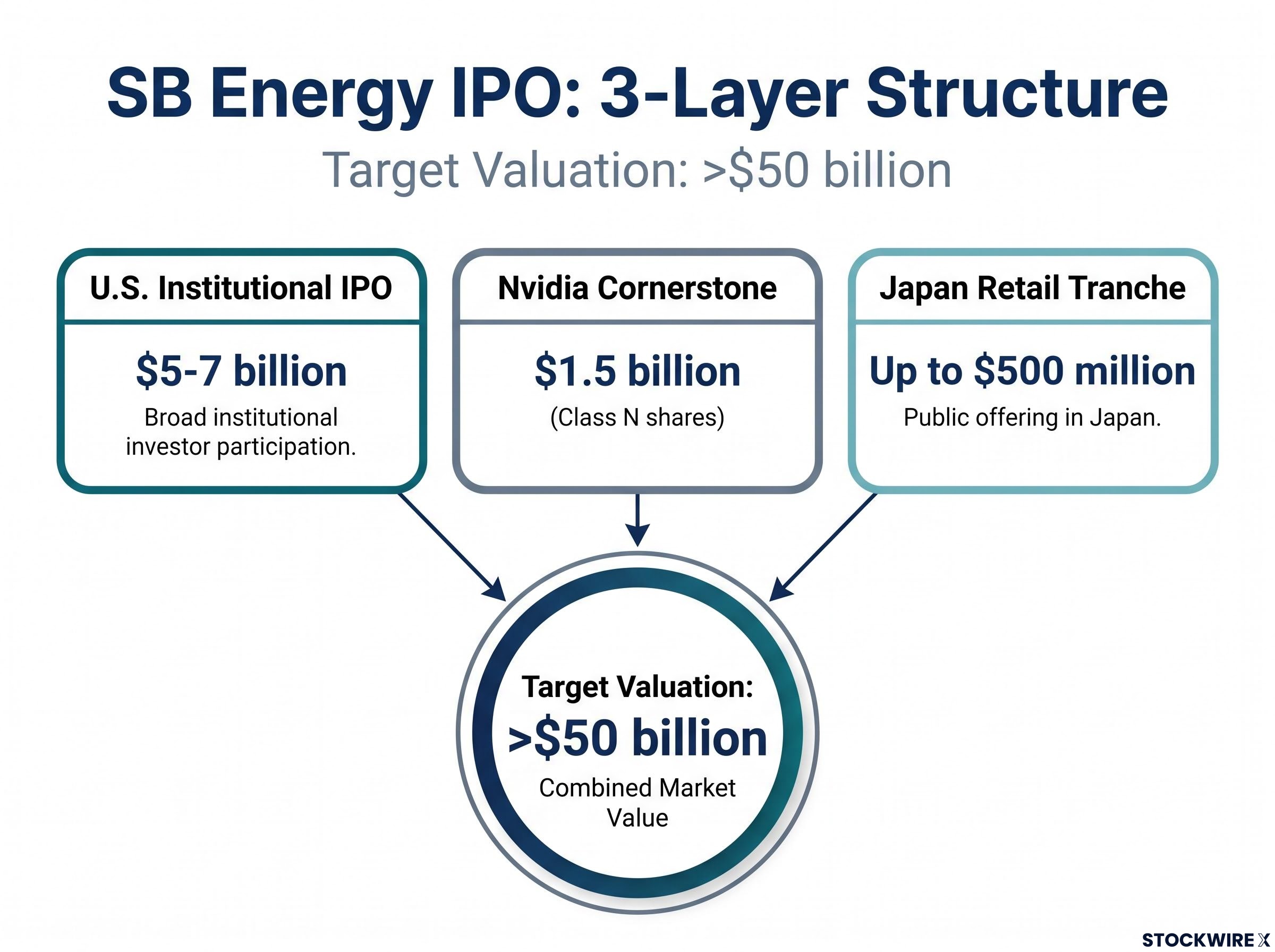
| Component | Amount | Purpose | Counterparties |
|---|---|---|---|
| U.S. institutional IPO | $5-7 billion | Primary raise via Nasdaq listing | U.S. institutional investors |
| Japan retail tranche | Up to $500 million | Data-centre and power infrastructure | Japanese retail investors |
| Nvidia cornerstone | $1.5 billion | Anchor demand at IPO price | Nvidia (Class N shares) |
Nvidia’s commitment, confirmed The S-1/A exhibit documentation filed on 4 September 2026 confirms Nvidia’s commitment to invest $1.5 billion at the eventual IPO price, held through non-voting Class N shares.
Here is what that three-layer structure tells you. SoftBank is building committed demand from several directions at once rather than leaning on a single bookbuilding process. Read it as a deliberate strategy to anchor the price range before U.S. institutions ever sit down to set terms.
The three-layer capital architecture SB Energy is deploying reflects how modern mega-IPOs are engineered to anchor demand before bookbuilding opens, a dynamic that connects directly to the IPO structural mechanics that consistently advantage institutional investors over retail participants entering through secondary markets.
When big ASX news breaks, our subscribers know first
Why $500 million is going to Japanese households first
Most coverage treats the Japan tranche as a curiosity. It is closer to the load-bearing beam of the whole demand structure.
The logic borrows directly from a playbook run only months earlier. When SpaceX raised roughly $2.2 billion from Japanese investors in June 2026, it converted domestic brand loyalty and household savings into cornerstone demand that supported the wider offering.
The SpaceX precedent SpaceX raised approximately $2.2 billion from Japanese investors in June 2026, giving local households rare direct exposure to a global tech issuer. SB Energy’s Japan tranche is widely read as a deliberate replication of that approach.
SoftBank has the one asset that makes this replicable: domestic brand recognition strong enough to reach into Japan’s roughly $15 trillion pool of household financial assets. SB Energy is carving off up to $500 million of newly issued shares for exactly that audience, earmarked for data-centre and power-generation infrastructure.
The regulatory groundwork is already laid. SB Energy filed a securities registration statement with a local Japanese finance bureau on 15 September 2026, the prerequisite for any domestic public offering there. The selling agents named in that filing are:
- Mizuho Financial Group
- Daiwa Securities Group
- PayPay Securities
- Rakuten Securities
- SBI Holdings
Now the detail that changes how you should read every U.S. listing headline. According to Morningstar, the offering price for the Japanese tranche will be set sometime between September 2026 and February 2027.
That window stretches well past any likely U.S. listing date. It means the Japan pricing and the U.S. IPO are not necessarily the same event, and the Japan allocation could close first, handing SoftBank a committed anchor that reduces its U.S. bookbuilding risk.
SoftBank is stitching these channels together deliberately. It is concurrently running a ¥1 trillion retail bond aimed at Japanese retail investors, funding AI-sector commitments and partially refinancing loans tied to its OpenAI stake. For U.S. investors, the Japan tranche is the clearest early read on how much confirmed demand exists before institutional bookbuilding even begins.
What justifies a $50 billion valuation, and what does not
This is the section where the $50 billion number either becomes defensible or falls apart. Skip it, and you will not understand what you would actually be buying.
The bull case rests on tangible-sounding pillars. SB Energy has 8.8 GW of contracted data-centre capacity, OpenAI warrants the company values at approximately $5.5 billion, Nvidia’s $1.5 billion cornerstone, and a place near the centre of the AI-infrastructure narrative.
The bear case looks at the same facts and sees a different picture entirely.
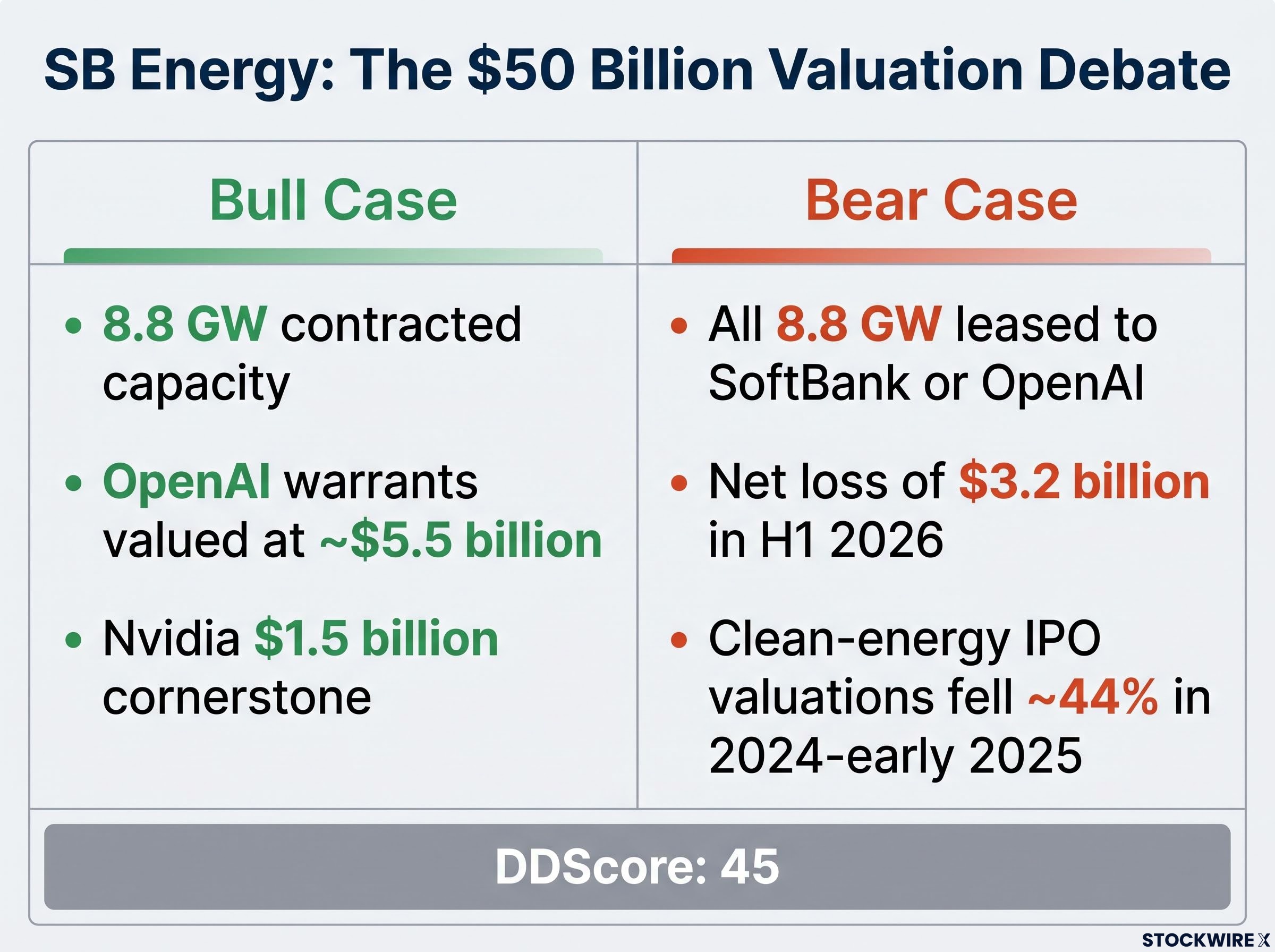
| Bull case | Bear case |
|---|---|
| 8.8 GW of contracted capacity signals real demand | All 8.8 GW is leased to SoftBank or OpenAI, not independent customers |
| OpenAI warrants valued at approximately $5.5 billion | Valuation leans on warrants and guarantees, not operating earnings |
| Nvidia’s $1.5 billion cornerstone endorses the story | SB Energy has no operating data centres yet |
| AI-infrastructure growth narrative | Net loss of $3.2 billion in H1 2026, mostly non-cash |
| Big-name partners could carry the deal if sentiment holds | Clean-energy IPO valuations fell approximately 44% in 2024-early 2025 |
DDScore’s IPO diligence note assigns SB Energy a DDScore of 45, arguing that a $50+ billion valuation makes the assumptions on project delivery, financing, and future cash flow considerably more demanding.
Whether 8.8 GW of contracted capacity represents a meaningful market position depends heavily on where global demand is heading: Citi’s revised data-centre capacity forecasts, which tripled the 2031 projection to 370 GW at a 25% compound annual growth rate, suggest the addressable market is large enough to sustain multiple scaled entrants, though the path from committed capital to operating revenue remains the contested variable.
There is one gap you should hold onto. The IPO targets $5-7 billion, yet Finance Yahoo reports analyst estimates that SB Energy may need around $7 billion in additional equity beyond IPO proceeds, plus substantial debt, to fund its pipeline. The proceeds alone will not complete the build-out, which means continued access to debt and equity markets after listing is not a nice-to-have. It is the thesis.
Where the structure gets complicated
The related-party arrangements are where valuation turns into a genuine puzzle. SoftBank sits in four seats at once: parent, key customer, guarantor, and trademark licensor collecting 1% of consolidated gross profit.
The SEC Item 404 disclosure rules require companies filing S-1 registrations to identify transactions with related persons above $120,000 and describe the material terms, a standard that makes SB Energy’s overlapping SoftBank roles as parent, customer, guarantor, and licensor a particularly dense disclosure obligation.
The related-party problem Reuters Breakingviews describes SB Energy as tangled in an “unusually dense web of related-party arrangements,” listing SoftBank’s overlapping roles alongside OpenAI’s combined tenant-and-partner status.
That web raises a real question for minority shareholders. If a tenant is also your controlling shareholder, how willing will the board be to enforce a lease against them? SB Energy will remain a “controlled company” under Nasdaq rules, with SoftBank keeping majority control and Nvidia holding non-voting Class N shares.
The S-1 also discloses that SB Energy is “substantially dependent” on OpenAI, as both a tenant and an equity partner. If OpenAI’s financial position deteriorates or its contracts are reassessed, near-term revenues and project financing are directly exposed. You are not buying a diversified customer base. You are buying a concentrated bet on three linked entities.
What the timing debate actually means for investors watching the deal
Two very different stories about timing have been circulating, and the difference matters.
The New York Times reported that SB Energy struggled to attract sufficient investor interest at a valuation above $50 billion, potentially pushing the offering to mid-to-late October 2026. Read on its own, that sounds like a stumble.
An anonymous source familiar with the matter, speaking to Investing.com on 22 September 2026, offered the counter-narrative: preparations are proceeding as intended, and mid-to-late October was the original scheduling baseline rather than a delay. Same date, opposite framing.
The SpaceX precedent matters here beyond the Japan tranche comparison: the SpaceX IPO demonstrated that headline valuation records and the actual mechanics of bookbuilding, pricing, and aftermarket performance can diverge sharply from what early reporting implies, a pattern worth holding in mind as SB Energy’s own framing battle plays out.
The immediate market backdrop tilts positive. On 22 September 2026, technology equities rallied and the Nasdaq reached a new all-time intraday high on AI-related momentum, an environment that sits awkwardly against reports of investor hesitancy over the valuation.
Finance Yahoo’s read As of 18 September 2026, Finance Yahoo framed SB Energy as expected to seek $5-7 billion “within the coming weeks,” describing the timing as near-term but not tied to a specific date.
Rather than fixate on any single IPO-date headline, watch the three variables that will actually govern whether the window stays open:
- AI-sector sentiment. The Nasdaq’s record on 22 September is the most concrete positive signal in the immediate environment, but it does not settle the valuation debate.
- Debt-market conditions. SB Energy’s own S-1 warns that securing required financing could become difficult if debt markets tighten, a live risk for a capital-intensive pipeline.
- Competing SoftBank offerings. The concurrent ¥1 trillion retail bond runs alongside this listing, and overlapping deals can strain appetite among SoftBank-focused investors.
Knowing that the timing dispute is partly a matter of characterisation, delay versus original plan, protects you from overreacting to early reporting. The AI backdrop is encouraging, but debt-market conditions will tell you more about the window than any date headline will.
What these structural layers mean for anyone evaluating this deal now
Pull the threads together and a coherent picture emerges. As of late September 2026, SB Energy is a three-layer capital raise, wrapped around a contested valuation, sitting inside a timing debate that is as much about narrative as fact.
Several material things remain undisclosed. There is no final share count, no IPO price range, and no effective date for the S-1, the point at which the deal formally enters active pricing.
That absence of a price range across every amendment filed so far is the single most telling signal. It tells you bookbuilding has not yet begun in earnest, and watching for the amendment that introduces a price range is the most reliable way to know the deal is entering its final phase.
If you want to track this without relying on second-hand press coverage, here is a concrete monitoring routine:
- Check the SEC EDGAR page for SB Energy (CIK: 0002133037) for the amendment that adds a price range. That filing signals the active pricing phase.
- Note the Japanese tranche pricing window (September 2026 to February 2027), which may close before the U.S. listing.
- Watch debt-market conditions, the risk SB Energy itself flags most explicitly.
- Track AI-sector index performance as a proxy for the sentiment carrying this deal.
The filing architecture tells the story earlier and more reliably than most financial news will. The possible U.S. window is mid-to-late October 2026, though even that characterisation is contested.
For investors wanting to understand where SB Energy’s offering fits in the broader wealth-creation timeline, our full explainer on pre-IPO and post-IPO investing examines how entry price relative to offer price is the single biggest driver of IPO outcomes.
This article is for informational purposes only and should not be considered financial advice. Investors should conduct their own research and consult with financial professionals before making investment decisions.
Past performance does not guarantee future results, and any references to valuation targets, timing, or funding needs are drawn from press reports and analyst estimates rather than finalised company figures. These are speculative and subject to change based on market developments and company performance.