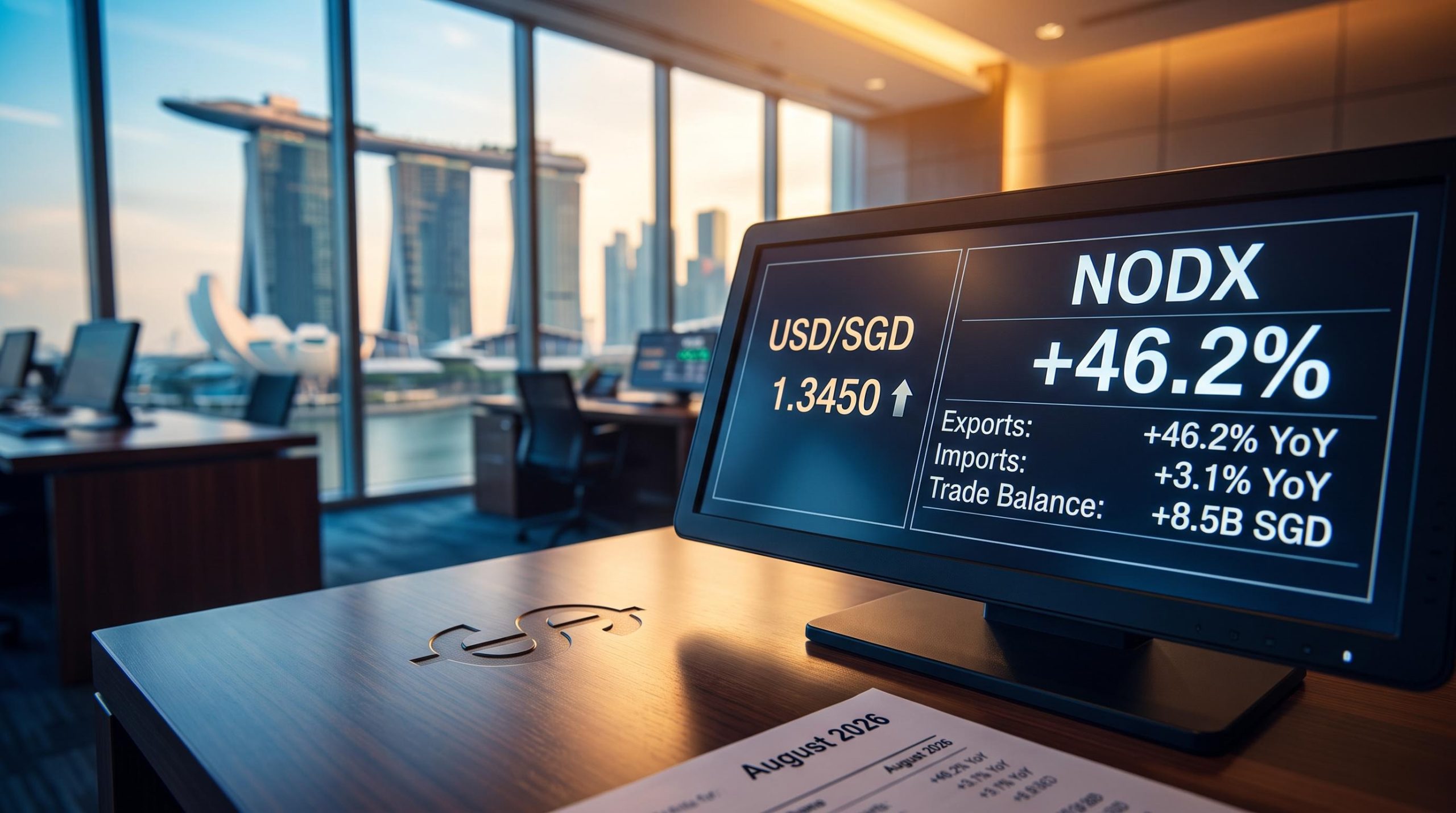
Singapore’s non-oil domestic exports jumped 46.2% year-on-year in August 2026, the fastest annual pace since October 1988. The figure landed in a routine trade data release from Enterprise Singapore on 17 September 2026, and it immediately raised two questions every Singapore market watcher should be asking.
The number did not just beat expectations; it embarrassed them. It vastly outpaced the Bloomberg consensus of 35.1%, accelerated sharply from July’s already strong 24.1%, and pushed year-to-date growth to 22.4%, well beyond the government’s full-year forecast ceiling of 16%. What makes this analytically interesting is not the export number alone. It is that a historic trade print has arrived at the same moment as a core inflation trajectory heading toward a two-year high.
Working through the analysis, you will be better positioned to judge whether this boom is as clean as the headline suggests. The real question is what these two converging signals mean for Singapore’s monetary authority before its October decision.
A number that does not arrive often: what August’s NODX result actually says
Start with the headline, because it is the kind of figure that does not appear more than once in a generation. Singapore NODX growth of 46.2% year-on-year has not been matched since October 1988, nearly four decades ago.
The historical anchor August 2026 NODX rose 46.2% year-on-year, the fastest annual growth rate Singapore has recorded since October 1988.
The surprise dimension sharpens the picture. Economists surveyed by Bloomberg had penciled in 35.1%, itself an aggressive call given the volatility in Singapore’s trade data. The actual result cleared that by more than eleven percentage points, and it built directly on July’s 24.1% reading rather than reversing it.
The composition is where the scale becomes genuinely striking. Electronics NODX surged 131.8% year-on-year, and the subcategories read almost implausibly: disk media products up 290.2%, personal computers up 237.9%, and integrated circuits up 90.9%. Non-electronics exports, often the quieter half of the account, also turned positive at 12.0%.
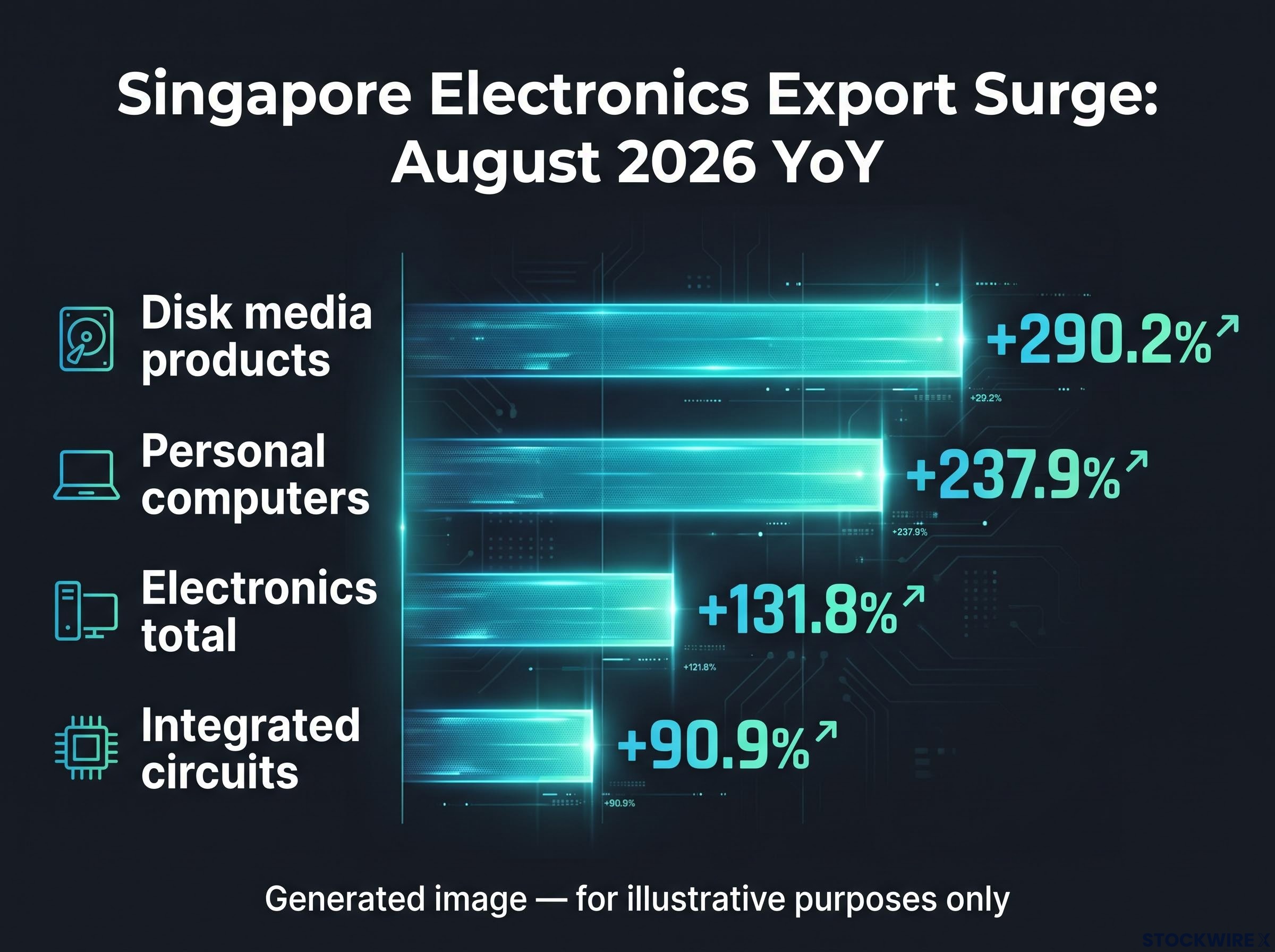
Here is the number that matters most. On a seasonally adjusted month-on-month basis, NODX rose 10.9% in August. That figure strips out the year-ago comparison entirely, which tells you the momentum is happening right now, not just relative to a weak base twelve months ago. Underlying demand, not the calendar, is doing the heavy lifting.
| Category | August 2026 YoY Change | July 2026 YoY Change | Note |
|---|---|---|---|
| NODX total | +46.2% | +24.1% | Fastest since October 1988 |
| Electronics total | +131.8% | +112% | Primary driver of the result |
| Disk media products | +290.2% | n/a | Largest subcategory gain |
| Personal computers | +237.9% | n/a | Upgrade cycle contribution |
| Integrated circuits | +90.9% | n/a | AI chip demand |
| Non-electronics | +12.0% | n/a | Broader-based recovery |
If you only see the 46.2% figure without this breakdown, you cannot form a view on whether the pace holds. The composition is the story.
When big ASX news breaks, our subscribers know first
How much of the boom is real, and how much is the calendar?
Any extreme data print invites the same first question: is this a genuine improvement, or is it an artefact of what happened a year ago? For August 2026, the honest answer starts with an uncomfortable admission.
The base was extraordinarily weak. August 2025 NODX stood at S$13.3 billion, the lowest monthly reading of that entire year, with exports contracting 11.3% year-on-year in that month. Both electronics and non-electronics fell. When you divide this year’s shipments against that trough, the percentage mechanically inflates.
This caveat is not obscure. Coverage across Channel NewsAsia, Singapore Business Review, and IBTimes Singapore all flagged the low base as a partial explanation, so if you have read other reporting, you have already met this argument. Commerzbank analysts Henry Hao and Moses Lim expect growth momentum to decelerate as those favourable base comparisons fade in the months ahead.
So far, the base-effect case looks strong. But it is incomplete.
The evidence that points beyond the base
Three pieces of data argue that something more durable sits underneath the calendar distortion.
- The seasonally adjusted month-on-month gain of 10.9%. This measure compares August 2026 to July 2026, not to a year ago. A weak 2025 cannot explain it. The acceleration is happening within the current sequence of months.
- Year-to-date growth of 22.4%. Across the first eight months of 2026, NODX has already blown past the government’s full-year forecast of 14-16%. A single month’s base quirk cannot carry an eight-month cumulative figure that far above target.
- Non-electronics also positive at 12.0%. If this were purely an electronics base-effect spike, the rest of the account would be flat. It is not. The recovery has breadth.
The conclusion is not tidy, and it should not be. The August surge is partly amplified by the calendar, and the headline pace will slow as the 2025 trough rolls out of the comparison. But the underlying level of Singapore’s exports is genuinely elevated. Anyone who dismisses the result as pure statistical illusion is making the opposite error to the reader who takes 46.2% at face value.
The AI and electronics structural story underneath the numbers
Underneath the base-effect debate sits a real economic engine, and understanding its mechanism is what separates monitoring the story from simply reacting to each new print.
The driver is the global build-out of artificial intelligence infrastructure. Hyperscale cloud providers and large enterprises are pouring capital into GPU clusters, high-performance servers, and networking equipment. A substantial share of that hardware routes through Singapore’s trade and logistics hub, which lifts NODX in AI chips, disk media, and server components. IBTimes Singapore directly tied the surge to robust AI-related demand and shipments of data-centre equipment.
Singapore semiconductor-linked equities, concentrated in equipment and precision engineering rather than foundry operations, have been absorbing AI infrastructure capex tailwinds across 2026, which means the electronics NODX surge and the equity rally reflect the same underlying demand cycle from different vantage points.
A second, more cyclical driver runs alongside it. PC upgrade cycles and major consumer electronics product refreshes contributed to the electronics category, which is why personal computers posted a 237.9% year-on-year gain rather than tracking the more modest pace of integrated circuits.
There is also a geopolitical layer. As firms diversify manufacturing and logistics amid US-China trade tensions and tighter export controls on advanced chips, Singapore’s role in re-routing high-end semiconductors and server equipment expands. That adds to NODX even without large domestic fabrication capacity.
AI chip export controls carry bipartisan Congressional backing in the United States and are grounded in national-security law, which places them outside the reach of bilateral trade negotiations and makes the regulatory risk to Singapore’s semiconductor re-routing role structurally durable rather than contingent on any single summit outcome.
The forward view Commerzbank analysts Henry Hao and Moses Lim expect NODX performance to remain solid in the near term, underpinned by AI-related consumption demand and major consumer electronics product releases.
Here is where the interpretation matters for you. The structural driver is real and probably durable over the next few quarters. But the gains are concentrated in a single cyclical technology theme, which makes the story less stable than a 131.8% electronics print might suggest.
The specific vulnerabilities are identifiable:
- A slowdown in global AI capex, which would filter into electronics NODX quickly.
- Tighter US export controls on advanced chips, which could erode Singapore’s re-routing role.
- Base-effect normalisation, as the weak 2025 comparison rolls off.
- A shift in manufacturing location, which would redirect trade flows away from the hub.
Treat continued strength as probable in the near term and structurally fragile in the medium term. This is not a permanent regime shift. It is an elevated level built on a theme that can cool.
Rising inflation meets a booming trade account: what this means for MAS
The export boom would be simpler to read if it stood alone. It does not. A second data stream is moving in a direction that complicates everything.
Singapore’s core inflation, the measure that excludes private road transport and housing accommodation costs, has climbed from 0.3% year-on-year in August 2025 to 2.0% in July 2026. Commerzbank forecasts a further step up to 2.2% for August 2026, which would be the highest reading in roughly two years. That forecast release lands on 23 September 2026, two days after this analysis publishes.
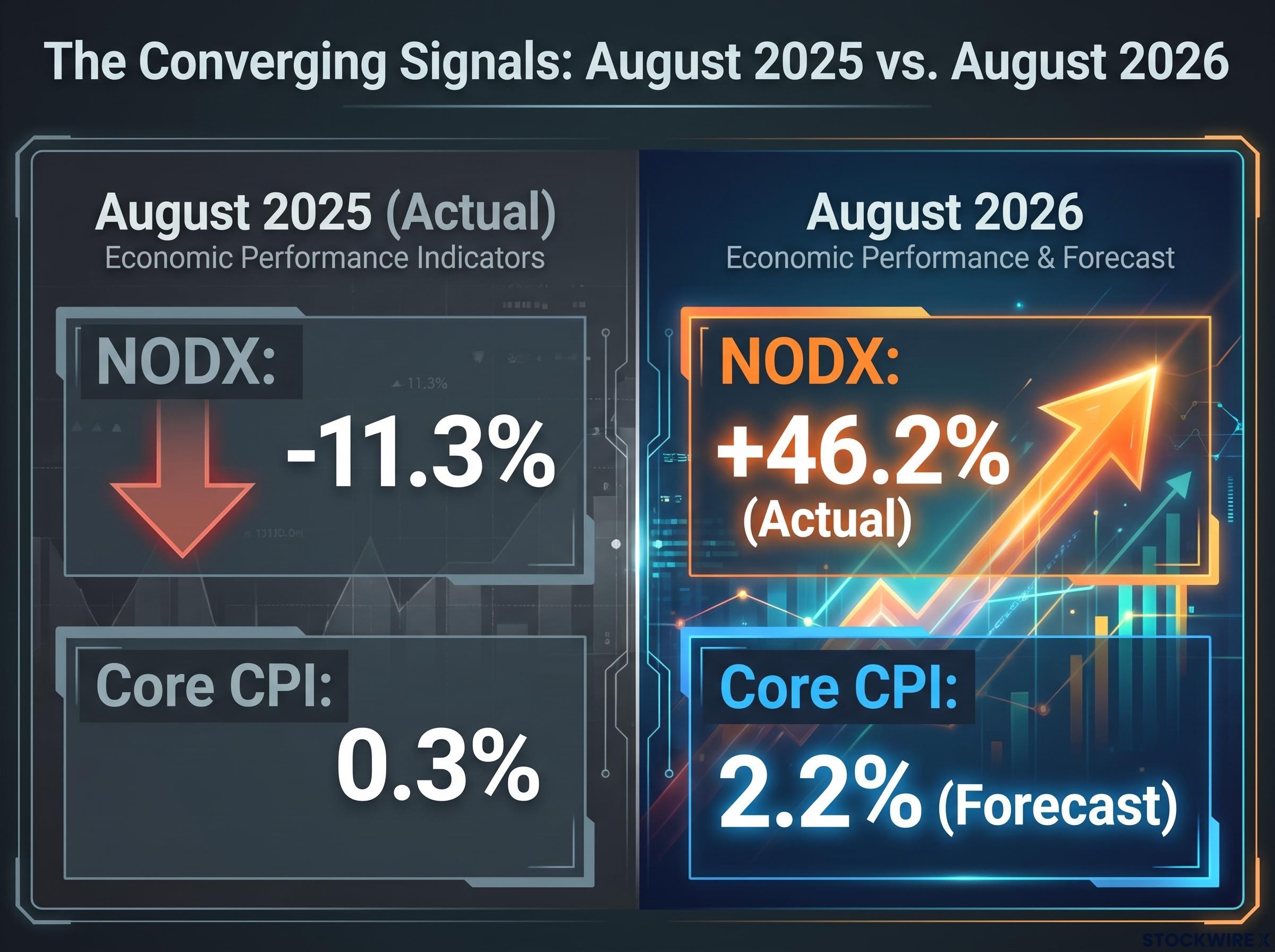
| Measure | August 2025 Actual | July 2026 Actual / August 2026 Forecast |
|---|---|---|
| Headline CPI (YoY) | 0.5% | 2.2% actual / 2.3% forecast |
| Core CPI (YoY) | 0.3% | 2.0% actual / 2.2% forecast |
| NODX (YoY) | -11.3% | 46.2% actual (August) |
To understand why this matters for markets, you need the mechanism. The Monetary Authority of Singapore (MAS) does not set interest rates. It manages the Singapore dollar nominal effective exchange rate, or S$NEER, by adjusting the slope, width, and centre of a policy band. Allowing faster currency appreciation leans against imported inflation but raises concerns about export competitiveness. That trade-off is the entire dilemma.
MAS has adjusted the S$NEER policy band twice in 2026, in April and again in July, with the Singapore dollar holding in the upper half of its appreciating corridor throughout the year, a structural ceiling that directly caps how far USD/SGD can rally against any dollar-strength episode.
Exchange rate policy transmission differs from conventional rate-setting in one critical respect: rather than adjusting an overnight lending rate, MAS shifts the slope and centre of a currency band, which means the inflationary and growth signals it responds to reach asset prices through the currency channel rather than through bank funding costs.
The October MPS as the decision inflection point
The next formal decision is the October 2026 Monetary Policy Statement, and it forces MAS to take a position on whether this export boom is inflationary, cyclical, or both.
Two camps have formed. One argues that AI-driven export strength lifts medium-term growth and inflation potential, which would warrant a firmer S$NEER path to keep price pressures anchored. The other stresses that base effects and a sector-specific boom in AI hardware and consumer electronics are insufficient grounds for tightening, especially if broader services and wage inflation stay contained.
The number to watch Commerzbank forecasts core CPI of 2.2% year-on-year for August 2026, potentially a two-year high. The confirmed figure arrives on 23 September 2026.
For anyone positioning around the Singapore dollar or Singapore-linked assets, this is where the data becomes actionable. USD/SGD was trading near 1.2760, up roughly 0.7% over the preceding week on general US dollar strength and elevated oil prices rather than domestic developments, according to Commerzbank. The August CPI release on 23 September is the last major input before MAS decides. Whether core inflation confirms or misses the 2.2% forecast will meaningfully shape that call.
What the data actually resolves, and what remains genuinely uncertain
Pull the four layers together and a clear-eyed position emerges, though not a tidy verdict.
On the base-effect question, the answer is firm: the August surge is partly amplified by the calendar and partly genuine. The 10.9% seasonally adjusted month-on-month gain and the 22.4% year-to-date trajectory both confirm underlying momentum that is more than statistical noise.
On the structural question, the answer carries nuance. The AI and electronics demand story is real and near-term durable, but it is concentrated in a cyclical technology theme exposed to capex swings, export controls, and manufacturing shifts. Treat it as structurally elevated, not permanently locked in.
The inflation and policy question stays open, and deliberately so. It resolves at two events: the August CPI release on 23 September and the October 2026 MPS.
Your watch-list of the five variables that could reverse the picture:
- Sustainability of global AI capex. Any slowdown in hyperscaler infrastructure spending would filter rapidly into electronics NODX.
- US export controls on advanced chips. Regulatory tightening could erode Singapore’s semiconductor re-routing role.
- Base-effect normalisation. As the 2025 trough rolls off, headline growth rates will fall even under unchanged demand.
- Broadening of inflation. Whether core inflation’s climb reflects genuine domestic demand or its own base effect will be central to the MAS debate.
- USD strength trajectory. Continued dollar appreciation could complicate S$NEER management.
The 22.4% year-to-date figure makes a full-year forecast revision essentially certain regardless of how the rest of 2026 unfolds. This is one of the strongest trade prints Singapore has produced in nearly four decades, but you should leave with a specific watch-list rather than a clean all-clear.
This article is for informational purposes only and should not be considered financial advice. Investors should conduct their own research and consult with financial professionals before making investment decisions. Past performance does not guarantee future results. Financial projections are subject to market conditions and various risk factors, and forward-looking statements are speculative and subject to change based on market developments.