
A law signed in July 2025 now requires the private companies issuing digital dollars to park their reserves in US Treasury securities. Washington did not present this as a debt-financing tool. It framed it as consumer protection.
The GENIUS Act, enacted as Public Law 119-27, created the first federal framework for payment stablecoins in the United States. Its headline rule is simple: full reserve backing in cash or short-term Treasuries. But the fiscal arithmetic buried inside that rule is anything but neutral.
With dollar-pegged stablecoins circulating at roughly $300 billion or more, the reserve mandate effectively conscripts a growing class of private issuers into buying short-term sovereign debt. The dynamic resembles money-market fund regulation, but it now sits at the crossroads of crypto markets, monetary policy, and the government’s own financing needs.
The recent legislative struggle of the CLARITY Act adds a further layer. The broader market-structure framework meant to accompany the GENIUS Act has stalled, which leaves the stablecoins US Treasury demand function as the clearest outcome of Congress’s crypto agenda so far.
What follows maps the mechanism: how reserve mandates translate into Treasury demand, why that demand is more fragile than policymakers suggest, and what the signals from Capitol Hill now tell you about the direction of travel.
What the GENIUS Act actually built into the reserve requirement
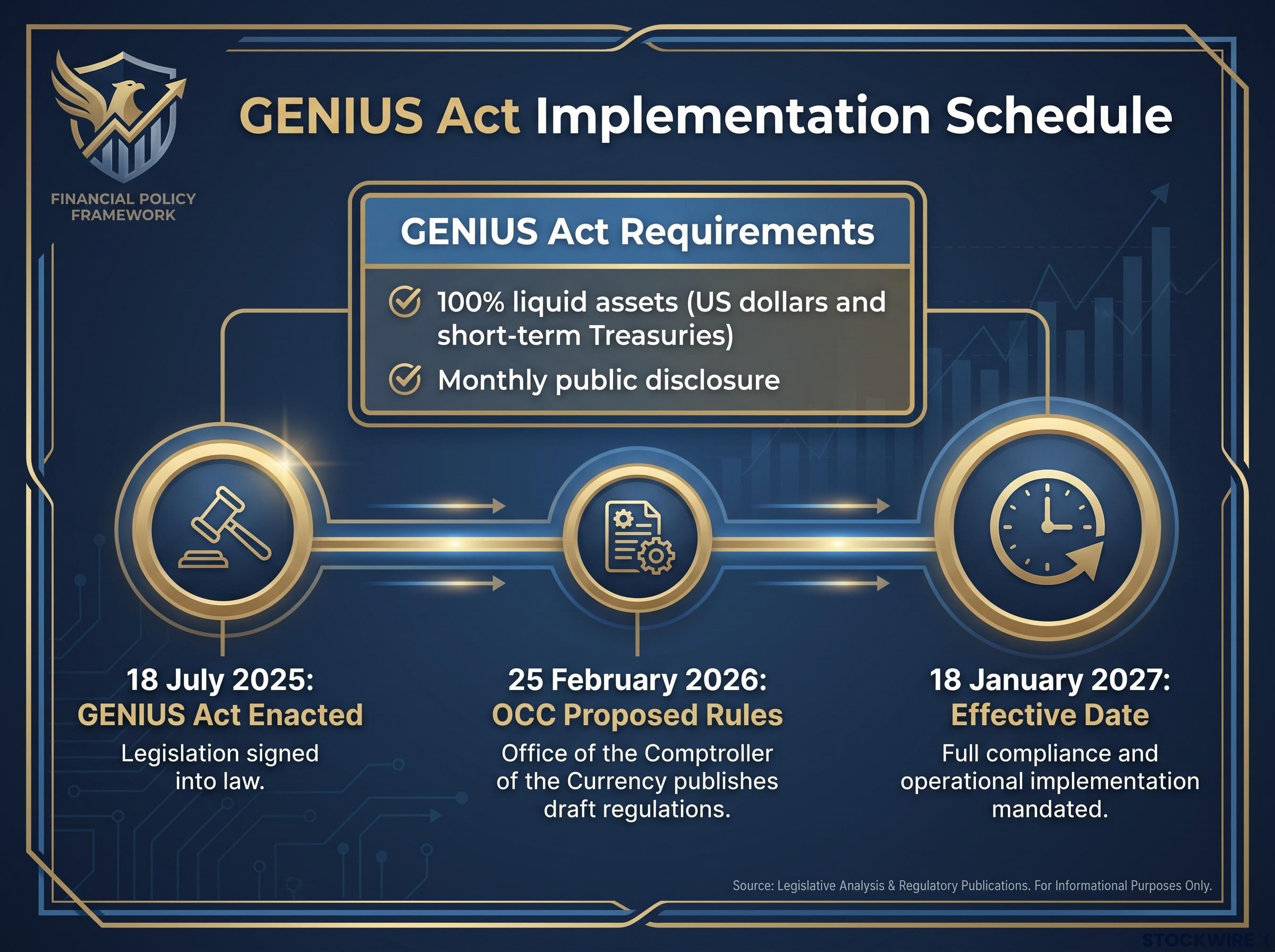
Read the statute plainly, and the reserve rule looks like standard prudential plumbing. Every payment stablecoin issued under the Act must be backed one-for-one by liquid assets, specifically US dollars and short-term US Treasury securities. On top of that, issuers must publish the composition of those reserves every month.
The White House fact sheet, released on the signing date of 18 July 2025, describes these as strong reserve requirements designed to ensure stability and trust. Congressional Research Service overviews and legal commentary from firms including Latham & Watkins treat the same rules as protections for redemption rights and guardrails against runs.
That framing has a clear precedent. Money-market funds and bank treasury desks already hold large blocks of government paper to satisfy liquidity requirements, and traditional bank rules on high-quality liquid assets nudge lenders toward Treasuries. The GENIUS Act simply extends that established logic to nonbank stablecoin issuers, turning what large issuers already did voluntarily into a legal obligation.
Here is the timeline that makes the rule binding.
| Provision | Requirement | Effective Date |
|---|---|---|
| Reserve backing | 100% liquid assets: US dollars and short-term Treasuries | No later than 18 January 2027 |
| Reserve disclosure | Monthly public disclosure of reserve composition | No later than 18 January 2027 |
| Issuer eligibility | Restricted to permitted payment stablecoin issuers | On effective date |
The permitted reserve asset classes are narrow:
- US dollars held as cash
- Short-term US Treasury securities
The OCC’s notice of proposed rulemaking, dated 25 February 2026, confirms the effective date as the earlier of 18 months after enactment, which lands on 18 January 2027, or 120 days after federal regulators finalise implementing rules.
The OCC notice of proposed rulemaking, published on 25 February 2026, lays out the proposed capital adequacy, risk management, and licensing standards that will accompany the reserve mandate, giving the 18 January 2027 compliance deadline its operational substance.
None of the official language calls this a fiscal instrument. But that is what it is. Any rule that mandates short-term Treasury holdings at scale is simultaneously a channel for financing government debt, whether or not that is how Washington chooses to describe it. Understanding that dual nature is what lets you judge whether the resulting demand is genuinely structural or merely a policy coincidence.
When big ASX news breaks, our subscribers know first
How $300 billion in stablecoin reserves becomes a Treasury demand story
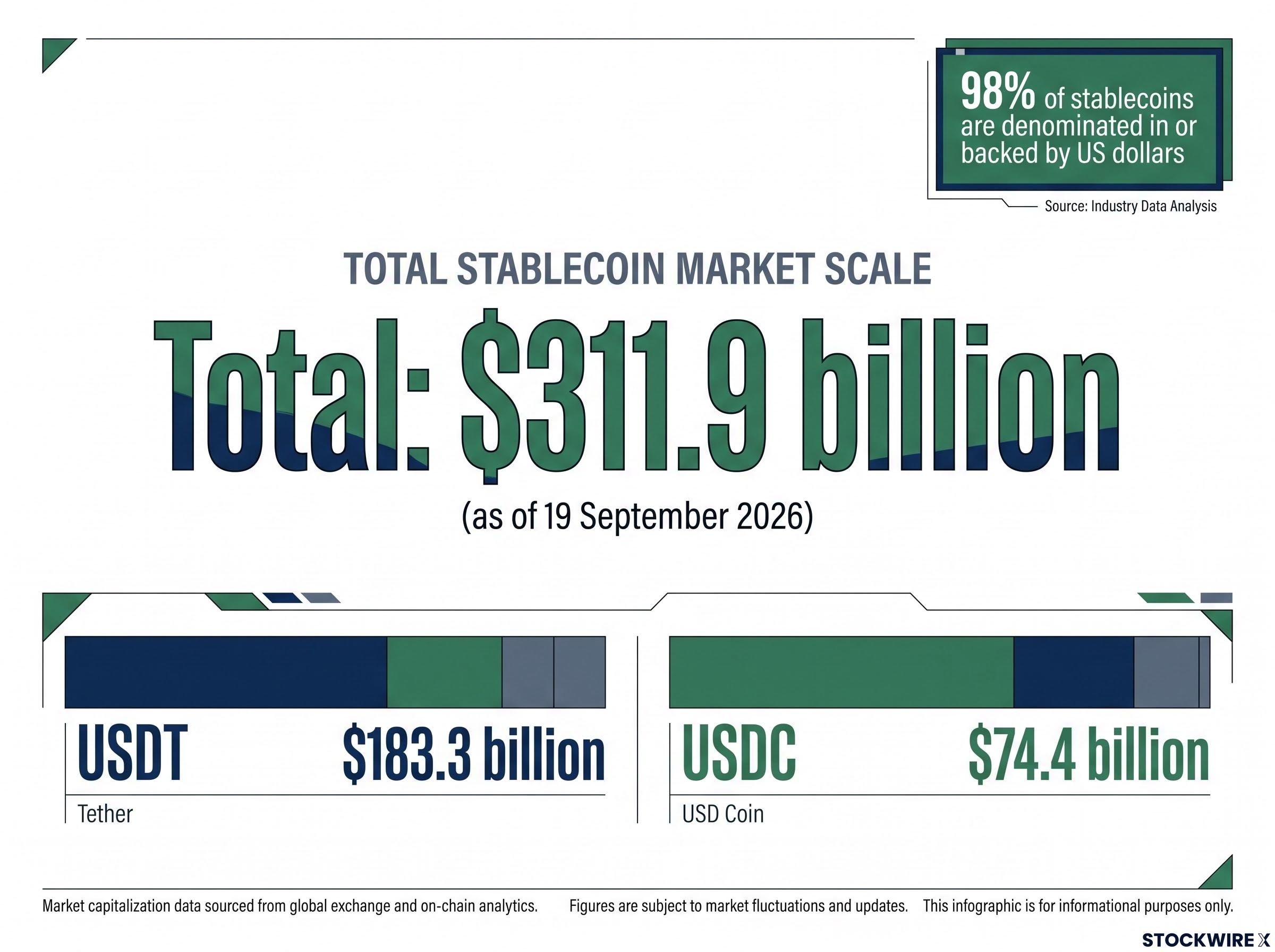
Start with the size of the pool. Dollar-pegged stablecoins sit somewhere in the $288 billion to $322.7 billion range as of mid-to-late September 2026, depending on the source. One dashboard reported a point estimate of $311.9 billion as of 19 September 2026, with USDT at roughly $183.3 billion and USDC at roughly $74.4 billion, though those specific figures come from a single source and are not independently confirmed across the research.
Approximately 98% of stablecoins in circulation are denominated in or backed by US dollars.
The Andersen Institute puts dollar-pegged stablecoins near $300 billion outstanding as of August 2026, of which reserve-backed tokens make up roughly $270 billion. That reserve-backed portion is the part that matters for Treasury markets.
Now apply the reserve rule. For every dollar of stablecoin issued, a matching dollar of cash or short-term Treasuries must sit behind it. Growth in the token supply is therefore, in mechanical terms, growth in reserve holdings, and a large share of those reserves flows into short-dated government debt.
That places stablecoin issuers in a long lineage. Regulated money-market funds and stable-value products have absorbed Treasury bills for decades, issuing short-term, par-redemption liabilities and investing the proceeds in safe public debt. Stablecoins under GENIUS-type rules fit the same template, only with on-chain liabilities.
| Demand Channel | Approximate Scale | Asset Focus | Regulatory Mandate |
|---|---|---|---|
| Money-market funds | Multi-trillion (long established) | T-bills and short-term government debt | SEC liquidity and quality rules |
| Bank HQLA requirements | Large, embedded in bank balance sheets | Government securities | Liquidity coverage ratio rules |
| Foreign central banks | Large official holdings | Treasuries across maturities | Reserve management policy |
| Stablecoin issuers (GENIUS Act) | ~$270B reserve-backed | Cash and short-term Treasuries | 100% reserve mandate |
The international backdrop reinforces the point. Liquidity-buffer rules across the EU, UK, and other jurisdictions already steer banks and collective investment schemes toward sovereign debt. The novelty here is that blockchain-based tokens are being pulled into the same role.
For anyone trying to read US debt markets, the takeaway is direct. Stablecoin issuers now join money-market funds, bank treasury desks, and foreign central banks as a distinct category of short-term Treasury buyer. What makes this category different is that its demand scales with retail and institutional appetite for digital dollars, a variable that behaves nothing like steady official demand.
Treasury buyer composition has already been shifting structurally, with foreign reserve managers plateauing near 33% of outstanding debt and US commercial banks stepping in as the primary marginal buyer at a record $4.8 trillion in holdings, a rotation that frames exactly where stablecoin issuers enter the picture as an additional demand layer.
Why this demand is procyclical, not structural, and what critics say about the longer-term risk
The optimistic reading is easy to state. A new class of buyers deepens the market for short-term Treasuries, adds diversity to the investor base, and locks private balance sheets into supporting government debt. In normal conditions, that is exactly what happens.
Then the assumptions start to wobble.
Central-bank and Bank for International Settlements (BIS) work on stablecoins accepts that large issuers invest reserves in short-term government securities, making them meaningful marginal buyers. The same research stresses that this demand is procyclical. It expands when crypto appetite runs hot and can contract sharply in a confidence shock.
That is the pivot. The mechanism that adds demand in good times can reverse in bad ones. In a rapid run, issuers would be forced to liquidate large volumes of short-term Treasuries to meet redemptions, flipping from providers of demand into sources of forced selling. The parallel to money-market fund runs is exact, and it means the same channel can transmit stress rather than absorb it.
Adjacent to the stablecoin reserve channel, tokenized repo markets are projecting a structurally different interaction with Treasury liquidity: Deutsche Bank estimates intraday tokenization could drain approximately $250 billion in precautionary reserve balances from the Federal Reserve, a dynamic that would compound the short-term Treasury demand picture the GENIUS Act is separately constructing.
Analysts frame the outcomes across three broad scenarios:
- Growth plateau: stablecoin supply stabilises, incremental Treasury purchases level off, and a growing source of marginal demand simply stops growing.
- Run scenario: a confidence shock forces mass redemptions, issuers dump short-term Treasuries, and volatility in cash and repo markets is amplified.
- Policy contingency: regulators build backstop liquidity facilities and resolution regimes to manage the very risk the reserve mandate created.
The trust environment surrounding this legislation is not reassuring, according to the critical commentary in the source material.
US consumer confidence reportedly reached its lowest recorded level in 52 years of measurement data, observed roughly five to six months before the interview, according to Lynette Zang.
If you assumed the GENIUS Act created a reliable backstop for Treasury demand, the procyclicality problem should reset that assumption. The net effect on Treasury market stability depends entirely on whether a run ever materialises. Absent that, the demand adds depth. In a crisis, it does the opposite.
The critics’ longer-term case: from fiscal convenience to fiscal dependency
The sharper critique moves from mechanics to incentives. By manufacturing a captive base of demand for short-term Treasuries, the argument runs, the arrangement may encourage fiscal authorities to lean harder on short-duration financing. That compresses the maturity profile of public debt and concentrates rollover and refinancing risk, precisely the exposures a stable funding base is meant to reduce.
The original source pushes this further, projecting that the approach will ultimately produce hyperinflationary conditions. That conclusion sits well beyond mainstream policy consensus and is not established in the accessible research record, so treat it as a stated critical position rather than a settled forecast.
The source grounds that position in a theory of money itself. Money, in this framing, serves four functions: a unit of measurement, a medium of exchange, a standard for compensation, and a long-term store of value. Fiat currencies, the argument goes, already fail the fourth function, and stablecoin regulation extends that failure rather than correcting it. A Gallup survey cited by Zang, indicating that roughly 89% of Americans perceive corruption within political institutions, is offered as context for the public trust conditions in which the policy is landing.
What the CLARITY Act’s stall signals about where digital asset policy lands next
Legislation reveals priorities through what survives and what does not. On that measure, the contrast between the two halves of Washington’s crypto package is instructive.
The CLARITY Act, filed as H.R. 3633 in the 119th Congress, cleared the House of Representatives by a vote of 294-134 on 17 July 2025. Committee Chairman French Hill described it as landmark legislation establishing clear rules of the road for digital assets.
What happened next is less certain. The original source reports that the bill failed a Senate cloture vote of 49-50 on 15 September 2026, though the research layer could not independently confirm that specific outcome through accessible official records. What is confirmed is that the bill has not become law, while the GENIUS Act has.
The CLARITY Act Senate vote, which ended 49-50 on 15 September 2026, produced an immediate market reaction: Bitcoin fell roughly 4% and Coinbase dropped 10.1% in a single session, giving investors a live read on how tightly crypto equity valuations had priced the passage premium the bill never delivered.
Had it passed, the CLARITY Act would have done three things:
- Split jurisdiction over digital assets between the Commodity Futures Trading Commission (CFTC) and the Securities and Exchange Commission (SEC)
- Banned interest payments on idle stablecoin balances
- Added an insolvency safe harbor for digital asset holders
Two of those provisions matter for the shape of the market. The interest ban, combined with the GENIUS Act reserve mandate, could make regulated, non-yielding stablecoins the default settlement asset on compliant platforms. The original source warns that major technology companies are expected to issue proprietary GENIUS-compliant stablecoins, potentially locking users into closed commercial ecosystems with restricted exchange options.
| Bill | Status | Key Provisions | Market Impact |
|---|---|---|---|
| GENIUS Act | Enacted (P.L. 119-27, 18 July 2025) | 100% reserve backing, monthly disclosure, permitted issuers | Creates short-term Treasury demand channel |
| CLARITY Act | House passed 294-134; Senate not enacted | CFTC/SEC split, interest ban, insolvency safe harbor | Market-structure guardrails absent |
The signal is hard to miss. The piece of legislation with direct implications for Treasury financing became law. The piece governing broader market structure did not. That asymmetry is worth holding in mind when you ask whose interests this legislative package ultimately served, because the current legal landscape leaves issuers facing mandatory Treasury reserve requirements with no accompanying framework to govern competition, jurisdiction, or consumer protection at the market level.
What investors and policy watchers should make of this arrangement now
Pull the threads together, and the core tension is clear. The GENIUS Act generates real short-term Treasury demand under normal conditions, but that demand is conditional, procyclical, and may encourage the very short-duration financing behaviours it is supposed to buffer against.
Scale keeps the claim honest in both directions. A $300 billion reserve base under a 100% mandate is a meaningful marginal buyer class for short-term Treasuries. It is not large enough to be the decisive variable in a genuine sovereign debt stress scenario.
US Treasury market risk has already been repricing in measurable ways, with the 10-year yield touching 5.01% and Norway’s sovereign wealth fund proposing to cut its Treasury allocation by roughly a third, context that matters when assessing whether a new $270 billion marginal buyer class meaningfully offsets the structural deterioration already underway.
The bigger structural concern is concentration. With issuance restricted to permitted issuers and the CLARITY Act stalled, the framework hands both the Treasury-demand function and a measure of private monetary power to a small number of financial and technology incumbents.
Three variables will decide whether this arrangement works as intended or becomes a source of instability.
- The growth trajectory of the stablecoin market: whether supply keeps expanding, plateaus, or reverses.
- The next Congress’s approach to market-structure legislation: whether the CLARITY Act, or something like it, is revived to supply the missing guardrails.
- The regulatory build-out before the deadline: whether stress-testing, backstop liquidity facilities for short-term government securities, and clear resolution regimes are in place before 18 January 2027.
The read to take from all of this is that the Treasury demand function is real but contingent, and the absence of the CLARITY Act’s guardrails makes the current arrangement less stable than its architects intended.
This article is for informational purposes only and should not be considered financial advice. Investors should conduct their own research and consult with financial professionals before making investment decisions. These statements are speculative and subject to change based on market developments and policy decisions.