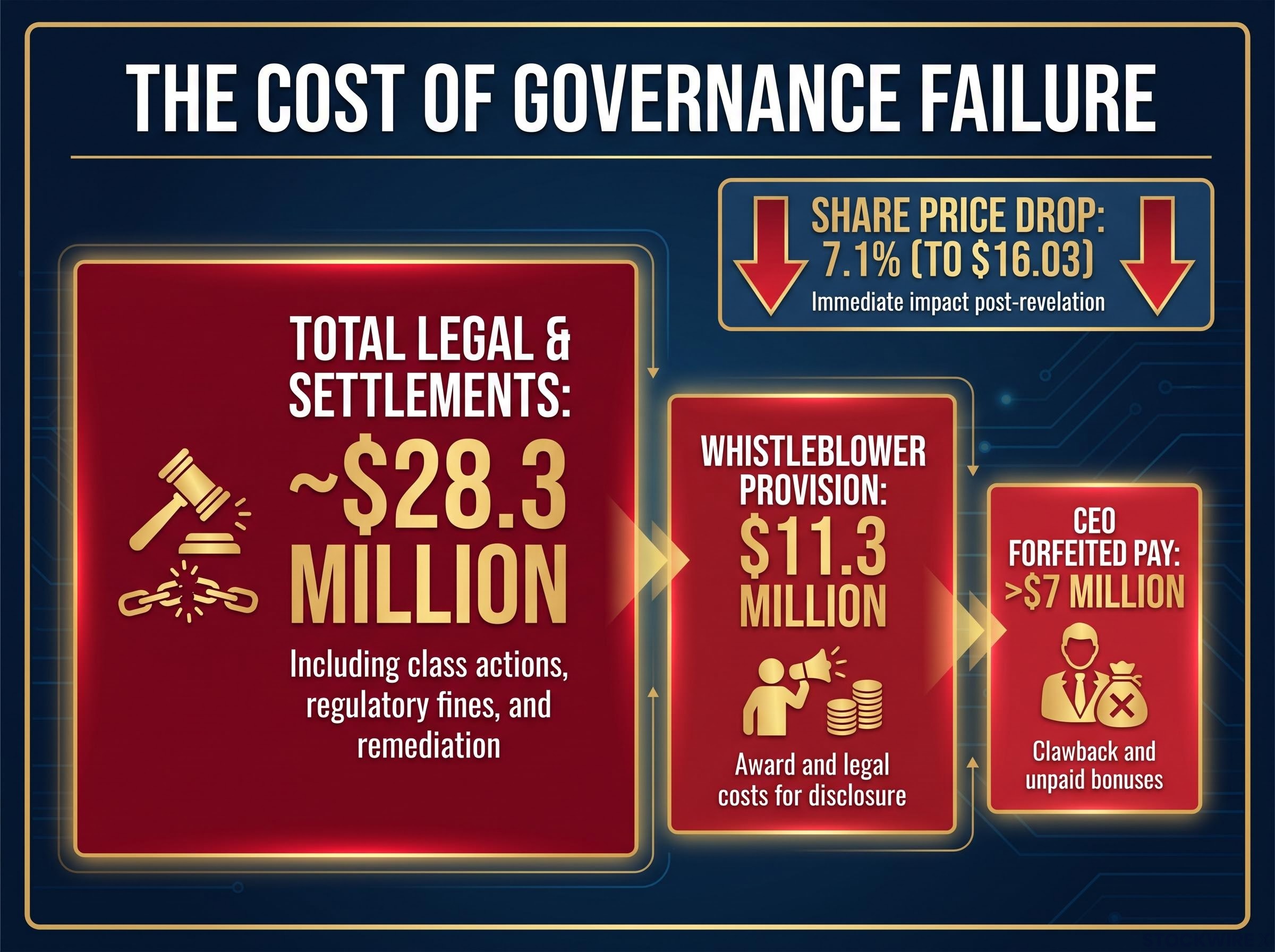
A CEO forfeiting more than $7 million in pay is the headline. The number that should actually stop you is $28.3 million, the estimated combined cost of legal fees and settlements that Super Retail Group shareholders absorbed because of one undisclosed relationship.
That figure did not come from a failed product or a downturn in sales. It came from a governance breakdown, and it is capital that could otherwise have funded dividends, expansion, or share buybacks.
The termination of CEO Anthony Heraghty in September 2025 offers a rare, fully documented look at how quickly an undisclosed personal conflict can erode both shareholder value and market confidence. This is one of the clearest recent examples of corporate governance failures on the ASX playing out in real time.
Here is what the case teaches you: how to spot the red flags before they cost you, and how to read the difference between a board that manages executive misconduct properly and one that lets it fester.
Tracing the financial fallout of the Super Retail saga
On 16 September 2025, Super Retail Group announced via an ASX release that Heraghty had been terminated. The board had concluded his disclosures about an alleged undisclosed personal relationship with the company’s former Chief Human Resources Officer, Jane Kelly, were not satisfactory.
The Super Retail timeline is easier to interpret once you understand the board governance hierarchy that governs these decisions: the CEO reports to the board, the board reports to shareholders, and a termination announcement is almost always the public conclusion of a deliberation that began months earlier behind closed doors.
The market reacted immediately. Shares fell as much as 7.1% intraday, dropping to around $16.03 before partially recovering.
For the CEO personally, the cost was steep. The board lapsed all unvested performance rights, all vested but unexercised performance rights, and the cash component of the FY25 short-term incentive. An October 2025 disclosure put the total forfeited package at a market value of more than $7 million.
But the executive’s forfeited pay was the smaller number. The company itself set aside $11.3 million for costs tied to the whistleblower dispute, and subsequent reporting placed the total damage at roughly $28.3 million in combined legal fees and settlements.
You need to view sudden executive departures like this one not as internal human resources matters, but as immediate threats to the value of your holdings. The forfeited pay recovers a fraction; the settlement and legal costs come straight off the balance sheet.
| Category | Affected Party | Estimated Financial Impact |
|---|---|---|
| Forfeited incentives (lapsed rights + withheld FY25 STI) | Anthony Heraghty (CEO) | More than $7 million |
| Provision for whistleblower dispute costs | Super Retail Group (shareholders) | $11.3 million |
| Total combined legal fees and settlements | Super Retail Group (shareholders) | Approximately $28.3 million |
How the market priced the leadership vacuum
Broker commentary framed the fall as a governance premium, not an earnings problem. RBC Capital Markets initiated coverage on 17 October 2025 with a neutral recommendation and a price target of $18.20, describing the incident as adding governance uncertainty to an otherwise solid sales backdrop.
Capital Brief reported on 22 October 2025 that investors remained focused on the board’s clawback actions even as the company posted higher year-on-year sales. The stock’s partial recovery tells you the market treated this as a leadership shock to absorb, not a permanent hit to the business.
When big ASX news breaks, our subscribers know first
How private relationships become Corporations Act breaches
A workplace relationship is not, by itself, illegal. What turns it into a corporate governance problem is a legal concept called a material personal interest.
A material personal interest exists when a person in a position of authority stands to gain or lose personally from a decision they are involved in. When a CEO oversees a direct report they are in a relationship with, and then participates in decisions about that person’s pay, redundancy, or employment conditions, that interest is squarely in play.
Australian directors and officers carry a legal duty to act with care and diligence under Section 180 of the Corporations Act. This is the provision that governs whether an executive’s judgment meets the standard the law expects.
The McPherson’s Federal Court judgment sharpened what duty of care means for a sitting CEO: Justice Markovic found that failing to act on material information the company already held, for fifteen days, was sufficient to constitute a breach under section 180(1), even without any intent to deceive.
Section 180 carries maximum civil penalties of between $1,110,000 and $1,565,000 per contravention for the 2022-2024 period. Those are the stakes attached to getting it wrong.
Directors are normally shielded by something called the business judgment rule, which protects good-faith decisions made on an informed basis. But that protection evaporates when a conflict of interest taints the decision. If you have a personal stake you did not disclose, you cannot claim your judgment was neutral.
Here is the sequence that moves a situation from private matter to sanctionable breach:
- A relationship forms between a CEO and a direct report.
- That relationship creates a material personal interest in decisions affecting the subordinate.
- The executive fails to fully disclose it to the board.
- The executive then participates in related decisions, on pay, incentives, or redundancy, without recusing themselves.
Once that chain completes, every decision in it is potentially tainted. According to governance commentary from Veremark in 2026, the threshold is crossed precisely when disclosure fails and the executive keeps participating without stepping back.
Understanding this mechanism lets you see why a seemingly minor disclosure failure can invalidate an entire chain of corporate decision-making inside a company you hold. It is not the relationship that regulators care about; it is the compromised decisions that flow from hiding it.
Governance bodies including the Australian Council of Superannuation Investors (ACSI) provide strict templates requiring relationship-based conflicts to be formally declared, recorded, and managed through independent oversight or recusal. Justice Collier noted in 2017 that no Australian case has imposed liability purely for a private relationship, so the offence lives in the non-disclosure and the tainted decisions, not the relationship itself.
Whistleblower protections and the board accountability gap
The swift September 2025 termination looked decisive. But the timeline before it tells a more uncomfortable story about how the board handled internal warnings.
The termination followed litigation brought by two former senior executives, Rebecca Farrell and Amelia Berczelly. They alleged bullying, victimisation, conflicts of interest from the undisclosed relationship, and misuse of corporate resources. A central claim was that Heraghty continued overseeing the senior employee and participating in decisions on her pay, incentives, and redundancy despite the alleged conflict.
The board’s response evolved sharply. In an ASX announcement in October 2024, the board, supported by independent external advisers, concluded that none of the allegations were substantiated.
Nearly a year later, in September 2025, the company reached a confidential settlement with the two whistleblowers, made without admission of liability. The sum was kept confidential but stated to be less than the $30 million to $50 million range in loss and damage first warned of in 2024.
The contrast is stark. For over a year, the board publicly stood behind its CEO while, according to reports, one whistleblower’s access to the internal reporting system was removed after a second complaint.
Governance critics, including Inside Retail Asia and The Sydney Morning Herald, argue the board discounted internal legal and compliance warnings it had been aware of since April 2024. The concern is not just that a conflict existed, but that a board can defend an executive publicly while the internal signals point the other way.
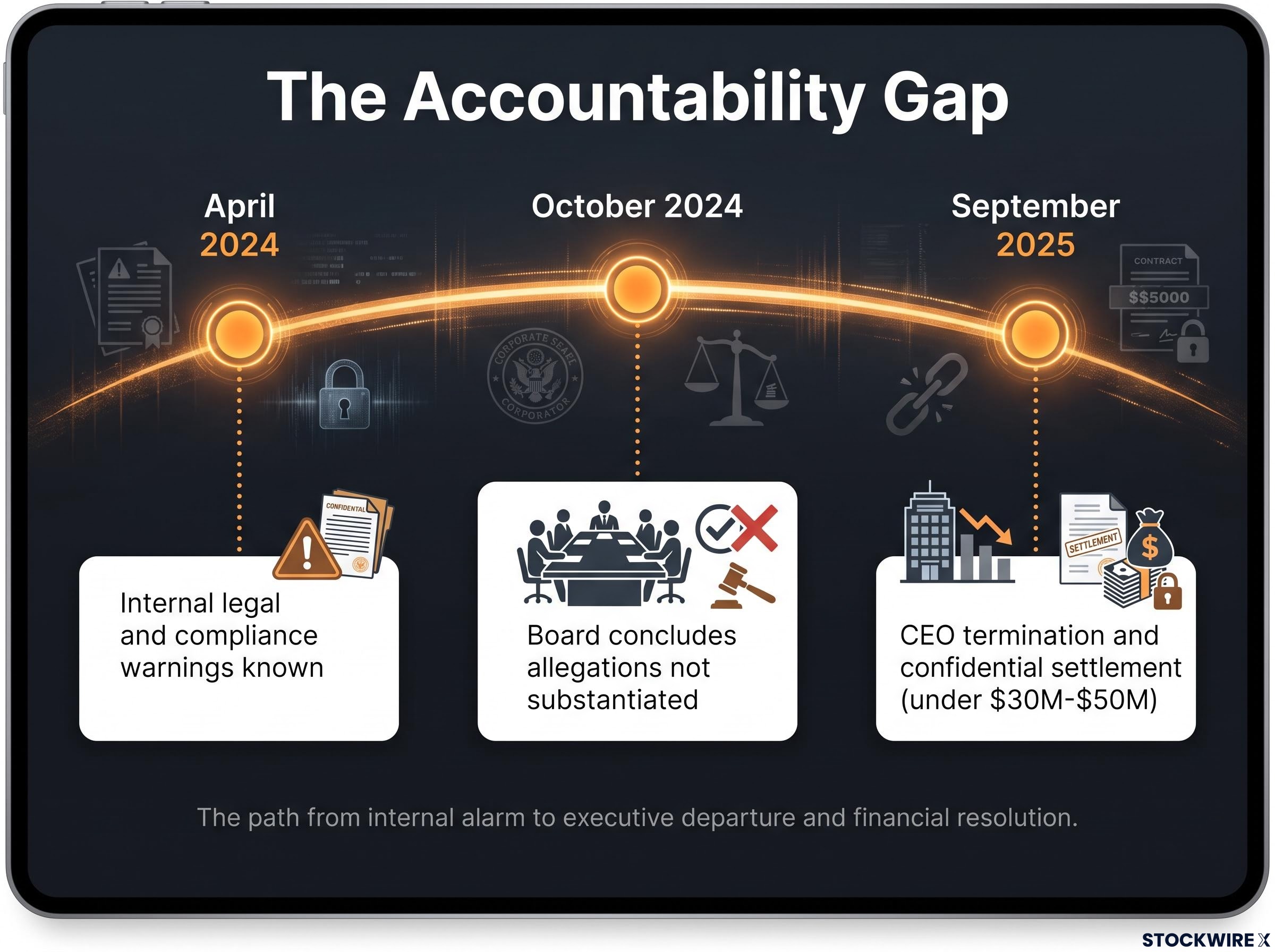
This timeline shows you why boilerplate corporate responsibility reporting can mask deep cultural risk. The company’s 2025 Responsible Business Report outlined its whistleblower integrity line, Whispli, yet did not address the Farrell and Berczelly claims at all. When you evaluate management transparency, look past the polished annual report and watch how long a board takes to act on warnings it already holds.
ASIC’s RG 181 conflict of interest guidance, published in December 2025, sets out the formal framework Australian companies must follow to identify, assess, and manage conflicts, including the documentation and independent oversight steps that a properly functioning board is expected to apply when an executive relationship is flagged.
The regulatory divide between ASIC action and board clawbacks
There is a gap between a board disciplining an executive and a regulator prosecuting one, and confusing the two can leave you overestimating how protected your capital really is.
The board actions were internal accountability measures. The Australian Securities and Investments Commission (ASIC) taking someone to court is a separate matter entirely, carrying civil penalties and legal findings.
As of late 2026, ASIC had not initiated civil penalty proceedings against Heraghty directly under Section 180 or Section 1309, though reporting notes an investigation into the broader whistleblower dispute remains ongoing. Prosecuting a case built on a private relationship is difficult; precedents such as ASIC v Wilson (Quintis) and ASIC v iSignthis Limited show that regulators usually need clear continuous-disclosure violations or proof of compromised financial decisions to trigger serious enforcement.
The EOS case illustrated that director liability in Australia runs on two simultaneous tracks: a corporate penalty absorbed by shareholders and separate personal proceedings against the individual executive, meaning a company settling a dispute does not close the regulatory file on the people who made the decisions.
That leaves the board as the primary line of accountability. At the AGM, chair Sally Pitkin confirmed the FY25 short-term incentive payment had been withheld and that the board was taking legal advice on clawing back past payments.
The Super Retail board’s enforcement actions included:
- Terminating Heraghty and lapsing all unvested performance rights.
- Lapsing all vested but unexercised performance rights.
- Withholding the cash component of the FY25 short-term incentive.
- Seeking legal advice on clawing back previously paid incentives.
You cannot rely on the regulator alone to protect your capital. The lesson here is to evaluate whether the board itself is acting decisively to recover funds and enforce consequences, because in many cases that is the only accountability that actually arrives.
Evaluating leadership risk in your Australian equities
The Super Retail saga distils into a practical framework for judging any company you hold. Documented, enforceable conflict-of-interest regimes, with clear triggers for disclosure, recusal, and independent investigation, are now a baseline expectation, not a nice-to-have.
Review the governance and remuneration reports of your largest holdings. Check specifically for robust clawback provisions, the kind that let a board recover pay when misconduct surfaces, and for evidence that internal reporting channels are genuinely protected rather than decorative.
The Super Retail case shows what happens when a board’s public posture diverges from its internal risk awareness; evaluating board alignment signals before a crisis, including director equity ownership relative to fee income and whether equity was purchased or simply granted as compensation, gives investors an earlier read on how a board is likely to respond under pressure.
Remember the timeline that mattered most here: whistleblower reports surfaced well before the financial hit landed, and the board initially denied them. Early internal warnings, even ones a board publicly dismisses, often precede significant costs to shareholders.
This article is for informational purposes only and should not be considered financial advice. Investors should conduct their own research and consult with financial professionals before making investment decisions.