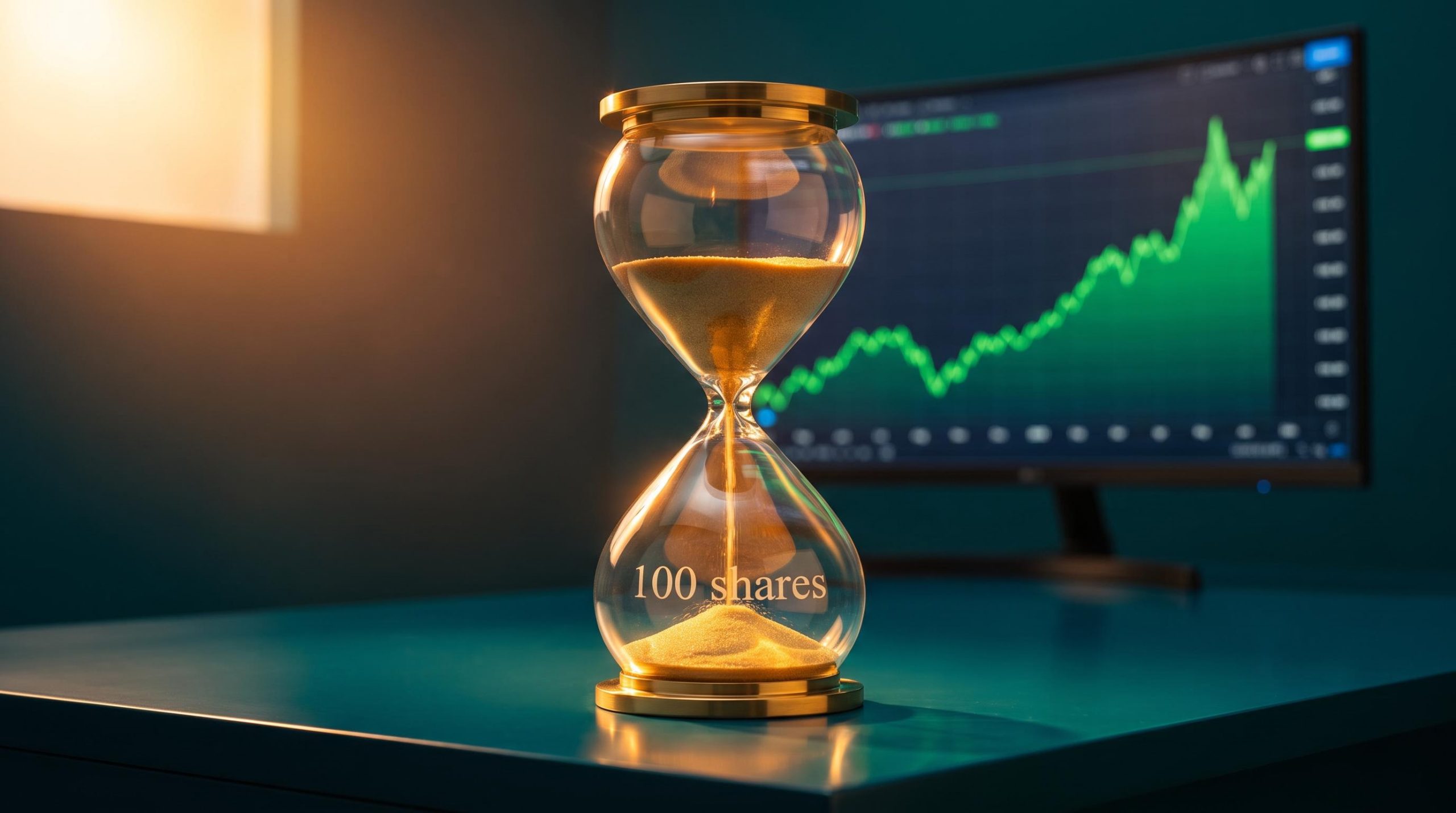
A small outlay controls 100 shares and can multiply several times over in a matter of days. That single feature is why buying options pulls in more traders every year, and it is also why most of them walk away with nothing.
The scale is worth pausing on. Total U.S. options volume reached roughly 15.2 billion contracts in 2025, up 24-26% from 2024, with retail traders now accounting for around 30% of that flow. Participation has never been higher.
Yet the warnings have never been louder. Regulators from the U.S. Securities and Exchange Commission (SEC) to India’s market watchdog, SEBI, are publishing data showing rapid and total loss as the common outcome, not the exception.
That gap between the appeal and the reality is the reason to read on. This explainer covers how buying call and put options actually works, what the numbers look like before and after a trade, and the specific conditions under which the math works for you rather than against you.
What you are actually buying when you purchase a call or put
Strip away the jargon and one options contract is a simple thing: the right, but not the obligation, to buy or sell exactly 100 shares of an underlying stock at a fixed price (the strike) before a set deadline (the expiration date). You choose the strike and the expiry. You pay for the privilege upfront.
That upfront payment is the premium, and here is the single most important fact about it: the premium is the total maximum you can lose. Not a dollar more.
The buyer of any call or put can lose 100% of the premium paid, and nothing beyond it. That defined risk is the structural advantage of buying options.
The two contract types are mirror images. A call gives you the right to buy, so it profits when the stock rises. A put gives you the right to sell, so it profits when the stock falls.
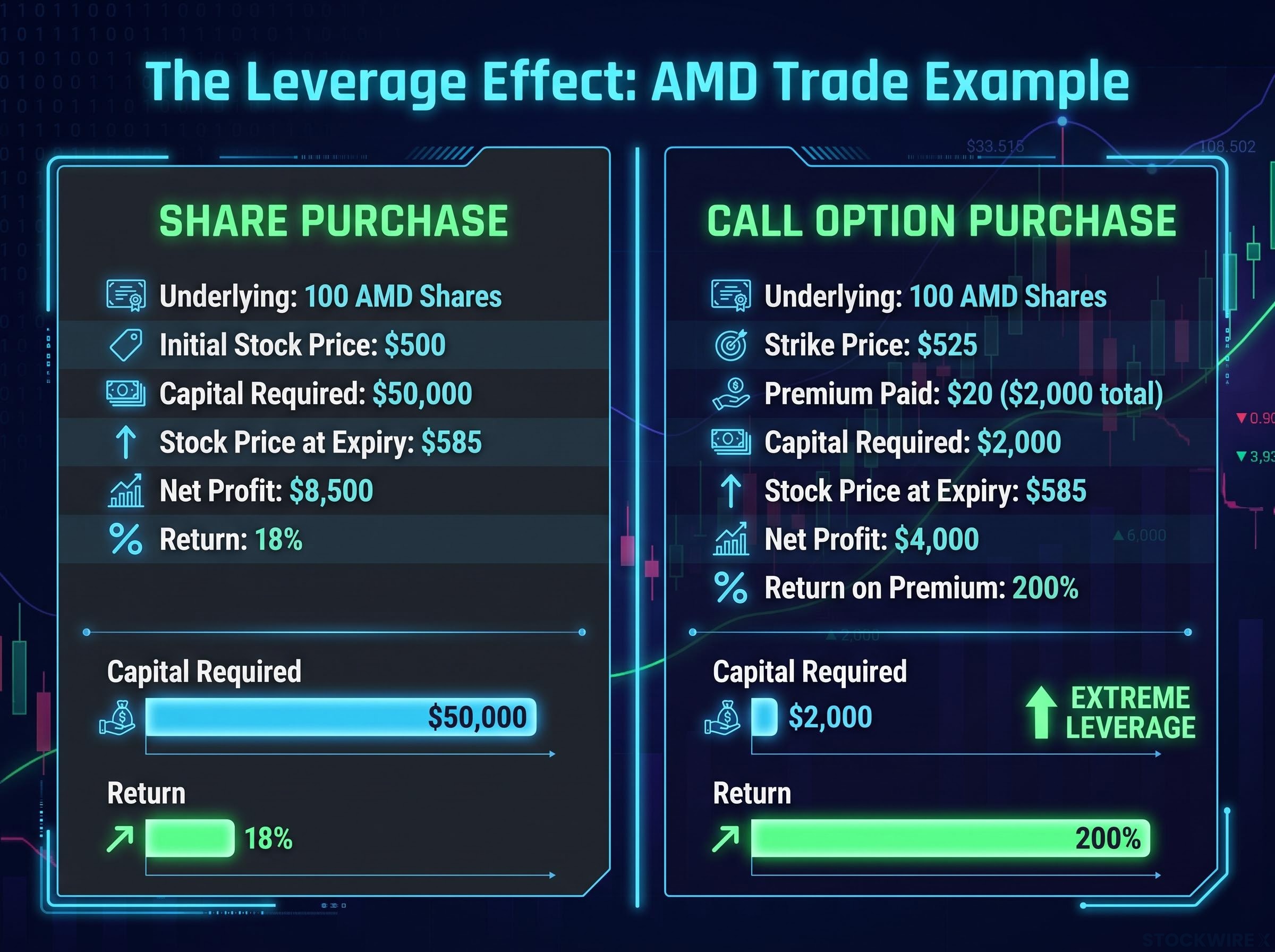
Consider a call on AMD with the shares trading at $500. A $525 strike call priced at a $20 premium costs $2,000 in total, because one contract covers 100 shares. Your breakeven at expiration is $545: the $525 strike plus the $20 you paid.
Now a put on Palantir with the stock at $165. A $150 strike put at a $6 premium costs $600 total, and your breakeven sits at $144, the strike minus the premium.
| Underlying | Direction | Strike | Premium paid (total) | Breakeven at expiration |
|---|---|---|---|---|
| AMD | Call (bullish) | $525 | $2,000 | $545 |
| Palantir | Put (bearish) | $150 | $600 | $144 |
Here is where the appeal becomes obvious. Controlling 100 AMD shares outright at $500 would tie up $50,000. The call gives you exposure to the same 100 shares for $2,000, roughly 25 times the capital efficiency.
That leverage is the whole attraction. It is also the whole danger, because the same ratio means a modest adverse move can wipe out your entire position while the stock itself has barely moved.
When big ASX news breaks, our subscribers know first
How breakeven and profit work in practice (with real numbers)
Numbers make this concrete in a way definitions never will. Watch the AMD call unfold.
The stock climbs from $500 to $585 before expiration. Your $525 strike call now has intrinsic value of $60 per share ($585 minus the $525 strike). Multiply by 100 and the contract is worth $6,000.
You paid $2,000. Your profit is $4,000.
- Stock price at expiry: $585
- Intrinsic value per share: $60 ($585 less the $525 strike)
- Total contract value: $6,000 ($60 x 100 shares)
- Net profit: $4,000 ($6,000 less the $2,000 premium)
- Return on premium: 200%
Compare that with owning the shares. Buying 100 AMD at $500 costs $50,000, and the same move to $585 returns $8,500 in profit. The share trade makes more in absolute dollars, but it demands 25 times the capital for an 18% stock gain, while the option turned the identical move into a 200% return.
That is the leverage story in a single comparison. But the same math carries the warning.
The stock must move past the strike by at least the premium paid before you make a single dollar at expiration.
If AMD had stalled at $544 instead of $585, you would have lost everything, despite the stock finishing higher than where you bought the call. Direction alone is not enough. You need magnitude.
Real premiums show how tight the margins get near expiry. On 17 September 2026, with AMD closing at $545.09, the near-the-money 547.50 strike call for the very next day last traded around $5.42 (bid $5.30, ask $5.55). These are single-digit dollar premiums with almost no time left for the stock to move.
The Palantir put in numbers
The put follows the identical logic in reverse. Palantir falls from $165 to $130 before expiration.
- Stock price at expiry: $130
- Intrinsic value per share: $20 ($150 strike less the $130 market price)
- Total contract value: approximately $2,000
- Net profit: approximately $1,400 (against the $600 premium)
- Return on premium: roughly 233%
A $35 decline, about 21% of the share price, produced a 233% return on the $600 premium. That is the put’s version of leverage.
The capital contrast is starker still against short selling. To short 1,000 Palantir shares at $165 you would need around $165,000 of capital at risk. The put gave you comparable downside exposure for $600, which is why puts are often used as a defined-risk alternative to shorting outright.
The capital contrast with short selling is particularly stark: shorting 1,000 Palantir shares exposes a trader to theoretically unlimited loss and daily borrow fees that can exceed 15% annualised on heavily shorted names, while the put contract defines the maximum loss at the premium paid and nothing beyond it.
The three forces that destroy most options buyers
You can be right about direction and still lose everything. Three structural forces make that possible, and they work against you every day you hold a long option.
- Implied volatility: the price you pay for uncertainty. When volatility is high, premiums are expensive, and a collapse after the event (“vol crush”) can leave you with a loss even if the stock moves your way.
- Theta (time decay): the daily rent you pay for holding the position. Each day without sufficient movement erodes the option’s value, and the decay speeds up as expiration nears.
- Position sizing and leverage: because premiums look cheap in dollar terms, buyers routinely oversize, and a 100% loss on an oversized position can gut an account even though the loss per contract is capped.
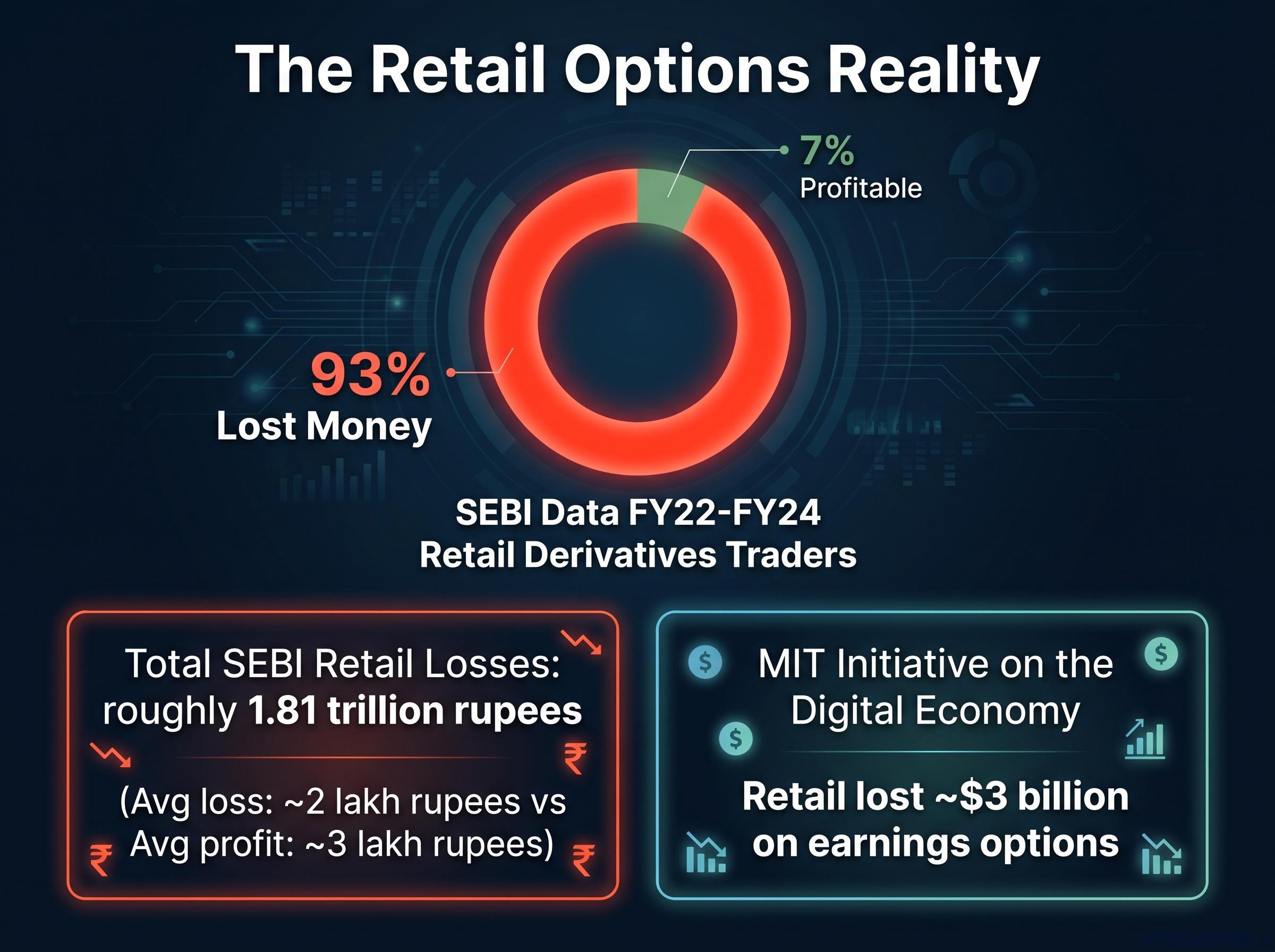
Start with volatility, because it is the least obvious. Traders love buying into big events like earnings, exactly when implied volatility inflates the premium. A MIT Initiative on the Digital Economy paper, “Losing is Optional: Retail Option Trading,” found retail traders lost about $3 billion on options around earnings announcements. Average losses ran 5-9% of the investment on standard events and 10-14% on high-volatility events.
Implied volatility is not a directional signal; it is the market’s real-time consensus on how much movement to expect, extracted by reverse-engineering live option prices rather than from historical data, and it sets the price of every premium you pay before direction comes into the picture at all.
Then time decay, the most relentless of the three. Hold a long option through a quiet week and its extrinsic value drains away regardless of what you think the stock will eventually do. Hold it to expiry with no intrinsic value and it expires worthless.
The costs bite before the stock even moves. Using that live AMD data, paying the ask at $5.55 and selling straight back at the bid of $5.30 loses roughly 4.5% on the bid-ask spread alone, before a single cent of price movement.
The aggregate outcomes are sobering. SEBI found that 93% of retail derivatives traders lost money between FY22 and FY24, with total losses of roughly 1.81 trillion rupees including transaction costs and average losses around 2 lakh rupees per losing trader.
SEBI data shows 93% of retail derivatives traders lost money over a three-year window, one of the starkest real-world datasets on retail options outcomes anywhere.
The SEC’s options bulletin and FINRA Rules 2360 and 2220 both stress the same point: options are not suitable for all investors, and the entire premium can be lost. None of these three forces requires you to be wrong about direction. Being right on the stock but wrong on timing or volatility pricing produces the same result as being completely wrong.
SEC investor alerts on options risks consistently emphasise that the entire premium paid can be lost and that options are not suitable for all investors, reinforcing the same suitability standard embedded in FINRA Rules 2360 and 2220.
When buying options makes sense, and when the odds are against you
Options are not inherently a bad tool. They are a precision instrument that rewards specific conditions and punishes the rest. The useful question is not whether options are risky, but whether your particular trade sits in the defensible column.
| Factor | Buying is defensible when | The odds are against you when |
|---|---|---|
| Conviction and timing | High conviction on both direction and timing of a large move | A speculative punt with no clear timing thesis |
| Implied volatility | Low or reasonable, so the premium is not inflated | Elevated pre-event, exposing you to vol crush |
| Position size | Small enough that a 100% loss is planned and acceptable | Oversized because the dollar premium looked cheap |
| Contract duration | Enough time to survive near-term noise | Very short-dated or 0DTE lottery-style bets |
The flow data shows where retail actually sits. Retail traders make up roughly 30% of total U.S. options volume in 2025 and nearly half of daily 0DTE volume, the contract type with the most aggressive time decay of all.
There is a mathematical fix for some of this. A call debit spread means buying a call and simultaneously selling a higher strike call, which cuts the net premium and therefore reduces the extrinsic value working against you. The trade-off is capped upside.
- Call debit spread: buy a call, sell a higher strike call. Lowers your net cost and breakeven in exchange for a ceiling on gains.
- Put debit spread: buy a put, sell a lower strike put. Same mechanical benefit for a bearish view.
Educators such as Tastytrade and Interactive Brokers point to these spreads as higher-probability structures, particularly when implied volatility is low. Yet a University of Alberta working paper found single-leg long calls and puts make up over 60% of retail positions, while spreads represent just 1%.
That 1% figure is the tell. The structure professional educators most often recommend is the one retail traders almost never use, which says a great deal about the distance between how options are marketed and how they are best deployed.
For readers wanting to run the numbers before placing a spread, our dedicated guide to calculating probability of profit covers the credit-to-width formula, delta-based strike selection, and the P50 metric used for setting early-exit rules, with worked examples across common spread structures.
What you need to know before you place the trade
The tension runs through everything above. Leverage and defined risk are genuine advantages of buying options. Time decay, volatility pricing, and the sheer precision required are the built-in disadvantages, and they work against you every day you hold.
Winning is possible, but the conditions are narrow. SEBI data shows the roughly 7% of profitable retail traders earned average profits near 3 lakh rupees, while the losing majority averaged around 2 lakh rupees in losses. Options are not structurally impossible to profit from; the window for doing it consistently is just small.
Before you buy any call or put, work through four questions.
Every strike on an options chain carries two distinct probability figures: the probability of expiring in-the-money at the final close and the probability of touching that level at any point before expiration, and these two numbers diverge significantly for out-of-the-money contracts in ways that directly affect stop-loss and exit decisions.
- What is the breakeven price, and how far past the strike does the stock need to travel?
- What is implied volatility telling you about whether this premium is cheap or inflated right now?
- What is the maximum loss as a percentage of your total account, and is that a planned outcome?
- How many days does the stock actually have to make the move you are anticipating?
The AMD and Palantir examples are your templates. Every breakeven calculation and capital comparison above applies directly to any trade you evaluate.
Options reward precision on direction, timing, and volatility. Get any one of the three wrong and the structure penalises you, often as harshly as if you had been wrong about all of it.
For most circumstances, share ownership or a defined-risk spread is the more sensible default. Single-leg buying earns its place only when conviction, timing, volatility, and sizing all line up.
This article is for informational purposes only and should not be considered financial advice. Investors should conduct their own research and consult with financial professionals before making investment decisions. Past performance does not guarantee future results, and the entire premium paid for an option can be lost.