
When you encounter a pharmaceutical company, you probably reach for one of two boxes. Either it develops new drugs from scratch, or it manufactures generic copies of drugs that others invented. Most investors sort every pharma business into one or the other without thinking about it.
A third model exists, and failing to recognise it is not a matter of taste. It is a repeatable, quantifiable analytical error that produces the wrong answer no matter how carefully you run the numbers.
The mispricing is structural. When you apply biotech-style risk assumptions to a business that is not a biotech, or generic-manufacturer margin logic to a business not competing on price, you misjudge its timeline, its capital needs, its risk profile, and its competitive position. The analysis can be immaculate and still be wrong, because the question set was wrong from the start.
This is a practical orientation to the pharmaceutical reformulation model: how it works, why it sits outside both inherited categories, and which questions it actually requires you to ask. Get the framework right and the specific company analysis follows. Get it wrong and every conclusion inherits the error.
Why the two-box model leaves investors with the wrong answer
Start with the original-development box. A company in this box invents a new molecule, secures patent exclusivity, and earns pricing power on the back of it. The price of that reward is a decade-long timeline, a phase 1 through phase 3 clinical programme that ranks among the most capital-intensive activities in any industry, and a high probability of failure at each regulatory gate. You are buying a lottery ticket with a very large payout and very long odds.
Now the generic-manufacturer box. Here the molecule is already invented and off-patent. The regulatory route is well defined and approval is close to certain. The catch is that everyone else can do the same thing, so margins are thin, there is no exclusivity, and competition runs entirely on cost against a commoditised product.
A company running a third model gets measured against whichever box it superficially resembles. If it looks like a drug developer, investors apply the decade and the failure risk. If it looks like a generic, they apply the thin margins. Both readings are wrong, and each one is wrong in a specific, correctable direction.
The four errors that follow from the wrong framework
- Timeline error: Applying full clinical development timelines makes you expect a decade to market and discount near-term revenue, even when the actual path is materially shorter.
- Risk error: A molecule with years of established clinical use does not carry the same safety risk as one never tested in humans. Treating them as equivalent overstates the binary risk.
- Capital error: Full phased development is enormously expensive. A model that bypasses it has a completely different funding profile, which matters most for small-cap companies watching their cash burn.
- Competitive error: When no new molecule patent exists, the question of what protects the business is a genuinely different one. There are real answers, but only if you know to look for them.
Each of these errors is correctable once you understand the model correctly. Recognising which one you are making is the first step toward auditing your existing assumptions about a reformulation company and replacing the ones that do not fit.
The reformulation risk profile is structurally distinct from novel drug development in ways that matter for capital allocation: leveraging existing molecular safety data removes the largest single binary in a full clinical programme, leaving the bioequivalence bar as the primary technical hurdle rather than first-in-human unknowns.
When big ASX news breaks, our subscribers know first
What reformulation actually involves, and why regulators treat it as its own category
The starting point is a molecule that already works. A pharmaceutical ingredient with an existing regulatory registration, a documented safety record, and an established history of clinical use. The molecule is not the innovation. Somebody else already proved it is safe and effective.
What changes is how that molecule is delivered into the body. The delivery mechanism covers how the drug enters your system, how fast it is absorbed, how stable it is, how it is administered, and how easy it is to use. A compound available in only one dosage form can be reformulated into another while the active ingredient stays exactly the same.
This is not a cosmetic change. Onset speed, absorption consistency, and administration convenience all affect whether a medicine performs as intended in real-world use. A reformulated product can be meaningfully different even when the therapeutic ingredient is untouched.
The scope of formulation change is wider than most investors assume. Common examples include:
- Sustained-release matrices that spread a dose out over time rather than releasing it all at once
- Formulations that increase bioavailability, meaning more of the drug actually reaches the bloodstream
- Controlled release that reduces peak-trough variability, the gap between the drug’s highest and lowest concentration in the body
- Delivery designs that improve patient adherence, making the treatment easier to stick to
Because delivery changes can genuinely alter clinical performance, regulators treat reformulation as its own formal category, not a shortcut. In Australia, the Therapeutic Goods Administration (TGA) runs a data-driven pathway built on bioequivalence standards.
TGA regulatory reference The core guidance document is titled “Providing biopharmaceutic data for medicine applications,” originally published 1 July 2014 and most recently updated 12 November 2024.
This is not an Australian quirk. International regulators, including in the United States, have established distinct hybrid pathways for reformulation submissions. In the US these are often filed as 505(b)(2) applications, a new-drug route separate from generic approvals. Reformulation is a globally recognised development category with its own data requirements, which reframes it from a corner-cutting exercise into a formally recognised innovation pathway. That distinction is the foundation for everything that follows.
How bioequivalence works, and what it means for the economics
Here is the technical heart of the model. Because the active ingredient is already registered, the developer does not need to prove the molecule is safe or effective all over again. That work is done. What it must prove is that its reformulated product delivers the ingredient into your bloodstream comparably to the reference product. That proof is called bioequivalence.
The study design is far smaller than a full clinical trial. The standard approach is a randomised, two-period, two-sequence crossover, where each subject receives both the test and reference products in different periods. Under TGA guidance, the number of evaluable subjects must not be fewer than 12, with the actual sample size set by a statistical power calculation.
Two pharmacokinetic parameters carry the assessment: area under the concentration-time curve (AUC), which measures total drug exposure over time, and peak concentration (Cmax), the highest level the drug reaches in the blood. The test has a hard pass mark.
The acceptance range The 90% confidence interval for the test-to-reference ratio of AUC and Cmax must fall within 80.00 to 125.00 percent, per the TGA-adopted CHMP/EMA guideline (CPMP/EWP/QWP/1401/98 Rev.1/Corr).
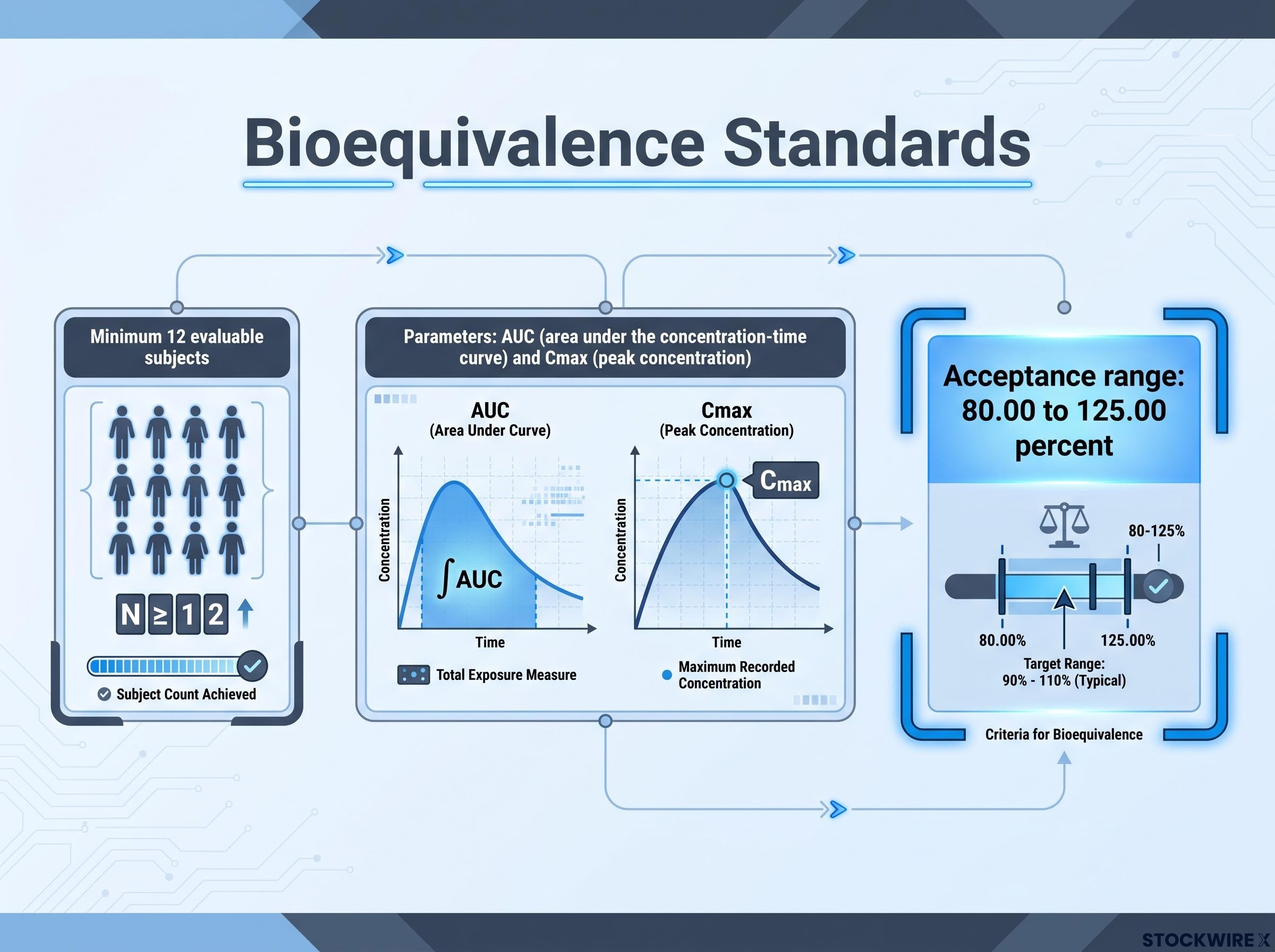
That range tells you something important. This is a rigorous, quantitatively defined standard with a binary pass or fail outcome, not a subjective or discretionary judgement. When you estimate regulatory risk for a reformulation programme, you are estimating the odds of clearing a defined statistical bar, which is a very different exercise from estimating the odds of a novel molecule proving safe in humans for the first time.
The TGA guideline on bioequivalence investigation sets out the full technical requirements governing study design, pharmacokinetic parameters, and the statistical acceptance criteria that a reformulated product must satisfy to achieve ARTG registration in Australia.
Now translate the science into economics. The table below sets the two pathways side by side.
| Feature | Full clinical development | Bioequivalence pathway |
|---|---|---|
| Timeline | Around a decade to market | Materially shorter |
| Capital intensity | Among the most capital-intensive in any industry | Substantially lower |
| Subject count | Hundreds to thousands across phases | Minimum 12 evaluable subjects |
| Primary risk type | Binary safety and efficacy risk | Clearing a defined statistical bar |
| What must be shown | Molecule is safe and effective | Comparable delivery to reference product |
One caution keeps this honest. Bioequivalence is not a guaranteed pass to market. The TGA still assesses manufacturing quality, product quality, and the full data package, and it can request additional studies where the justification is inadequate. Shorter and cheaper does not mean automatic.
TGA approval timeline variability is a genuine execution variable even for well-prepared submissions, as Memphasys demonstrated when its Felix System received clearance approximately two months ahead of guidance, a reminder that regulatory outcomes can diverge from schedule in either direction.
What protects the position, and where the honest limits are
State the constraint plainly, because it is real and material, not a technicality. Reformulation does not create patent protection over the underlying molecule. Anyone else can, in principle, work with the same active ingredient.
So what does protect the business? Four things, and they are different in character from molecule exclusivity. Formulation intellectual property, covering specific excipient combinations, release profiles, or delivery architectures. Manufacturing know-how that is genuinely hard to replicate. First-mover position in a regulatory pathway. And commercial execution.
Formulation patents, manufacturing know-how, and regulatory first-mover position are all recognised competitive moat sources, though each operates differently from the network effects and switching costs that anchor moat analysis in software and platform businesses.
These moats have a weakness you need to price in. Formulation and delivery patents cover specifics, which means competitors can attempt to design around them. Regulatory and payer attitudes can also erode the advantage if the clinical benefit of the delivery change is marginal or unproven. Durability, in other words, depends on the delivery improvement being demonstrably worth having, not just formally registered.
The Australian market context and early-access pathways
Registration cost is broadly fixed regardless of how large the target market is. That single fact reshapes the economics in a small market like Australia, where the commercial case for full local registration does not always hold. A development model with a lower cost base widens the range of products that are commercially viable to register here.
Two TGA pathways help bridge the gap between development and full registration. The Special Access Scheme (SAS) lets a registered health practitioner access an unapproved therapeutic good for an individual patient on a case-by-case basis, with guidance updated 1 October 2024. The Authorised Prescriber scheme lets an authorised medical practitioner supply a specified unapproved good to a defined class of patients without per-patient TGA approval, subject to six-monthly reporting. Sponsors are not obliged to supply merely because a product has been prescribed.
These are bridging mechanisms that can generate early revenue and clinical data ahead of full ARTG registration, not permanent commercial states.
Eve Health Group (ASX: EVE) is a commercial-stage Australian life sciences company whose stated model is reformulating established compounds to improve delivery, using bioequivalence studies to support ARTG registration without traditional phased trials. It also runs a separate consumer wellness business in gut health. Company ASX announcements from March 2026 describe a stated focus on the bioequivalence-testing-only pathway, with certain products accessed via SAS-B and others in early development. All forward-looking statements about registration are company intentions, not assured outcomes. For product-level detail, refer to the company’s ASX announcements.
Because there is no molecule patent, the durability analysis is entirely about execution quality. Ask these four questions of any reformulation business:
- What formulation IP exists, and how robust is it against design-around?
- What is the capital requirement between the current stage and registration?
- Which access pathway products are on market, and what does that imply for revenue timing?
- What does the path to full ARTG registration actually look like?
What this framework changes for the investor doing the work
Pharma development is not a single discipline with a uniform risk profile. It spans several distinct models, each carrying its own timeline, capital requirement, and competitive logic. Reformulation is the least well understood of those models, and that gap in understanding is exactly where the mispricing lives.
Structural mispricing of the kind described here tends to persist when the analytical framework most investors apply is wrong at the category level, not wrong in the numbers, because no amount of careful modelling corrects an error that lives in the question set rather than the calculation.
The value of getting this right is not academic. An investor who understands the reformulation model knows which questions to ask, and knows the answers will look nothing like those produced by a biotech or generic-manufacturer template. You avoid systematic error in both directions: you neither over-discount a near-term pathway by applying decade-long biotech timelines, nor underestimate the durability question by assuming generic-style margin dynamics.
That is the whole point. The right framework is the difference between a question set built for a different business and the questions that actually reveal what a reformulation company is worth and what risk it carries.
This article is for informational purposes only and should not be considered financial advice, medical advice, or a recommendation regarding any medicine or treatment. Past performance does not guarantee future results, and forward-looking statements are speculative and subject to change. SWX has a commercial relationship with Eve Health Group. This information is provided for educational purposes. Investors should conduct their own research and consult with financial professionals before making investment decisions. Readers seeking product-level detail on Eve Health Group should refer to the company’s ASX announcements.