
Fibrosis is the body’s scarring response, and it runs on the same enzymatic machinery no matter where it happens. Whether scar tissue forms in your skin after surgery, hardens your lungs, or displaces the blood-producing cells in your bone marrow, the underlying process is identical.
At the centre of that process sit the lysyl oxidase enzymes. These enzymes cross-link collagen and elastin, the structural proteins in your tissue, turning healthy and pliable tissue into rigid, poorly degradable scar material.
The role of lysyl oxidase enzymes in collagen cross-linking is well characterised in the peer-reviewed literature: these enzymes catalyse the formation of covalent bonds between collagen and elastin chains, progressively stiffening the extracellular matrix into the poorly degradable scar tissue that defines fibrotic disease.
That single mechanism is what makes Syntara‘s pipeline interesting to understand. The company is applying one approach, inhibiting the lysyl oxidase enzyme family, across a range of tissues: myelofibrosis, skin scarring, kidney fibrosis, MASH (a liver condition), pulmonary fibrosis, and cardiac fibrosis.
Skin is the unusual case here. It is the only organ where fibrotic change can be photographed, imaged, and measured directly on a living patient within months, which makes it a visible test bed for the whole mechanism.
StockWire X may have a commercial relationship with companies mentioned in this article. This article is for informational purposes only, does not constitute medical advice, and should not be read as a recommendation to seek any treatment.
What follows gives you a framework for evaluating small clinical trials, using Syntara’s skin programme to show how smart methodology strips the guesswork out of early data.
Why skin trials historically produce results you cannot trust
Here is the uncomfortable truth about scarring research: it is among the noisiest and most variable fields in all of medicine. Individual patients with wounds that look broadly similar can end up with entirely different scars, driven by factors outside any researcher’s control.
The scale of the problem is enormous. A widely cited 2003 estimate, originating from a BMJ article by Bayat and colleagues, put the number of patients in the developed world who acquire scars each year at roughly 100 million, following both elective and trauma surgery. There is still no newer epidemiological figure that has replaced it; sources simply recycle the 2003 number.
The trouble is that scars refuse to behave consistently. A long list of variables changes how any individual scar forms:
- Genetics and individual healing biology
- Age
- Skin type
- The nature of the injury itself
- The quality of the surgical closure
- How the scar remodels over time
Layer on top of this a second problem: how scars get measured. Traditional scar scoring leans heavily on subjective clinician judgement using descriptive rating scales, such as visual scores of redness or stiffness.
That subjectivity has a real cost. Different assessors frequently score the exact same scar differently, so the measurement tool itself introduces noise before the drug is even considered.
Now put the two problems together. When the biological variation between people is larger than the effect the drug produces, a conventional two-group comparison tells you almost nothing.
This is the trap you need to recognise before you read any small trial. A noisy, underpowered study burns through a clinical-stage company’s finite cash and time without ever answering the core medical question, which means you cannot rely on its headline result in either direction.
That is why trial size is the wrong thing to fixate on. Participant numbers fit neatly into a headline, but design quality is what determines whether the answer means anything, and design quality only reveals itself when you read the protocol. Before you risk capital on an outcome, you need to understand how the trial was built.
Pre-revenue biotech analysis requires a different toolkit from conventional equity assessment: conventional metrics like earnings per share carry no weight when a company’s entire value is held inside a trial that has not yet reported, which is precisely why design quality, not participant numbers, becomes the primary analytical variable.
When big ASX news breaks, our subscribers know first
Designing the biological noise out of the patient population
So how do you fix a problem this fundamental? You stop trying to average across different people and start controlling the variation before it ever enters the data. Syntara’s SNT-9465 Phase 1b study is a useful worked example of exactly that discipline.
The first principle is to make each patient their own control. Syntara’s trial uses a split-scar design: the active cream and placebo are each allocated to separate portions of the same scar, with a buffer zone between them that stops the topical treatment crossing over and compromising the placebo region.
The elegance here is worth sitting with. Because each participant carries both the treatment and the control on a single scar, genetic, environmental, and systemic factors are held constant across the comparison. You strip out the between-patient variation that ruins most scarring data.
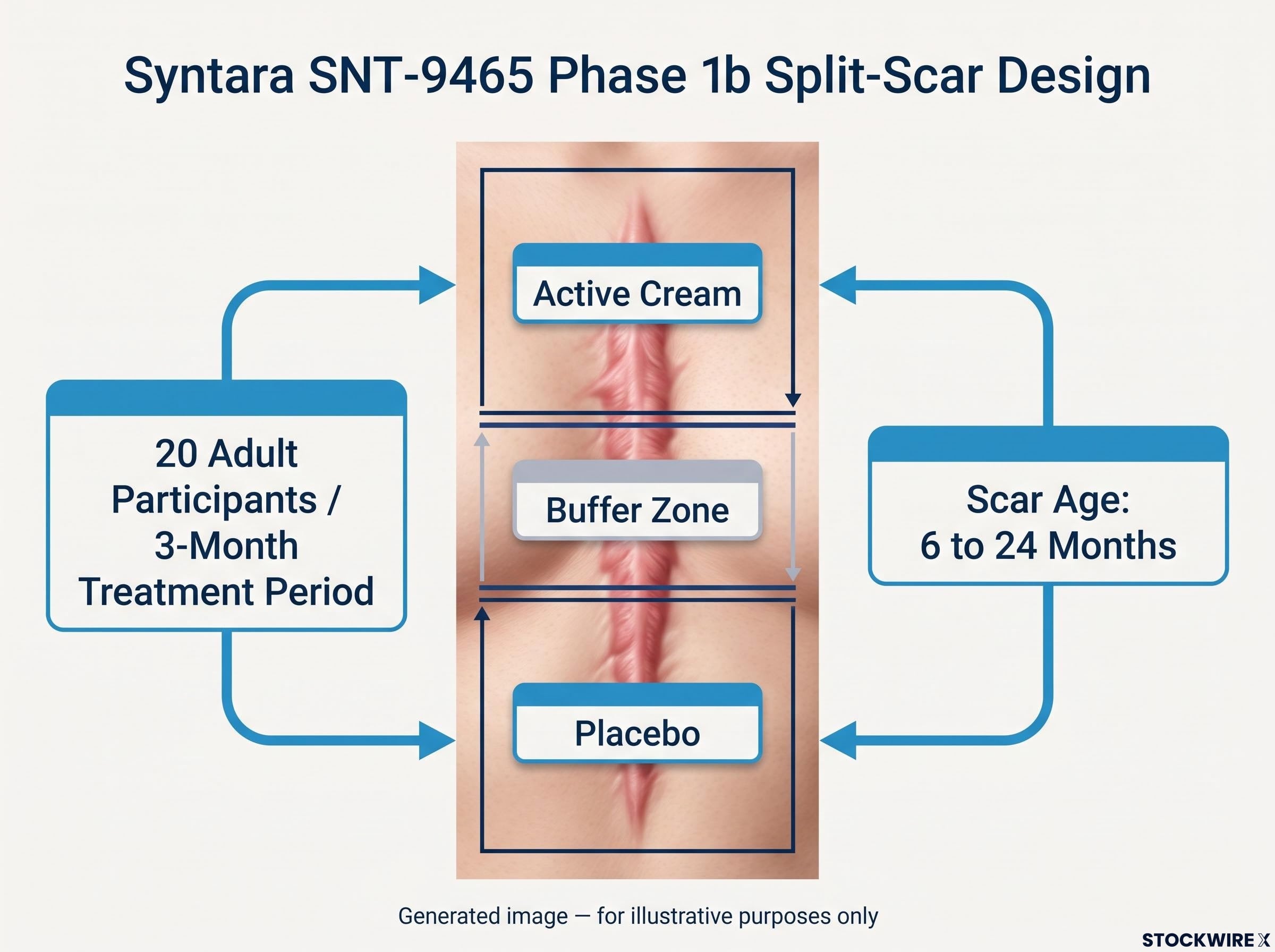
The specifics of the study reinforce the point. It is a randomised, double-blinded, placebo-controlled trial enrolling 20 adult participants over a three-month treatment period.
That number, 20, looks tiny. But a split-scar design built this way can be more informative than a poorly controlled trial three times its size, because it removes the noise that would otherwise swamp the signal.
There is a read for you as an investor buried in this. When a management team designs a trial to eliminate biological variables upfront, it signals they are serious about generating usable data rather than a headline. Trial design is a competence tell.
Controlling the patient population
The second principle is to restrict who gets in. Syntara limits enrolment to adults with hypertrophic sternotomy scars, the raised scars that form after open chest surgery, aged between 6 and 24 months.
Sternotomy scars are unusually consistent by the standards of scarring research. The wound follows a standard path, sits in the same anatomical position every time, is made under controlled surgical conditions, and is closed using techniques that are broadly similar from one patient to the next.
Compare that to random trauma, where the wound could be any shape, any depth, in any location, caused by any mechanism. By choosing one highly uniform scar type, Syntara removes an enormous source of uncontrollable variation before the first patient is even treated.
The scar-age window does similar work. Scars remodel naturally over time, changing in colour, thickness, and pliability, so a scar at three months behaves differently from one at three years. Narrowing entry to the 6-to-24-month band means every participant sits within a comparable phase of that natural remodelling, tightening the comparison further.
The SNT-9465 enrolment progress also validates the patient selection strategy at a biological level: baseline biopsies from five participants showed markedly higher lysyl oxidase activity in scars under 24 months old compared to the 13-year average scar age in the earlier SOLARIA2 study, confirming that the 6-to-24-month entry window is capturing the most biologically active phase of remodelling.
Measuring biological reality instead of clinical opinion
Controlling who enters the trial only solves half the problem. You still have to measure the result, and this is where scarring research usually collapses back into opinion.
The third principle is to measure objectively. Instead of relying on a clinician’s visual impression, the trial uses imaging tools such as optical coherence tomography (OCT), a technique that produces detailed cross-sectional images of tissue beneath the skin surface. That lets researchers quantify structural change rather than debate appearance.
The evidence that this approach can detect real biological change comes from Syntara’s first-generation compound, SNT-6302. This is a critical distinction, so hold it firmly: SNT-6302 is not the drug currently in the Phase 1b trial.
In the SOLARIA2 study, an OCT subgroup of 14 patients showed statistically significant improvements in scar vascularisation and extracellular matrix remodelling after three months, according to Syntara. A separate Phase 1c study of SNT-6302 in 42 participants in 2023 recorded a mean 66% reduction in lysyl oxidase activity two days after the final dose.
The mechanistic groundwork stretches back further still. Preclinical research led by University of Western Australia (UWA) scientists, published in Nature Communications in 2022, showed that a topical pan-lysyl oxidase inhibitor reduced collagen deposition in injury models without reducing tissue strength.
The fourth principle is to confirm target engagement, and this is where investors most often trip. Target engagement means the drug actually reaches and acts on its intended biological target at the doses given. It is not the same thing as the drug improving a scar.
| Feature | SNT-6302 | SNT-9465 |
|---|---|---|
| Generation | First-generation compound | Next-generation compound |
| Key clinical data | 2023 Phase 1c (42 patients); OCT imaging findings in SOLARIA2 subgroup | Phase 1a target engagement and tolerability only |
| Current status | Used in exploratory investigator-initiated work | Currently in Phase 1b |
For SNT-9465, the drug in the current Phase 1b, the Phase 1a study established dose-dependent target engagement and an acceptable tolerability profile, according to Syntara’s ASX announcements. That is meaningful, but it stops well short of proving the scar gets better.
Target engagement vs clinical efficacy Target engagement confirms a drug hits its chemical target. Clinical efficacy confirms it produces a real health benefit, in this case a measurably improved scar. Confusing the two is one of the most common ways investors misread early data.
That distinction protects you. A company proving its drug works chemically is not the same as proving it works clinically, and you should never let the first stand in for the second.
Clinical milestone taxonomy matters here because target engagement and clinical efficacy sit at entirely different points on that ladder: the Phase 1a finding belongs to the first rung, and the Phase 1b readout will determine whether the programme can claim any foothold on the second.
Reading the boundaries of early-stage clinical evidence
Good design improves the quality of an answer. It does not guarantee the answer will be positive, and this is where you need to stay grounded.
State the current position plainly. SNT-9465 is an unapproved investigational drug, and its Phase 1a work established target engagement and tolerability only. There is no data yet showing it actually improves scars.
Three boundaries deserve to be held separately in your mind:
- SNT-9465 lacks efficacy data. Everything demonstrated so far concerns whether the drug reaches its target and is tolerated, not whether it heals a scar.
- The Phase 1b is small by design. At 20 participants, it is built to establish safety and gather an early signal, not to definitively prove efficacy.
- The SATELLITE study is a different thing entirely. This is an investigator-initiated, exploratory study run through UWA under Professor Fiona Wood, testing the older SNT-6302 compound in keloid scars.
That last point matters because keloid scars have substantially different underlying biology from the hypertrophic sternotomy scars in Syntara’s Phase 1b. Findings from the keloid work do not translate directly to the hypertrophic scar programme, and conflating the two would mislead you.
Here is the productive way to hold all of this. A well-constructed Phase 1b provides a trustworthy answer in either direction. Should SNT-9465 produce no detectable effect within a protocol this carefully controlled, that outcome carries genuine credibility, because the tight design cannot be blamed for masking a real signal.
Past performance does not guarantee future results. These statements are speculative and subject to change based on clinical developments and company performance.
Turning a clinical readout into a readable event
Understanding trial design is the difference between guessing on a coin flip and making an informed assessment. When you know how variation was controlled and how the result will be measured, the eventual data stops being a mystery and becomes something you can actually read.
The next milestone is close. Syntara has reported that recruitment for the SNT-9465 Phase 1b passed 60% and is expected to close in Q3 2026, with the readout following.
The value of this framework outlives any single company. The two principles that matter most, controlling variation and measuring objectively, apply to any small trial in any indication, which gives you a permanent tool for reading early-stage data wherever you encounter it.
Small cap stock research at the primary source level is where trial design quality becomes visible: ASX announcement feeds publish protocols and enrolment updates before any secondhand summary reaches investors, which means readers who go directly to the source can distinguish design rigour from promotional noise before the market prices it in.
This article is for informational purposes only and should not be considered financial advice. Investors should conduct their own research and consult with financial professionals before making investment decisions.
—