Everyone is watching the wrong number. The headline probability of a rate hike, quoted anywhere from 54% to 94% depending on the index, has become the obsession of the financial press. It is also the least useful figure an investor can fixate on right now.
The upcoming Federal Open Market Committee announcement is not really about whether rates move this week. It is a high-stakes balancing act, and the danger sits in the Fed’s forward trajectory: its ability to satisfy a market that has already priced in aggressive tightening stretching all the way through 2027.
What follows here is a framework for understanding how this single policy lever will trigger simultaneous, interconnected reactions across bond, currency, and precious metals holdings. Get the transmission mechanism right, and the initial market reaction stops looking like chaos and starts looking like something you can read.
The dangerous gap between Fed reality and market pricing
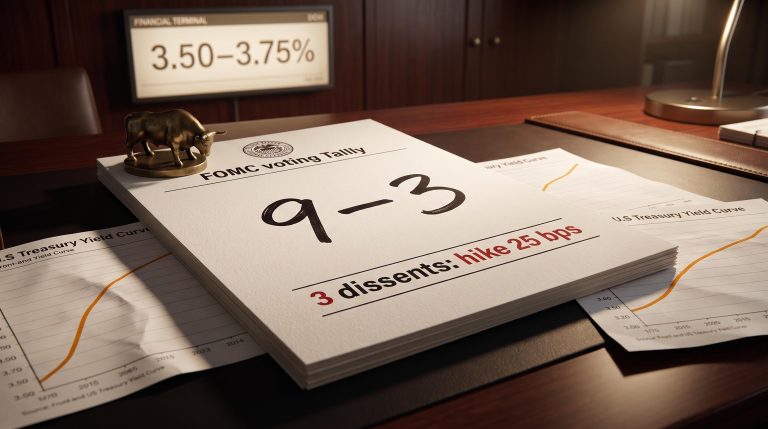
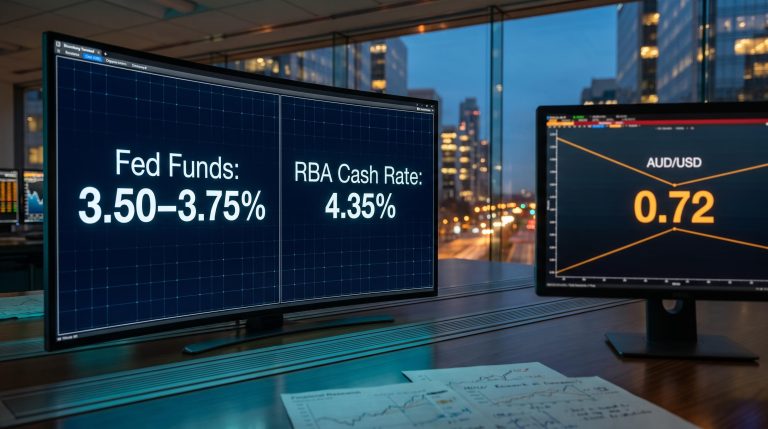
Start with where the Fed actually stands. At its most recent completed meeting on 28-29 July 2026, the Committee held the target range for the federal funds rate at 3.50-3.75%. The vote was 9-3, with three dissenters pushing for a 25 basis point hike.
That split matters. It tells you the hawkish camp inside the Fed is real and vocal, which is exactly what has fed the market’s conviction that more tightening is coming.
The nine-three split at the July meeting carried weight precisely because of the FOMC structure: only twelve members vote at each meeting, and three dissents in favour of an immediate hike signals a hawkish bloc large enough to shape the September statement’s language even if it cannot outvote the majority.
Here is where the gap opens. According to a Federal Reserve Bank of San Francisco “FedViews” note dated 3 September 2026, financial markets expect the FOMC to lift the fed funds rate to roughly 4.25% by mid-2027, equivalent to two or three further hikes. Cumulative pricing implies close to four total increments beyond the current level by the end of 2027.
Against that, the Fed’s own longer-run projection sits far lower. FRED’s Summary of Economic Projections series pegged the longer-run federal funds rate at 3.1% as of the 17 June 2026 update.
| Current Fed Funds Rate | Market-Implied Peak (mid-2027) | Longer-Run Neutral Rate (SEP) |
|---|---|---|
| 3.50-3.75% | ~4.25% | 3.1% |
That spread between where the market thinks rates are going and where the Fed’s own long-run anchor sits is the real risk. If the Fed’s updated dot plot undershoots the aggressive 4.25% market path, it risks looking behind the curve, and that credibility gap can paradoxically drive long-end yields higher through a rising term premium.
The read for your portfolio is this: the danger is not the hike itself. It is a hike paired with a softer future roadmap that disappoints an overstretched market. That combination is how a widely expected decision still produces a sharp selloff, and it is the setup you should be bracing for.
When big ASX news breaks, our subscribers know first
How one policy lever moves three markets simultaneously
A single Fed statement does not land on one asset. It ripples through several at once, and understanding the sequence lets you read the initial reaction before it fully plays out on the screen.
The mechanism runs on surprise, not on the decision. A hawkish surprise, meaning the Fed sounds tougher than markets expected, typically pushes US yields higher, strengthens the dollar, and pressures gold. A dovish surprise reverses all three, lifting gold and non-dollar currencies. The chain of transmission looks like this:
- A policy or rhetorical surprise shifts rate expectations.
- Rising yields attract foreign capital chasing higher returns.
- That inflow strengthens the US dollar.
- A stronger dollar pressures emerging market currencies and commodities priced in dollars, including gold.
Track those four steps in order after the announcement drops, and you can separate a temporary knee-jerk from the start of a genuine trend.
The crucial role of real yields
The single most important variable for gold is not the nominal interest rate. It is the real yield, which is the interest rate after subtracting expected inflation. This is the true opportunity cost of holding an asset that pays you nothing.
Gold produces no income, so when real yields rise, the appeal of holding it falls, because bonds now offer a better inflation-adjusted return. The historical relationship is well documented.
Gold’s counterintuitive resilience through the 2022-2023 hiking cycle is explained by real yields: surging inflation expectations kept the inflation-adjusted rate deeply negative even as the Fed raised aggressively, eliminating the opportunity cost that would normally drive metal prices lower.
PIMCO estimates that a 100 basis point increase in 10-year real yields has historically led to an 18% decline in inflation-adjusted gold prices. UBP notes a 1% rise in 10-year TIPS yields (Treasury Inflation-Protected Securities, government bonds whose value adjusts with inflation) is consistent with roughly a $100 per ounce fall in spot gold.
There is a wrinkle worth knowing. A University of Malta study found this inverse link was strong before the pandemic but became statistically insignificant afterward, as geopolitics, fiscal fears, and structural demand for alternative stores of value muddied the relationship.
What this tells you is that real yields remain the anchor to watch, but the anchor has been dragging. When gold holds firm against rising real rates, it is usually a sign that sovereign fiscal anxiety is overriding the traditional maths, and that is precisely the anomaly in play right now.
Unpacking the Treasury market’s internal credibility crisis
To see how fragile the foundation is heading into this decision, look at what has been happening in the Treasury market itself. The government has been intervening to support long-dated bond prices, and the intervention has been visibly straining.
Treasury Secretary Scott Bessent publicly warned market participants against betting against the Treasury, then backed the warning with buybacks, purchases of the government’s own long-dated debt designed to support prices. The escalation ran like this:
- On 19 August 2026, Treasury announced it would double the maximum size of long-dated liquidity-support buybacks from $2 billion to at least $4 billion per operation.
- On 9 September 2026, the program was escalated again, to buy back up to $6 billion of 10- and 20-year notes.
- During the first expanded operation on 10 September 2026, Treasury purchased only about $5.187 billion, falling short of the $6 billion cap.
That shortfall was read as a signal. Because the actual amount landed below the cap, markets took it as evidence that the Treasury’s resolve or capacity to hold price levels was limited, and the selloff accelerated. The 10-year yield approached 5% even as momentum indicators diverged on the price highs, hinting the yield advance may be losing steam.
Strategists at JPMorgan warned that doubling or tripling buybacks treats the symptom, not the underlying fiscal imbalance. ING was blunter, comparing the operations to rearranging deckchairs on the Titanic given a national debt nearing $40 trillion.
The Treasury buyback programme‘s failure to hold long-end prices reflects a mechanical ceiling: measured against more than $31 trillion in marketable debt outstanding, even a $6 billion per-operation cap is too small to shift the structural supply-demand balance, which is why strategists at JPMorgan and ING treated the escalation as a symptom management exercise rather than a solution.
Here is why this matters for your fixed-income allocation. Bond volatility right now is being driven as much by Treasury credibility and deficit fears as by monetary policy. If the Fed delivers a hawkish surprise on top of an already nervous long end, the pain could be disproportionate, and the government safety net you might be counting on is currently failing to hold.
Gold and the dollar sit coiled as traditional rules suspend
Gold and the dollar are doing something unusual heading into the decision: almost nothing. Both are hovering in tight consolidation ranges, and that stillness is not comfort. It is a coiled spring.
Gold has been oscillating in a $4,280 to $4,480 per ounce band, holding its ground despite conditions that would normally drag it lower. Rising oil prices lift inflation expectations, which usually imply higher rates and weaker gold, yet that traditional correlation has temporarily broken as traders refuse to commit ahead of the Fed.
The recent swings show just how sensitive the metal is to the policy narrative. Following a hawkish Jackson Hole-style speech in late August, gold dropped about 3% to $4,567.23. It then rebounded 2.3% in early September after dovish comments from Fed Governor Christopher Waller cut the odds of a September hike from roughly 62% to 54%.
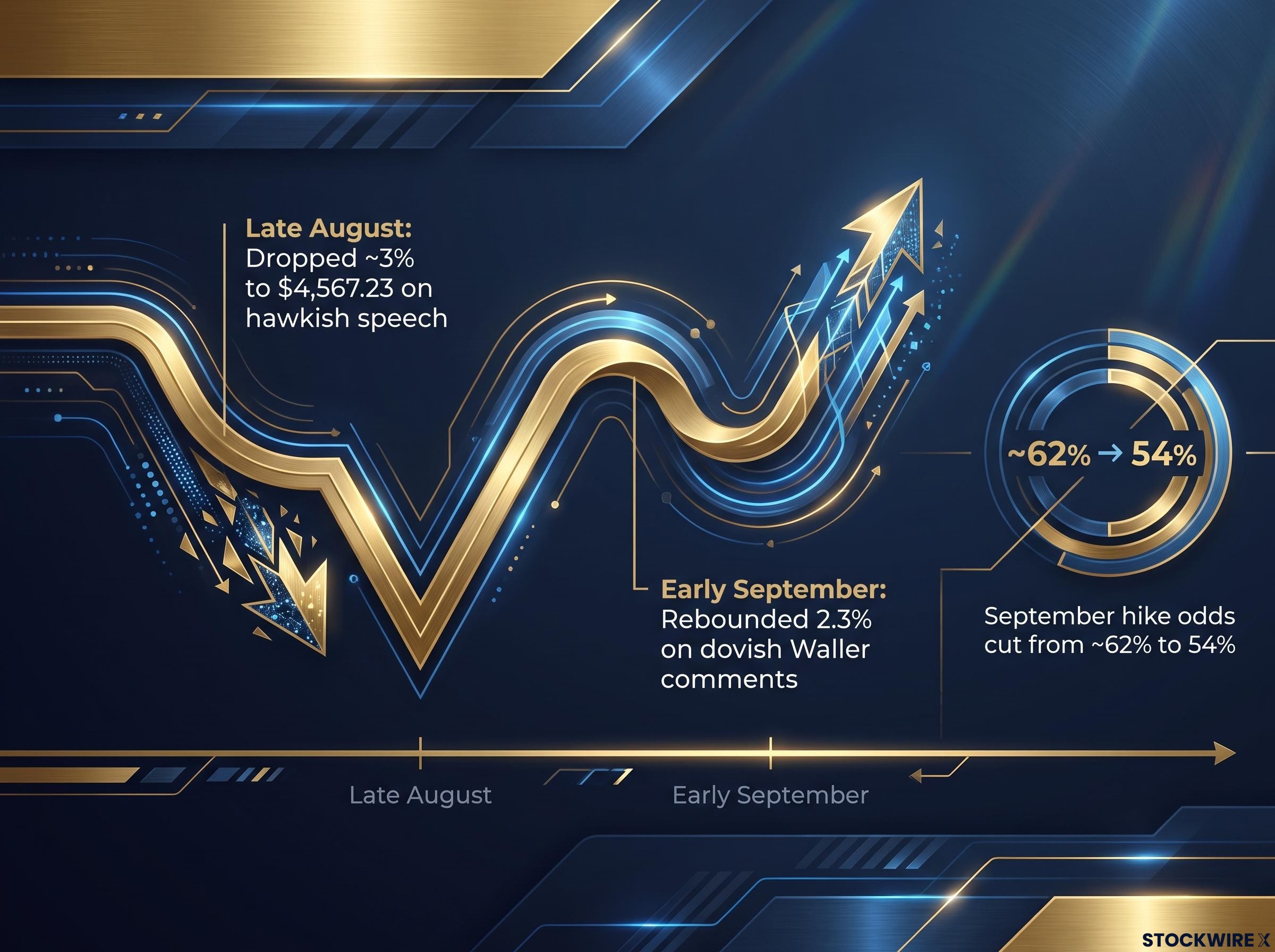
That whipsaw is the point. Gold’s resilience against rising oil and yields is a temporary suspension of the normal rules, not a permanent shift, and crowded pre-positioning means the release could be violent in either direction once the Fed speaks.
Currency markets await a directional catalyst
The dollar is trapped in the same holding pattern. Recent attempts to rally on oil-driven yield expectations failed to produce lasting upward momentum, leaving the currency waiting for a catalyst.
The euro, a useful proxy for the dollar’s broad direction, has been locked in a consolidation range that has persisted since roughly mid-August. Its stillness reflects the market’s collective indecision.
The asymmetry here is worth noting. If the Fed underdelivers on the hawkish tone the market expects, an anti-dollar narrative could take hold quickly, handing the euro and other non-dollar currencies fresh upside. A dovish disappointment is exactly what the current positioning is least prepared for.
Positioning for the post-announcement volatility
The core danger of this decision is not the outcome. It is how thoroughly it has already been priced in. When a hike is this heavily anticipated, crowded positioning frequently produces a buy the rumour, sell the fact reaction, where the dollar and gold reverse sharply after the event regardless of the headline.
In the first 48 hours, watch two things above the noise. First, the term premium on long-dated Treasuries: if it climbs, it signals investors are demanding compensation for fiscal risk rather than reacting to tightening alone. Second, gold’s move against real yields: a rally alongside rising yields would confirm that fiscal anxiety, not monetary policy, is now steering the metal.
Long-end yields rising even as the Fed holds is a classic sign of yield curve steepening driven by a credibility premium rather than rate expectations; after the July 29 press conference, Wolfe Research, Capital Economics, and Barclays all identified the same fault line between a hawkish written statement and a cautious Chair tone as the mechanism pushing duration risk compensation higher.
The takeaway is that a heavily priced-in event leaves the market exquisitely vulnerable to even minor rhetorical shifts. A single softer sentence in the statement could unwind trades built on months of hawkish conviction.
This article is for informational purposes only and should not be considered financial advice. Investors should conduct their own research and consult with financial professionals before making investment decisions.
Past performance does not guarantee future results. Financial projections are subject to market conditions and various risk factors, and the forward-looking scenarios described here are speculative and subject to change based on Fed policy and market developments.