Nvidia is having its fastest-growing quarter on record, and it is doing so while deliberately refusing to compete at the most valuable layer of the AI stack.
That is the paradox worth sitting with. The company that could plausibly build a frontier model to rival OpenAI or Meta has decided not to, and that decision, not the hardware, is arguably the most important thing to understand about where its revenue comes from.
On 14 September 2026, at the All-In Summit, Jensen Huang made this competitive philosophy explicit. Nvidia now runs the compute beneath every major frontier model in the world, and that universal position is not an accident of demand. It is the output of a deliberate boundary the company draws around itself.
So what kind of company is Nvidia actually becoming, and does the strategy hold as hyperscalers build their own chips and frontier labs grow more powerful? Here is what the strategy looks like when you trace it through Nvidia’s financials, its partnerships, and its product decisions.
The philosophy behind Nvidia’s refusal to compete with its own customers
The foundational idea is simple to state and hard to execute: build technology as high up the stack as you need to, but stop the moment your customers have the capability to do it themselves. Go higher and you threaten the people who buy from you. Stop short and you leave them dependent.
That dependency, engineered rather than accidental, is the whole game.
Nvidia could theoretically build general-purpose frontier models to compete head-on with the labs it supplies. It does not. According to Huang’s framing at the All-In Summit, the company deliberately positions itself as the layer everyone else builds on top of, which is why the labs are willing to coexist with it rather than route around it.
“We build technology as high up the stack as necessary, but we stop where our customers have capability, so they rely on us rather than feel threatened by us.” (Framing attributed to Jensen Huang, All-In Summit, 14 September 2026)
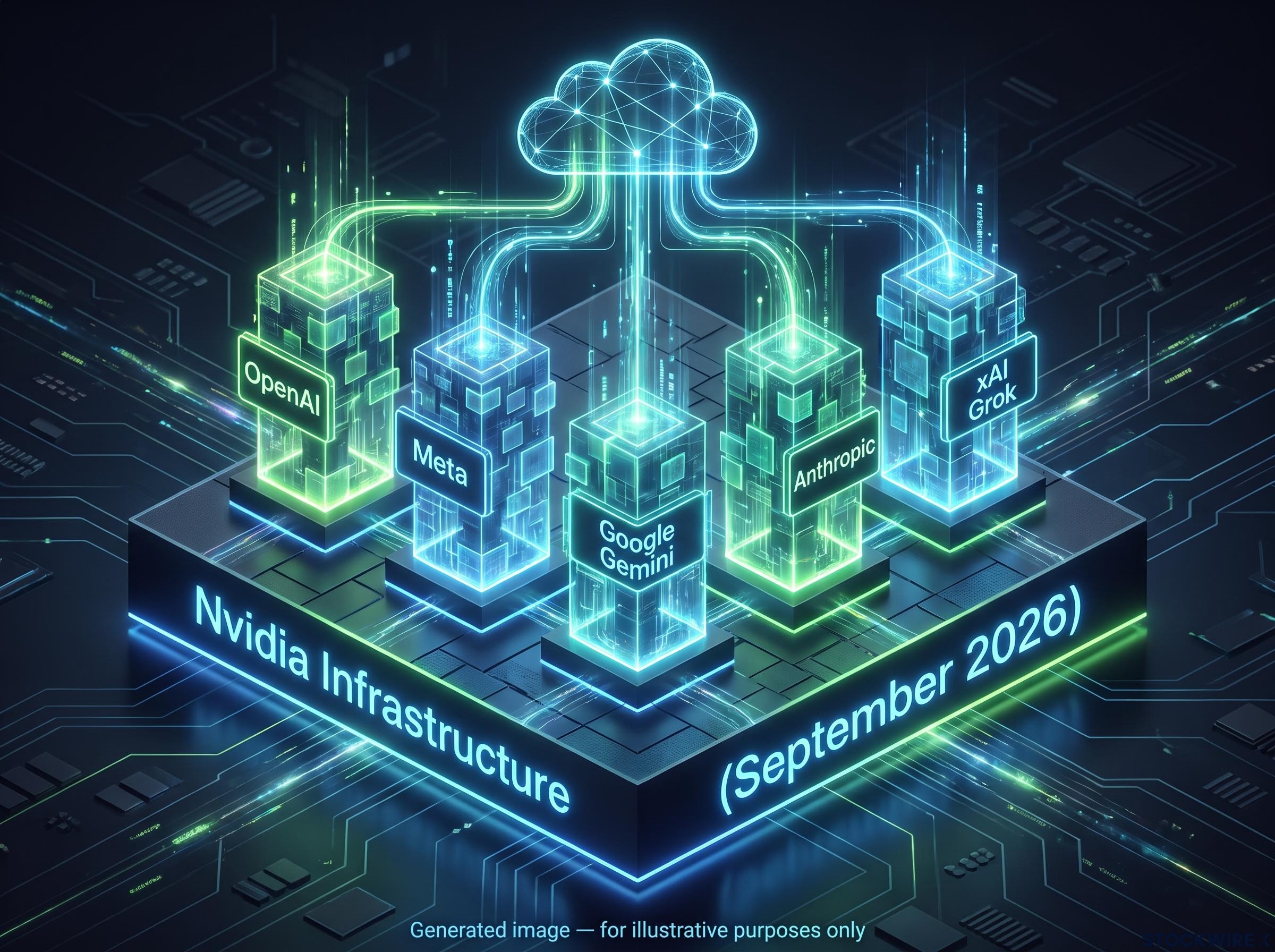
The proof is in who is on the platform. As of September 2026, every major frontier model provider runs on Nvidia infrastructure:
- OpenAI
- Meta
- Google Gemini
- Anthropic
- xAI Grok
That is not a customer list. It is a statement that the fiercest competitors in AI all rent the same foundation, and the landlord is Nvidia.
This restraint has deep roots. The company built foundational layers like cuDNN and Megatron-Core (the low-level software that lets AI frameworks run efficiently on its chips) precisely so the broader ecosystem could flourish without Nvidia needing to own the application layer itself. It made the ground fertile and let others plant.
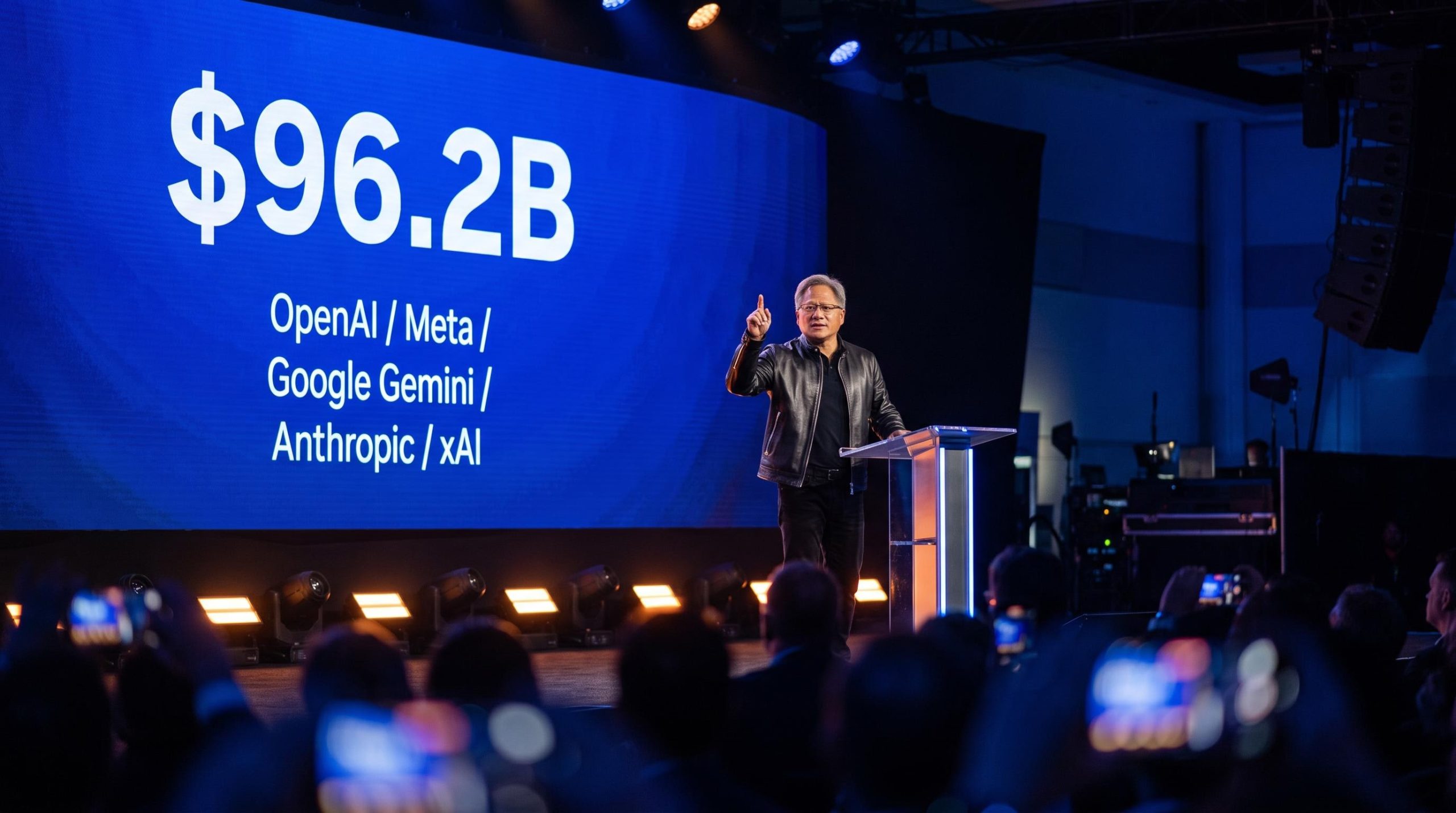
Here is what that means for you as an investor. Nvidia’s restraint is not a missed opportunity at the frontier; it is the mechanism by which it became indispensable to every competitor at once. When the company reported $96.2 billion in quarterly revenue, up 106% year-over-year and 18% sequentially on 26 August 2026, that figure was not measuring the sale of chips in isolation. It was measuring indispensability.
The moat, in other words, is not winning a product category. It is being the infrastructure every product category depends on.
When big ASX news breaks, our subscribers know first
What 106% revenue growth actually tells you about the AI infrastructure build-out
Look at the last three quarters as a sequence rather than three separate headlines, and a specific story emerges about the pace of AI infrastructure investment.
| Quarter | Revenue | YoY Growth | Sequential Growth |
|---|---|---|---|
| Q4 FY26 | $68.1B | +73% | +20% |
| Q1 FY27 | $81.6B | +85% | +20% |
| Q2 FY27 | $96.2B | +106% | +18% |
Read the year-over-year column and the rate of change is still climbing: 73%, then 85%, then 106%. This is not a business plateauing. It is one where the annual comparison is getting steeper even as the absolute base gets enormous.
That kind of number invites extrapolation. The more useful question is where the pressure would first appear if it started to build.
The answer sits in customer concentration. Approximately 60% of Nvidia’s revenue is funded by four major hyperscalers, the same cloud providers now building their own custom AI chips. That is the tension at the centre of the growth story: Nvidia’s biggest buyers are also its most credible future competitors.
The scale of hyperscaler capex commitments now funding Nvidia’s order book, with combined 2026 guidance in the $600-$805 billion range and the Stargate Project adding a further $500 billion in sovereign-scale data centre investment, means the concentration risk cuts both ways: the same customers building competing silicon are also the buyers committing capital at a rate that has no historical precedent.
The specific threat is custom silicon. According to a July 2026 analysis from ValueAdd VC, hyperscaler-built application-specific chips (ASICs, chips designed for one narrow task rather than general use) cost between a fifth and a third of Nvidia’s comparable pricing.
Marvell’s accelerating custom silicon trajectory, pulling forward its $3 billion quarterly revenue target by a full quarter and setting a $10 billion custom chip ambition by fiscal 2029, reinforces the same structural point: when both the standardised GPU track and the bespoke ASIC track accelerate simultaneously, the signal is broad-based infrastructure demand, not vendor momentum.
“Custom hyperscaler chips cost between one-fifth and one-third of Nvidia’s comparable pricing.” (ValueAdd VC analysis, July 2026)
These chips are not sold on the open market. What they do is let a hyperscaler route predictable, repetitive inference workloads (the everyday running of already-trained models) onto its own cheaper hardware, quietly reducing its dependence on Nvidia at the margin.
Here is the interpretive point for you. The acceleration is real, but the concentration means that if even one major hyperscaler meaningfully shifts internal inference to its own silicon, the sequential growth rate is the first place you will see it. Note that sequential growth already eased from 20% to 18% in the most recent quarter.
That is not yet a warning sign. It is the metric to watch, and it is far more informative than the headline annual figure.
How Nvidia is building an alternative to hyperscaler dependence
Nvidia is not sitting still while that concentration risk hangs over it. Its answer is the NeoCloud, and it is better understood as a strategic hedge than a supply-chain footnote.
NeoClouds, or Nvidia Cloud Partners, are independent operators that build GPU-based data centres using Nvidia hardware. The point of backing them is to grow a customer base beyond the four hyperscalers, and the argument Nvidia leans on is one the giants structurally cannot match: geography.
According to Huang, agile NeoClouds can deploy regionally in ways that hyperscalers headquartered in Seattle or Palo Alto simply cannot, which matters intensely for customers needing local data residency or sovereign control over where their AI runs.
Nvidia does not just supply chips to these partners. It scaffolds the entire operation through a “land, power, shell” model (helping secure physical sites, electricity, and building shells) via initiatives such as Cloverleaf. The support runs through several mechanisms:
- Reference architectures for building the data centres
- Direct financial assistance
- Revenue-sharing arrangements
- Credit-support structures
- Equity investment in downstream supply chains, including land and power
Industry expectations point to 8 GW of installed NeoCloud capacity by the end of 2026. The named operators span the globe: CoreWeave and Nebius at scale, alongside Australian players like Firmus and Sharon AI, reflecting how distributed this build-out is meant to be.
The binding constraints on AI deployment, specifically power availability and cooling density rather than chip supply, are increasingly where capital is concentrating, which means the NeoCloud partners Nvidia backs through its ‘land, power, shell’ model are navigating bottlenecks that sit one layer below the GPU economics most coverage focuses on.
What this tells you is that Nvidia is not passively waiting for hyperscaler dependence to erode its pricing power. It is building a parallel customer base on purpose. But that build-out comes with a bill that does not yet show up cleanly on the revenue line.
The backstop risk that the NeoCloud expansion creates
To get partners to commit to enormous GPU orders, Nvidia offers minimum-revenue guarantees and backstop programmes. In plain terms, if a NeoCloud partner cannot fill its contracted GPU capacity because demand disappoints, Nvidia may be on the hook to absorb the shortfall.
That converts a commercial relationship into a contingent liability. Nvidia is effectively underwriting demand for its own hardware.
Estimates suggest this exposure could reach $175 billion by 2028. That figure is not a cost Nvidia expects to pay in a base case. It is a tail risk, the kind investors should model as a low-probability but high-magnitude scenario rather than a line in the operating budget.
For anyone building a valuation, the NeoCloud story deserves two entries, not one. It is Nvidia’s most credible hedge against concentration risk, and it is a source of off-balance-sheet exposure that would bite hardest in exactly the demand slump that would already be hurting the core business.
Where Nvidia does compete: domain-specific models and the Poolside deal
The non-competition philosophy is a rule, and the fastest way to understand a rule is to examine where it bends. Nvidia does build its own frontier models, but only in narrow domains where there is direct customer demand and no adequate third-party model to point that demand toward.
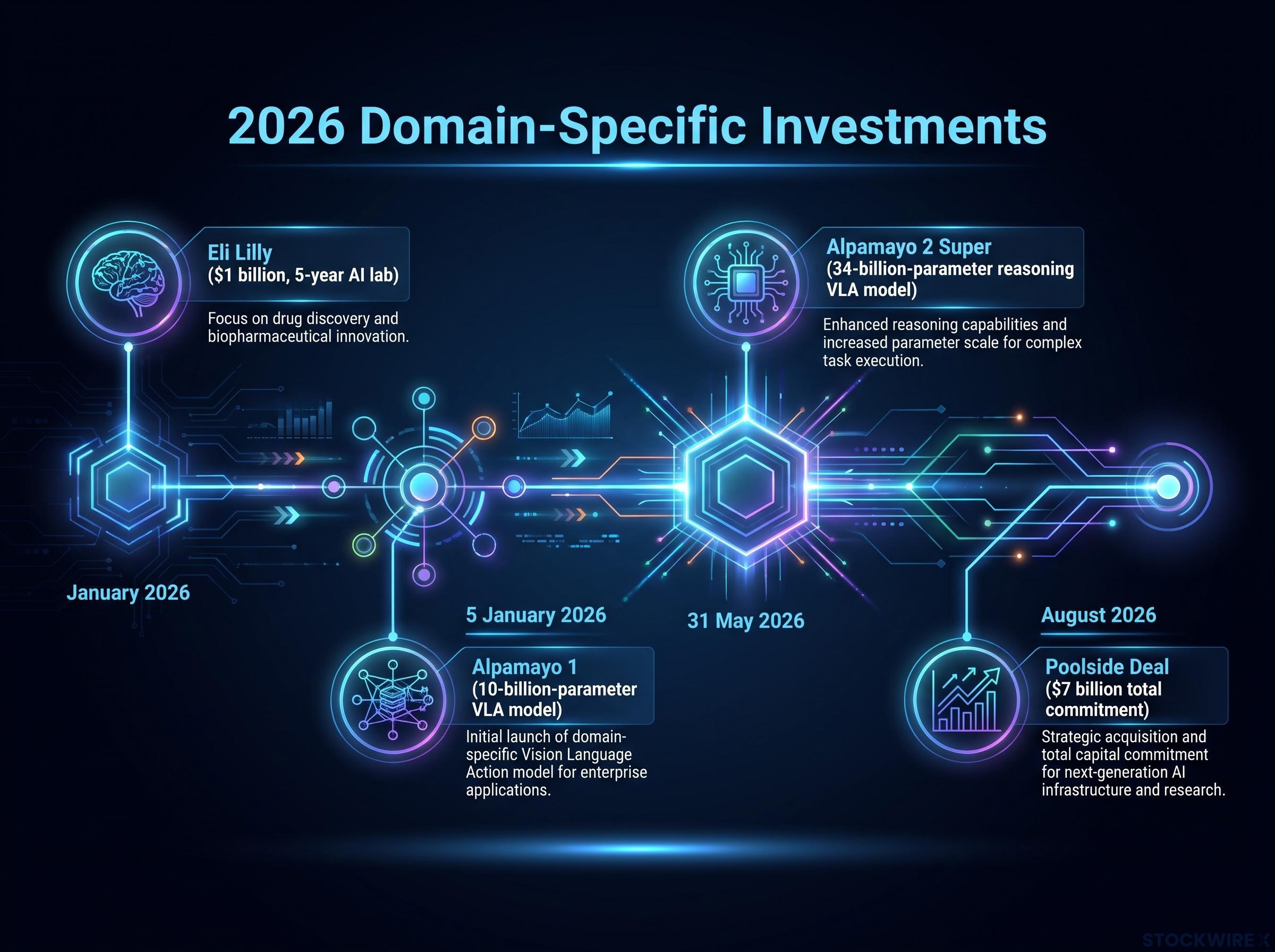
The clearest example is autonomous vehicles. Nvidia developed the Alpamayo family of Vision-Language-Action models (systems that combine seeing, understanding language, and taking action) for self-driving cars, a domain where no major frontier lab had built adequate solutions and where Nvidia held both the hardware and the data-pipeline advantage.
Two models define the range:
- Alpamayo 1: a 10-billion-parameter VLA model, launched at CES on 5 January 2026, aimed at reasoning-based self-driving.
- Alpamayo 2 Super: a 34-billion-parameter reasoning VLA model for Level 4 robotaxis, launched at GTC Taipei on 31 May 2026.
These act as cloud-side teacher models, trained on Nvidia’s Cosmos platform and then distilled into smaller versions that run locally on Nvidia’s DRIVE AGX Thor car hardware. Every one of them creates demand for more Nvidia silicon.
The same logic runs through the Poolside agreement, announced in August 2026, which is frequently misread as Nvidia becoming an AI model company. It is not an acquisition.
The Poolside deal, in structure: a $6 billion license for Poolside’s “Model Factory” software and its open-weight Laguna coding models, plus a $1 billion equity investment at a $12 billion pre-money valuation. A $7 billion total commitment. Poolside remains an independent company, and more than 100 of its engineers were hired into Nvidia.
That structure matters. Nvidia gets open-weight coding capabilities and elite engineering talent without becoming a foundation model business that competes with its own customers. This is the same pattern behind the Nemotron open-weight model family (reasoning and coding models integrated with Nvidia’s NIM microservices), which shipped in stages between December 2025 and June 2026.
The vertical push extends into life sciences too. In January 2026, Nvidia and Eli Lilly announced a $1 billion, five-year co-innovation AI lab, building on Nvidia’s BioNeMo platform for drug discovery.
Here is the interpretive thread for you. Nvidia competes vertically only where doing so expands the total market for its own GPUs. Each domain-specific model is, in effect, a demand-creation engine for the hardware underneath it. The exceptions do not contradict the strategy. They serve it.
What the strategy holds and where the pressure builds from here
Trace the full arc and the picture resolves. Nvidia’s refusal to compete with its customers produced universal adoption and 106% year-over-year revenue growth. The NeoCloud build-out hedges its concentration risk. The domain-specific models expand its hardware market rather than threatening its buyers. It is a coherent system.
The durability of that system rests on three things holding at once: hyperscalers continuing to find Nvidia more cost-effective than custom silicon for frontier training, NeoCloud partners actually absorbing the GPU capacity Nvidia has guaranteed, and vertical models continuing to grow the pie rather than antagonise customers.
There is a fourth variable the market underappreciates, and it comes from the open-source ecosystem Nvidia itself backs. Research cited in the unified summary shows 94% of enterprises now use two or more LLM providers, and open models reach roughly 90% of closed-frontier performance at up to 87% lower inference cost when self-hosted.
Semiconductor market concentration has reached a level that draws direct comparisons to the dot-com era, with chip companies accounting for a record 13% of US equity market capitalisation as of April 2026, a backdrop that makes the gap between Nvidia’s revenue acceleration and the unresolved question of AI product monetisation a live valuation risk rather than a theoretical one.
That commodity pressure sits on Nvidia’s customers today. Over time, commodity pressure on customers becomes commodity pressure on the average selling prices Nvidia can command.
So watch these three signals over the next two to three quarters:
- Hyperscaler custom silicon adoption rate: how aggressively the big four route internal inference onto their own chips.
- NeoCloud capacity utilisation: whether the guaranteed GPU capacity is actually being filled, which determines if that $175 billion backstop stays theoretical.
- Sequential quarterly revenue growth: the leading indicator, because it will move before the year-over-year headline does.
None of this tells you what Nvidia is worth. It tells you what information would change the answer, which is the more useful thing to carry away.
This article is for informational purposes only and should not be considered financial advice. Investors should conduct their own research and consult with financial professionals before making investment decisions.
Past performance does not guarantee future results. Financial projections are subject to market conditions and various risk factors. Forward-looking figures, including the $175 billion backstop exposure estimate for 2028, are speculative and subject to change based on market developments and company performance.