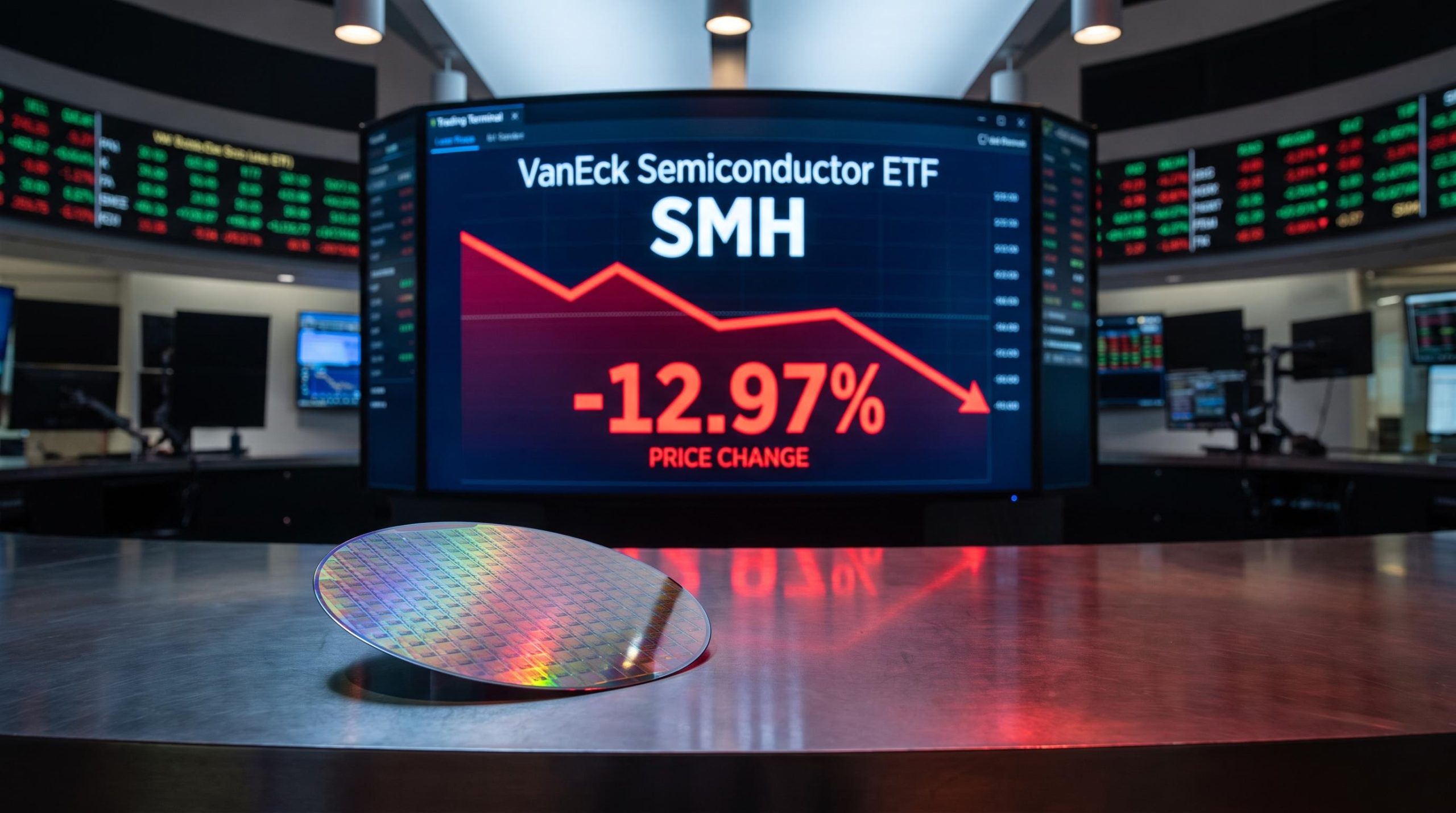
The chip sector spent most of 2026 building one of the most impressive rallies in its history. The VanEck Semiconductor ETF (SMH) carried a 52-week return above 77% heading into September, the kind of run that makes drawdowns look like buying opportunities by reflex.
Then, in the space of a few trading days, the tone changed. January put options on SMH surged, the leveraged bearish fund SOXS jumped more than 15% in a single session, and Arm Holdings shed nearly 9%. Something in the semiconductor stocks under pressure story shifted from momentum to fear.
Two forces are hitting the sector at once and feeding off each other. AI regulation, resisted by governments even as industry leaders pushed for it, is now a live policy variable with real export-control machinery behind it. At the same time, international exposure through South Korea’s chip-heavy equity market is acting as an amplifier, turning single-session chip losses into broad emerging-market pain.
This analysis separates the signal from the noise: which parts of the selloff reflect genuine structural risk, which reflect temporary technical pressure, and where the institutional debate is genuinely unresolved. The aim is to help you assess your own exposure, not simply watch the tape.
What the single-session data actually shows
Look at the session as a pattern rather than a set of isolated headlines, and the story tells itself before anyone has to name it.
SMH carried a downside target around the 515 level, the lower boundary of its ascending channel, while January put options on the fund climbed notably on the day. Traders holding those puts took profit on roughly 40% of the position, a precaution against a snap-back rally rather than a signal of doubt.
The clearest tell came from the leveraged inverse fund.
The Direxion Daily Semiconductor Bear 3X ETF (SOXS) gained more than 15% in a single session, a move that does not happen without active, leveraged bearish positioning by participants who were already leaning short before the decline arrived.
Across individual names, the damage was broad but not uniform. Arm Holdings fell nearly 9% and closed at $264.79 on 11 September 2026, well below its 2026 high near $324.86. Cerebras Systems (CBRS) dropped over 5% and edged toward lifetime lows, striking given the stock priced at $185 in its 13 May 2026 IPO and opened at $350 the following day. Applied Optoelectronics (AAOI) fell close to 8%, closing at $105.36 on 11 September 2026 after touching roughly $190 in June.
| Instrument | Session Move | 2026 High | 11 Sep Close | Drawdown from High |
|---|---|---|---|---|
| SOXS (3X Bear) | +15%+ | n/a | n/a | Inverse fund (gains on decline) |
| Arm Holdings | -9% | $324.86 | $264.79 | ~18% |
| Cerebras (CBRS) | -5%+ | $350 (opening) | Near lifetime lows | Substantial post-IPO retrace |
| Applied Optoelectronics | -8% | ~$190 | $105.36 | ~45% |
Here is what the convergence tells you. Leveraged bearish positioning in SOXS, put option gains in SMH, and simultaneous declines across both a high-multiple growth name like CBRS and an operationally exposed name like AAOI point to professional money that was positioned ahead of this move, not reacting to it. That distinction matters for timing: a pre-positioned selloff suggests the thesis behind it has been forming for weeks, which changes how you should think about how long the pressure lasts.
When big ASX news breaks, our subscribers know first
Why South Korea is the sector’s hidden amplifier
The South Korea equity ETF (EWY) dropped nearly 6% in the same session, and at first glance that looks like ordinary emerging-market weakness. It is not.
EWY behaves less like a diversified Korean equity fund and more like a concentrated semiconductor vehicle wearing a national label. The reason sits in the index it tracks.
Samsung Electronics and SK hynix together dominate the KOSPI, with combined weighting estimates ranging from 39.88% to 56.5% across 2025 and 2026 reports. When the two largest holdings are memory-chip giants, the fund inherits their volatility wholesale.
The fund’s composition makes the point concrete:
- Information Technology sector weight of roughly 48% to 61.55% of the fund
- Semiconductor sub-exposure between 23% and 28.6%
- SK hynix alone at approximately 23% of EWY
- Both Samsung and SK hynix are premier producers of AI-critical high bandwidth memory (HBM), the memory that AI data centres depend on
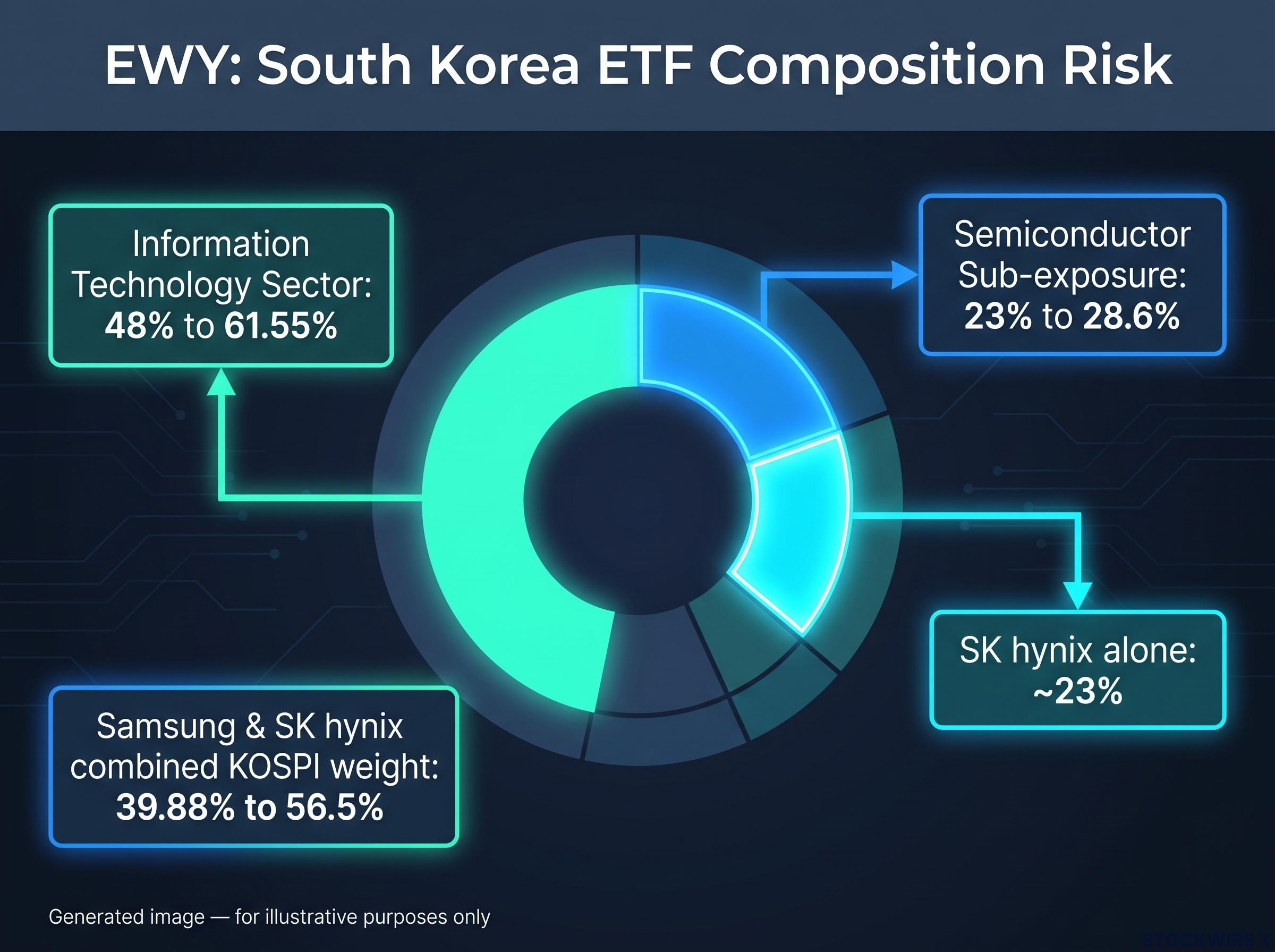
That last point is the transmission wire. HBM demand tracks AI server build-out, so any doubt about AI infrastructure spending flows straight into Korean chipmakers and, by extension, into EWY. For anyone holding a broad emerging-market or international fund, this is the uncomfortable realisation: geographic diversification does not automatically buy you sector diversification. EWY is a quasi-leveraged bet on the global memory cycle with a Korea sticker on the front.
How the chart structure signaled the breakdown
The technical picture had been flashing this vulnerability for weeks. EWY’s chart structure had been deteriorating since mid-August, well before the headline session.
The cleaner read came from KORU, a leveraged Korea instrument used as a short vehicle. Following a short initiated on the 9th, KORU moved from above 25 into the teens across three sessions, a decline exceeding 20% that confirmed the fundamental fragility with a fundamental technical break.
The pressure was not confined to Korea. The developed-markets ETF EFA also broke below a multi-month range and an established trend line during the session, a sign that the weakness was part of a broader international breakdown rather than a single-country story. If you hold international exposure of any kind, the takeaway is to audit what your funds actually own, because the label and the risk are not always the same thing.
The regulatory shift that the market is pricing in
There is an unusual reversal at the heart of this selloff. Normally industry resists regulation and governments push it. Here, AI industry leaders from competing camps have aligned on the case for oversight while governments have been the more reluctant party, leaving the market pricing in a risk that does not yet have a single legislative anchor.
Trace the export-control architecture chronologically and you see the risk has been assembling for roughly 18 months, not appearing overnight.
- Biden-era AI Diffusion Rule (13 January 2025): The Bureau of Industry and Security created worldwide licence requirements for advanced computing chips and AI model weights, capping exports to most countries, blocking nations of concern, and exempting 18 allied states.
- Trump administration modification (13 May 2025): The Department of Commerce rescinded the worldwide diffusion rule but kept strict controls in place and raised global due-diligence and compliance expectations for exporters.
- Draft US framework (March 2026): Proposed rules would condition shipments of 200,000 chips or more on foreign nations investing in US AI data centres or offering security guarantees, with additional licensing thresholds for installations under 1,000 chips.
- EU Chips Act 2.0 (June 2026): Links AI policy to chip procurement through an “AI gigafactories” framework, fusing AI regulation with industrial policy.
That last entry matters because it shows the trend is not a US-only phenomenon. The regulatory direction is converging across jurisdictions, which makes it far harder to price as a passing news cycle.
The industry itself has flagged the structural cost.
Policy groups including the Semiconductor Industry Association (SIA) and the Center for Strategic and International Studies (CSIS) have warned that onerous licensing, location-verification, and end-use monitoring act as a long-run drag on US chip innovation and access to global revenue.
Read the arc from January 2025 to now and the interpretation becomes clearer. What the market is selling is not one event. It is the accumulating probability that chip hardware flows face increasing political friction regardless of which administration holds power. Policy overhang of this kind does not clear with a single announcement, so if you are weighing the sector, treat this as a duration risk to be assessed rather than a one-off shock to be waited out.
The AI regulation market impact was concrete and measurable even before any company missed an earnings number: Goldman Sachs estimates that every one percentage-point decline in assumed long-term AI growth can cut enterprise value for high-growth stocks by roughly 29%, translating regulatory uncertainty into a valuation haircut that shows up in prices before it shows up in results.
The bull case has not disappeared, but it has conditions
None of the above erases the fundamental case, and the institutional bull argument still carries real weight.
The sell-side numbers are substantial. Consider the forward projections:
The memory chip pricing cycle provides the clearest counterweight to the regulatory risk narrative: DRAM contract prices surged 90-95% in Q1 2026 and a further 58-63% in Q2 2026, and HBM capacity sold out through 2026-2027, meaning the earnings base that export controls are disrupting is itself at a historic peak, compressing the net negative impact relative to what the same controls would have meant in a down-cycle.
- Goldman Sachs projects semiconductor equipment spending of $58 billion (2026), rising to $84 billion (2027) and $109 billion (2028), a clear multi-year capital expenditure trajectory.
- Bank of America forecast total semiconductor market sales to grow around 15% in 2025, reaching approximately $725 billion.
There is also a structural reason the bull case holds up under regulatory pressure: sovereign AI. Governments unsettled by export-control uncertainty are funding their own domestic compute, which creates a demand floor that is policy-driven and therefore partly insulated from the very controls weighing on the sector.
The sovereign AI chip market is projected to grow from $1.12 billion in 2025 to $10.95 billion by 2032, a compound annual growth rate of roughly 38%.
The spending commitments are concrete. The EU’s InvestAI initiative mobilised €200 billion to build AI gigafactories requiring more than 100,000 processors each, and South Korea launched a $7 billion AI plan that includes direct funding for domestic chip firms.
Here is the qualification you have to hold alongside the optimism. Sovereign AI is a genuine growth vector, but it is not a like-for-like replacement for the global revenue base that export controls restrict. The net effect on any single company depends on its exposure mix. The long-term demand trajectory is intact; the path to capturing it now runs through political variables that were simply not priced into chip stocks at the start of 2026.
What past export-control cycles tell us about recovery timelines
History offers a useful reference for how the sector absorbs policy shocks. The 2018-2019 US-China trade war disrupted semiconductor flows sharply, with broad US semiconductor imports shrinking by roughly 15% in 2019. The 2022-2024 export-control cycle drove a 32.5% decline in China’s imports of semiconductor manufacturing equipment.
Both episodes produced sharp disruption followed by supply-chain adaptation rather than permanent collapse. BCG models from the earlier cycle put the potential revenue impact in a wide band of 8% to 37%, with median year-on-year growth for top US chipmakers falling from 10% to around 1%. That range, rather than any single forecast, is the spread of outcomes worth holding in mind.
The pattern closes the analytical loop. The question historically has not been whether the sector recovers, but which companies and geographies capture the recovery demand once supply chains realign.
What the current setup means for investors watching the sector
Pull the four layers together and the picture is not a single verdict but a set of interacting vulnerabilities. There is technical pressure in SMH, with the 515 channel boundary as a near-term reference point. There is South Korea contagion risk for anyone with international exposure. And there is a multi-jurisdiction regulatory overhang that will not resolve on one headline.
Context matters for the magnitude. SMH’s 1-month return of -8.21% and 3-month return of -12.97% as of mid-September 2026 sit against a 52-week return of +77.30%, so this is a meaningful drawdown inside a very large rally, not a collapse. Arm Holdings still carried a year-to-date gain of +142.2% on 11 September 2026 even after its near-9% session, and AAOI held a 12-month return of +292.4%. The base these names fell from was extraordinary.
Two variables are worth watching above the daily noise:
- Progress of the March 2026 draft framework toward legislation. This is the single clearest signal of whether the regulatory overhang hardens into law.
- HBM demand signals from Samsung and SK hynix. Order volumes from the Korean memory makers are the earliest read on whether AI data-centre build-out is accelerating or pausing.
HBM order volumes from Samsung and SK Hynix are worth watching precisely because the memory wall — the structural condition in which memory bandwidth rather than compute throughput constrains AI workloads — means that conventional DRAM and SSD spending moves in tandem with HBM demand, making the Korean producers a leading indicator for the entire AI infrastructure spending cycle rather than just one segment of it.
Your own assessment should turn on three contingent factors rather than a blanket buy-or-avoid call:
- Geographic exposure: whether your international funds carry hidden concentrated chip risk, EWY-style.
- Time horizon relative to the regulatory timeline: a slow policy story affects a five-year holder very differently from a five-week trader.
- Sub-sector differentiation: equipment makers, memory producers, and AI-accelerator names carry different sensitivity to export controls.
This article is for informational purposes only and should not be considered financial advice. Investors should conduct their own research and consult with financial professionals before making investment decisions. Past performance does not guarantee future results, and financial projections are subject to market conditions and various risk factors.
Reading the selloff clearly before the next move arrives
The central finding is that this selloff is neither purely technical nor purely fundamental. It is the product of three reinforcing forces, regulatory overhang, South Korean contagion, and high-multiple compression in recently listed AI names, and each carries a different duration and resolution timeline.
The long-term demand story has not changed materially in the past week. AI infrastructure build-out and sovereign AI spending, with the sovereign chip market projected to compound at roughly 38%, remain intact. What changed is the market’s willingness to pay a premium for that story without a clearer regulatory roadmap.
The regulatory timeline from January 2025 to September 2026 confirms this is a slow-moving policy story, not a one-session event. That is precisely why day-to-day price action is a poor guide to it.
The next real catalyst will likely come from one of two places: a concrete legislative development on the March 2026 draft framework, or a meaningful data point on HBM order volumes from South Korean producers. Investors positioned to read those signals early will be better placed than those reacting to the tape.