
The story most investors tell themselves about great founders is that genius and vision did the heavy lifting. The data, and the founders themselves, tell a more complicated story.
David Rubenstein, co-founder of The Carlyle Group, has spent decades in rooms with Jeff Bezos, Bill Gates, and Ray Dalio. His firsthand read is that extraordinary outcomes are not simply the product of extraordinary people. They are the product of extraordinary people in specific moments, making specific bets, with a serious amount of fortune running alongside them.
The most useful lessons from successful founders are not about copying traits. They are about understanding what the evidence actually says: who starts transformational companies, which qualities genuinely predict success, and how structural luck compounds into category dominance. After this, you will have a sharper framework for separating luck from skill when you evaluate an early-stage business.
The startup failure myths investors need to stop believing
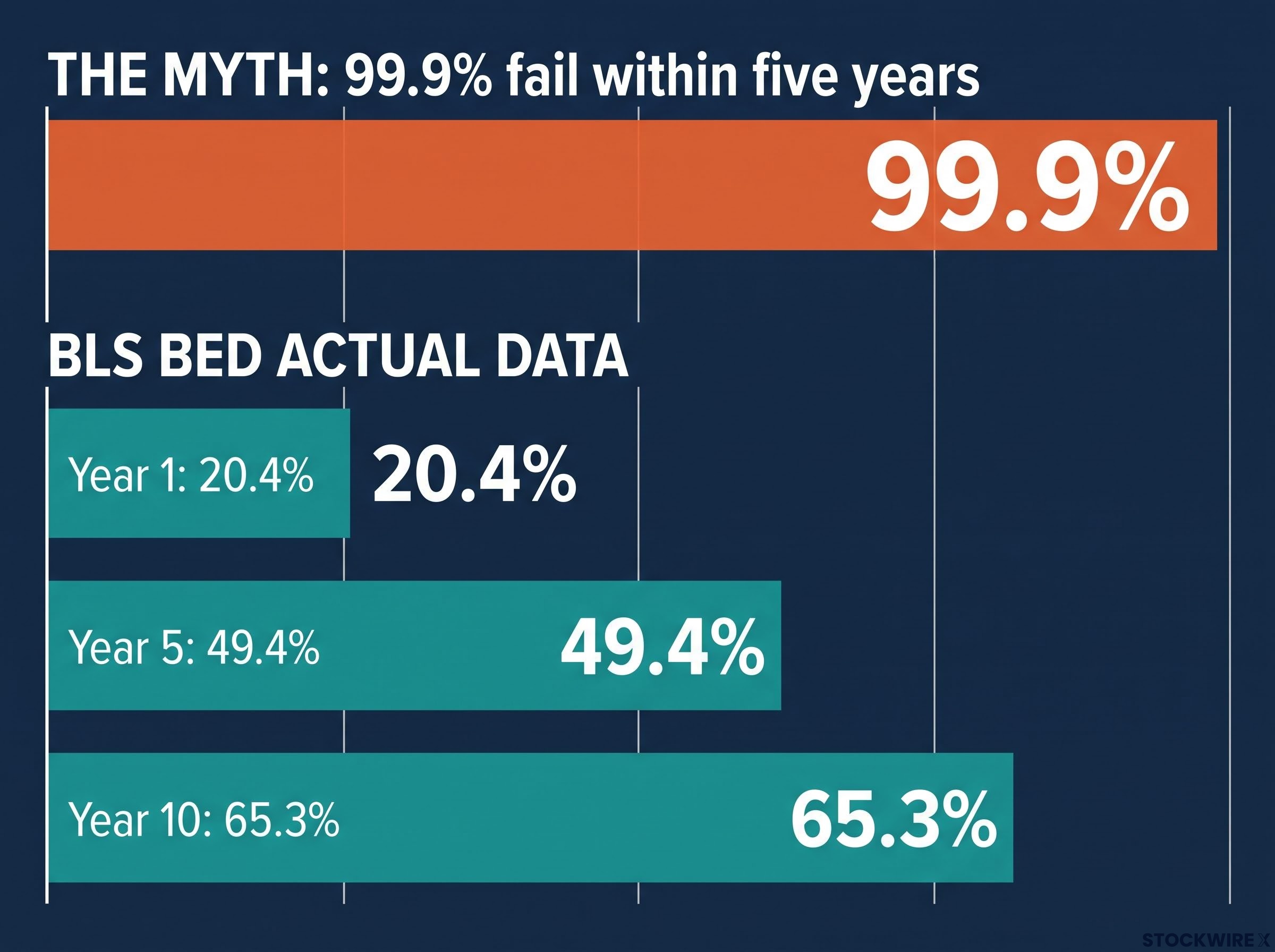
You have probably heard the number: 99.9% of US companies fail within five years of founding. It is dramatic, it is memorable, and it is not supported by the current evidence.
The best-grounded figures come from the U.S. Bureau of Labor Statistics (BLS) and its Business Employment Dynamics (BED) survival tables. According to a 2025 analysis of the 2024 BED data, 20.4% of businesses fail in their first year, 49.4% fail within five years, and 65.3% fail within ten. Multiple 2026 syntheses using the same BLS BED Table 7 cohort data through March 2025 put the five-year survival rate at roughly 50.6-51.4%.
| Timeframe | Failure rate (BLS BED) |
|---|---|
| Year 1 | 20.4% |
| Year 5 | 49.4% |
| Year 10 | 65.3% |
Why this matters to you: the corrected data changes the base rate baked into any early-stage thesis. Roughly a coin flip over five years is hard, but it is not the near-certain wipeout that the folklore implies, and that recalibration should shape how much diversification and how much conviction each position warrants.
Why the 99.9% figure persists despite the evidence
The culprit is survivorship bias, the error of drawing conclusions from only the visible winners while the failures quietly disappear from the record. When you study only the survivors, your picture of the norm gets systematically distorted.
Survivorship bias operates here in the same way it distorts broader investing narratives: the founders who employed identical habits and failed leave no visible record, so the pattern of visible winners gets treated as proof of a replicable formula rather than a selected sample.
Entrepreneur magazine and The Decision Lab both point to Jobs, Gates, and Zuckerberg as the figures whose prominence encourages people to copy visible behaviours, while the thousands of founders who behaved almost identically and failed leave no trace. Dramatic statistics travel faster than accurate ones, and the inflated number sticks precisely because it feels true.
When big ASX news breaks, our subscribers know first
Who actually starts transformational companies (the founder age data will surprise you)
The image is fixed in the culture: the college-aged prodigy in a dorm room. Gates and Zuckerberg left their studies early to build world-changing companies, and those two stories do enormous work in shaping how investors picture a founder before they have read a single line of a pitch deck.
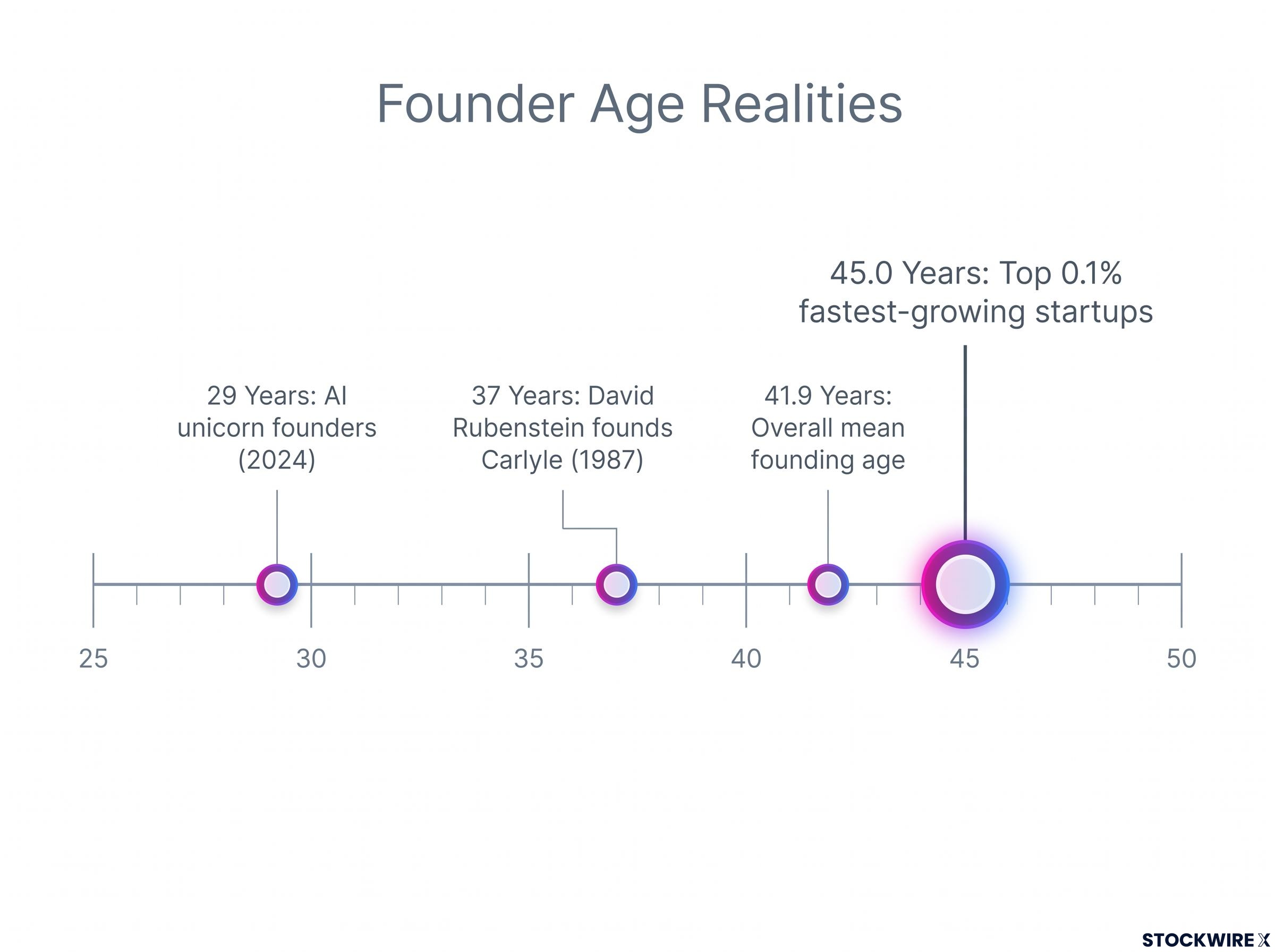
The empirical picture looks nothing like the archetype. The landmark study “Age and High-Growth Entrepreneurship” by Azoulay, Jones, Kim, and Miranda used U.S. Census Bureau data on 2.7 million founders between 2007 and 2014, and it found a mean founding age of 41.9 years. For the top 0.1% fastest-growing startups, the mean founder age rises higher still.
The empirical case rests on Age and High-Growth Entrepreneurship, the Azoulay, Jones, Kim, and Miranda study published through the U.S. Census Bureau’s Center for Economic Studies, which analysed 2.7 million founders and found the mean founding age of the top 0.1% fastest-growing startups to be 45.0 years, directly contradicting the dorm-room archetype.
The founders of the top 0.1% fastest-growing startups had a mean age of 45.0 at founding, according to Azoulay, Jones, Kim, and Miranda.
Syntheses from MIT Sloan and Kellogg reinforce the point: the average founder of a high-growth tech venture sits around 45 at founding, and in IPO or acquisition exit cases the average lands in the mid-40s.
Rubenstein himself is a clean anchor point. He founded Carlyle in 1987 at age 37, motivated partly by a then-current belief that anyone who had not started a company by that age probably never would. The data now says the opposite: he was, statistically, still on the early side of the curve.
Here are the numbers worth keeping in mind:
- Overall mean founding age across 2.7 million founders: 41.9 years
- Mean age for the top 0.1% fastest-growing startups: 45.0 years
- The exception: AI unicorn founders’ average age fell from about 40 in 2020 to just 29 in 2024, per a Fortune 2026 analysis
That AI exception is instructive rather than contradictory. It shows that capital-rich, hype-driven cycles can temporarily pull the archetype younger in a specific sector, not that the underlying pattern has flipped.
For you as an investor, the read is direct. Mid-career experience appears to be a structural advantage in high-growth company building, so filtering too hard toward young founders in most sectors means systematically passing on the statistically strongest cohort. The empirical centre of gravity sits in the mid-40s, not the early 20s, and first-pass founder evaluation should reflect that.
Extraordinary self-confidence, ordinary starting ambitions, and the psychology behind transformational founders
Here is the detail that should reset your instincts. Bezos’s early ambition, as Rubenstein tells it, was to reach $100 million in annual revenue. Zuckerberg’s original Facebook concept was a tool for Harvard students to find dates.
Neither man began with prophetic, world-remaking scale in mind. What they had was relentless confidence in the face of iterative uncertainty, which is a very different trait from grand vision on day one.
Rubenstein and others have consistently identified the same cluster: extraordinary self-confidence paired with high work intensity, real intelligence, and a willingness to recruit people who covered their own gaps. Early rejection is part of the pattern, not a deviation from it; Steve Schwarzman’s autobiography records that Blackstone‘s first fund was turned down by roughly 97% of prospective investors.
The research complicates any tidy trait checklist. A 2023 PNAS paper found that the two personality traits most consistently predicting startup outcomes are conscientiousness and neuroticism. A 2024 Columbia Business School brief found that high conscientiousness helps early fundraising but is negatively associated with high-growth exits.
The three most consistently evidenced qualities, with the important caveat attached to each:
- Conscientiousness: helps a founder raise a first fund, but can work against a high-growth exit later.
- Neuroticism: consistently predictive of outcomes, though its effect shifts with context and stage.
- Self-confidence: widely observed among transformational founders, yet not uniform even among them.
That last point deserves the human detail behind it.
Rubenstein describes himself as an anxious workaholic who never reached a sense of financial security even a decade into running Carlyle, and rates his own confidence below figures like Bezos or Gates.
His response to that self-assessment is itself the strategic lesson: he deliberately built around partners with stronger technical expertise. What emerges for you is not a clean checklist but a dynamic one. The traits that help a founder raise a first fund can actively work against scaling, which means assessing a founder at a single moment is structurally insufficient. If you lean on charisma or self-presentation as a proxy for transformational potential, you may be measuring the wrong variable at the wrong stage of the company’s life.
The same logic applies directly to management evaluation at the small-cap level, where per-share value creation over time, rather than charisma or founding narrative, is the most reliable signal that a leadership team is compounding rather than consuming investor capital.
The IBM moment: how structural luck compounds into category dominance
In 1980, IBM needed an operating system for its new personal computer and commissioned one from a small company called Microsoft. The contract terms that followed are still studied as one of the most consequential in business history.
IBM took a non-exclusive licence to what became PC-DOS. Microsoft retained ownership and, critically, the right to license the same operating system as MS-DOS to any other manufacturer it chose.
The reasoning was risk management, not strategy. IBM’s legal department actively wanted Microsoft to own the software so that any intellectual property infringement risk sat with Microsoft, not IBM.
IBM’s legal team reportedly treated the operating system as a “hot potato” in terms of intellectual property exposure, which is exactly why they were content to let Microsoft keep it.
The upfront price reflected how little IBM valued the asset: roughly $75,000 for the licence, with full rights reportedly available for about $50,000. Then the asymmetry did its work. IBM was prohibited from sublicensing DOS, while Microsoft faced no such restriction, so Microsoft licensed MS-DOS to Compaq and every clone maker that followed.
| Dimension | IBM | Microsoft |
|---|---|---|
| Licence type | Non-exclusive | Retained ownership |
| Sublicensing rights | Prohibited | Unrestricted |
| Long-term outcome | Lost control of its own platform | Windows became the industry standard |
Rubenstein calls this one of the greatest examples of luck in modern business history, and the research supports treating luck as a real structural force. The NBER paper “Skill vs. Luck in Entrepreneurship and Venture Capital” estimates that luck accounts for 17-30% of performance variation, concentrated around idea discovery and market timing.
For you, the case is a template. The party that holds the right to license broadly is the one who captures compounding value as adoption scales, which means that in any modern software, AI infrastructure, or API-layer deal, the question of who controls the licensing layer, and who is barred from sublicensing, matters more than who owns the hardware or the customer.
In AI infrastructure this principle is directly consequential: the value captured at the licensing layer, rather than at the hardware or application endpoint, determines which company inherits the compounding economics as adoption scales across enterprise deployments.
What the luck-and-skill balance actually means for investors evaluating early-stage companies
You do not have to choose between “skill matters” and “luck matters,” because the current research does not force that binary. The NBER work shows persistent performance among top entrepreneurs and VCs, which is genuine evidence of skill in opportunity selection, execution, and risk management. The same body of statistical analysis puts luck at 17-30% of performance variation, heaviest around idea discovery and timing.
The more useful distinction is between random luck and structural luck. A 2023-2024 University of Southampton doctoral thesis found that luck is heavily embedded in privilege, social networks, and structural conditions such as supportive stakeholders. Harvard Business Review takes this further, arguing that founders can systematically increase their exposure to luck through dense networking and rapid experimentation.
That reframes the founder qualities Rubenstein now emphasises. In 2024-2026 appearances he consistently returns to six attributes, which are best read as signals that a founder will keep stepping into the path of structural luck rather than as a predictive formula:
- Persistence: the willingness to stay in the game through repeated rejection.
- Focus: concentration on the few things that compound.
- Humility: the self-awareness to build around personal gaps.
- Chutzpah: boldness and comfort taking risks outside the norm.
- Ability to influence others: recruiting talent and capital.
- Ethical standards: the trust base that keeps stakeholders engaged.
Structural conditions that multiply founder skill
Three conditions in the research most reliably amplify a founder’s skill into an outsized result.
The first is platform control, the licensing architecture that decides who captures value as adoption scales, exactly as the IBM case demonstrated. The second is network density, which is where structural luck exposure actually lives, and the third is adaptability, the capacity for rapid experimentation.
A 2025 fundraising playbook captures the shift in how investors weight this, distinguishing “10,000-hour founders” who are experienced operators from “coachable hustlers” who are early in their careers, with capital increasingly flowing toward execution ability and adaptability over pedigree. A Harvard-linked commentary from 2025 describes the emerging “AI-Savvy Founder” who treats the company as an experimentation machine, a modern illustration of the same principle. The practical takeaway is that backing transformational companies means evaluating the structural conditions around a founder, not just the founder in isolation.
Building the investor’s lens for transformational potential
The evidence does not hand you a formula. It hands you better questions.
When you next assess an early-stage founder, three questions carry most of the weight:
- Structural positioning: where does this founder sit relative to the platform or licensing layer, and who holds the right to license broadly?
- History under rejection: what does the founder’s track record reveal about persistence when the answer keeps coming back as no?
- Luck-amplifying infrastructure: is the network density, backing, and timing present that lets structural luck compound?
Fortune is irreducible, and Rubenstein’s point is not that this makes analysis pointless. His point is that the founders of transformational companies were the people who kept themselves in the game long enough for luck to find them.
Consider that even Rubenstein could not forecast his own institution’s ripple effects. Glenn Youngkin was recruited from McKinsey to Carlyle, spent 25 years there, and was elected Governor of Virginia in 2021, an outcome no one could have modelled from a résumé. Transformational company building runs on a longer and less predictable timeline than most investors assume, which is exactly why rigorous structural analysis and genuine humility about timing have to be held at the same time.
Individual investors hold structural advantages in this context that institutional allocators do not: the freedom to hold through a multi-year founder maturation arc without client redemption pressure, and the ability to take positions in small-cap companies too early or too small for fund mandates to accommodate.
This article is for informational purposes only and should not be considered financial advice. Investors should conduct their own research and consult with financial professionals before making investment decisions. Past performance does not guarantee future results, and statements about future outcomes are speculative and subject to change based on market developments.