#
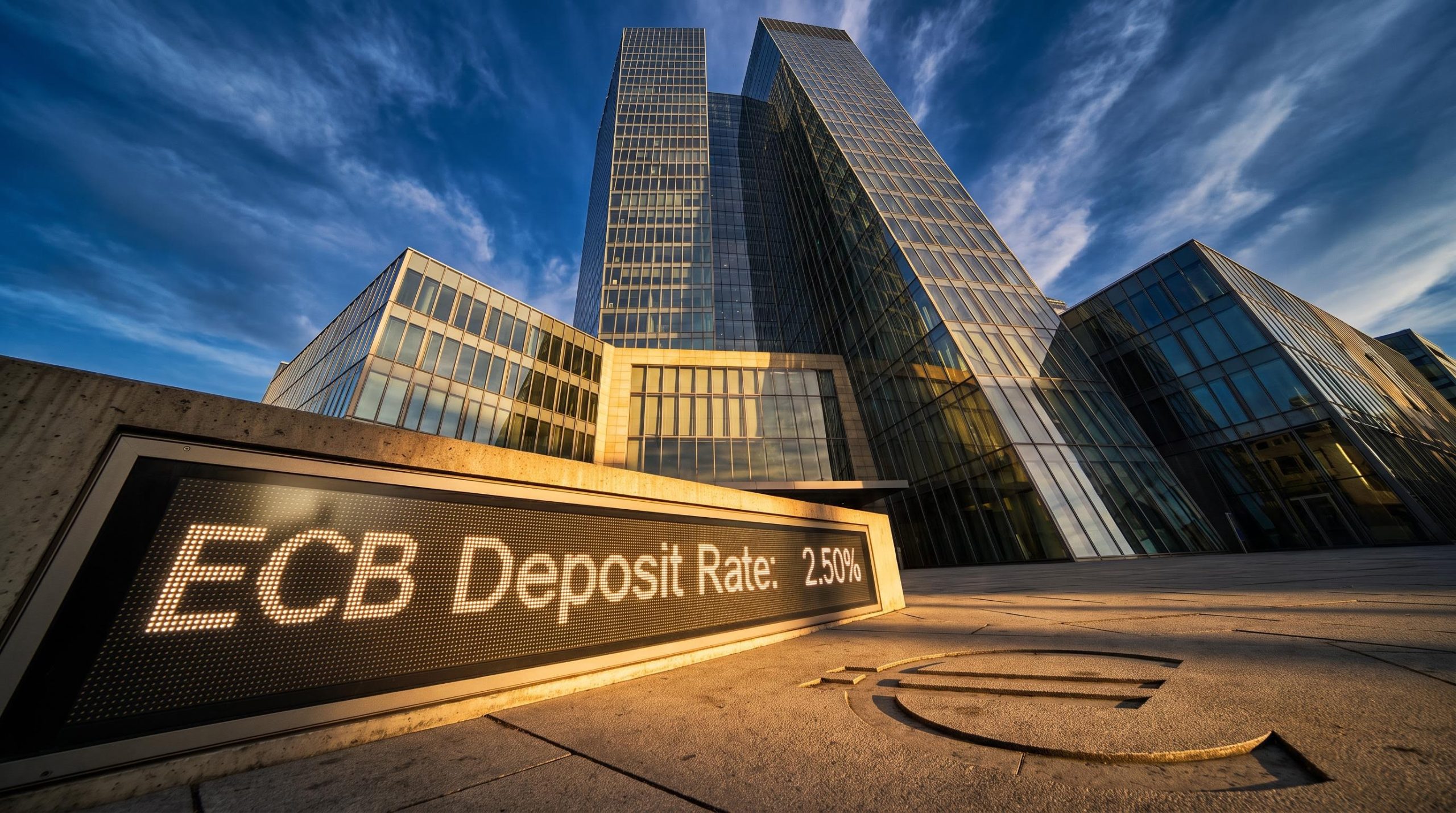
The European Central Bank has raised rates for the second time in three months, lifting its deposit facility rate to 2.50% and making clear the tightening job is not finished. The decision, effective 16 September 2026, lands as a conflict-driven energy shock has pushed the Governing Council’s own inflation projections above target across every year of its forecast horizon.
This is not a one-off adjustment. Markets are now pricing close to 40 additional basis points of ECB tightening before the end of 2026, a path that would carry the deposit rate to 2.75% or higher. For anyone holding euro-denominated assets, exposed to EUR/USD, or watching how a structurally important reserve currency responds to a sustained tightening cycle, the reach of this decision extends well past Frankfurt.
Here is what the September decision actually tells you about where ECB policy is headed, and what that means for euro-sensitive positions.
The September decision: what the ECB actually decided
The ECB raised all three of its key interest rates by 25 basis points on 10 September 2026, with the new levels taking effect on 16 September 2026. The move pushed the deposit facility rate to 2.50%, the main refinancing operations rate to 2.65%, and the marginal lending facility rate to 2.90%.
| Rate Name | New Level | Effective Date |
|---|---|---|
| Deposit facility rate | 2.50% | 16 September 2026 |
| Main refinancing operations rate | 2.65% | 16 September 2026 |
| Marginal lending facility rate | 2.90% | 16 September 2026 |
Each rate governs a different corner of the money market, which is why the three-rate structure matters for anyone pricing Eurozone fixed income. The deposit rate sets what banks earn parking cash at the ECB, the refinancing rate anchors their borrowing costs, and the lending rate caps the top of the corridor.
Each rate governs a different corner of the money market, a structure built around the ECB’s three-rate corridor that sets the ceiling, floor, and midpoint for overnight interbank lending across the entire Eurozone banking system.
The post-meeting communication reinforced a tightening bias rather than hinting at a pause. The ECB’s summary statement underscored the Governing Council’s focus on returning inflation to its 2% target, language that markets read as a signal of more to come.
When big ASX news breaks, our subscribers know first
The second hike in three months: context for the tightening sequence
The September move was the second 25 basis point increase of the year. It followed a hike in June 2026, which itself was the ECB’s first such rate rise since 2023.
Two hikes in three months is not a reaction to a single data print. It is a deliberate, sequential campaign.
That sequencing tells you the ECB has moved from a reactive posture into an active tightening cycle, which changes the question from whether it will hike again to how far the cycle can travel before it begins to weigh on Eurozone growth.
The inflation architecture forcing the ECB’s hand
The forecast underpinning the September decision comes from the Eurosystem staff macroeconomic projections published on 11 June 2026. Those projections put headline inflation, measured by the Harmonised Index of Consumer Prices (HICP), the standard gauge of Eurozone price changes, at 3.0% for 2026, 2.3% for 2027, and only back at the 2% target in 2028.
The structural driver is an energy shock tied to conflict in the Middle East. Euronews framed the September hike as a response to the energy shock driven by the Iran war, and the June projections attribute the revised inflation path directly to a surge in energy costs linked to that conflict. Headline inflation is projected to peak at 3.4% in the third and fourth quarters of 2026 before beginning a slow descent.
The supply-side inflation debate that preceded the June hike, centred on whether rate increases can meaningfully cool price pressures rooted in disrupted energy supply rather than excess demand, has not been resolved by the September move and remains the most important structural question overhanging the December decision.
The most telling detail is the direction of the revisions. Compared with the March 2026 baseline, the ECB lifted its 2026 headline forecast by 0.4 percentage points and its 2027 forecast by 0.3 percentage points.
| Year | Eurosystem Staff Projection | SPF Estimate (Q3 2026) | ECB Target |
|---|---|---|---|
| 2025 | 2.1% | – | 2.0% |
| 2026 | 3.0% | 2.7% | 2.0% |
| 2027 | 2.3% | 2.2% | 2.0% |
| 2028 | 2.0% | 2.0% | 2.0% |
The ECB Survey of Professional Forecasters for the third quarter of 2026, published on 24 July 2026, tells a similar story from an independent set of eyes: headline inflation of 2.7% in 2026, 2.2% in 2027, and a return to 2.0% over the longer term. Forecasters sit slightly below the ECB’s own numbers, but both see inflation above target through 2027.
BBVA Research framing Following the September decision, BBVA Research now expects another 25 basis point hike toward the end of the year, taking the deposit rate to 2.75%, with further upside risk if the conflict and energy shock persist.
An inflation forecast that sits above target across the full projection horizon, and that has been revised up in two consecutive rounds, tells you the ECB cannot credibly pause without risking its inflation-fighting credibility. For bond investors and currency traders, that projection path is the single most important input to duration and carry positioning in euro assets right now.
What markets are pricing in for the rest of 2026
Markets have already done the maths. Following the September decision and the official communications that came with it, investors are pricing close to 40 additional basis points of ECB tightening before the end of 2026.
That figure is not a coin flip. It implies near-full pricing of one more 25 basis point hike, plus partial pricing of a second, and the institutional research desks are lined up behind it.
- BBVA Research, in its 10 September 2026 note “Europe | ECB hikes, December looms larger,” expects a further 25 basis point hike in December, taking the deposit rate to 2.75%, with explicit upside risk if the energy shock and conflict persist.
- Scotiabank, in its mid-September publication “Hawkish ECB Hike Tees Up Additional Tightening,” described the move as the second quarter-point increase since the campaign began in June and read it as setting up more to come.
- Barclays analysts similarly anticipated further ECB tightening following the hawkish policy communication.
Scotiabank “Hawkish ECB Hike Tees Up Additional Tightening.”
When three major research desks independently reach for the same hawkish read and project further hikes, the signal has been received cleanly. That makes a December hold the surprise scenario, not the base case.
Notably, no prominent dovish or dissenting institutional voices surfaced in the post-September commentary. For traders pricing EUR/USD or Eurozone rate products, that absence sharpens the directional signal: the near-term policy corridor points one way, and there is little visible pushback against it.
What the ECB’s pivot means for the euro and global FX markets
The reach of this decision starts with the euro’s structural weight. It is the world’s second most actively traded currency, the official unit of exchange for 20 Eurozone nations, and one half of EUR/USD, the most heavily transacted currency pair on the planet.
- Official currency of 20 Eurozone nations
- Second most actively traded currency globally
- EUR/USD is the world’s most transacted currency pair
- The four largest Eurozone economies represent roughly 75% of the bloc’s total output
That structural footprint means an ECB shift into active tightening is not a regional policy footnote. It is a recalibration of a major global risk anchor, and any portfolio with euro exposure needs to account for it.
The mechanism runs through interest rate differentials. As the ECB tightens, the carry dynamics of euro-denominated assets shift relative to other reserve currencies, which feeds into capital flows and EUR/USD positioning. Higher rates raise the return on holding euros, all else equal, which alters the relative attractiveness of the currency against the US dollar and other alternatives.
The carry dynamics of euro-denominated assets shift relative to other reserve currencies when the ECB tightens, a transmission channel that runs through rate differentials, OIS curve pricing, and the gap between what is priced and what the ECB actually delivers.
Because Germany, France, Italy, and Spain together generate around 75% of Eurozone output, an ECB rate decision is a macro signal about a systemically significant economic area, not a niche adjustment.
Why ECB signals carry outsized weight in global FX
The ECB Governing Council meets eight times a year, and each decision arrives with post-meeting communication from ECB President Christine Lagarde that markets parse closely for forward guidance. That cadence means every meeting is a scheduled repricing event.
A single 25 basis point move from the ECB does not just shift EUR/USD. It ripples across the full set of euro crosses, from EUR/JPY to EUR/GBP, because the euro sits on one side of so many of the world’s most traded pairs.
For anyone holding EUR/USD, Eurozone equities, or euro credit, the shift from pause to active tightening changes the relative appeal of euro assets, and the currency’s structural weight amplifies every signal the ECB sends.
What the December meeting will settle, and what to watch until then
The market has priced the consensus. What matters now is spotting the inputs that could force a reprice in either direction before the next ECB decision.
- The energy price trajectory tied to the Middle East conflict. BBVA Research explicitly named the persistence of the conflict and energy shock as the variable most likely to push the ECB beyond 2.75%, which makes energy markets the highest-frequency leading indicator ahead of December.
- Updated Eurosystem staff projections. The September 2026 projections were not published alongside the rate decision, so the June 2026 forecasts remain the operative baseline until fresh numbers arrive. Any revision to that inflation path would reshape the December calculus.
- The tone of Governing Council communication. A shift toward data-dependent, pause-friendly language would challenge the hawkish consensus the market has built.
The energy price trajectory tied to the Middle East conflict has already demonstrated its capacity to force emergency fiscal responses across Japan and Europe, with Brent reaching approximately $111 in the weeks following the Barakah drone strike and the IEA classifying the resulting supply disruption as a persistent structural risk rather than a transient spike.
The December hike to 2.75% is BBVA’s base case, with upside risk stated openly. With roughly 40 basis points already priced for year-end, the meeting is high-stakes before a single data print lands.
There is a second-order risk worth naming. The absence of any dovish institutional counterweight makes this a consensus trade, and consensus trades unwind sharply when the data diverges from the base case. The asymmetric risk sits not in the base case itself but in the scenarios where energy either escalates further or reverses hard.
This article is for informational purposes only and should not be considered financial advice. Investors should conduct their own research and consult with financial professionals before making investment decisions.
Past performance does not guarantee future results. Financial projections are subject to market conditions and various risk factors. Forward-looking statements are speculative and subject to change based on market and geopolitical developments.