

ECT completes its MXene stack with a defence-use sublicence
Environmental Clean Technologies Limited (ASX: ECT) has announced that Xenica Inc, a wholly owned subsidiary of its acquisition target Xenica Pty Ltd, has secured a sublicence from MXene Inc. to produce and sell MXenes for military and defence end-uses. The agreement brings together the market-access component of a four-part strategy ECT has been assembling to move FJH-produced MXenes from the laboratory to defence customers.
The acquisition of Xenica is subject to shareholder approval and is expected to complete on or around 22 October 2026. Any revenue from the sublicence remains subject to acquisition completion, successful and repeatable scale-up, production of material meeting customer specifications, and customer qualification.
ECT’s assembled MXene stack now comprises four interlocking components:
- Exclusive Flash Joule Heating (FJH) synthesis licence from Rice University, held via Xenica
- US reactor production platform at Metallium Ltd’s Gator Point facility
- Initial supply of US-sourced MAX Phase precursor
- Defence market rights via the MXene Inc. sublicence
When big ASX news breaks, our subscribers know first
What MXenes are and why production has been the problem
MXenes are a family of two-dimensional advanced materials that combine metallic electrical conductivity with a surface chemistry that can be precisely tuned for specific end-uses. The combination has attracted sustained research and commercial interest across defence, aerospace, electronics, energy storage, and industrial coatings.
The central obstacle has been production. Conventional MXene synthesis relies on hydrofluoric-acid or fluoride-salt etching of a MAX Phase precursor: a multi-day batch process generating substantial fluoride-containing waste and consuming significant water per unit of product. Scalability issues inherent in this wet-chemical approach have kept MXenes largely confined to laboratory settings, preventing industrial deployment.
Why FJH changes the equation
ECT’s development programme is investigating whether Flash Joule Heating offers a fundamentally different manufacturing pathway rather than an incremental refinement of the conventional multi-stage process. The FJH process reaches reaction temperature in seconds, eliminates bulk acid handling, and materially reduces waste output.
Initial FJH testing through ECT’s work with Metallium has produced MXene material in a fraction of the time required by conventional routes. ECT’s near-term objective is to demonstrate that this result is repeatable at scale at Gator Point. Repeatability, not the initial result, is the current milestone.
The Gator Point reactor agreement that underpins ECT’s production platform was signed as a binding 12-month engineering deal with Metallium, covering three commissioned FJH units that had already demonstrated 83% availability across a continuous 12-hour campaign before ECT’s scale-up programme began.
| Process | Time | Acid use | Waste output | Scalability |
|---|---|---|---|---|
| Conventional etching | Multi-day batch | Hydrofluoric acid or fluoride-salt (bulk) | Substantial fluoride-containing waste; high water consumption | Not scalable; limited to laboratory settings |
| Flash Joule Heating (FJH) | Seconds to minutes | No bulk acid handling | Materially reduced waste | Designed for scale; initial results achieved through work with Metallium |
Defence as the launch market — demand, policy, and pricing
Supply is the constraint, not demand
ECT’s announcement cites public statements from MXene Inc., the sublicence counterparty and the only exclusive military-use MXene licensee, confirming that high-quality MXene production has historically been confined to small batches. MXene Inc. reports it has scaled from grams to kilograms of monthly production and is targeting metric-ton capacity by 2027 to meet existing defence contracts.
The bottleneck is domestic production capacity, not demand. Defence procurement is performance-led: buyers select materials on capability rather than cost, making it an appropriate first market for a new and as-yet unproven production pathway.
High-quality US-produced MXenes are currently offered at prices exceeding US$100 per gram, with higher pricing for electronics- and research-grade material. Realised pricing and revenue will depend on product specification, production consistency, customer qualification, and contracted volumes.
US Executive Order 14415 creates a compliance deadline
US Executive Order 14415, signed 20 July 2026, directs the Department of War to strengthen domestic defence supply chains. The order carries three specific directives relevant to MXene supply:
- Waivers for covered materials from non-compliant foreign sources are restricted from 1 January 2027
- Prime contractors and subcontractors at every tier are required to map supply chains back to raw-material origin
- Qualification of alternative domestic material sources is to be accelerated
A qualified, US-produced MXene from a domestically sourced precursor is the type of supply this policy is designed to bring forward. ECT has sourced an initial 4 kg of MAX Phase precursor from a US defence-aligned source and is progressing discussions to expand precursor supply as the programme scales.
MAX Phase precursor supply was the gating constraint holding back structured production runs at Gator Point, with ECT securing an initial 4kg at US$3,475 per kilogram from a US defence-aligned source, sufficient for approximately 15-40 production runs before the programme scales further.
Initial applications and the radar-absorbing materials market
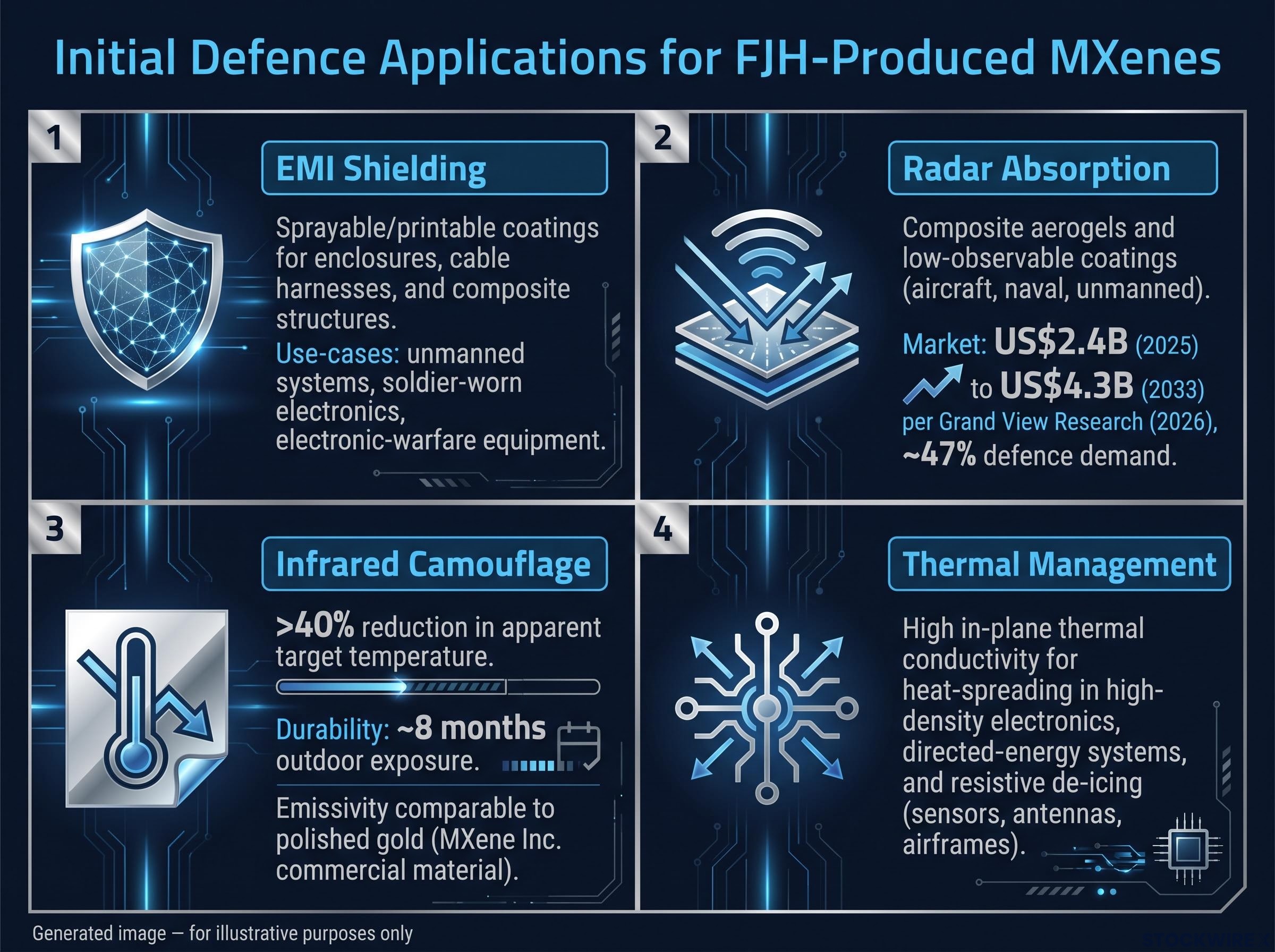
ECT’s announcement identifies four initial application areas for FJH-produced MXenes in defence contexts:
- EMI shielding — MXene films applied as sprayable or printable coatings to enclosures, cable harnesses, and composite structures; use-cases include unmanned systems, soldier-worn electronics, and electronic-warfare equipment
- Radar absorption — MXene composite aerogels for low-observable coatings on aircraft, unmanned systems, and naval superstructures; the radar-absorbing materials market was US$2.4 billion in 2025 and is forecast by Grand View Research (2026) to reach US$4.3 billion by 2033, with defence representing approximately 47% of demand
- Infrared camouflage — Published research has found MXene coatings can reduce apparent target temperature by more than 40%, with stabilised coatings retaining performance over approximately eight months of outdoor exposure; MXene Inc. reports emissivity comparable to polished gold for its commercial material
- Thermal management — High in-plane thermal conductivity in a coatable film supporting heat-spreading for high-density electronics, directed-energy systems, and resistive de-icing of sensors, antennas, and airframe surfaces
It is important to note that the radar-absorbing materials market figures are third-party estimates from Grand View Research (2026), provided as context only and not ECT projections. The performance figures cited for infrared camouflage and other applications are from published research on specific laboratory formulations. ECT has not yet produced material to these specifications; independent characterisation is a near-term milestone.
Executive Chairman Faldi Ismail
“This agreement adds a critical market-access component to the MXene strategy we have been assembling. Subject to completion of the Xenica acquisition, ECT will have brought together FJH synthesis technology, access to a commissioned US reactor platform, US-sourced precursor and, through MXene Inc., rights to supply the defence market.”
“The opportunity exists because the potential of MXenes has been demonstrated for more than a decade, while production at consistent commercial scale remains a significant constraint. Our focus now is straightforward: demonstrate repeatable production at Gator Point, independently characterise the material and progress customer qualification. If the early FJH results can be replicated at scale, we believe ECT has the potential to address one of the key bottlenecks limiting MXene commercialisation.”
What comes next — milestones to watch
The sublicence grants Xenica Inc the right to supply defence end-uses. It is not a customer contract. ECT’s path from sublicence to revenue involves four sequential milestones:
- Repeatable production at Gator Point
- Independent characterisation against defence-relevant specifications
- Customer sample delivery
- Customer and programme qualification
ECT’s longer-term strategy, as outlined in the announcement, is to expand FJH-produced MXene commercialisation across broader industrial sectors through additional end-use licensing arrangements over time. The markets beyond defence, including energy storage, printed and flexible electronics, RF and antenna systems, and industrial coatings, are larger in volume but more demanding on cost, throughput, and consistency. The announced rationale is that defence revenue funds and validates the production platform, consistent with a phased commercialisation approach that targets high-return military applications before pursuing larger-volume markets. This approach aligns with research published in the Renewable and Sustainable Energy Reviews proposing such a phased strategy.
The overall strategy remains conditional on completion of the Xenica acquisition, which requires shareholder approval and is expected to complete on or around 22 October 2026. ECT has stated it will update the market as each milestone is achieved.
Don’t Miss the Next ASX Defence Tech Breakthrough
Big News Blast delivers FREE breaking ASX news straight to your inbox within minutes of release, complete with in-depth analysis already done for you. Join 20,000+ investors who stay ahead of the market the moment announcements hit. Click the “Free Alerts” button at StockWire X to start receiving alerts today.