Look at any coin in your pocket and run a finger along the edge. Those tiny ridges are not decoration. They exist because governments have always found ways to quietly expand their money supply at savers’ expense, and the milled edge was one of the first institutional defences against it.
This is not an antique problem. Global headline inflation sits at roughly 4.7% for 2026 according to IMF projections, U.S. consumer prices have climbed from 2.4% in February to 3.4% by August 2026, and in Argentina the gap between the official and market exchange rate reached nearly 60% by mid-2024 as citizens fled into harder assets.
Against that backdrop, a growing number of investors are looking past equities and gold toward Bitcoin as an additional layer of debasement protection. The question is whether that instinct is grounded in evidence or driven by narrative.
This piece gives you the full picture, including the parts that complicate the case: the historical pattern, the mechanical argument for Bitcoin as an inflation hedge, the empirical record, and the portfolio lens you need to form your own view.
Why governments have always been tempted to debase their currency
Start in ancient Rome. Coin shaving, physically filing slivers of metal off circulating coins, let holders mint fresh currency from existing stock. It was an early, tactile version of expanding the money supply through debasement, and it was so widespread that it forced a structural response.
That response came centuries later at the Royal Mint, where Isaac Newton advanced the milled edge, the ridged rim that made shaving visible and therefore harder to hide. The lesson embedded in that ridge still applies: whenever money can be quietly diluted, someone will try.
The incentive is always the same. Governments facing debt, war, or spending commitments have repeatedly found it easier to expand the money supply than to cut spending or raise taxes openly. Push that logic to its extreme and you get the endpoints history remembers.
- Rome: coin shaving reduced the metal content of currency, eroding real value coin by coin.
- Weimar Germany: runaway money printing rendered salaries and savings nearly worthless within months.
- Zimbabwe: hyperinflation destroyed the purchasing power of bank deposits and wages.
- Venezuela: severe debasement drove citizens into foreign currency and hard assets to survive.
These are not random catastrophes. They are the same structural pressure taken to its limit, which is why the search for non-fiat stores of value keeps returning across centuries.
From coin clipping to quantitative easing: the mechanism changes, the incentive does not
The modern version wears different clothing. Charles Schwab’s April 2026 explainer on the debasement trade defines contemporary debasement not as physical coin tampering but as the product of excessive government debt, unconstrained money creation, and eroding confidence in fiat institutions.
The mechanism changed. The incentive did not. IMF projections show global headline inflation rising from 4.1% in 2025 to 4.7% in 2026 before an expected easing, which illustrates how ongoing structural erosion expresses itself as a cycle rather than a one-off event.
Argentina shows the acute version in real time. In an April 2024 ICIS interview, economist Carlos Perez described savers earning roughly 5% per month on bank deposits while inflation ran near 11% per month under currency controls, a real loss of about 6% monthly that effectively helped recapitalise the central bank.
“Savers are paying with their losses to help the central bank,” Perez explained, describing how policy-induced debasement transfers wealth from households to the state.
By mid-2024, according to a July 2024 OMFIF piece, the gap between Argentina’s official and market exchange rate had widened to nearly 60% as ordinary people fled the peso. The takeaway for you is structural, not seasonal: debasement is the default pressure on any monetary system when fiscal discipline weakens, which is exactly why the question of alternative hedges keeps resurfacing.
Distinguishing debasement from cyclical weakness matters for how investors size their response: Goldman Sachs classifies the current dollar episode as cyclical rather than structural, noting the dollar is roughly 15% overvalued but reserve-currency status is not at risk, a distinction that changes the urgency and scale of any hedge allocation.
When big ASX news breaks, our subscribers know first
What Bitcoin was designed to do, and how that design is supposed to work
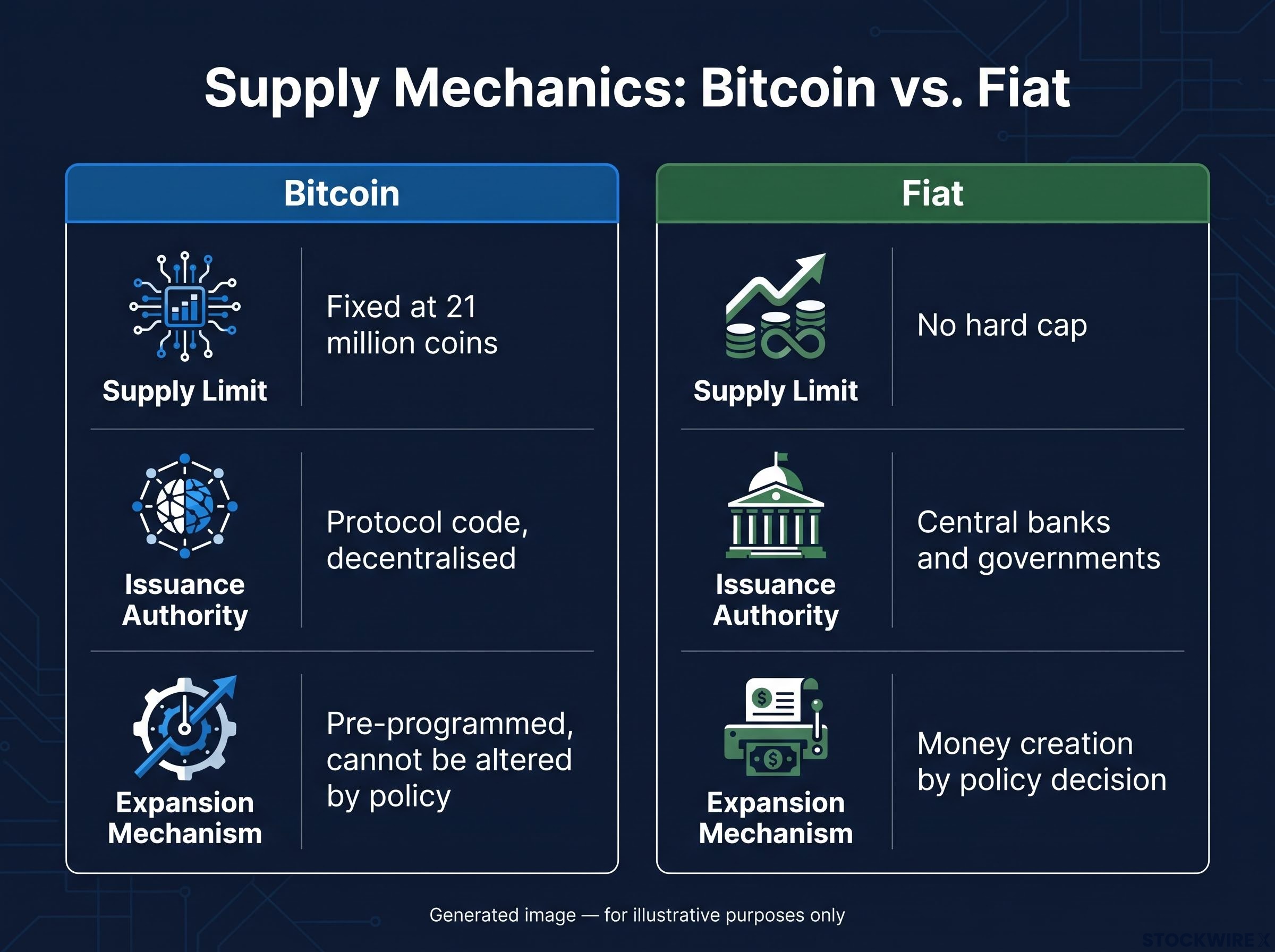
Bitcoin was built as an engineering answer to the problem you just walked through. Where fiat supply can be expanded by policy decision, Bitcoin’s supply is capped at 21 million coins and released on a pre-programmed schedule that no government or central bank can alter.
That is the core anti-debasement mechanism. According to Bitcoin.com’s March 2026 educational material, this scarcity is a real, verifiable design choice that fiat currencies do not share, encoded in the protocol rather than dependent on any institution’s fiscal restraint.
The design rests on three features working together:
- Fixed supply cap: no more than 21 million coins will ever exist.
- Pre-programmed issuance: new supply enters on a predictable, declining schedule.
- Decentralised consensus: no central authority can vote to expand the supply.
This is where the “debasement trade” framing comes in. Schwab’s April 2026 note lists Bitcoin alongside gold and real estate as assets investors use to hedge unsustainable fiscal and monetary policy, and Matrixport’s May 2026 commentary frames Bitcoin as part of a basket of fixed or scarce-supply assets that can theoretically hold purchasing power when governments run chronic deficits and suppress real interest rates.
For investors who have historically leaned on equities as their main defence against currency devaluation, Bitcoin is increasingly considered an additional layer rather than a replacement for productive assets.
| Dimension | Bitcoin | Fiat currency |
|---|---|---|
| Supply limit | Fixed at 21 million coins | No hard cap |
| Issuance authority | Protocol code, decentralised | Central banks and governments |
| Expansion mechanism | Pre-programmed, cannot be altered by policy | Money creation by policy decision |
| Inflation protection claim | Scarcity encoded in design | Depends on institutional discipline |
The scarcity argument tells you Bitcoin’s hedging case rests on protocol design, not market sentiment. Evaluating it therefore means asking a harder question: does a fixed-supply digital asset actually behave the way its design implies?
What the evidence actually shows about Bitcoin and inflation
Start with the evidence that supports the case. An SSRN paper from September 2024, “Is Bitcoin an Inflation Hedge?”, found that using monthly data from 2010 to 2023, Bitcoin returns rose significantly after positive CPI shocks, with the effect strongest during Bitcoin’s early adoption phase.
That is a genuine signal, but a narrow one. The same study noted the effect was context-specific and concentrated around CPI surprises in Bitcoin’s earliest years, not a stable property across the full period.
The more recent research points the other way. A March 2026 cross-country study hosted by the Munich Personal RePEc Archive found no significant correlation between Bitcoin returns and inflation across the full sample or within advanced economies, concluding that Bitcoin’s valuation responds more to exchange rates, interest rates, and speculative behaviour than to CPI trends.
Bitcoin’s 2022 inflation test remains the most instructive single data point in the hedge debate: Bitcoin lost approximately 77% of its value during the highest inflation in four decades while gold held broadly stable, a divergence that reflected their fundamentally different correlations with risk assets under stress.
A July 2026 MDPI paper covering the United States and India from 2015 to 2024 reached a similar verdict: Bitcoin’s behaviour was structurally unstable across economic regimes, with no consistent CPI correlation in any of six model specifications.
The MDPI authors concluded that investors in both countries “find little basis to rely on Bitcoin as a systemic inflation hedge.”
Then there is the market behaviour. Nasdaq’s July 2025 commentary argued Bitcoin functions as a leveraged risk asset, noting it rallied 121% in 2024 while the U.S. dollar was strong, with its major moves tracking broad risk appetite and liquidity cycles rather than inflation.
| Asset | Inflation correlation (academic) | Annualised volatility | Hedge reliability |
|---|---|---|---|
| Bitcoin | Weak and inconsistent in recent studies | 60-80%, up to 100% in stress | Unreliable, behaves as risk asset |
| Gold | Strengthening links to inflation | Far lower than Bitcoin | More reliable historically |
| TIPS | Direct inflation linkage by design | Low | Structurally reliable |
Volatility and risk-asset correlation: the two structural limits on the hedge case
Volatility is the first structural problem. The 2026 MDPI study found Bitcoin’s annualised realised volatility regularly exceeds 60-80%, and an arXiv working paper summarising Chinazzo and Jeleskovic’s 2024 modelling found it can exceed 100%, roughly 3.6 times that of gold and 5.1 times that of global equities.
The practical implication is uncomfortable. During systemic stress, exactly when inflation protection is most valuable, Bitcoin tends to sell off alongside equities rather than hold value.
Correlation is the second limit. Nasdaq’s finding that Bitcoin behaves as a high-beta growth proxy is visible right now: Bitcoin sits at roughly -12% year-to-date in 2026 alongside a broader market drawdown, the opposite of what you would want from a debasement hedge in an inflationary year.
The research pattern tells you something specific. Bitcoin’s inflation-hedging properties were real in narrow historical windows but have weakened as institutional adoption grew, which means today’s case rests more on future expectations than on demonstrated recent performance.
What the historical lesson actually teaches investors today
Come back to where this started. The consistent lesson from Roman coin shaving through Weimar to Argentina is not that any single alternative asset is the answer. It is that holders of only cash and domestic currency instruments suffer the sharpest real losses when institutional trust erodes.
That points toward diversification, not toward one miracle hedge. For long-term investors, equities across U.S. and Canadian markets have historically been the primary, validated defence against fiat devaluation, with Bitcoin considered a potential satellite allocation for those willing to accept its volatility, not a core replacement.
The value-investing critique is worth taking seriously even if you ultimately allocate. Bitcoin generates no cash flows, dividends, or economic output, so it cannot compound intrinsic value the way productive assets do. Any price appreciation depends entirely on future buyers valuing it more, a concern rooted in Benjamin Graham’s framework for productive assets.
The performance data cuts both ways. An Ainvest analysis from September 2025 noted Bitcoin outperformed gold in 2024, roughly 135% against 26.7%, but carried 40-80% annualised volatility that severely limits its reliability for smooth wealth preservation.
Here is a framework for thinking about debasement protection as a basket rather than a bet:
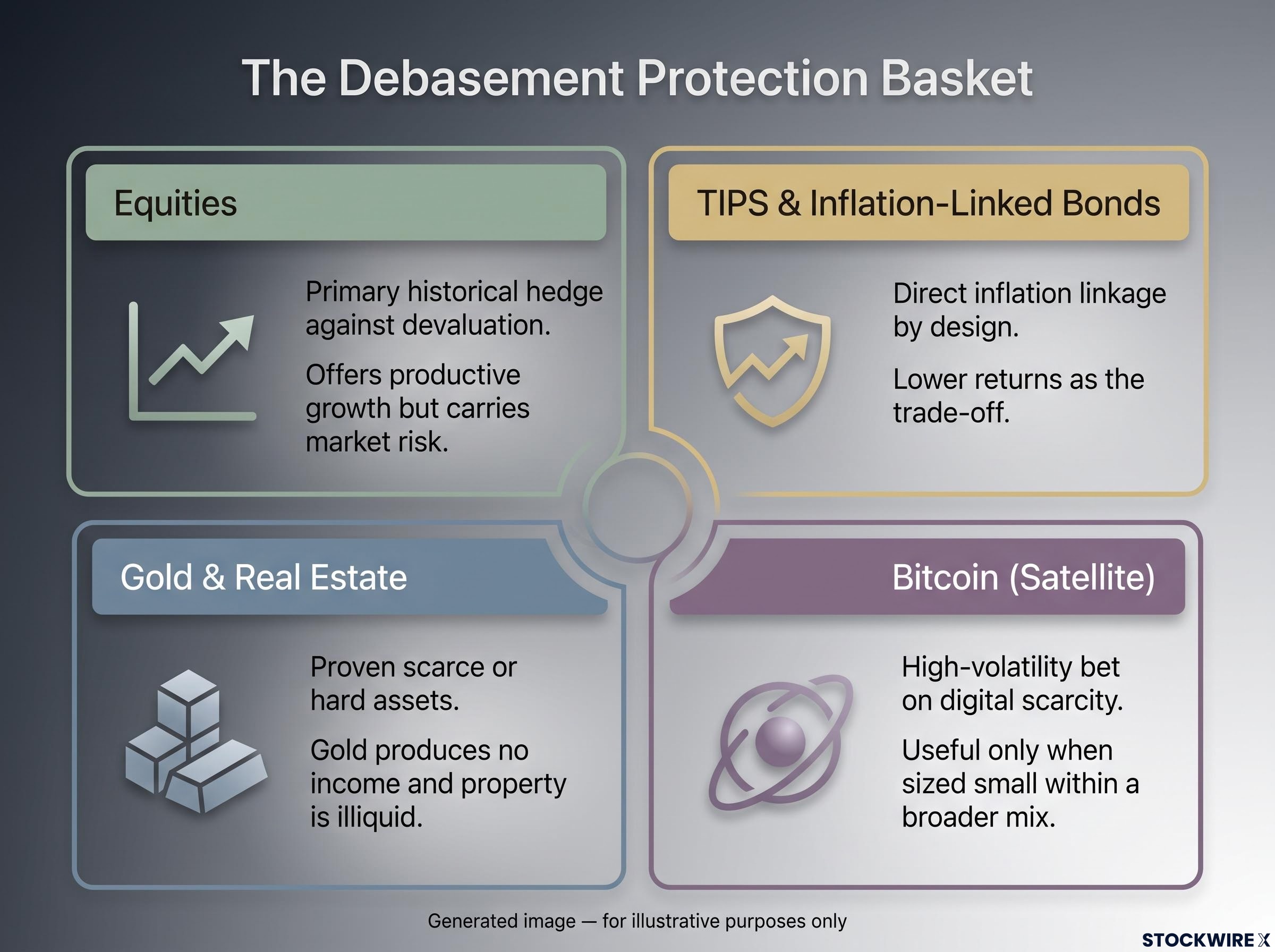
- Equities: the primary historical hedge against devaluation, offering productive growth but carrying market risk.
- TIPS and inflation-linked bonds: direct inflation linkage by design, with lower returns as the trade-off.
- Gold and real estate: proven scarce or hard assets, though gold produces no income and property is illiquid.
- Bitcoin as satellite: a high-volatility bet on digital scarcity, useful only when sized small within a broader mix.
TIPS as an inflation hedge carry a structural advantage the current yield environment has sharpened: 30-year real yields near 3.05% place investors in the top quartile of real yield opportunity since 2000, a context the article’s comparison table flags but does not fully explore.
Schwab and Matrixport both frame the debasement trade as a basket approach, combining equities, gold, real estate, and potentially Bitcoin, rather than a single-asset wager on any one instrument.
The portfolio lesson for you is precise. The historical case for debasement protection is strong, but the evidence does not support Bitcoin as the primary vehicle for it, which means position sizing and asset mix matter more than the yes-or-no question of whether to hold it at all.
Making an informed call on Bitcoin in a debasement-aware portfolio
The tension is honest and worth stating plainly. The structural scarcity case for Bitcoin as a debasement hedge is intellectually coherent, but recent evidence shows the hedging relationship has weakened as Bitcoin has grown more correlated with risk assets and institutional flows.
You can see it in the numbers. Bitcoin sits at roughly -12% year-to-date in 2026 while global headline inflation runs near 4.7%, precisely the environment where a debasement hedge should be earning its keep. The 2024 SSRN study found the hedging effect strongest before COVID and diminishing since, even as gold’s inflation links strengthened.
The Bitcoin case is strongest under specific conditions, and weakest under others:
- Strengthens the case: a long time horizon that lets digital scarcity play out.
- Strengthens the case: genuine tolerance for 60-100% annualised volatility.
- Strengthens the case: a portfolio already anchored in productive assets and proven hedges.
- Weakens the case: a short horizon where drawdowns cannot recover.
- Weakens the case: a need for stable, predictable real returns.
- Weakens the case: a portfolio not yet diversified across established inflation hedges.
The genuinely unresolved question is whether Bitcoin’s correlation with risk assets will persist as it matures, or whether its fixed-supply design eventually asserts itself in high-inflation regimes. That is unknown, and you should size any position accordingly. The IMF’s projection of inflation easing to 3.9% by 2027 is a reminder that the debasement threat may be cyclical rather than permanent.
The historical lesson argues for diversifying away from cash and domestic currency instruments. Whether Bitcoin is the right vehicle for part of that diversification depends on your time horizon, risk tolerance, and existing asset base, not on the scarcity narrative alone.
Sizing Bitcoin within a portfolio requires accounting for its volatility in risk-adjusted terms, not just dollar terms: Bitcoin’s annualised volatility runs 3-4 times higher than US equity volatility, meaning a 5% dollar allocation can represent a much larger share of total portfolio risk than the nominal weight implies.
This article is for informational purposes only and should not be considered financial advice. Investors should conduct their own research and consult with financial professionals before making investment decisions. Past performance does not guarantee future results, and financial projections are subject to market conditions and various risk factors.