Citi’s macro strategy team has just handed clients a list of five credible reasons the year-end rally could fall apart, then told them to stay long risk anyway. That contradiction is not sloppiness. It is the whole argument.
The note landed around 13 September 2026, one day after August core inflation came in hotter than expected. Core CPI rose 0.3% month-over-month against a 0.2% consensus, a single data point that pushed Fed rate hike expectations sharply higher. The five risks Citi flagged, a hawkish Fed, rising global bond yields, a yen carry trade unwind, an oil shock, and European gas disruption, all have live data behind them right now. The question is not whether they exist. It is whether markets are pricing them correctly.
This is a risk triage, not a note summary. By the end, you will know which of Citi’s five bearish risks the team considers overstated by markets, which it has already partially hedged by closing trades at a profit, and what conditions would flip its pro-risk stance. That framework is something you can apply to your own positioning, whether or not you agree with Citi’s conclusions.
What the August CPI miss actually tells you about the Fed’s next move
Start with the number, because it changed the arithmetic. Core CPI, which strips out volatile food and energy prices, rose 0.3% in August 2026, above the 0.2% economists had penned in. That was the largest monthly core gain since April 2026, per Reuters, with the annual rate sitting at 2.4%.
A Fed rate hike is now nearly fully priced following that print. What the number tells you is blunt: the path to rate cuts has narrowed materially, and anyone still positioned for easing before year-end is now carrying a risk the data no longer supports.
But Citi’s real concern runs deeper than one meeting. The team is not asking whether the Fed hikes at the meeting scheduled for the week of 15 September 2026. It is asking whether the committee has shifted to a durable hawkish posture that markets have not fully repriced.
The Federal Reserve September 2026 calendar confirms the FOMC meeting is scheduled for 15-16 September, with Governor speeches and communications in the surrounding days providing additional signals on the committee’s policy direction ahead of the decision.
The rhetoric supports that read. Chair Kevin Warsh’s Jackson Hole speech was widely characterised as unambiguously hawkish.
BlackRock’s read on Jackson Hole BlackRock strategist Gargi Pal Chaudhuri described Warsh’s Jackson Hole address as “decidedly hawkish,” warning that higher rates were the likely response if inflation failed to improve at a satisfactory pace.
Both Barclays and Deutsche Bank now forecast two 25 basis point hikes, at the September and December meetings, off the back of that tone. Not everyone agrees the words will translate into action. Alpine Macro’s Chen Zhao argues the odds of actual tightening remain very low, and JPMorgan’s David Kelly questions whether Warsh is overstating the economy’s strength.
How Citi reads the committee beyond the chair
This is where Citi’s analysis earns its keep. Rather than trade the chair’s rhetoric, the team maps individual FOMC members into camps, which gives a more granular read on where policy is actually heading than any single speech.
| Member | Stance | Implication for rate path |
|---|---|---|
| Hammack, Kashkari, Logan, Warsh | Favour hikes | Core of a tightening bias |
| Barr, Cook, Waller | Data-dependent, leaning hold | Swing votes; balance the committee |
| Bowman, Jefferson, Powell | No public statement (as of 13 September 2026) | Silent votes that decide consensus |
The unspoken members matter most. Citi explicitly notes that Warsh’s job as chair is to build committee consensus, meaning his personal hawkish preference may not determine the outcome. Powell’s silence, in particular, is a variable, not a given. That is why the Fed risk is real but not binary.
Warsh’s communication regime is itself a risk variable that the committee mapping exercise does not fully capture: the scrapping of forward guidance means every data release now carries greater pricing weight, amplifying the gap between Citi’s probability-weighted view and how markets actually reprice in real time.
When big ASX news breaks, our subscribers know first
Bond yields and the carry trade: two risks with one transmission mechanism
The second and third risks look separate on Citi’s list. They are not. Rising global bond yields and a yen carry trade unwind share a single transmission mechanism, and understanding how one feeds the other is the key to reading both.
Citi’s bond thesis is specific. The rise in yields is concentrated at the front end and reflects energy price pass-through, not an expanding fiscal risk premium. That distinction matters, because a front-end move driven by energy is far less likely to derail growth than a broad repricing of sovereign credit risk.
The institutional counterweight is heavier than Citi’s framing lets on. The IMF Fiscal Monitor from April 2026 flagged advanced economy yields rising by as much as 60 basis points since February 2026, with the UK cited, and both the IMF and BIS stress a fiscal sustainability channel that Citi’s energy-centric view does not fully address. Where Citi sees an energy story, the IMF sees deficits and debt loads pushing yields higher regardless of the trigger.
Now connect the yields to the yen. As front-end yields rise globally and the Bank of Japan’s meeting on 18 September 2026 approaches, the rate differential that makes borrowing in yen attractive narrows. That is the link. The same energy-driven yield pressure Citi identifies erodes the economics of the carry trade.
Citi’s own positioning tells you something here.
A positioning signal, not just a profit Citi closed a six-month dual digital trade, tied to the Nikkei above 61,000 and USD/JPY below 157, at 97% of its maximum payout, and took profit on a one-year yen OIS payer position ahead of the BoJ meeting.
That exit is a signal in itself. Even a team maintaining a pro-risk stance decided the asymmetry on this specific trade had shifted enough to walk away with the money on the table. Citi also notes yen term premium has been declining since July 2026.
The mechanics of a carry trade unwind in practice
For readers newer to the concept, a carry trade is a funding trade. You borrow in yen at very low rates, then buy higher-yielding assets elsewhere, pocketing the difference. It works beautifully until it does not.
Yen carry trade mechanics explain why the BoJ’s rate at 1%, already a 31-year high, has not collapsed the trade: a 2.5-2.75% spread over US rates still makes borrowing yen and deploying into higher-yielding assets structurally attractive, which is why Citi’s own exit from yen positions is a signal about asymmetry shifting rather than the trade dying.
The unwind sequence is where the damage happens. When the yen appreciates or the BoJ tightens, the trade turns unprofitable, and leveraged investors must sell assets to repay their yen borrowing. They sell the most liquid, most profitable positions first, regardless of whether those companies have strong fundamentals.
That is why a currency move can hit assets that have nothing to do with Japan. FXStreet identifies five equity fault lines most exposed to such an unwind:
- AI semiconductors
- Expensive software names
- Japanese exporters
- Leveraged small caps
- Rate-sensitive REITs
The dynamic self-reinforces. Bloomberg and Reuters both describe how crowded positioning turns a gradual reduction into a fast, broad liquidity event. Saxo’s Charu Chanana notes positioning remains “sizeable,” while BCA Research has called the trade a “ticking time bomb.” The practical takeaway for you: the BoJ’s September meeting deserves close attention even if you hold no Japan exposure directly.
Why Citi thinks the European gas market is mis-priced heading into winter
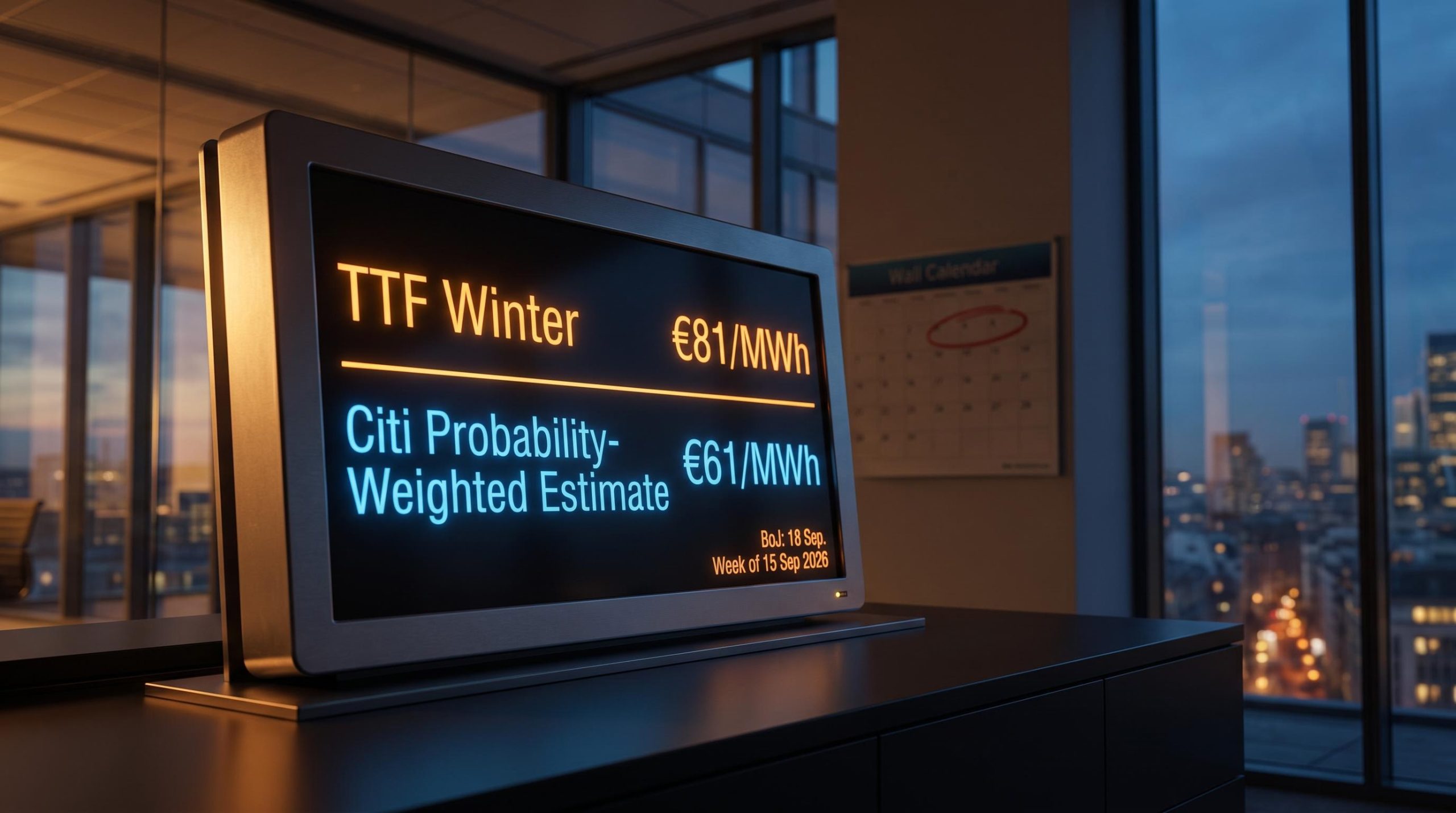
The gas risk comes down to a hard number. At the time of Citi’s note, markets were implying roughly €81/MWh for Dutch TTF gas, the European benchmark, this winter. Citi’s own probability-weighted estimate is around €61/MWh, a discount of roughly 25% to prevailing pricing.
That 20-point gap is not an academic disagreement. It is a direct investment thesis, expressed through European utilities and LNG importers, the equities Citi flags as beneficiaries if prices converge toward its base case.
| Source | Price estimate | Methodology | Date of reference |
|---|---|---|---|
| Market-implied (Citi note) | ~€81/MWh | Prevailing market pricing | ~13 September 2026 |
| Citi | ~€61/MWh | Probability-weighted estimate | ~13 September 2026 |
| ICIS (winter strip) | ~€55.3/MWh | Forward projection | 28 August 2026 |
| ICIS (peak monthly) | ~€59.5/MWh | Forward projection | 28 August 2026 |
The bearish case against Citi rests on storage. Wood Mackenzie’s late-July analysis paints a tight picture:
- Late July 2026 storage: just above 54% full, the lowest for that time of year since 2009
- Projected summer-end storage: around 73% of capacity
- Projected winter-exit storage: around 21% of capacity
That leaves very little buffer, and route disruptions compound it. Strait of Hormuz tensions pushed spot gas more than 50% above June lows, while El Nino-related transit reductions at the Panama Canal have squeezed LNG shipping.
Wood Mackenzie’s warning The firm cautions that Europe is entering the heating season with “limited protection against supply disruptions,” infrastructure outages, and weather-driven demand swings.
The EU institutions land closer to Citi. The European Commission’s Gas Coordination Group stated on 1 July 2026 that there was no immediate security-of-supply concern for the coming winter, with 80% storage deemed sufficient. For you, the spread between Citi’s estimate and market pricing is a live relative value signal in European energy equities. Whichever side is right, the gap tells you where institutional money is positioned and where it could move.
The oil shock scenario and why Citi’s pro-risk stance holds across all five risks
The oil shock is the thinnest of the five themes on hard data, which makes it the ideal lens for seeing Citi’s overall logic. The team’s fear references 1970s dynamics, where energy price spikes drove inflation, forced central banks into aggressive tightening, and crushed growth. Citi’s view is that current conditions do not yet meet that threshold.
This is where all five risks connect. Citi identifies elevated energy prices as the primary driver behind the front-end bond yield moves it monitors, which means oil, gas, yields, and the carry trade are analytically linked, not independent worries stacked on a list.
The oil and gas price divergence matters analytically here because Citi treats oil and gas as part of a unified energy story driving front-end yields, but the two commodities are responding to different resolution timelines: crude constraints are logistical and can reverse quickly with diplomacy, while European gas capacity losses from Qatar’s Ras Laffan facility are structural and measured in years.
The unifying argument is a claim about pricing. In each case, Citi contends the market is embedding excessive tail-risk probability, and that a probability-weighted view of outcomes, rather than a worst-case view, supports staying long risk assets.
A framework for deciding which risks to act on
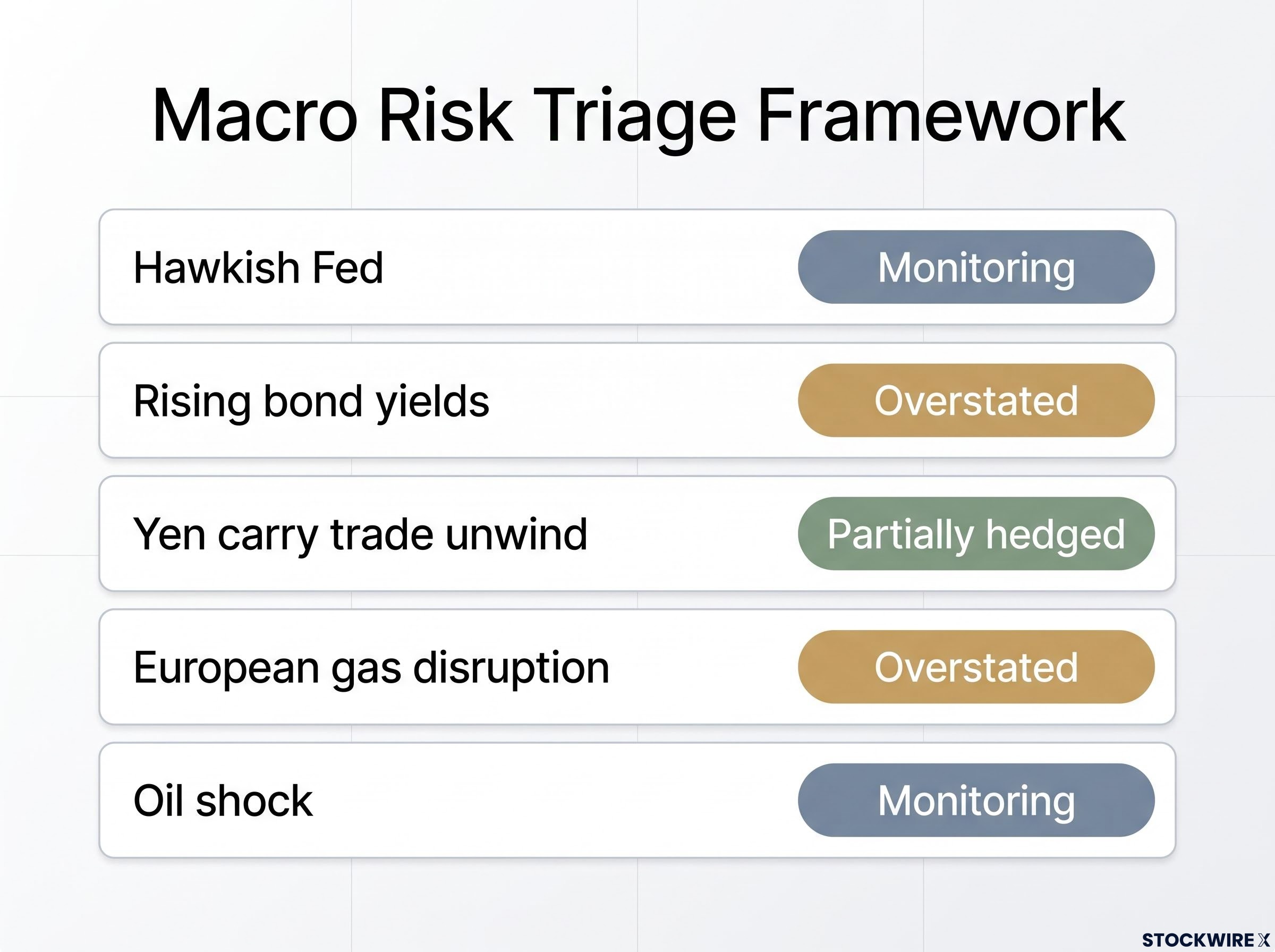
The most useful thing you can take from Citi’s note is not its conclusion but its method. The five risks sort into three practical buckets, summarised below with the team’s implicit verdict on each:
- Hawkish Fed: hinges on committee dynamics; monitoring
- Rising bond yields: viewed as energy-driven and less threatening than IMF/BIS framing; overstated
- Yen carry trade unwind: already traded around, positions closed at profit; partially hedged
- European gas disruption: viewed as mispriced by markets; overstated
- Oil shock: data-dependent, sits within the broader energy framing; monitoring
The decision rule falls out naturally. Where Citi acted by closing positions, the asymmetry was sharp enough to justify exit. Where it did not act, the team’s view is that market pricing already compensates adequately.
Probability-weighted risk frameworks of this kind require a baseline calibration: at what threshold does a tail risk justify defensive repositioning versus targeted monitoring, and knowing that number is what separates using Citi’s triage methodology from simply borrowing its conclusions.
The distinction between worst-case pricing and probability-weighted pricing is the real lesson. StoneX strategists Kathryn Rooney Vera and Jon Hilsenrath make a parallel point, arguing market expectations for the rate path are too high and that multiple hikes are unlikely if energy volatility and geopolitical risks weigh on growth. Before you borrow Citi’s conclusions, decide whether you accept its framework. That is where the analysis actually lives.
What shifts Citi’s view, and what investors should watch through year-end
Citi’s pro-risk call is not a fixed verdict. It is a position with observable triggers that would force a rethink, and most of them resolve soon. Here is what to track:
- FOMC outcome (week of 15 September 2026): a hike plus hawkish guidance escalates the Fed risk
- BoJ meeting (18 September 2026): a hawkish surprise tightens the carry trade squeeze
- Statements from the three silent FOMC members, Bowman, Jefferson, and Powell
- European storage fills through October, watched against Wood Mackenzie’s 73% summer-exit projection
- TTF price movement: convergence toward Citi’s €61/MWh or divergence toward the €81/MWh market level
The Fed threshold is specific. If Barr, Cook, or Waller move from data-dependent to explicitly hawkish, or Powell breaks his silence with a hawkish signal, the consensus balance shifts materially against the pro-risk case.
The gas threshold cuts the other way. If storage exits summer below 73%, or LNG route disruptions persist, the gap between Citi’s estimate and market pricing may reveal Citi underestimating risk rather than markets overestimating it.
The counterbalance StoneX argues that energy volatility and geopolitical risks could weigh on growth enough to make multiple Fed hikes unlikely, a direct counter to the two-hike forecasts from Barclays and Deutsche Bank.
The two meetings on 15-18 September are the first hard test of Citi’s probability-weighted framework. If the Fed and BoJ both surprise hawkishly in the same week, three of the five risks escalate at once, and the pro-risk thesis becomes materially harder to defend. Knowing which specific events would change the call is how sophisticated investors use institutional research, rather than simply accepting or rejecting it.
This article is for informational purposes only and should not be considered financial advice. Investors should conduct their own research and consult with financial professionals before making investment decisions. Past performance does not guarantee future results, and financial projections are subject to market conditions and various risk factors. These statements are speculative and subject to change based on market developments.