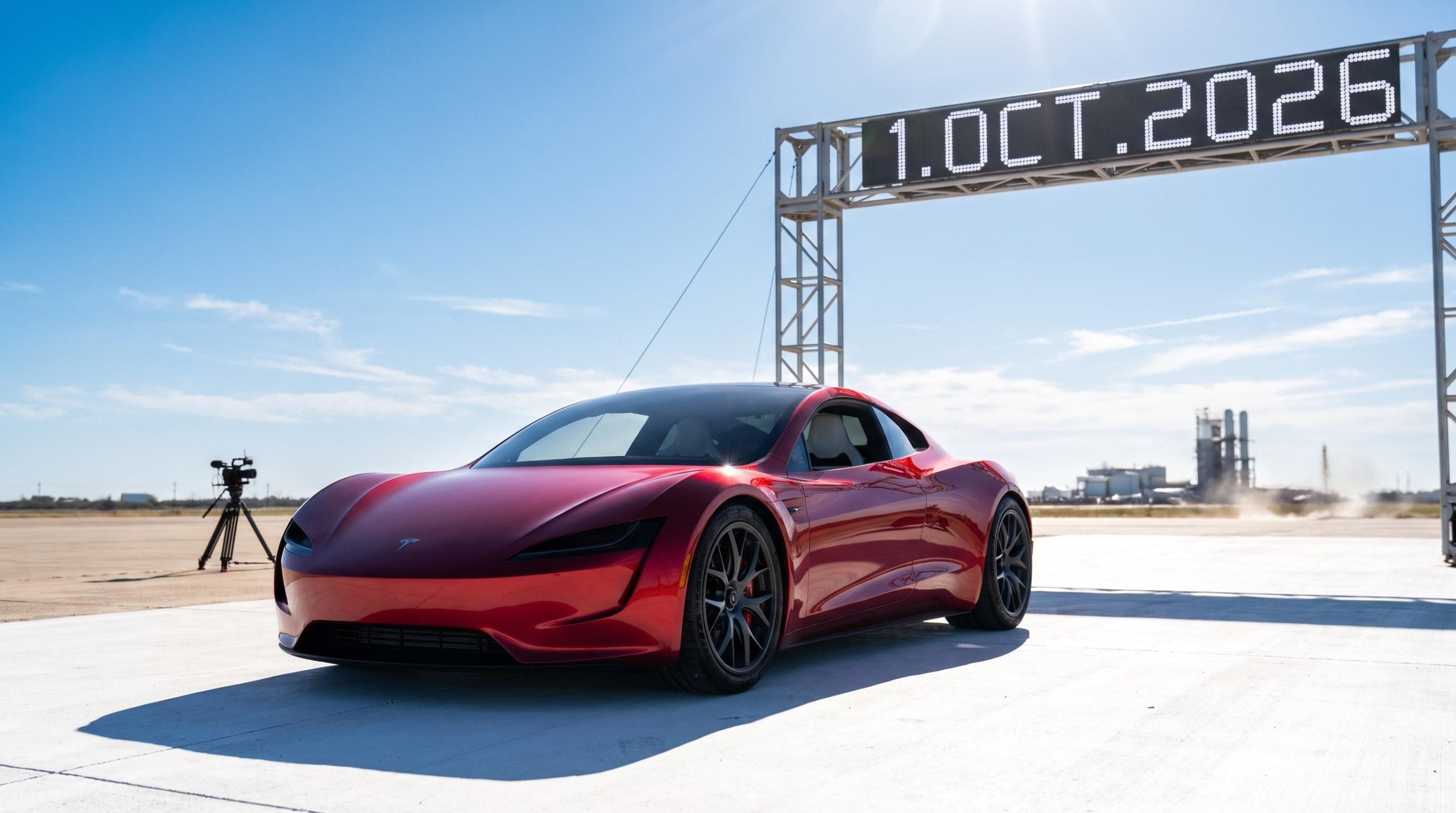
The countdown is running. On Tesla’s official Roadster website, a timer now ticks toward 1 October 2026, the date the company has finally set to reveal the second-generation Roadster to the world.
That car was first shown as a prototype in November 2017. Nine years and a long string of missed dates later, Tesla has posted “Go for launch” on X alongside a 10.01 graphic, and invitations have landed in reservation holders’ inboxes for an event in Waco, Texas.
What makes this different from the promises that came before is not the date itself. It is the logistics behind it: a confirmed location, RSVPs due by 16 September 2026, and non-transferable tickets issued to named guests. This is a reveal event, not a production or delivery announcement.
This piece lays out exactly what the 1 October event is and is not, what the SpaceX thruster demonstration actually involves, why the car took nine years to reach this point, and what the reveal means for Tesla’s brand and its investor narrative. If you are tracking Tesla through 2026, here is the orientation you need before the clock hits zero.
What Tesla has actually committed to on 1 October
Tesla will unveil the second-generation Roadster on 1 October 2026, a Thursday, in Waco, Texas. The company anchored the announcement in three concrete signals: the “Go for launch” post on X showing “10.01,” a countdown timer on its official Roadster website, and direct invitations sent to reservation holders.
Those invitations moved the story past a public teaser. According to reporting from TechCrunch and Electrek (both 12 September 2026), Tesla has issued formal event communications with specific conditions attached.
Here is what has been confirmed:
- Event date: 1 October 2026 (Thursday), Waco, Texas
- RSVP deadline: 16 September 2026
- Ticket conditions: non-transferable, guests aged 21 and older
- Event type: a reveal, not a production or delivery milestone
That last point is the one most likely to be misread, so it is worth stating plainly. Every credible outlet covering this, including TechCrunch, Electrek, Not a Tesla App, and TeslaNorth, describes 1 October as an unveil or reveal event. It is not a production start, and it is not a delivery date.
The distinction matters directly to you if you are holding a reservation or tracking Tesla’s product roadmap. An unveil tells you what the production-intent car looks like. It does not commit Tesla to when you can buy one or take delivery.
One detail remains open. As of publication, Tesla has not confirmed whether the event will be livestreamed, so the size of the audience beyond invited guests is still unknown.
When big ASX news breaks, our subscribers know first
The SpaceX thruster demonstration and what it involves
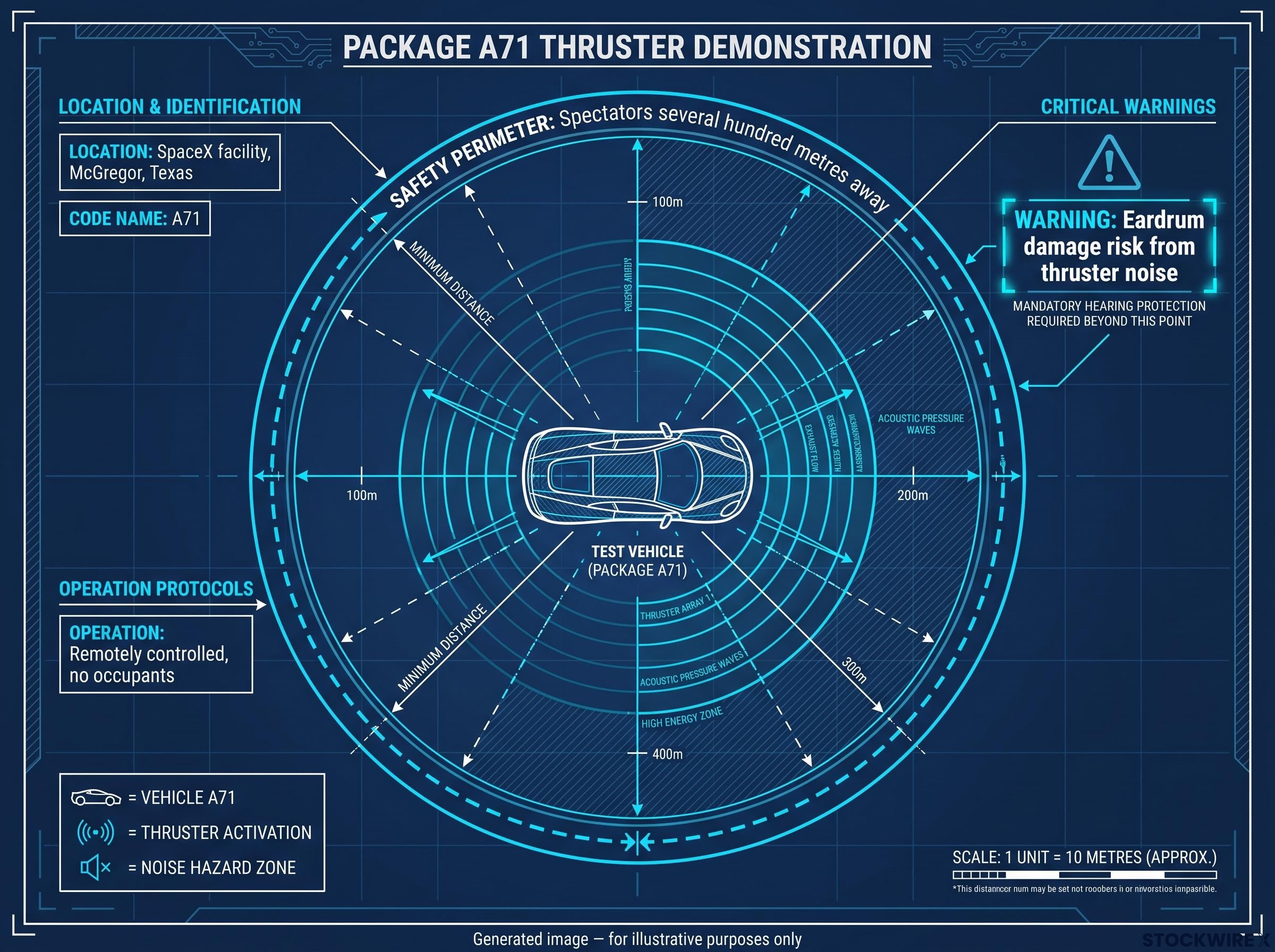
The centrepiece of the Waco event is a limited-edition Roadster fitted with cold-gas thrusters, jointly developed by Tesla and SpaceX. The package is internally code-named A71, and it is designed to let the car briefly hover rather than fly in any sustained way.
The way the demonstration is being staged tells you a great deal about what it is. The vehicle will be operated remotely, with no occupants inside. Spectators, meanwhile, will be held back.
Spectators will be kept several hundred metres away from the hovering Roadster because the thrusters are reportedly loud enough to damage eardrums.
That single safety protocol conveys the scale of the spectacle better than any specification sheet.
Here is what the research confirms about the A71 package:
- Code name: A71
- Demo vehicle operation: remotely controlled, no occupants
- Spectator safety distance: several hundred metres, due to eardrum-damage risk from thruster noise
- Demo site: SpaceX facility, McGregor, Texas, integrated into the 1 October Waco event
Reuters (14 August 2026), citing The Information, first reported the McGregor demonstration plan, with Teslarati (14 August 2026) describing a “SpaceX version” that would float for a short period. Autonext (16 August 2026) added the remote-operation and crowd-distance detail.
SpaceX’s public listing at $135 per share in June 2026, implying a $1.75 trillion valuation and bypassing a traditional institutional roadshow, marked the structural moment that made the Tesla-SpaceX engineering collaboration commercially legible to public market investors for the first time.
Put those parameters together and the picture sharpens. A remotely piloted, occupant-free car hovering behind a several-hundred-metre safety perimeter is a proof-of-concept designed for media impact and fan engagement.
The Tesla-SpaceX collaboration extends well beyond the Roadster thruster package; the June 2026 SpaceX Nasdaq listing has given the two companies a shared traded equity currency that analysts now cite as the structural foundation for a potential merger, a development with implications that reach far beyond any single product demonstration.
For you, that means the thruster demonstration is a display of engineering ambition, not a preview of a feature you will be able to buy or experience as a passenger. TopElectricSUV (17 August 2026) puts Roadster production at 2027, and the thruster-equipped variant is not a production configuration destined for retail sale. What you will be watching is theatre engineered to showcase the SpaceX collaboration, not near-production hardware.
Nine years of delays: how the Roadster reached October 2026
The clearest way to judge how much weight to place on the 1 October date is to look at the dates that came before it.
The prototype was unveiled in November 2017, with deliveries promised by 2020. That timeline has slipped repeatedly, driven by two forces: Tesla’s tendency to prioritise higher-volume product lines, and, more recently, the engineering complexity of the SpaceX thruster work. Electrek, citing The Information (5 June 2026), directly attributed the most recent slip to ongoing cold-gas thruster development.
There is also a communication pattern worth noting. When Elon Musk set the reveal for 1 April 2026, he acknowledged the date was chosen partly because it gave him room to walk it back.
Musk chose 1 April, April Fools’ Day, in part because it gave him built-in deniability if the date were to slip.
That admission is the single most revealing data point about how to read any Tesla Roadster date. Here is how the timeline has unfolded:
| Announced target | What actually happened |
|---|---|
| November 2017 prototype; deliveries by 2020 | Deliveries never began; car deprioritised for years |
| November 2025: unveil 1 April 2026, production 12-18 months later | April date slipped before arriving |
| March 2026: reveal “hopefully” next month | Moved to “probably late April” |
| Q1 2026 earnings call: “in a month or so” | Slipped again |
| June 2026: demo pushed to August due to SpaceX thruster work | Reveal not held in August |
| August 2026: reveal targeted “as early as this month” | Formalised for 1 October 2026 |
| October 2026: scheduled reveal in Waco | Countdown live; invitations issued |
If you are holding a reservation or tracking Tesla’s roadmap, the takeaway is straightforward. The 1 October date arrives after a documented pattern of revisions driven by both engineering and communication strategy, and that history should temper how confidently you treat the 2027-2028 production estimate now attached to it.
What the reveal means for Tesla’s brand and investor narrative
For Tesla’s image, the reveal does real work. The Roadster is a halo vehicle, and it reinforces the company’s association with performance, technological ambition, and the SpaceX ecosystem regardless of how many units ever roll off a line.
Reuters (14 August 2026) described it as a “long-delayed halo project,” notable for Tesla’s image and its relationship with early superfans. The thruster spectacle amplifies that narrative, tying the brand to rocket-adjacent engineering in a way few competitors can match.
The financial picture is a different story. The Roadster’s niche volume, its 2027-2028 production horizon, and its status as a reveal-not-delivery event place it well outside the near-term earnings calculus that drives institutional positioning.
Tesla’s forward valuation at 188x earnings means the Roadster reveal must be read against a share price that already prices in Optimus, robotaxi, and software revenue lines that do not yet exist, making halo-vehicle media cycles largely irrelevant to the earnings quality debate.
Here is the split for investors:
- What the reveal delivers: brand reinforcement, media attention, and re-engagement of the enthusiast community
- What it does not deliver: a firm production commitment, a delivery timeline, or near-term revenue impact
History supports that reading. Long-delayed halo cars such as the second-generation Acura NSX, the Ford GT, and the Lexus LFA each lifted brand perception without producing lasting shifts in stock valuation, because their volumes and margins were small relative to core product lines.
The accumulated skepticism the reveal must overcome is captured in one phrase. Electrek (21 April 2026) noted that some 2017 depositors face a potential decade-long wait.
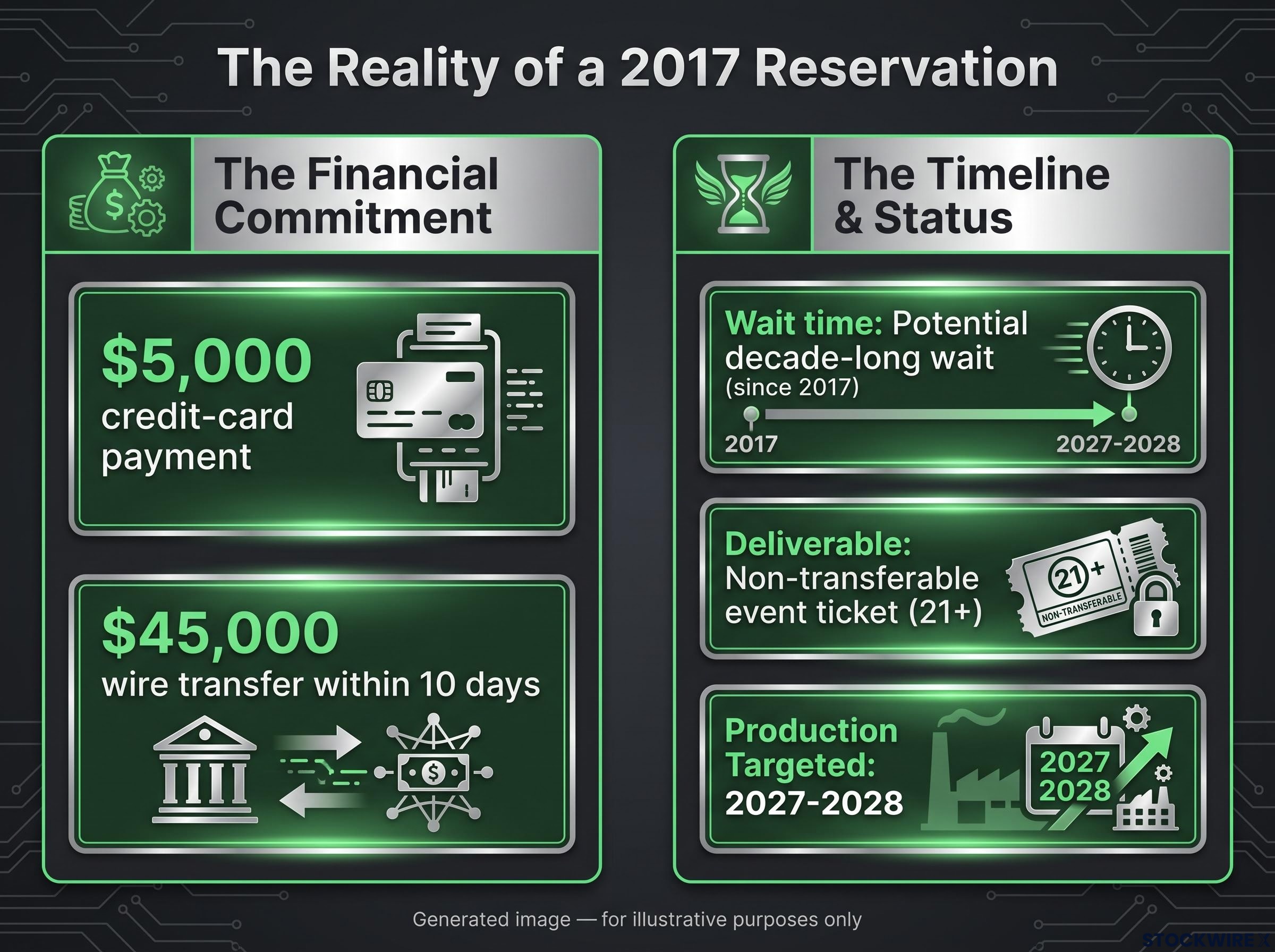
Production remains targeted for 2027-2028, meaning some 2017 depositors could wait a decade, “if it happens at all.”
Those deposits are not small: a $5,000 credit-card payment plus a $45,000 wire transfer within 10 days, accepted since 2017. For you as an investor, the read is this: the reveal is a brand maintenance event that may generate short-term attention, not a reason to revise earnings models for a company whose valuation turns on mass-market volumes, autonomy, and software.
Three weeks to Waco: what to watch before and after 1 October
With the RSVP deadline just four days out (16 September 2026) and the event 19 days away, there are specific signals worth tracking rather than a general sense of cautious optimism.
Before 1 October, three things are worth watching:
- Whether Tesla confirms a livestream. As of publication this remains unresolved, and it determines how public the reveal actually is.
- Whether the RSVP response signals demand. Strong or weak turnout from reservation holders is an early read on enthusiast appetite.
- Whether any further slippage occurs before 16 September. Given the delay history, the deadline itself is a test.
After the event, three variables will determine whether it carries lasting weight:
- Whether Tesla confirms or updates a production timeline. The current 2027-2028 target is the number that matters for depositors.
- Whether the SpaceX thruster demonstration executes as described. A hovering, remotely piloted car either delivers the spectacle or it does not.
- Whether Tesla converts the reveal into commercial momentum, such as new reservation openings or pricing disclosure.
With production targeted for 2027-2028, any decision you make in the next 12-18 months will rest on post-reveal communications, not the event itself. Acting on the announcement alone, before production and pricing details emerge, means deciding on brand momentum rather than confirmed commitments.
For investors wanting a disciplined framework to assess what each post-reveal signal actually implies for the stock, our dedicated guide to scenario-based Tesla valuation walks through probability-weighted bull, base, and bear cases with entry price discipline built into each scenario.
This article is for informational purposes only and should not be considered financial advice. Investors should conduct their own research and consult with financial professionals before making investment decisions.
Past performance does not guarantee future results, and any production or delivery dates referenced remain targets subject to change based on Tesla’s own track record of revision.
1 October is a milestone, not a finish line
The 1 October reveal is the most operationally credible commitment Tesla has made in nine years, backed by a live countdown, a confirmed venue, and invitations already issued. It is also still only a reveal, with production 12-18 months beyond it at the earliest.
On 2 October, some questions will have answers. The world will know what the production-intent Roadster looks like, what the SpaceX thruster demonstration delivered, and whether Tesla offered a firmer production timeline. Reservation holders and investors will have a cleaner basis for their next move.
The reveal answers some questions and opens others. The task now is knowing which category your specific question falls into: if you want to see the car and the spectacle, 1 October delivers. If you want certainty on when you can own one, that answer still lies further down the road.