Memory chip stocks in Seoul and Tokyo just delivered some of the sharpest single-session gains of 2026, and the trigger was a software product launch in San Francisco. That asymmetry is worth understanding before deciding whether the move tells you something durable or something fleeting.
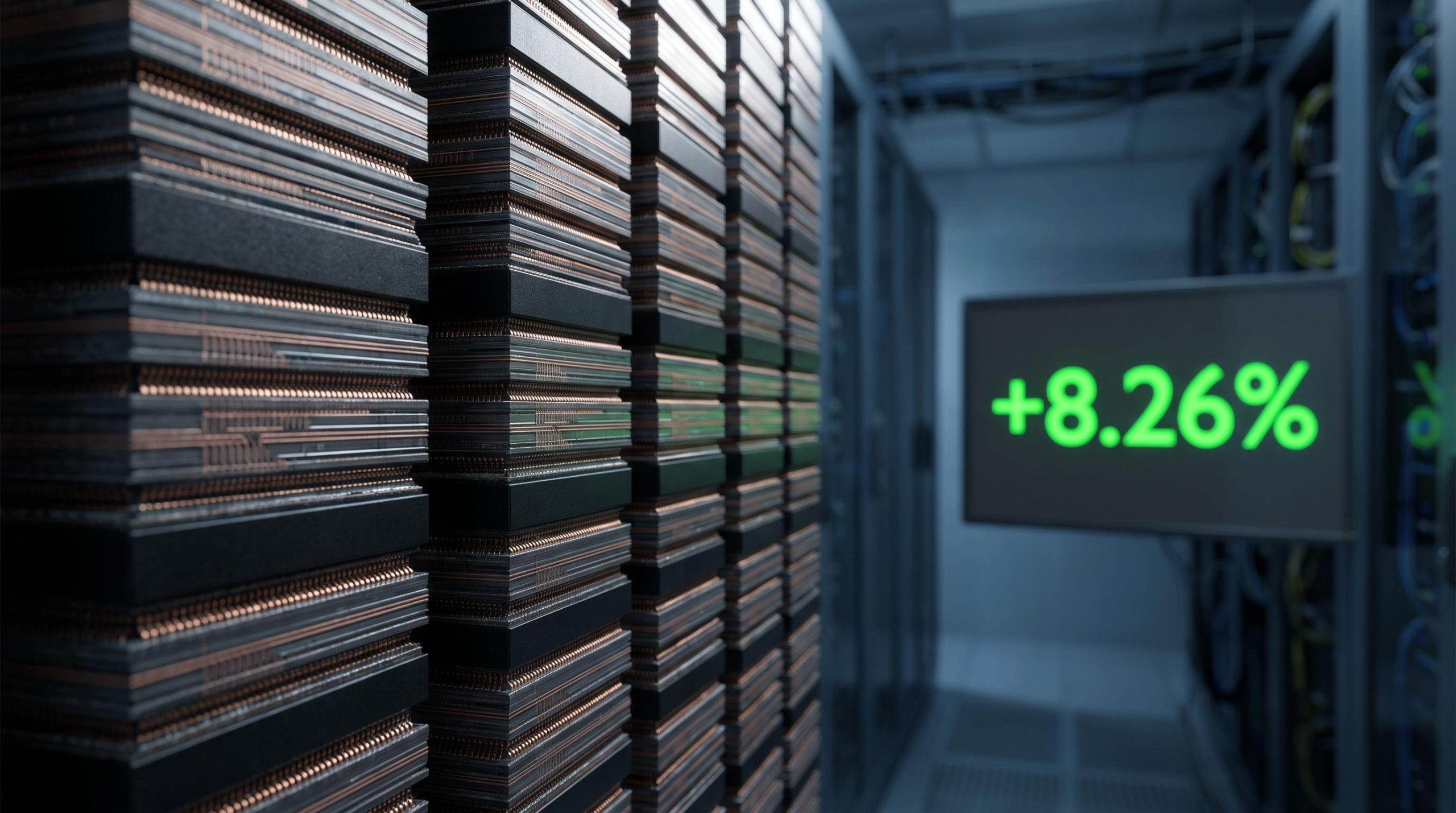
OpenAI released GPT-6 Astra on 3 September 2026. By the overnight session reported the morning of Tuesday, 8 September, SK Hynix had surged 8.26%, Kioxia had jumped roughly 9-9.3%, SoftBank Group had gained approximately 10%, and the Kospi had closed at a five-week high, up 4.6%.
For Australian investors, none of those names trade on the ASX. The question is what, if anything, flows downstream.
This piece maps the mechanism behind the rally, frames the structural-versus-cyclical debate that will decide whether the gains hold, and identifies the realistic pathways for ASX investors seeking exposure to the AI memory chip thesis. Here is a clear framework for assessing whether the Astra move is a signal worth acting on or a sentiment spike best observed from the sidelines.
How a software launch moved hardware markets by billions
A model released in the United States on 3 September set off a chain of buying that peaked in the Monday, 7 September trading session across Asia, reported the following morning. No new chip was announced. No fresh order data was published. What moved was expectation, and expectation moved hard.
Samsung Electronics climbed 5.68% to close at 270,000 KRW, according to Korea JoongAng Daily and FinanceFeeds, both explicitly tying the move to optimism after the Astra rollout. SK Hynix, the more direct high-bandwidth memory play, surged 8.26% to 1,783,000 KRW in the same session.
Across the water in Tokyo, the gains ran larger. SoftBank Group rose approximately 10-10.1%, per session recaps from Gate.com and CloseLook. Kioxia, a memory and storage specialist, jumped roughly 9-9.3% on the same expectations of memory chip orders flowing from frontier AI deployment.
Then the indices confirmed it. This was not four stocks moving in isolation.
Kospi: +4.6% to a five-week high The South Korean benchmark opened 3.34% higher and extended gains to close up 4.6%, led by Samsung and SK Hynix. It was the index’s first close above 6,900 since a late-August sell-off (Korea JoongAng Daily).
The Nikkei 225 rose 2.12% to 66,399.84, driven largely by semiconductor and AI-adjacent names, per Gate.com. Reported figures vary slightly by source and timing: CloseLook records the Nikkei up 2.0% at 66,315, and Investing.com puts it at +1.9%, differences that reflect intraday versus closing snapshots rather than disagreement about the direction.
| Asset | Session Move | Closing Level | Session Date |
|---|---|---|---|
| Samsung Electronics | +5.68% | 270,000 KRW | 7 September 2026 |
| SK Hynix | +8.26% | 1,783,000 KRW | 7 September 2026 |
| SoftBank Group | ~+10-10.1% | Not reported | 7 September 2026 |
| Kioxia | ~+9-9.3% | Not reported | 7 September 2026 |
| Kospi | +4.6% (five-week high) | ~6,965 | 7 September 2026 |
| Nikkei 225 | +2.12% | 66,399.84 | 7 September 2026 |
The breadth here matters when you assess what comes next. A move that spans two countries, four major stocks, and both leading indices reads as a coordinated repricing of AI infrastructure expectations, not sector rotation noise. That framing sets up the more important question: was the repricing justified by fundamentals, or by narrative momentum?
When big ASX news breaks, our subscribers know first
Why frontier AI models translate directly into memory chip orders
The market read a software launch and bought hardware makers. To understand why that is not a leap of logic, follow the physical supply chain that sits beneath every frontier model.
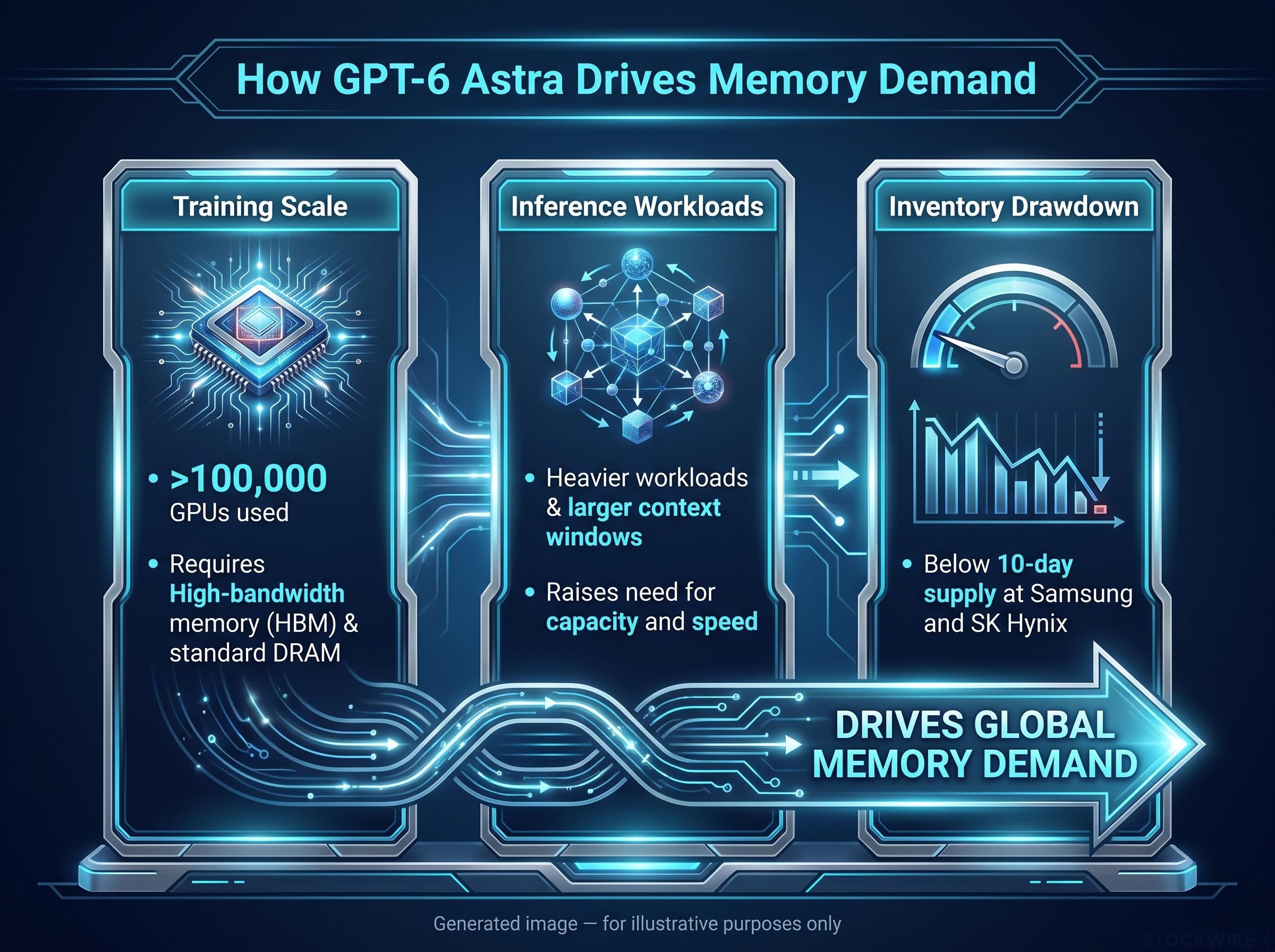
A model like Astra creates memory demand through three distinct channels:
- Training scale: GPT-6 Astra was reported to have trained on more than 100,000 GPUs, described as OpenAI’s largest-scale run to date. Each accelerator in those clusters relies on high-bandwidth memory (HBM), a stacked, high-speed memory format bolted directly onto the chip, plus large pools of standard DRAM in the server nodes around it.
- Inference workloads: Once a model is deployed, every query it answers draws on memory and bandwidth. Melius Research analyst Jordan Reitzes, cited by CNBC, described memory chips as key beneficiaries of frontier models because heavier workloads and larger context windows raise the need for both capacity and speed.
- Inventory drawdown: The launch landed at a moment when supply was already tight, which is what turned expectation into a sharp re-rating.
The HBM demand trajectory underpinning that re-rating is steeper than most cycle comparisons suggest: Citi projects a 434% rise in system-level HBM capacity per AI deployment as GPU counts scale from 72 to 576 per system, meaning per-chip and per-system demand vectors are pushing volumes higher simultaneously rather than trading off against each other.
That third channel is where the sentiment story acquired a fundamental spine. It is worth separating out.
The inventory signal that made Astra’s timing unusual
A KB Securities note, cited by FinanceFeeds, observed that memory inventories at Samsung and SK Hynix had fallen below a 10-day supply at the time of the Astra launch. That is a compressed buffer. It means the industry entered the launch with very little slack to absorb any acceleration in ordering.
Here is why that single number matters more than the headline percentages. When inventories sit under ten days, even a modest lift in AI infrastructure orders can drain existing supply before new manufacturing capacity comes online. That is the specific condition that converts a sentiment rally into a fundamental one.
It also explains the timing. The market repriced on the launch date itself, not after order confirmation arrived, because the inventory position meant traders were pricing the risk of a supply squeeze rather than waiting for proof it had happened.
For you, the takeaway is a filter. The skill that separates a tradeable signal from a headline trap is the ability to tell which AI product launches genuinely tighten memory markets and which produce only a sentiment bounce. Astra hit a market with almost no cushion, which is why this one had teeth.
The structural versus cyclical debate: what analysts are watching now
So the rally had a fundamental spine. That does not settle whether it was the start of a new cycle or a spike inside the old one. This is where the analysts split, and the split is genuine.
The structural case rests on that inventory figure. KB Securities, via FinanceFeeds, argues that sub-10-day inventories combined with a pipeline of frontier models like Astra could point to sustained HBM demand extending beyond the typical memory chip cycle. On this reading, AI is not a passing catalyst but a durable new source of demand, contingent on tightness persisting once fresh capacity is added.
The counterview is more sceptical, and it starts from what the rally has not yet shown.
The rally “needs proof” Remio.ai cautions that while Astra lifted Samsung and SK Hynix, investors still require visible, long-dated AI infrastructure capex and firm orders before treating the move as a new sustained cycle rather than a headline trade.
That caution has history behind it. MarketWatch points out that prior AI-driven memory rallies have been prone to reversals when actual demand fell short of elevated expectations. GuruFocus adds the structural reminder that memory remains a cyclical industry, sensitive to swings in global tech investment and macro conditions.
Cycle reversal risk is not hypothetical for memory names: SK Hynix swung from a $5.91 billion operating loss in 2023 to an annualised peak operating profit of approximately $33 billion by Q1 2026, a $39 billion trough-to-peak move that reflects the structural commodity nature of memory rather than company-specific performance, and Samsung fell roughly 7% in a single session after reporting decelerating price increases.
There is also a macro layer running underneath. Investing.com notes the chipmaker surge occurred alongside broader risks, including oil prices and Federal Reserve policy expectations, which means liquidity and sentiment conditions were amplifying the move independently of the chip fundamentals.
To adjudicate between the two views, analysts are watching three specific things:
- Capex commitment visibility: whether AI infrastructure buyers convert enthusiasm into firm, long-dated spending.
- Inventory trajectory: whether the sub-10-day tightness holds once new manufacturing capacity comes online, or rebuilds quickly.
- Macro overlay: whether Federal Reserve policy and oil prices are amplifying the AI-specific signal or suppressing it.
For an ASX investor watching from a distance, this question is not academic. It determines whether a position in global chip ETFs or American Depositary Receipts is a medium-term thesis or a short-term trade, and the honest answer is that the 7 September data alone cannot tell you. Neither the bull nor the bear case is obviously wrong yet, and recognising that uncertainty is more useful than picking a side on one session’s price action.
What ASX investors actually have access to in this trade
Start with the constraint, because it is the honest starting point. No ASX-listed stock was identified in any coverage of the Astra rally as a direct beneficiary. Samsung, SK Hynix, SoftBank, and Kioxia are all listed in Seoul or Tokyo. If you were hoping for a local name that captures this thesis cleanly, the research does not offer one.
That does not mean the trade is closed to you. It means it is indirect.
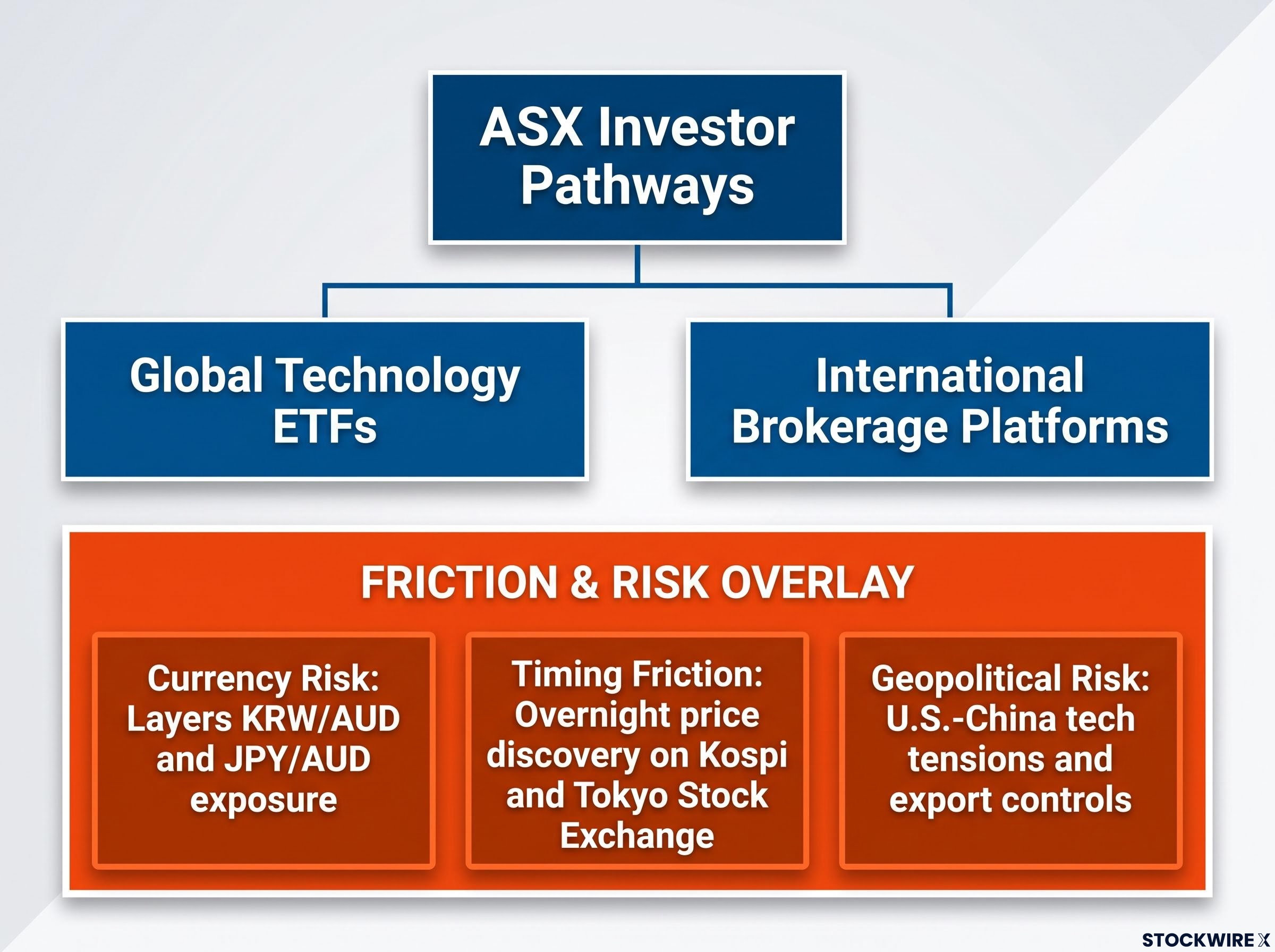
The realistic pathways for an Australian investor look like this:
Asian technology exposure through ASX-listed ETFs is one practical route, with ASIA delivering a 96.99% one-year return to June 2026 on the back of Korean and Taiwanese chipmaker weightings, though that figure reflects a recovery in valuations rather than a forward baseline, and China regulatory risk and Taiwan geopolitical tension remain live categories within its top holdings.
- Global technology ETFs that carry Korean and Japanese chipmaker exposure within their holdings, giving diversified but diluted access to the names that moved.
- International brokerage platforms that provide access to the Kospi and Tokyo Stock Exchange, allowing direct purchase of individual names such as SK Hynix or SoftBank.
Each pathway comes with a cost that a domestic trade would not carry, and that cost has two components worth separating out.
Currency and timing friction: the ASX-specific overlay
The first is currency. Buying SK Hynix or Samsung layers KRW/AUD exposure on top of the chip thesis; buying SoftBank or Kioxia adds JPY/AUD exposure. A strong session for the chipmakers can be dampened, or amplified, by where the Korean won or Japanese yen sits against the Australian dollar. You are taking two bets, not one.
The second is timing. The Kospi and Nikkei moves happened overnight relative to ASX trading hours, which means price discovery in Seoul and Tokyo is complete before the Australian market opens. You are typically reacting to a move that has already closed, not participating in it as it unfolds.
There is a further risk sitting behind the underlying names. CNBC notes that Samsung and SK Hynix operate within a geopolitical environment shaped by U.S.-China tech tensions and export controls, a factor that can affect supply chains regardless of how strong AI demand looks.
The practical read for you is this. The Astra-driven memory trade is accessible from Australia, but it is indirect, and the added friction of currency risk and overnight price discovery means position sizing and entry timing matter more here than they would in a purely domestic trade. Knowing that lets you make a deliberate call on whether the exposure available is proportionate to the thesis, rather than assuming ASX access to an AI theme equals direct chipmaker exposure.
Three variables that will determine whether the Astra rally holds
The useful question now is not what happened on 7 September but what to watch in the weeks that follow it. The structural-versus-cyclical debate will be settled by data, not by the size of a single session, and three variables will carry most of the weight.
- Hyperscaler capex commitments. Spending signals from the largest AI infrastructure buyers, names like Microsoft, Google, and Amazon, are the primary confirmatory signal, because firm capex is what converts narrative into orders. Watch for it.
- Samsung and SK Hynix inventory trajectory. The October-November reporting cycle is the next hard data point. On the KB Securities framework, if sub-10-day inventory levels persist as new capacity comes online, the structural demand thesis strengthens; if inventories rebuild quickly, the cyclical read reasserts itself.
- Nikkei and Kospi institutional behaviour. How the two indices trade in the two-to-four-week window after the rally will indicate whether institutional buyers are holding their new positions or quietly unwinding them.
Semiconductor cycle timing adds a further layer to that inventory watch: TSMC’s locked-in 2026 capital budget of $52-56 billion and Samsung’s estimated $70-80 billion annual outlay confirm that a supply wave is a structural certainty for 2027-2029, and the double-hit mechanism, where earnings disappointment and multiple compression arrive simultaneously when a cycle turns, is why waiting for quarterly red flags before reducing exposure has historically been too late.
The Remio.ai proof framework overlays neatly on this: order books, pricing power, and utilisation rates are the confirmation signals to look for. Investing.com’s reminder holds too, that Federal Reserve policy and oil prices can amplify or suppress AI-demand signals independently of the chip fundamentals themselves.
For an ASX investor, the October-November earnings cycle from Samsung and SK Hynix will be the clearest available test of whether Astra reflected genuine demand pull-through or a sentiment trade that preceded disappointing order data. A framework of three variables gives you a basis for updating your view as that data arrives, which is more useful than committing to a buy-or-avoid call on incomplete information now.
This article is for informational purposes only and should not be considered financial advice. Investors should conduct their own research and consult with financial professionals before making investment decisions. Past performance does not guarantee future results. Financial projections are subject to market conditions and various risk factors, and forward-looking statements are speculative and subject to change based on market developments.