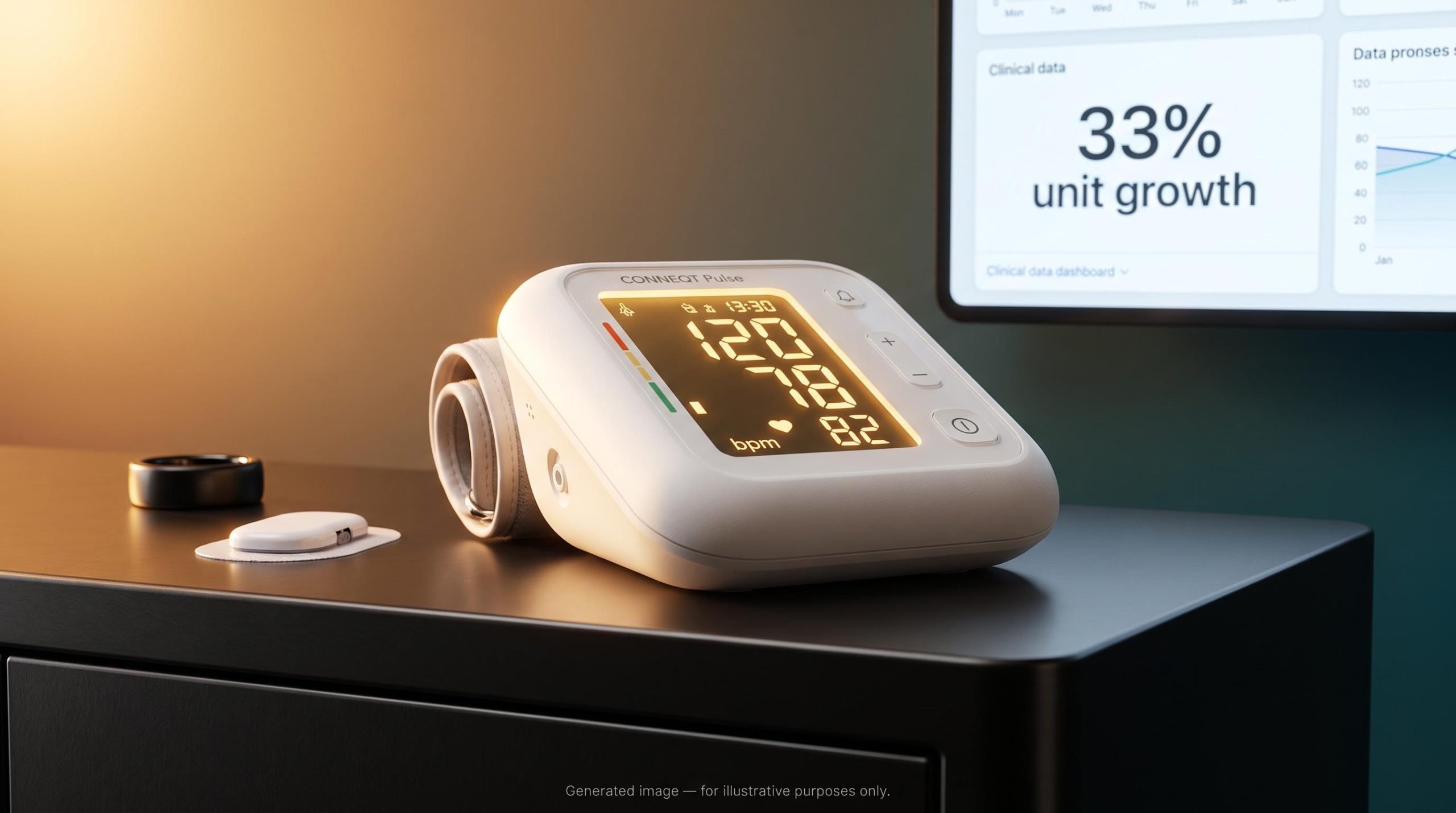
Before the CONNEQT Pulse could earn a place in Blueprint’s Protocol Marketplace, Bryan Johnson’s medical team had to clinically evaluate the device and clear it, turning what could have been a routine influencer placement into a credentialed product endorsement.
That clinical bar matters because of when it arrived. CONNEQT Health Limited confirmed the agreement in an ASX announcement dated 7 September 2026, and it lands on top of a quarter that was already a record: $1.3 million in consumer revenue, 3,574 Pulse units sold (up 33% quarter on quarter), and the first US$1 million Pulse quarter in the company’s history. Blueprint is an addition to a machine that was already running, not a rescue of one that had stalled.
This covers what Blueprint certification actually means in practice, what the financial trajectory looks like right now, and what the deal adds to a US longevity market that is already moving in CONNEQT’s direction.
What Blueprint certification actually means for CONNEQT Pulse
Blueprint’s Protocol Marketplace is not an open shelf. According to Blueprint’s own “At A Glance” materials, Johnson’s team evaluates the research behind each product’s components, applies statistical thresholds, runs safety testing, and only lists variants and doses that clear internal evidence criteria. Products earn placement; they do not buy it.
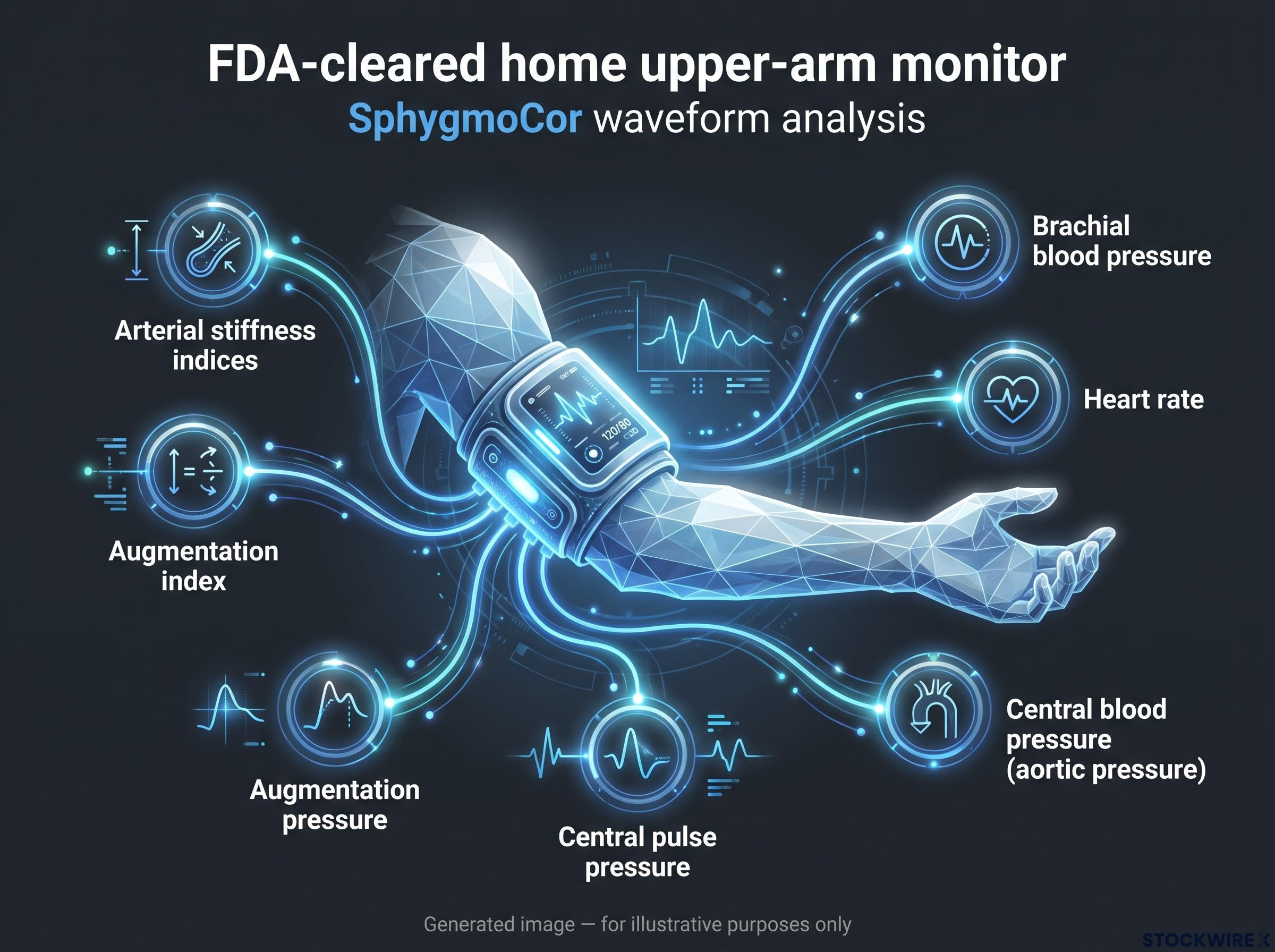
That filter is what the CONNEQT Pulse had to pass. The device is an FDA-cleared home upper-arm monitor built on SphygmoCor waveform analysis, delivering central blood pressure, augmentation index and arterial stiffness measurements that conventional home monitors do not provide.
From a single cuff reading, the Pulse reports seven cardiovascular measurements:
- Brachial blood pressure
- Heart rate
- Central blood pressure (aortic pressure)
- Central pulse pressure
- Augmentation pressure
- Augmentation index
- Arterial stiffness indices
Blueprint sets its bar high, and says so plainly.
“Blueprint is level 5 only.”
That standard indicates only the highest-tier, evidence-supported products make the cut. For context on the company it now keeps, the marketplace already features third-party health hardware including the Oura Ring 4 and the Dexcom Stelo continuous glucose monitor. To sit alongside those devices, the Pulse had to clear a medical evaluation that most consumer health hardware cannot pass. That is the mechanism that makes this deal commercially meaningful rather than cosmetically appealing.
Blueprint is the second major third-party validation CONNEQT received in 2026; the earlier AARP recognition, awarded in the ‘Most Comprehensive Data’ category across a 38-million-member organisation, established the Pulse’s clinical credibility with an older demographic before the longevity-focused Blueprint audience was added.
The structure reinforces the point. Blueprint hosts a dedicated product page and drives referrals, but purchases complete directly with CONNEQT rather than through Blueprint’s checkout, positioning it as a high-trust acquisition channel rather than a reseller.
There is a timing detail worth noting. CONNEQT’s VIP Signup Offer Terms, dated 15 August 2026, already named Blueprint as a separate commercial channel roughly three weeks before the public announcement, indicating the channel infrastructure was built ahead of the formal deal date. For US longevity consumers who are sceptical of generic health devices and hunting for evidence-backed alternatives, that credentialing is the signal that matters.
When big ASX news breaks, our subscribers know first
Record quarter before the Blueprint channel even opened
Start with the anchor number. Consumer revenue for Q4 FY26 reached $1.3 million, up 21% quarter on quarter and 34% in constant currency. That is the record, and Blueprint had nothing to do with it.
The unit picture explains the revenue. Pulse sales climbed from 2,694 units in Q3 to 3,574 in Q4, a 33% quarter-on-quarter jump that shows demand accelerating rather than flattening.
Then there is the milestone.
Q4 FY26 was the first quarter in CONNEQT’s history in which Pulse sales surpassed US$1 million, with cash receipts from Pulse of $1.40 million (US$1.0 million).
Beneath the hardware, an early recurring-revenue layer is forming. In-app purchases grew 71% quarter on quarter, from $40,000 to $68,000, a small number in absolute terms but a leading indicator of subscription-style digital revenue building on top of device sales.
Beneath the hardware revenue, SphygmoCor Cloud represents the next structural revenue layer CONNEQT is building, with a 510(k) clearance pathway formally initiated via FDA Pre-Submission in June 2026 and four distinct commercial pathways, including Biomarker-as-a-Service licensing and enterprise population health, designed to convert hardware adoption into recurring software revenue.
Here is how the quarter compared.
| Metric | Q3 FY26 | Q4 FY26 | Change |
|---|---|---|---|
| Consumer revenue | $1.1 million | $1.3 million | +21% |
| Pulse units sold | 2,694 | 3,574 | +33% |
| In-app purchases | $40,000 | $68,000 | +71% |
| Cash receipts from Pulse sales | – | $1.40 million | First US$1m quarter |
Total Q4 cash receipts from customers came to $1.88 million, of which $0.48 million came from ATCOR enterprise sales rather than consumer Pulse.
The full-year numbers frame the trajectory. Group revenue and other income reached $7.96 million for FY26, up 31.5% year on year, while the net loss narrowed 40% to $10.86 million from $18.19 million, with total expenses down 22%. A 40% loss reduction alongside 31.5% revenue growth tells you this is not a company buying revenue with escalating burn. The financials are moving in the direction that makes Blueprint’s incremental contribution meaningful rather than necessary for survival.
Enterprise sites and the longevity wave powering the wider thesis
CONNEQT is running on two tracks at once. Alongside the Bryan Johnson-driven consumer story sits an enterprise clinical business that scaled independently through FY26, and a market tailwind sits behind both.
Enterprise clinical adoption: 2 sites to 17 in one year
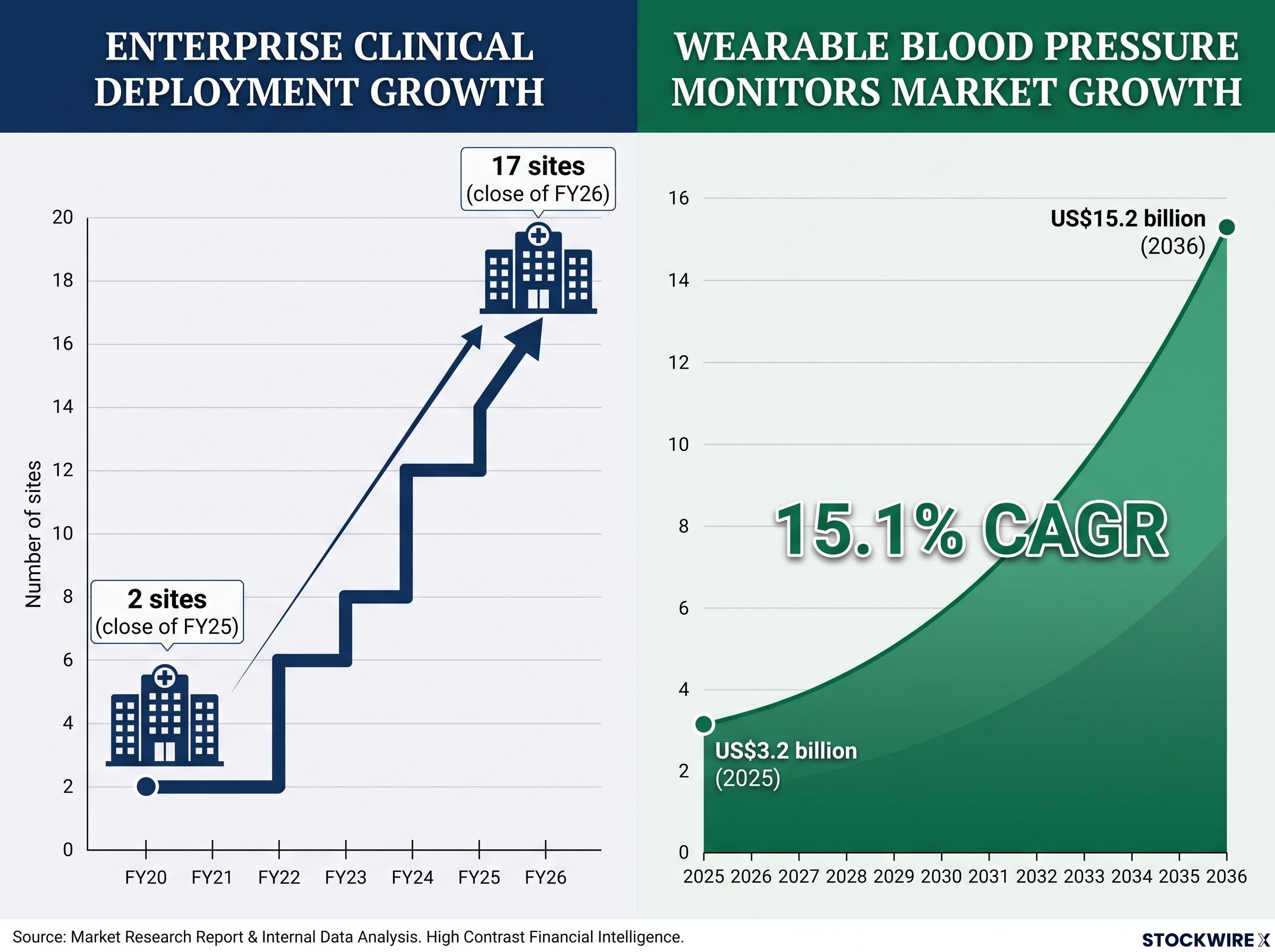
Enterprise clinical deployment locations expanded from 2 sites at the close of FY25 to 17 at the close of FY26, institutional validation that owes nothing to influencer dynamics.
Cumulative contracted enterprise value grew 65% quarter on quarter to $163,800 in Q4 FY26, and ATCOR enterprise sales contributed $0.48 million to Q4 cash receipts, a revenue line distinct from consumer Pulse. That 2-to-17 expansion tells you the clinical adoption story is real and independent of the consumer channel, which means CONNEQT’s US growth has a structural foundation that Blueprint accelerates rather than solely creates.
The cardiovascular diagnostics market is drawing multiple ASX-listed companies toward US clinical partnerships, with Artrya’s SAPPHIRE Study at Dignity Health Arizona representing a parallel example of how real-world evidence generation at US health systems is becoming a prerequisite for commercial adoption and reimbursement pathway development.
Arterial health monitoring and the longevity market
The category CONNEQT is targeting is growing on clinical and demographic fundamentals, not just influencer momentum. Industry research current as of mid-2026 sets out the scale:
- Vascular screening devices growing at roughly 6.7% CAGR (2024-2030)
- Arteriosclerosis detector market projected to more than double between 2025 and 2035
- Wearable blood pressure monitors at US$3.2 billion in 2025, projected to reach US$15.2 billion by 2036 at a 15.1% CAGR
Bryan Johnson sits at the commercial edge of that trend. PR News characterises him as “the most-photographed longevity-pursuit personality globally,” and Social Life Magazine notes his social-media posts routinely pull millions of impressions and move consumer markets in categories he endorses.
The point for readers evaluating the Pulse is credibility. Clinicians are adopting the same SphygmoCor technology independently of Blueprint, which distinguishes this from a typical influencer-backed gadget launch. Based on Q4 FY26 actuals, group revenue and other income were running at an annualised rate of roughly $10 million.
What Blueprint brings that CONNEQT’s existing US channels do not
Blueprint’s commercial logic is specific: it delivers a pre-qualified audience of high-spend, longevity-focused, evidence-seeking consumers who have already cleared their own scepticism threshold through their engagement with Johnson’s protocol. That is a different acquisition dynamic from any standard retail or digital channel.
The spending profile fits the product. Early Blueprint supplement subscriptions were referenced at approximately US$333 per month, indicating a consumer base accustomed to high health spending and a natural audience for a US$289 arterial health monitor. Marketing analysis of Blueprint’s email program suggests only around 11% of its campaigns are promotional, with the remainder educational, a trust-building model that aligns with medical-adjacent product positioning.
“The most-photographed longevity-pursuit personality globally.” (PR News)
The risks deserve to be named plainly.
- Single-personality dependency: Blueprint’s reach rests on one individual’s credibility and continued focus.
- A live, not theoretical, concern: Business Insider and Times of India have reported Johnson openly discussing stepping back from Blueprint’s day-to-day operations, describing the loss-making business as a distraction from his broader “Don’t Die” focus. Blueprint, which has reportedly raised US$60 million, has at times missed monthly break-even targets by more than US$1 million.
- Direct-purchase mitigation: Because purchases route through CONNEQT rather than Blueprint’s checkout, CONNEQT keeps the customer relationship, fulfilment and data.
Business Insider reporting on Johnson’s Blueprint plans, published in July 2025, detailed his public statements about stepping back from day-to-day operations and characterised Blueprint as a loss-making business that had at times missed monthly break-even targets by more than US$1 million, the factual basis for the single-personality concentration risk that any Pulse distribution analysis must account for.
Concentration risk is a familiar hazard for small-cap ASX health tech entering the US through a single partner. Rhythm Biosciences secured access to more than 65 US health systems through one CancerIQ partnership, illustrating both the reach and the exposure that a single channel creates.
The direct-purchase structure is the detail that matters most. If the Blueprint channel slows or shifts focus, CONNEQT retains the commercial infrastructure built through it rather than losing it entirely. That lets you read the deal as a growth accelerant with defined risk parameters, not as a categorical endorsement or a red flag.
Where CONNEQT’s US momentum goes from the Blueprint starting line
Three growth vectors are now operating at once: consumer channel expansion through Blueprint and existing US retail, enterprise clinical site scaling, and an early recurring digital revenue stream. The forward question is how they compound.
Blueprint certification goes live on top of a company already running at an annualised group revenue run-rate of roughly $10 million, with losses down 40% year on year and a 17-site enterprise network where contracted value grew 65% quarter on quarter. That reframes the question from whether the business needs the channel to whether the channel can accelerate an already-improving trajectory.
Arterial health monitoring positions CONNEQT as the next layer beyond wearables in preventive health, and the Blueprint listing provides a credentialed entry point into the longevity-focused consumer segment driving the category’s fastest growth. That segment is heading toward a US$15.2 billion wearable BP monitor market by 2036, on a 15.1% CAGR.
Three metrics will show whether the momentum holds:
- Blueprint’s first full referral quarter and what it contributes to Pulse unit sales
- The enterprise site count trajectory beyond 17, and whether contracted value keeps compounding
- In-app purchase run-rate as a proxy for the recurring revenue base building on the hardware layer
The combination of a credentialed Blueprint listing, a 17-site clinical network, and a declining loss rate means CONNEQT enters this phase with structural momentum rather than channel dependency. The open question is execution speed, not proof of concept.
This article is for informational purposes only and should not be considered financial advice. Investors should conduct their own research and consult with financial professionals before making investment decisions.
Past performance does not guarantee future results. Financial projections are subject to market conditions and various risk factors. Market size projections cited are drawn from third-party industry research and remain subject to change.