Here is a strategy that made money in roughly 72% of measured rebalances over 15 years. Since March 2022, it has reversed so sharply that investors still trading on it are systematically buying what the market has already sold.
The strategy was the ASX 200 index effect: buying stocks announced for addition to the benchmark and shorting those about to be dropped, in the weeks before the change took effect. It worked for so long that it became a standing playbook for active traders. Then it stopped, and the failure is not a blip. It is a symptom of how Australian equity markets now process predictable information.
The June 2026 rebalance, which swung hard from consumer discretionary and technology into hard assets and defence, gave that shift a live test.
Here is what the data covering 72 rebalances actually tells you, and what it does not: what the historical trade looked like, why it broke, how ASX 200 inclusion is actually decided, and how to read the next rebalance without assuming the old rules still hold.
What the index effect actually is, and why traders cared about it
Picture a trader watching a stock get named for addition to the ASX 200. That name triggers a chain of forced buying, because every passive fund that tracks the index must own the stock before the change takes effect. Buying is not optional for those funds. It is mechanical.
That forced demand is where the index effect comes from. Newly announced additions tended to appreciate ahead of implementation because the market knew a wave of index-fund purchasing was coming and positioned in front of it. The mirror trade worked the same way in reverse: passive funds must sell stocks leaving the index, so active traders shorted removals to ride the predictable downward pressure.
This was not a fringe arbitrage. According to a study of 72 rebalances from March 2007 to June 2026 led by Morgan Stanley equity strategist Antony Conte, the combined long/short trade was genuinely reliable for years.
The numbers explain why traders paid attention. Additions returned an average of 4.5% in the 20 trading days before implementation, while the ASX 200 itself fell 0.4% over that same window. Removed companies dropped an average of 4.6%.
The historical edge A strategy of buying additions and shorting removals over the 20-day pre-implementation window returned 9.1% on average and was profitable in approximately 72% of all measured rebalances, according to Morgan Stanley’s Antony Conte.
What happens after the rebalance takes effect
Here is the part most people miss. The premium existed before the change took effect, not after.
Once implementation passed, additions stopped outperforming, returning just 0.1% in the following 20 sessions against a 1.2% gain for the ASX 200. Removed stocks, meanwhile, tended to recover, rebounding an average of 3.3%. The price move ahead of implementation had already captured the anticipated flow, so what came next was mean reversion.
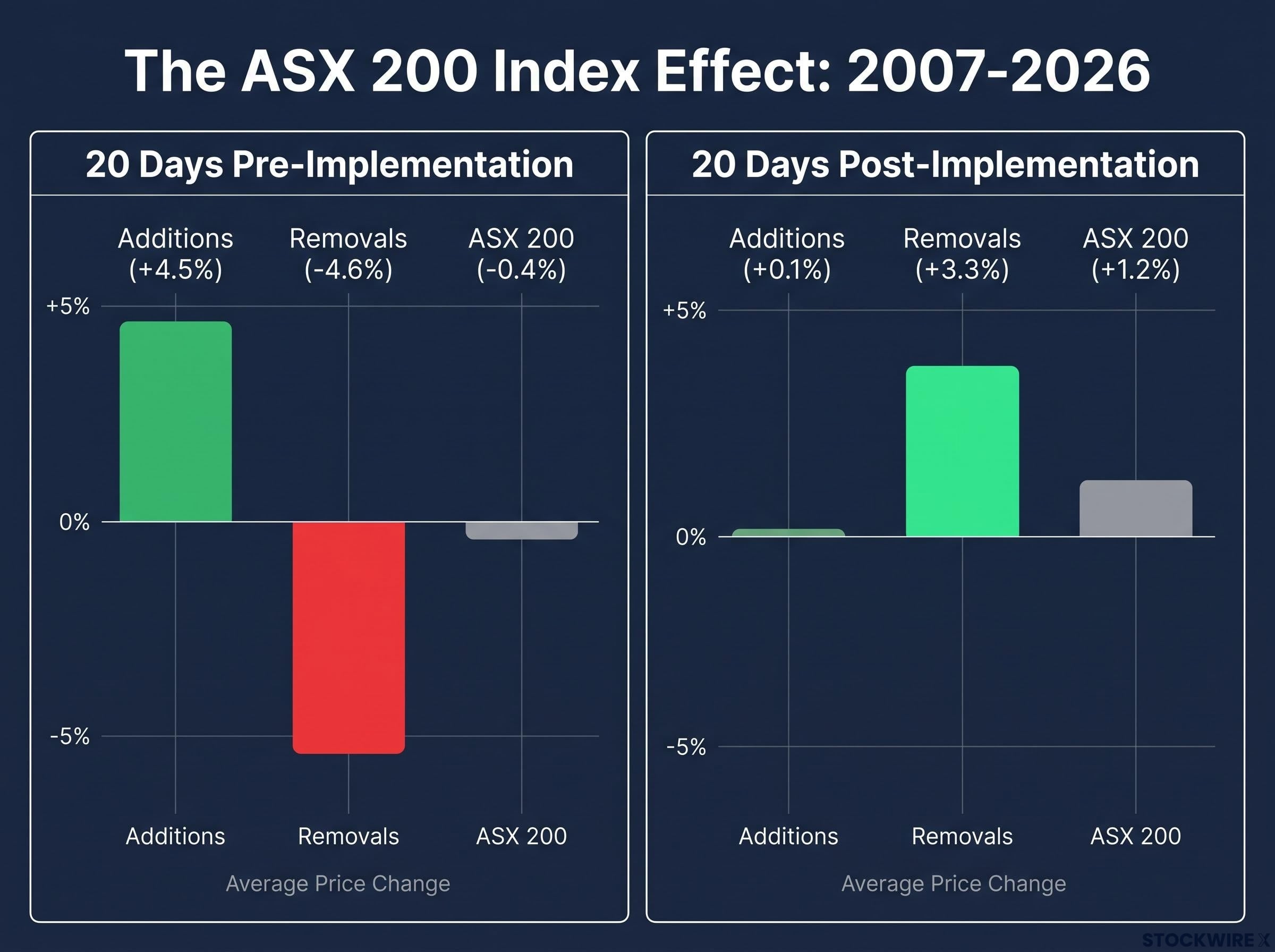
| Period (2007-2026) | Additions (avg return) | Removals (avg return) | ASX 200 (avg return) |
|---|---|---|---|
| 20 days pre-implementation | +4.5% | -4.6% | -0.4% |
| 20 days post-implementation | +0.1% | +3.3% | +1.2% |
That reversal pattern was visible in the full dataset well before 2022. It tells you the trade was never about holding through inclusion. It was about exiting before it, which means timing the entry and the exit was always the genuinely hard part.
When big ASX news breaks, our subscribers know first
How the ASX 200 actually decides who gets in and who goes out
To understand why the trade faded, you need to see how the index decides its membership, because the rules were built to resist exactly the kind of predictable events the trade depended on.
Membership is governed by S&P Dow Jones Indices and turns on size, liquidity, and ranking. The primary sizing metric is not raw market capitalisation. It is float-adjusted market cap: share price multiplied by shares on issue, then multiplied by the investable weight factor (IWF), which is the proportion of shares actually available to trade. A company can be large on paper but small on this measure if most of its stock is closely held.
The distinction between ASX listing and ASX 200 eligibility criteria matters here because the two processes are governed by entirely separate bodies under different rules, and a company can remain listed for years without ever clearing the float-adjusted market cap and liquidity thresholds that S&P Dow Jones Indices applies at each quarterly review.
Liquidity is a hard gate. A company’s median daily traded value relative to its float-adjusted market cap must be at least 50% of the market-wide ratio. Any stock that falls short is removed from the size rankings entirely, regardless of its absolute scale.
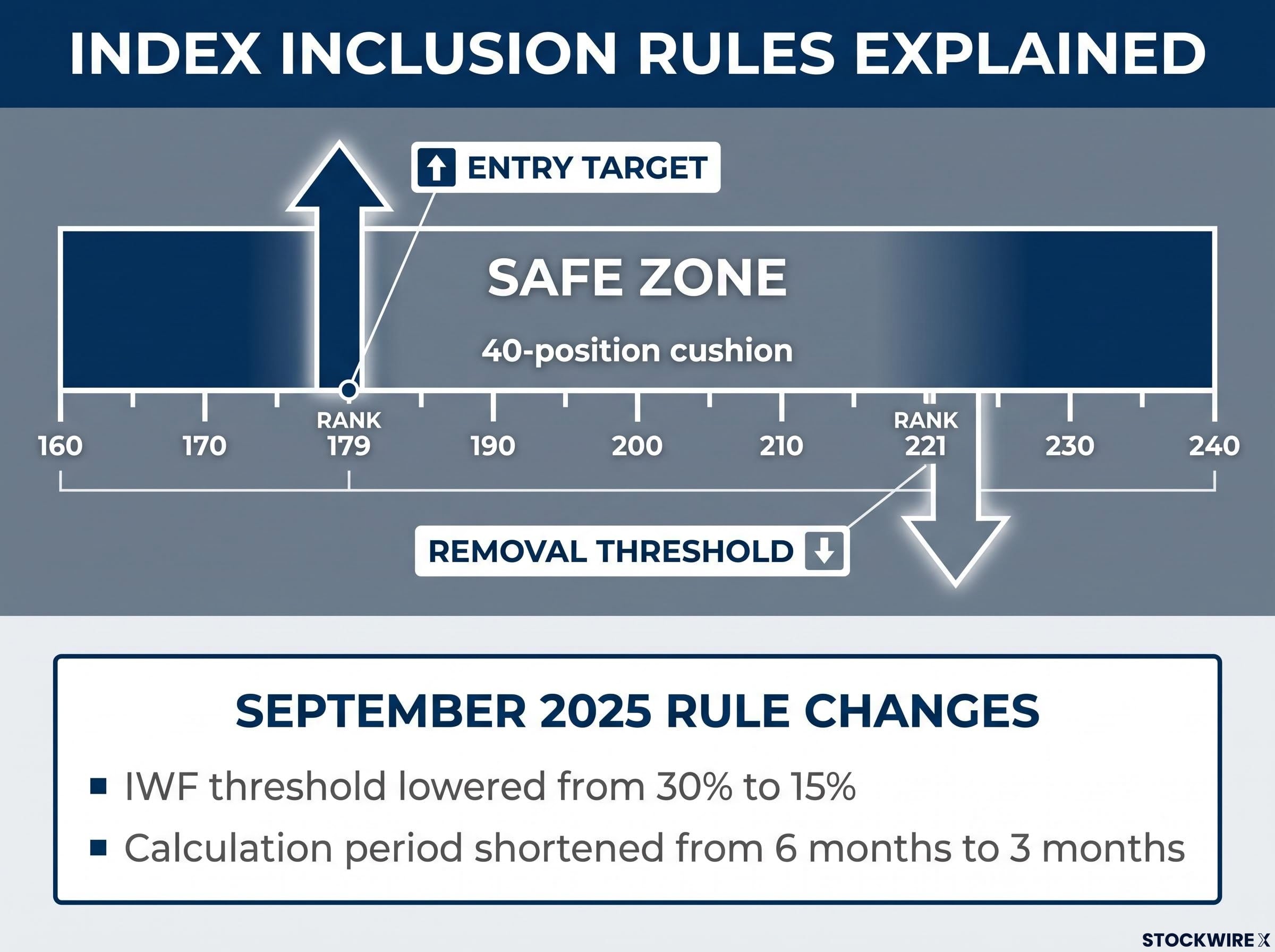
Then comes the buffer, and this is the feature that dampens the whole trade. To enter, a company must rank 179 or better. But an existing member is only removed once its rank falls to 221 or below. That 40-position cushion is deliberately asymmetric, designed to keep constituents stable and cut the turnover, and trading costs, that index funds would otherwise absorb.
What the September 2025 rule changes altered for active investors
On 4 September 2025, S&P Dow Jones Indices announced three changes, effective from June 2026, that made the index more responsive:
- IWF threshold lowered from 30% to 15%: more companies now clear the free-float bar, widening the pool of eligible entrants.
- Calculation period shortened from six months to three months: rankings now shift faster because a single unusual month carries less weight.
- Two-way turnover introduced: a stock can now be added the moment it crosses the entry buffer, even if no existing member has dropped below the exit buffer.
Modelling indicated the changes carried a tracking error of less than 0.2%, so index funds barely notice the difference. Active traders should. The shorter calculation window and lower IWF floor mean inclusion events can now happen more often and with less warning, compressing the announcement-to-implementation gap the old trade relied on. This was modernisation by S&P, not a reaction to the fading index effect, but the practical result is the same: inclusion is harder to see coming.
ASIC’s 2025 equity market review examined the structural conditions underpinning Australian public equity markets, providing the regulatory backdrop against which S&P’s September 2025 methodology changes were developed and assessed.
The June 2026 rebalance as a live test of the post-2022 pattern
The June 2026 quarterly rebalance is the cleanest recent test of the post-2022 pattern, and its character alone tells a story. Hard assets and defence walked in. Consumer discretionary and online services walked out.
The June 2026 rebalance was announced on 5 June and implemented at the close on 19 June, with all five additions carrying strong 12-month momentum but negative year-to-date returns at the point of inclusion, a combination that is central to the post-2022 argument this article examines.
| Company | Ticker | Sector | Direction |
|---|---|---|---|
| Elevra Lithium | ELV | Lithium / battery metals | Addition |
| Electro Optic Systems | EOS | Defence / space electronics | Addition |
| FireFly Metals | FFM | Copper / gold | Addition |
| Kingsgate Consolidated | KCN | Gold mining | Addition |
| Minerals 260 | MI6 | Gold / base metals | Addition |
| Guzman y Gomez | GYG | Quick-service restaurants | Removal |
| IDP Education | IEL | International education | Removal |
| SiteMinder | SDR | Hotel distribution software | Removal |
| Temple & Webster | TPW | Online furniture / homewares | Removal |
| WEB Travel Group | WEB | Online travel | Removal |
The change was announced on 5 June 2026, implemented at the close on 19 June 2026, and effective from the open on 22 June 2026. What makes it instructive is the split between long-term momentum and near-term drift heading into implementation.
Momentum without a payoff Kingsgate Consolidated carried a 133% 12-month return into implementation, yet was down 7% year-to-date at that point. FireFly Metals told a similar story: an 88% 12-month return, but down 4% year-to-date.
Those two figures are the whole argument in miniature. The additions were strong performers over a year, but they were already falling in the months before inclusion. That tells you the market had extracted the inclusion premium well before the effective date, which is exactly what the post-2022 pattern predicts.
The aftermath reinforced it. According to the original reporting, all five additions declined following inclusion. Some of that is sector, not index mechanics: Australian metals and mining stocks fell 9.8% over the post-implementation window, a headwind that goes some way toward explaining the losses but does not account for their full extent.
One data point cuts against the broader research trend. The removed stocks in June 2026 underperformed the market after implementation, rather than recovering as the post-2022 research generally suggests they would. That divergence is a useful reminder that a single rebalance is evidence, not proof, and that sector-level moves can muddy the read on any individual cycle.
Why the trade stopped working, and whether it can come back
The forces behind the reversal stack from the tactical to the structural, and they get harder to reverse as you go up.
The first is front-running. The ASX 200 has a longer gap between announcement and effective date than the S&P 500, and a 2023 SSRN paper (“Index Rebalance Effects of S&P/ASX 200”) argues that this window is precisely what lets arbitragers build positions on announcement and unwind them before implementation, draining the return out of the event itself.
The second is passive scale. Passive demand is now so large and predictable that sophisticated funds trade against it rather than alongside it. Morgan Stanley estimated the July 2026 index changes would generate approximately A$2.5 billion in total turnover, with roughly A$668 million in the ASX 200 alone. Back in January 2025, the same team estimated a 50 basis point weight increase for Sigma Healthcare would drive about A$537 million in passive trades.
That A$2.5 billion figure is more than a headline number. It is the scale of forced, predictable buying that hedge funds now actively position against, which means the passive flows that once created the opportunity now fund the arbitrage that has eliminated it.
The third force is the trade eating itself. As more active capital crowds a predictable event, the premium compresses. This is documented globally, and the numbers are stark.
The international benchmark The historic average price impact of an S&P 500 addition fell from roughly 8% in early decades to below 1% in recent years, with the effect now often statistically indistinguishable from zero.
Morningstar (April 2026) went further, reporting that companies added to the S&P 500 trailed matched peers by roughly 28% over one year and more than 55% over five years. Global data from Dimensional Fund Advisors (2025) found stocks averaged excess returns of about 4% in the 20 days before rebalancing, followed by a reversal of roughly 5.7% in the month after.
In short, the reversal runs on four mechanisms:
- Front-running: the long ASX announcement window lets arbitragers capture the return before implementation day arrives.
- Passive scale: flows are now big enough to be anticipated and shorted against.
- Methodology modernisation: more frequent, smaller inclusion events dilute the shock of any single one.
- Short-selling constraints: naked shorting is banned under ASX rules, reporting triggers at 0.01% of issued capital or A$100,000, and smaller deletions are hard to short without listed options.
Not everyone reads this as permanent. A New York Fed staff report concluded that once a stock’s extraordinary pre-inclusion momentum is controlled for, joining an index has no lasting effect on value, suggesting the old bump was partly selection bias: indices adding stocks that were already climbing. And in the Australian context, a February 2025 summary of research by Professor Carole Comerton-Forde cautioned against labelling recent market behaviour as structural decline. The safe read is that the effect has weakened materially, even if the debate over permanence stays open.
ASX short-selling rules prohibit naked shorting and require disclosure at 0.01% of issued capital or A$100,000, which means the short leg of the historical trade is structurally harder to execute on smaller deletions where listed options are absent and position sizes are limited by reporting thresholds.
Reading future rebalances without the old assumptions
The evidence points to a clear filter. If you are going to think about positioning around a rebalance at all, three variables now decide whether any residual premium is even theoretically on offer:
- Timing relative to the announcement, not the implementation. The front-running data shows the return, if it exists, materialises early. Using inclusion at implementation as a buy signal leaves you one step behind the arbitrage.
- Liquidity and short-ability of the removal candidate. ASX short-selling rules and the absence of listed options on smaller names mean the short leg is often impractical, which quietly removes half the historical trade.
- Predictability of the addition under current eligibility mechanics. The lower IWF floor and shorter calculation window make entrants harder to anticipate, so a surprise addition behaves differently from a telegraphed one.
Short interest data carries a four-business-day publication lag on the ASX, which means institutional positioning ahead of a rebalance announcement is largely established before retail investors can read the signal, compressing the window between a publicly observable event and a tradeable edge even further.
The post-2022 reversal does not mean index composition is irrelevant. It means the direction and timing of the price response has moved. The June 2026 case also showed that a sector drawdown, in that instance the 9.8% fall in metals and mining, can swamp any individual inclusion effect, so you have to separate index mechanics from macro before drawing conclusions.
If anything, the fading of the implementation-day premium pushes the real opportunity earlier, closer to announcement, where less capital competes and the signal is less crowded. That is where your attention belongs, if it belongs anywhere.
This article is for informational purposes only and should not be considered financial advice. Investors should conduct their own research and consult with financial professionals before making investment decisions. Past performance does not guarantee future results, and financial projections are subject to market conditions and various risk factors.