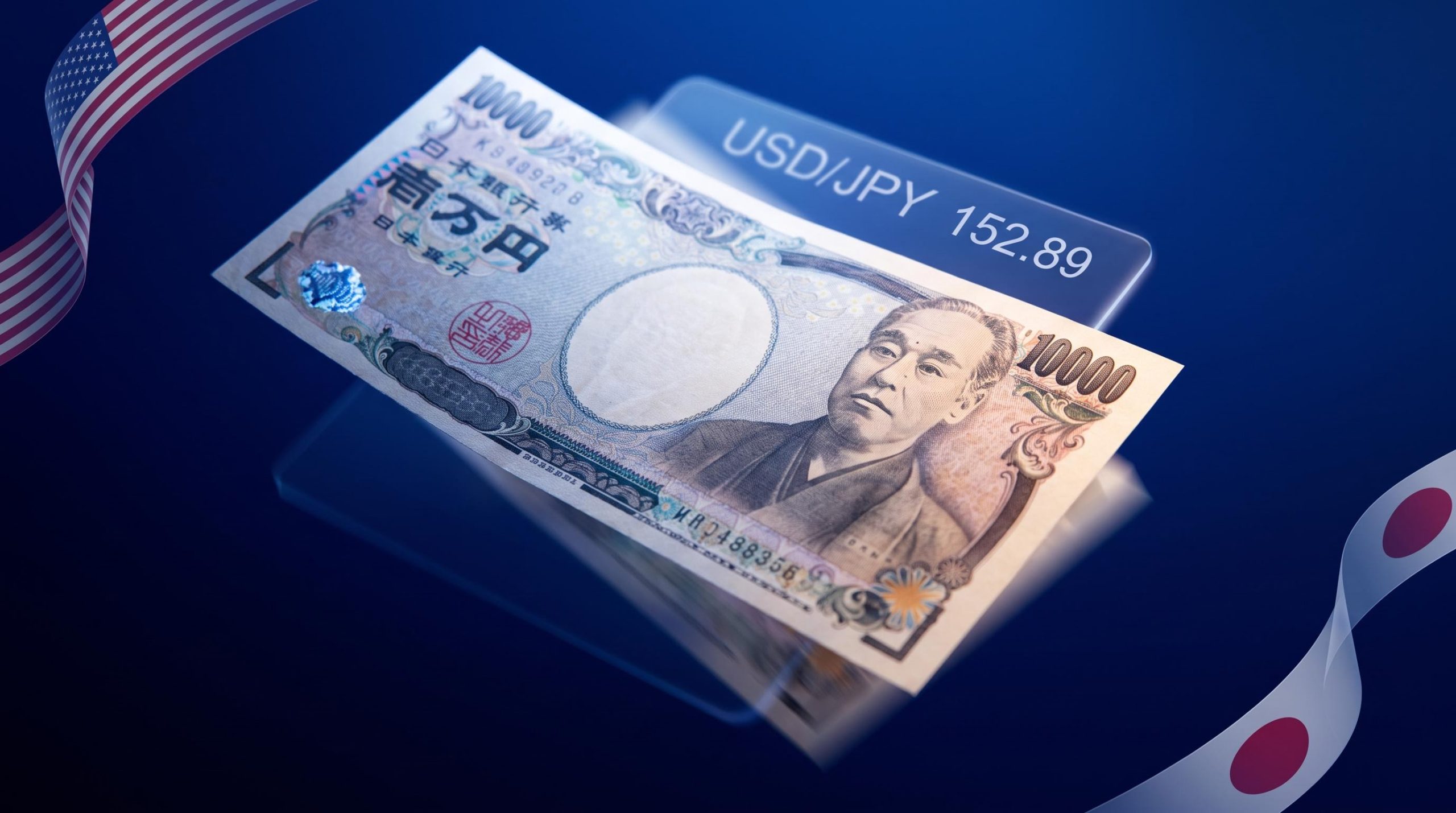
In late July 2026, the yen fell to its weakest level against the dollar since 1986. Within weeks, the United States and Japan did something they had not done together in nearly three decades: they intervened jointly to reverse it.
That sequence is the strange heart of the story. A currency reaches a four-decade low, and two of the world’s largest economies coordinate an operation last seen in 2011, when the goal was the exact opposite.
This moment sits at the intersection of two trends that had been building for years. Japan’s ultra-low interest rate era was straining under real inflation pressure, and the dollar had strengthened to the point where its trajectory was damaging a key trading partner. To understand what happened to the yen in 2026, you need to understand both the mechanics of intervention and the logic of the carry trade.
This piece gives you a clear framework for reading USD/JPY moves going forward. You will learn what drives the yen at a structural level, why coordinated intervention is categorically different from a country acting alone, and which signals actually matter for whether yen strength lasts. This is practical interpretive knowledge, not a news recap.
From 160 to 153: how fast the yen moved, and what triggered the shift
The numbers first. USD/JPY reached roughly 163-164 in late July 2026, the yen’s weakest level against the dollar since 1986. By early September 2026, it had recovered to a 152.89 intraday low, settling near the 153-154 range. Across the third quarter through early September, the yen appreciated more than 5%.
That recovery was not a single dramatic reversal. It was the product of an escalating campaign of intervention, stretched across months and rising in scale each time the yen tested new extremes.
The chronology matters, because it shows you a pattern of mounting pressure rather than one decisive strike:
- 30 April 2026: Japan executed a single-day yen-buying operation of 6.28 trillion yen (approximately $39-40 billion), its largest daily intervention on record, as the yen slid past 160.
- Late April to May 2026: The cumulative campaign reached roughly $72-73 billion, the largest unilateral effort Japan had mounted to that point.
- Late July 2026: Japan intervened during New York trading hours for the first time in about three months, with Bank of Japan data indicating it may have sold as much as $58.97 billion.
- 31 July 2026: Japan and the United States conducted a joint yen-buying operation, the first coordinated action of its kind in nearly thirty years.
| Event | Date | Amount (USD approx.) | USD/JPY Level | Outcome |
|---|---|---|---|---|
| Record single-day operation | 30 April 2026 | $39-40 billion | Past 160 | Yen rose as much as 3% |
| Cumulative April campaign | April-May 2026 | $72-73 billion | Around 160 | Largest unilateral effort to date |
| New York-hours operation | Late July 2026 | Up to $58.97 billion | 163-164 | Yen held above 40-year lows |
| Joint U.S.-Japan action | 31 July 2026 | Up to $36.58 billion (Japan) | Near 1986 lows | Coordinated reversal |
What the reserve drawdown reveals
Here is the detail that explains why the campaign escalated the way it did. Japan holds approximately $1.3 trillion in foreign exchange reserves, a substantial war chest. But following the April operations, those reserves recorded a 5.6% monthly drop in May 2026, a record for a single month.
That figure tells you something the headline intervention numbers do not. Unilateral intervention at this scale is only sustainable for a limited time, because every yen bought spends down a finite reserve balance that markets can estimate.
The escalation to coordinated action with the United States, then, was not a diplomatic flourish. It was a strategic necessity, and if you are tracking USD/JPY, that distinction matters for judging whether the move has further to run or is already the product of exhausted reserves and temporary short squeezes.
When big ASX news breaks, our subscribers know first
What is a carry trade, and why does yen weakness become self-reinforcing?
To understand why the yen kept sliding despite record intervention, you need to see it from a trader’s desk. The mechanism is called the carry trade, and it works because Japan’s interest rates sat far below almost everyone else’s for years.
The profit engine behind yen weakness is grounded in carry trade mechanics that persisted even after the Bank of Japan raised rates to a 31-year high, because a 2.5-2.75 percentage point spread over U.S. rates still makes borrowing cheap yen and converting into dollars one of the most structurally entrenched trades in global markets.
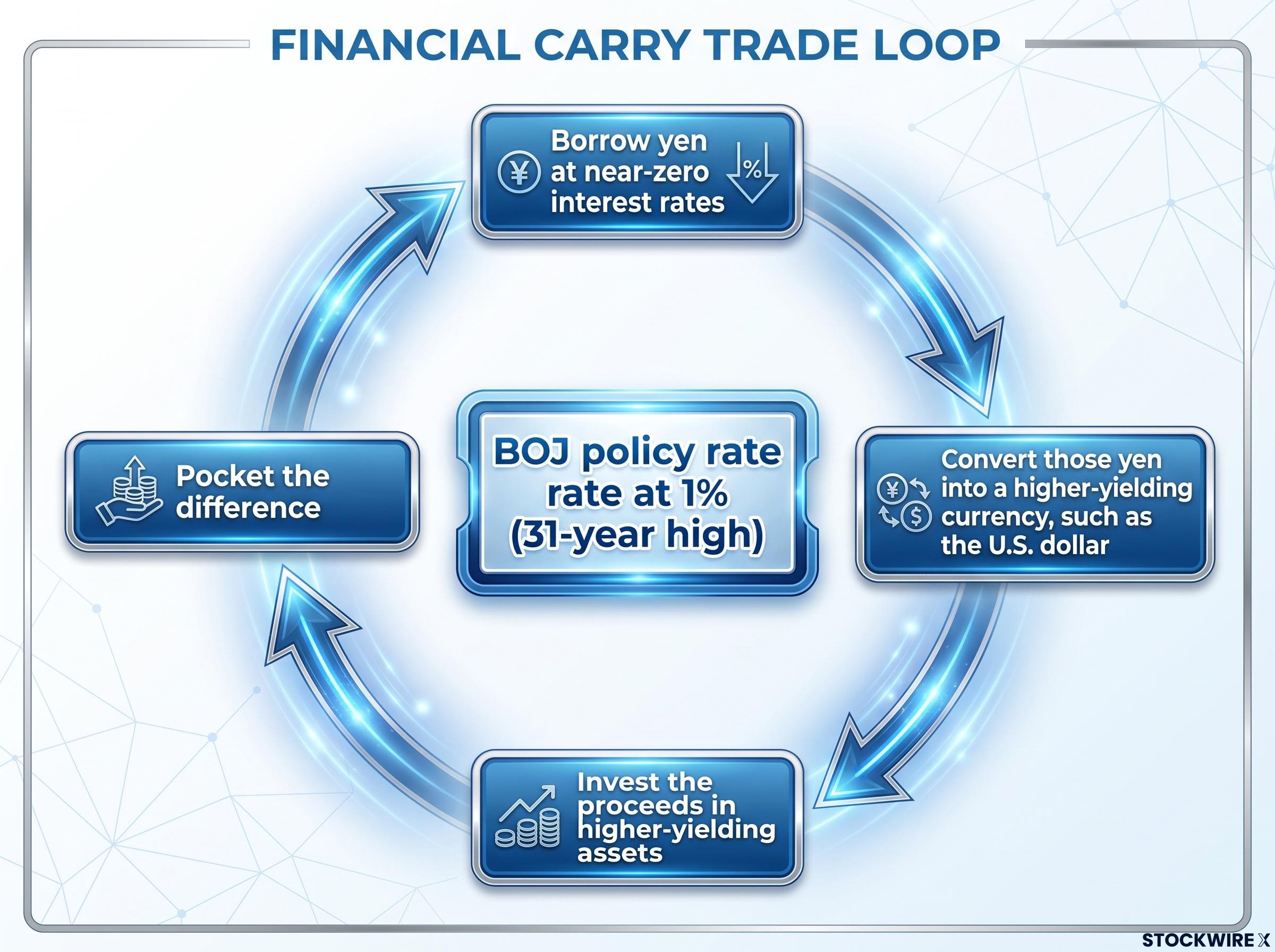
The logic runs in a few simple steps:
- Borrow yen at near-zero interest rates.
- Convert those yen into a higher-yielding currency, such as the U.S. dollar.
- Invest the proceeds in higher-yielding assets.
- Pocket the difference between what you pay to borrow and what you earn, as long as the exchange rate holds.
For an individual trader, this is a rational decision. The problem is what happens when thousands of them make the same decision at once.
Every carry trade requires selling yen to buy the higher-yielding currency. So the more traders pile into short-yen positions, the weaker the yen becomes. A weaker yen then makes the trade even more profitable, which attracts more positioning, which pushes the yen lower still.
That is the self-reinforcing loop. The yen’s weakness in 2026 was not simply a verdict on Japan’s economy. It was a structural trade with real profit incentives feeding on itself, and that is why intervention alone struggled to break it.
An external shock made things worse. The oil price spike linked to the Iran conflict hit Japan with particular force, because Japan imports the vast majority of its energy. A weaker yen combined with higher oil prices creates a compounding import inflation problem, worsening living costs and raising the urgency behind the intervention campaign.
The Bank of Japan had already begun responding. It held its policy rate at 1% as of its late July 2026 decision, a 31-year high reached after earlier hikes lifted rates out of negative territory. Yet even at 1%, the gap between Japanese rates and U.S. Federal Reserve rates remained wide enough to keep the carry trade attractive.
That gap is the point. Mitsuhiro Furusawa, Japan’s former top currency diplomat, made the case plainly.
Japan may conduct joint yen intervention “at any time” and should signal the chance of faster-than-expected interest rate hikes to stem the currency’s falls, Furusawa told Reuters on 14 August 2026.
Understanding this mechanism tells you why yen weakness in 2026 was structurally entrenched rather than a passing mood. It was a trade with a genuine profit engine behind it, and only a change in the interest rate differential could reliably unwind it. When BOJ rate expectations shift, carry trade unwind risk rises immediately, which means USD/JPY can move sharply and fast even without formal intervention.
Why coordinated intervention is categorically different from Japan acting alone
Japan can spend enormous sums buying its own currency. What it cannot do, acting alone, is escape a credibility ceiling.
The problem is arithmetic. Markets can estimate the size of Japan’s reserves, watch them deplete, and bet on eventual exhaustion. Even a record single-day operation runs into this limit, because every speculator knows the ammunition is finite and countable.
Japan’s ability to sustain the intervention campaign was further constrained by IMF episode limits on free-floating currency management, which cap the number of discrete intervention windows a country can execute before triggering formal IMF scrutiny of its exchange-rate classification.
U.S. participation changes that calculus entirely. When the United States enters, it brings institutional firepower Japan cannot replicate: the U.S. Treasury sold euros to buy yen, added its own rate checks, and communicated directly with market participants. Above all, it added a political signal that both Washington and Tokyo view the yen’s slide as a shared problem.
The rarity of the move is itself the message. The 31 July 2026 joint operation was only the second coordinated yen-related intervention since 1973, following the 2011 action taken after the Tohoku earthquake.
| Dimension | Japan acting alone | U.S. and Japan coordinated |
|---|---|---|
| Signal strength | Domestic concern | Shared bilateral concern |
| Reserve constraint | Finite, estimable | Two balance sheets in play |
| Market credibility | Vulnerable to exhaustion bets | Harder to fade |
| Political backing | Tokyo only | Tokyo and Washington |
| Historical frequency | Recurring | Second time since 1973 |
Japanese Finance Minister Satsuki Katayama confirmed the joint action, and U.S. Treasury Secretary Scott Bessent announced it, describing the yen as undervalued. According to Reuters citing central bank data, Japan may have spent as much as $36.58 billion buying yen on 31 July, while the amount the United States deployed was not publicly disclosed.
Tokyo “will not hesitate to take further action,” Japan’s finance ministry stressed following the joint intervention.
The 2011 precedent: same tool, opposite direction
The comparison with 2011 is instructive precisely because the direction was reversed. That coordinated action aimed to weaken a yen that had surged too far after the Tohoku earthquake, threatening Japan’s export recovery. In 2026, the same coordinated mechanism was used to strengthen a yen that had fallen too far.
The rarity is what carries the weight. When two major economies align publicly against a currency move, the risk premium for holding short-yen positions rises in a way that reserve size alone can never produce. You now have to price political risk on top of fundamental risk.
For anyone watching global FX, this sets a precedent worth noting: the United States has shown it is prepared to act against extreme dollar strength when it threatens a key ally. That changes the risk calculation for dollar-bullish positioning far beyond the yen.
The BoJ normalisation path: why rate hikes matter more than intervention for lasting yen strength
Intervention is the loud part of this story. The quieter part matters more.
Currency intervention treats a symptom, the spot exchange rate on a given day. Monetary policy normalisation treats the cause, the interest rate differential that makes the carry trade profitable in the first place. Only one of them can produce durable yen strength.
Here is how rate hikes do the work that intervention cannot. As Japanese rates rise toward those of the United States, the spread that funds the carry trade compresses. Borrowing yen to fund dollar positions becomes less profitable, which reduces structural demand for short-yen positions without spending a single dollar of reserves.
The Bank of Japan held its rate at 1%, a 31-year high as of June 2026, and market expectations pointed to further 0.25 percentage point hikes, including at the meeting scheduled for 17-18 September 2026. MUFG analyst Lee Hardman assessed that it appeared progressively more probable the BOJ would quicken the pace of its rate increases.
The July rate hold decision revealed an 8-1 split, with sole dissenter Hajime Takata pressing for an immediate move to 1.25%, a detail that shortened the perceived distance to the next hike and added a bilateral diplomatic dimension after U.S. Treasury Secretary Bessent publicly labelled the yen substantially undervalued in the same window.
This is where the two competing interpretations of 2026’s yen recovery diverge. One camp reads the yen surges as intervention-induced short squeezes that fade whenever the rate differential stays unfavourable. The other argues that if intervention is paired with faster BOJ hikes, the strength can become fundamental.
The evidence has begun tilting toward the second view. According to MUFG, Bessent’s remarks strengthened market conviction that Japan was committed to adjusting domestic policy to support the yen, complementing the joint intervention. A strong Reuters Tankan business sentiment reading, a monthly survey of Japanese firms that serves as a leading indicator for the BOJ’s own quarterly poll, added further support for continued normalisation.
The clearest signal came from price action itself.
USD/JPY’s decline toward 153.00 reflected shifting policy expectations rather than direct foreign exchange intervention, MUFG’s Lee Hardman assessed, with the pair trading around 153.50 in European hours near a roughly seven-month low.
That observation tells you the market is beginning to price in a credible BOJ tightening path, which is a more important signal than any single intervention announcement. If you hold USD/JPY exposure or carry trade positions anywhere in your portfolio, two variables deserve close attention above all others:
- BOJ meeting outcomes and rate decisions through the rest of 2026
- The Fed rate trajectory and U.S. employment data
- USD/JPY levels relative to intervention thresholds
- Reuters Tankan readings as a leading BOJ indicator
Intervention creates the window. Policy is what closes it.
What determines whether yen strength holds from here
You now have the tools to read the yen rather than simply react to headlines. Three variables will decide whether 2026’s recovery is a structural inflection or an intervention-induced pause.
Two of these mechanisms reinforce yen strength. Intervention narrows the speculative window by making short-yen positions dangerous to hold. BOJ normalisation changes the fundamental carry calculus by compressing the rate spread. The third variable is the wild card: the Federal Reserve’s own rate path and the direction of U.S. economic data.
That third factor showed its power on 7 August 2026, just days after the joint action. A surprisingly weak U.S. employment report drove a sudden yen surge, with traders already alert to further intervention.
That episode is a worked example of a tightening feedback loop. In an environment already primed for intervention, a weak U.S. data point lowers Fed rate expectations, compresses dollar yields, and amplifies yen gains. You do not need an intervention announcement to see a large yen move any more.
The stakes extend well beyond the currency pair. A carry trade unwind does not stay contained in FX; the leveraged positions funded by cheap yen borrowing sit across global risk assets, so a sharp unwind can force broad market adjustments. Coordinated intervention that caps extreme dollar strength also has implications for non-yen currency pairs.
Carry trade unwind risk does not stay confined to FX: the leveraged positions funded by cheap yen borrowing sit across global equities, bonds, and emerging-market assets, and the 2024 episode showed that 40-60% of speculative positioning can clear within weeks without producing the cascading structural breakdown that peak-fear headlines typically imply.
Here is the framework to carry forward:
- Watch the pace of BOJ rate hikes against the Fed’s hold-or-cut trajectory. The differential is the fundamental driver.
- Watch USD/JPY relative to the roughly 155-160 range as a potential re-intervention threshold.
- Watch U.S. employment and inflation data as the key dollar-weakening catalyst in this environment.
Japan’s $1.3 trillion reserve balance is substantial, but the 5.6% May depletion is a standing caution on how long unilateral support can last. History offers the cleanest lesson: interventions work best when they reinforce, rather than fight, the underlying direction of monetary policy. Furusawa’s warning that Japan may intervene “at any time” now functions as a permanent risk premium that reprices carry trades on any yen-weakening move.
Reading the yen from here: the signals that will settle the durability question
Strip away the drama, and the 2026 episode resolves into three causal layers working together. Intervention mechanics set the immediate spot rate. BOJ policy normalisation reshapes the fundamental carry calculus. U.S. data and the dollar’s trajectory supply the external catalyst. Read as one interpretive framework rather than three separate stories, they tell you how yen dynamics actually work.
What remains genuinely uncertain is real. Whether the BOJ’s 17-18 September meeting delivered a further hike, whether the U.S. economy keeps producing data surprises that weaken the dollar, and whether the U.S.-Japan framework holds if USD/JPY drifts back toward extremes are all open questions.
The 2011 comparison offers the enduring lesson: coordinated intervention reserves its force for moments of extreme misalignment, and 2026 clearly met that bar. With the BOJ rate at a 31-year high of 1%, a normalisation path still has considerable room to run relative to decades of ultra-loose policy, and Furusawa’s “at any time” language ensures the intervention threat persists even when no operation is active.
USD/JPY’s decline toward 153 reflected “shifting policy expectations rather than direct foreign exchange intervention,” MUFG’s Lee Hardman assessed.
That single observation is the most important signal in the entire episode. When the pair, at a 152.89 early-September low, moves on policy expectations alone, it tells you the market is beginning to believe the normalisation story. Belief is what turns a tactical rally into a structural one.
This article is for informational purposes only and should not be considered financial advice. Investors should conduct their own research and consult with financial professionals before making investment decisions. Past performance does not guarantee future results, and forward-looking statements about central bank policy and currency movements are speculative and subject to change based on market developments.