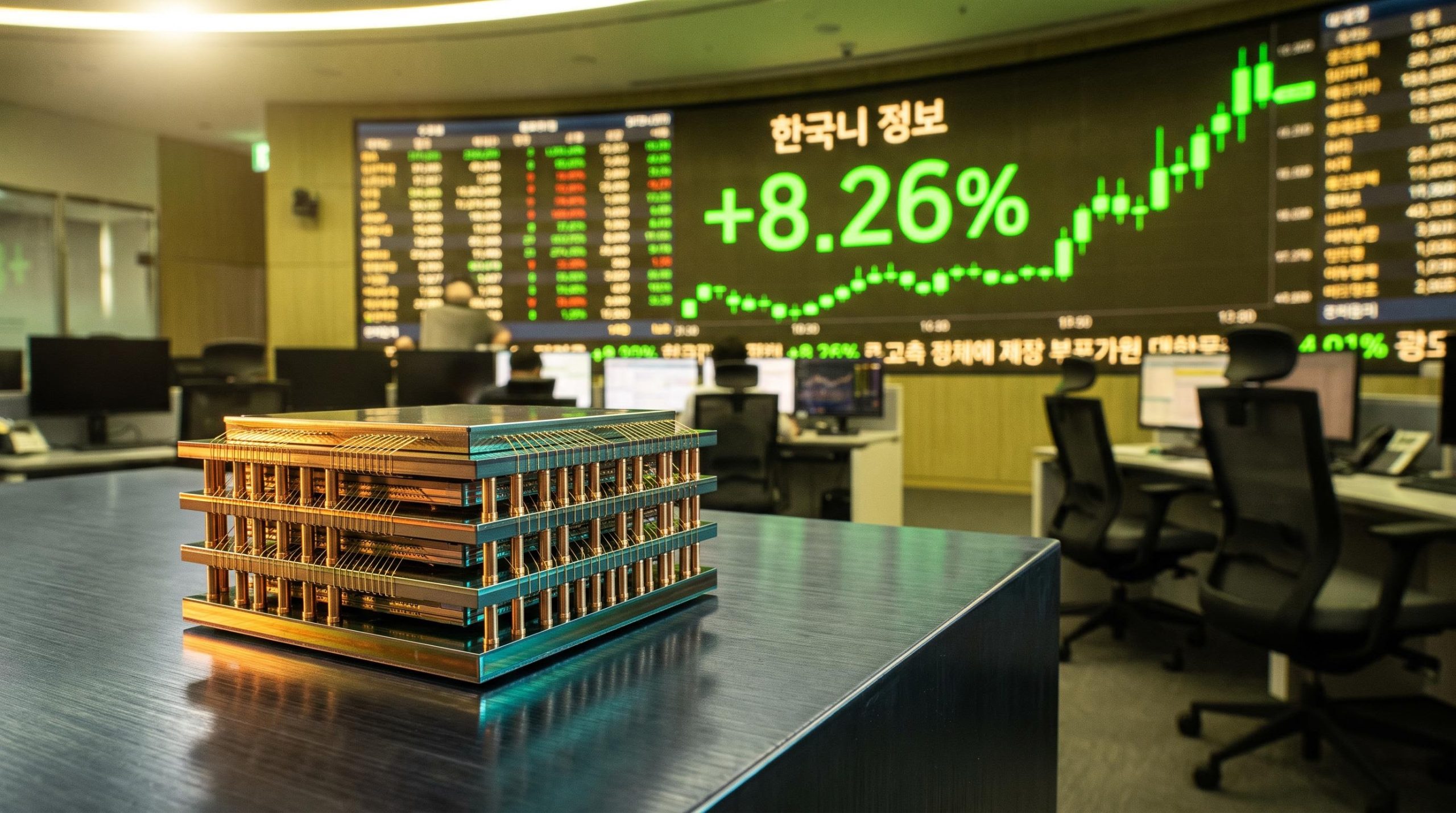
SK Hynix shares surged 8.26% in a single session on 7 September 2026, one of the sharpest moves the stock has made all year. The catalyst was not an earnings beat or a supply deal. It was a language model.
OpenAI’s GPT-6 Astra, launched on 3 September 2026, carries an architecture that analysts describe as unusually memory-intensive. For anyone watching the Korean semiconductor space, that single architectural detail turned into a fast reassessment of who benefits most from the next wave of AI infrastructure spending. SK Hynix, which holds roughly 50-60% of the global high-bandwidth memory market, sits closest to that demand signal.
This piece maps the chain from model launch to market move, walks through the valuation compression that set the stage for such a violent reaction, and lays out the structural risks that separate a durable re-rating from a short-covering bounce. By the time you finish, you will know whether the rally reflects a genuine shift in SK Hynix’s earnings trajectory or a relief move off a heavily oversold base.
Seoul’s sharpest AI trade: what the 7 September session actually showed
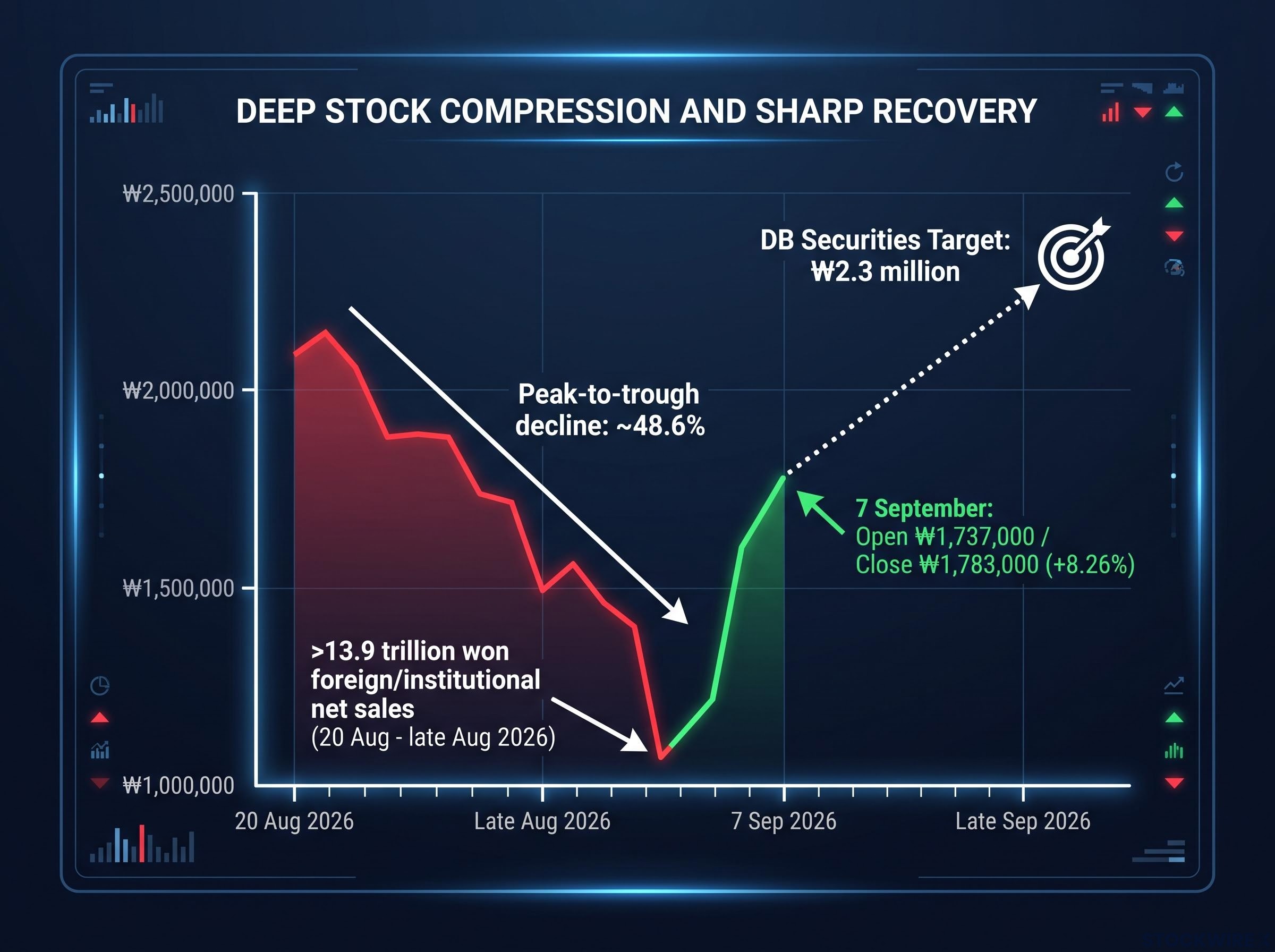
The move was fast and it was large. SK Hynix opened at ₩1,737,000 and closed at ₩1,783,000 on 7 September 2026, up 8.26% from the previous session. The next day added a further 0.6%, closing near ₩1,793,000.
Here are the numbers that anchor the session:
- Open: ₩1,737,000 on 7 September 2026
- Close: ₩1,783,000, up 8.26%
- Follow-through: approximately ₩1,793,000 on 8 September, up roughly 0.6%
That a US model launch produces a Seoul trading session is not coincidence. The Nasdaq 100 and Kospi 200 have carried a price correlation of more than 91% over the prior two years, which makes Korean memory names a mechanical proxy for the American AI trade. When sentiment shifts in US technology, Seoul moves with it.
The single-session percentage is the headline. The flow data underneath it is the story.
Overseas investors turned to net buyers of Korean equities in the first week of September 2026, reversing sustained selling that had weighed on the market for weeks. To gauge how heavy that selling had been, combined foreign and institutional net sales topped 13.9 trillion won between 20 August and late August 2026.
That reversal matters more than the 8.26% print, because it tells you institutional positioning shifted on the back of Astra, not just retail enthusiasm. A bounce driven by short covering fades. A return of foreign capital is the kind of move that can hold.
Analyst target: ₩2.3 million DB Securities raised its price target for SK Hynix to ₩2.3 million following the launch, with broader consensus pointing to over 50% upside from the 7 September close.
When big ASX news breaks, our subscribers know first
Why a language model is a hardware procurement decision
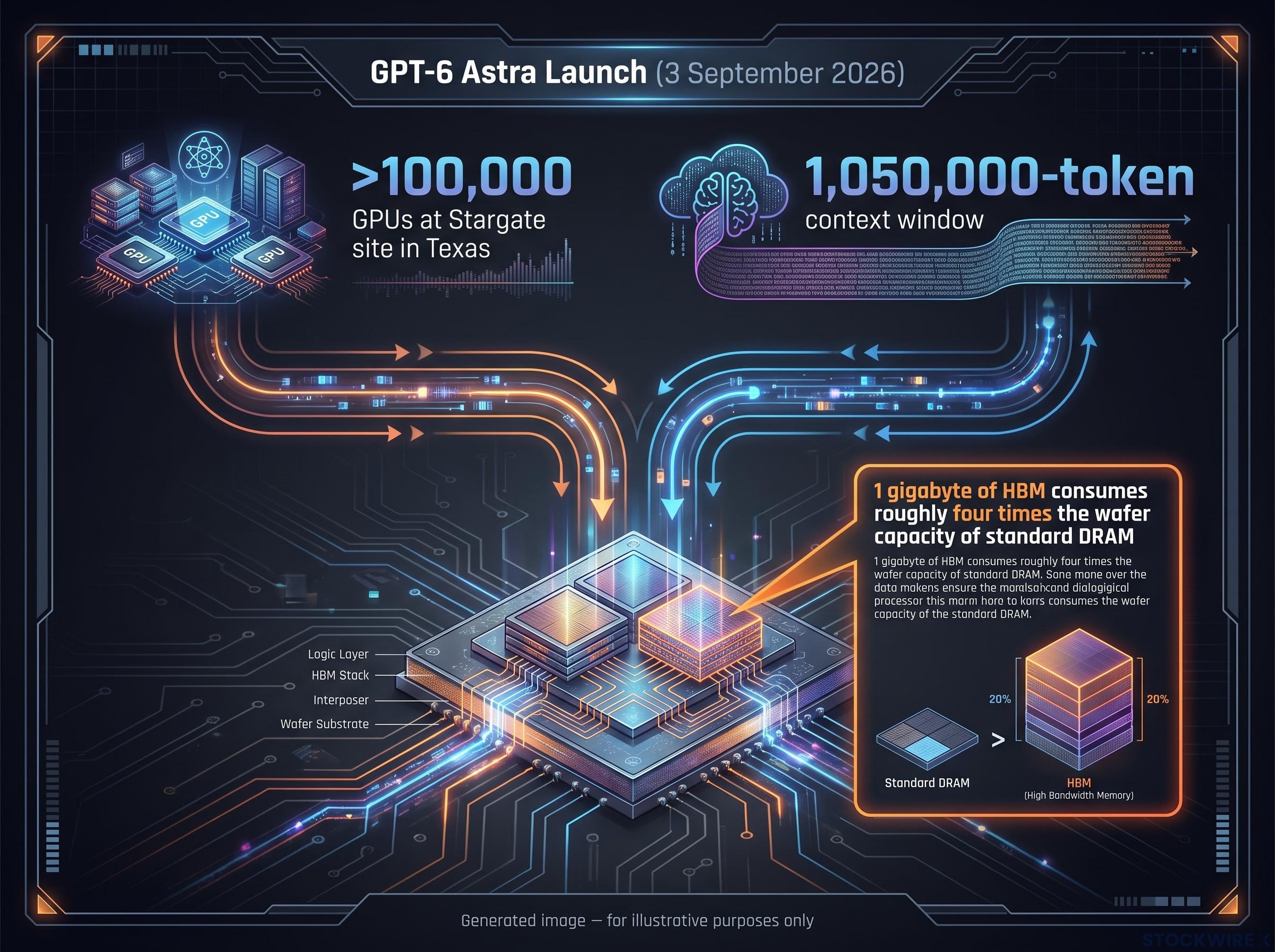
To understand the rally, follow the architecture. GPT-6 Astra was built on OpenAI’s largest training run to date, reportedly running more than 100,000 GPUs at the Stargate site in Texas. Its specifications read like a memory stress test.
The model carries a 1,050,000-token context window, can generate up to 128,000 tokens in a single call, and uses recurrent depth reasoning, a technique where the model loops through its own layers repeatedly to reason more deeply. Each of these capabilities compounds the amount of memory bandwidth the hardware has to sustain.
The memory wall that recurrent depth reasoning exploits is not limited to HBM: Bernstein’s August 2026 research identifies conventional DRAM and SSD as structural co-beneficiaries, because inference decode phases and RAG deployments push demand into the broader memory stack, not only the stacked memory sitting on the GPU die.
High-bandwidth memory (HBM), a stacked memory design that moves data far faster than standard chips, is currently the only memory type able to feed that bandwidth at both training and inference scale. So when a model this large ships, the demand does not land on generic chips. It lands on HBM.
The arXiv research on LLM memory bandwidth requirements identifies the substantial memory footprint and high bandwidth demands inherent to large language model inference as the primary architectural driver for HBM adoption, providing technical grounding for why capability advances at the model level translate directly into procurement pressure at the chip level.
Here is the number that reframes the entire thesis: 1 gigabyte of HBM consumes roughly four times the wafer capacity of standard DRAM. That means scaling an AI model does not produce a linear increase in memory demand. It produces a convex one, where each step up in capability draws disproportionately more manufacturing capacity.
SK Hynix absorbs the largest slice of that non-linearity because it holds the largest slice of the market.
| Vendor | Q1 2026 share | Q2 2026 share | Full-year 2026 estimate |
|---|---|---|---|
| SK Hynix | ~58% | ~50% | ~50% |
| Samsung | ~21% | ~33% | ~28% |
| Micron | ~21% | ~18% | ~22% |
The company also supplies an estimated 60-70% of Nvidia’s HBM orders, per late-2025 and early-2026 figures, placing it at the centre of the supply chain for AI’s dominant chip.
HBM total addressable market Estimated at $56 billion in 2026, $116 billion in 2027, and $168 billion in 2028, according to market modelling.
If you treat HBM demand as simply “more AI spending means more chips,” you will misprice both margin and volume. The wafer intensity and the market share are the sharper lens.
How 48% valuation compression set the fuse
The September rally makes more sense once you see what preceded it. SK Hynix was trading roughly 48.6% below its 2026 peak when the stock jumped, and that is not a detail. It is the reason an 8.26% move was even possible.
Through July and August 2026, the sell-off was brutal. Consider the scale:
- Peak-to-trough decline: approximately 48.6% from the 2026 high
- Philadelphia Semiconductor Index forward price-to-earnings multiple: contracted from around 29 times in June 2026 to under 19 times
- Combined foreign and institutional net sales: more than 13.9 trillion won between 20 August and late August 2026
Semiconductor valuation compression in mid-2026 was not uniform: the Philadelphia Semiconductor Index forward price-to-earnings multiple contracted from around 29 times in June to under 19 times, but individual names diverged sharply, with Micron trading below 9 times forward earnings while other names carried multiples that exceeded dot-com-era peaks.
The mechanics were violent on a daily basis. Single-session intraday drops ran 9-15% for SK Hynix and 5-10% for the KOSPI, and over parts of August the stock shed roughly 35% as oversupply fears took hold. This was a compression event, not an orderly repricing.
A 7 September research note from Saxo Bank captured the counter-view, arguing that AI capability advancement remains ongoing and continues to support sector investment. That view had been drowned out through the summer. Astra gave it a catalyst.
Here is what the compression means for reading the rally. A stock that has fallen nearly half from its peak needs far less new positive information to produce a large percentage bounce. The 8.26% move was as much a function of the depressed starting point as of anything specific to GPT-6 Astra.
SK Hynix’s buyback as floor, not catalyst
SK Hynix concentrates its capital return on share repurchases rather than dividends, which sets it apart from Samsung’s dividend-heavy approach. The buyback it began on 20 August 2026 provided mechanical price support during the worst of the sell-off.
What it could not do was reverse the foreign selling on its own. The float kept contracting, but overseas capital only turned until the Astra catalyst arrived.
The buyback’s real significance is structural. It signals management conviction that the stock is undervalued, and it provides ongoing per-share support as the share count shrinks, which is a floor rather than a spark.
The risks that the rally has not priced out
The demand case is real. So are the headwinds, and the September move has not resolved any of them.
Start with competition. Samsung is reportedly preparing a low-price strategy, with HBM shipments projected to grow around 20% annually through 2026, while Micron is targeting roughly 20% market share. Both could erode SK Hynix’s pricing power precisely as the demand story peaks in the headlines.
Then there is customer concentration. Supplying 60-70% of Nvidia’s HBM orders is the reason for SK Hynix’s leadership and its single largest vulnerability at the same time. That figure cuts both ways: it amplifies the upside when Nvidia’s demand runs hot, and it is the first variable to watch if Nvidia diversifies its supply chain.
| Risk factor | Potential impact |
|---|---|
| Competitive pricing pressure | Samsung’s low-price strategy and Micron’s share push could compress margins |
| Customer concentration | 60-70% Nvidia reliance leaves earnings exposed if orders diversify |
| HBM4 yield constraints | Qualification bottlenecks expected to restrict supply for 2-3 quarters |
| Geopolitical exposure | US export controls and China market access risks remain unresolved |
| Memory cycle reversal | Double-digit HBM price declines possible as new capacity comes online |
The structural risks sit independent of competition. HBM4, the next-generation standard, brings yield and qualification bottlenecks expected to constrain supply for 2-3 quarters, and history shows memory prices tend to collapse when large new capacity arrives all at once. SK Hynix is still projected to lead HBM4 at roughly 54% share in 2026, ahead of Samsung at 28% and Micron at 18%, but leadership does not immunise pricing.
Against all of that sits a structural counterweight that is hard to ignore.
The demand anchor Goldman Sachs and Morgan Stanley estimate that over half of the projected $1.3 to $1.5 trillion in total AI capital expenditure planned for 2027 will flow directly to memory.
Market modelling points to HBM undersupply of 5.4-6.0% spanning 2026-2028 and DRAM undersupply of 4.9-5.0% in 2026. The risk stack does not invalidate the demand thesis. It defines the ceiling on how much of that demand converts into sustained margin expansion, and you need both sides to size a position sensibly.
DRAM supply tightness extends well beyond the AI training window: SK Hynix projects the shortage through 2030, with all three major producers fully sold out through 2026 and HBM inventory sitting at just 3-4 weeks industry-wide, a scarcity condition that existed before GPT-6 Astra arrived and will persist after the headlines move on.
A reset, not a resolution: what the Astra rally actually changes
Strip out the noise, and the September move changed a specific, limited set of things. It did not rewrite the whole story.
What the Astra rally confirmed:
- A demand signal from the most capital-intensive AI model yet built
- A foreign investor flow reversal, from sustained selling to net buying
- Analyst target upgrades, with DB Securities at ₩2.3 million (around 29% above the 7 September close) and consensus upside above 50%
What remains unresolved:
- Competitive pressure from Samsung’s pricing strategy and Micron’s share push
- Customer concentration at 60-70% of Nvidia’s HBM orders
- Geopolitical exposure to US export controls and China access
- The memory cycle risk that has ended every prior boom
The forward question is narrow and it is the one worth holding onto. The Astra launch confirmed the demand signal but did not resolve the supply question. Whether HBM undersupply of 5.4-6.0% persists into 2027, or whether Samsung and Micron capacity normalises pricing ahead of schedule, is where the stock’s next 20-30% move in either direction will come from.
HBM contract pricing is the mechanism that converts the undersupply thesis into actual earnings: Bernstein projects a 2-2.5 times increase for 2027 contracts, with cost increases amplifying approximately fourfold at the hyperscaler purchase level once GPU vendors apply margin preservation, a cascade that makes SK Hynix’s margin trajectory non-linear if the pricing lands anywhere near that range.
The demand case is intact. The supply timeline is the variable. The HBM undersupply data is the single metric worth tracking from here.
This article is for informational purposes only and should not be considered financial advice. Investors should conduct their own research and consult with financial professionals before making investment decisions.
Past performance does not guarantee future results. Financial projections are subject to market conditions and various risk factors, and forward-looking statements are speculative and subject to change based on market developments and company performance.