Gold is trading near $4,400/oz while the 10-year Treasury yield sits at 4.78% and the 30-year approaches 5.25%. In any standard framing of how these two markets relate, that combination should not exist.
This is not a data error, and it is not an anomaly quietly waiting to correct. It is a signal that the conventional model for reading gold has run into a condition most investors have never encountered at scale: yields rising not because the economy is strong, but because investors are demanding more compensation to hold U.S. government debt.
That distinction matters for anyone holding gold, considering it, or assuming it must sell off as long as rates stay high. After this piece, you will know how to tell the difference between yield environments that are genuinely bearish for gold and those where rising yields are themselves the argument for owning it.
Why the old playbook says gold should be falling right now
Start with the model almost every investor carries in their head, because it is a good one, and it works most of the time.
The relationship between yields and gold is meant to be inverse. When real yields (the return on a bond after inflation) rise, the opportunity cost of holding gold rises with them. Gold pays no interest and generates no cash flow. So when a Treasury bond starts paying more, capital rationally rotates out of the metal and into the bond. Higher yields, lower gold. That is the default.
The relationship between real yields and gold prices held up through the fastest hiking cycle in four decades because surging inflation expectations kept real yields negative even as nominal rates climbed, a dynamic that explains why the headline Fed funds rate has always been a poor standalone input for reading the gold market.
The current numbers make that default look badly broken:
- The 10-year Treasury yield sat at 4.77-4.78% in early September 2026, up sharply from 4.17% one year earlier.
- The 30-year yield reached 5.25% as of 3 September 2026.
- Gold traded near $4,400/oz, up roughly 30-35% since August 2025.
The model is not vague, either. It has a historical calibration precise enough to make the current picture genuinely uncomfortable.
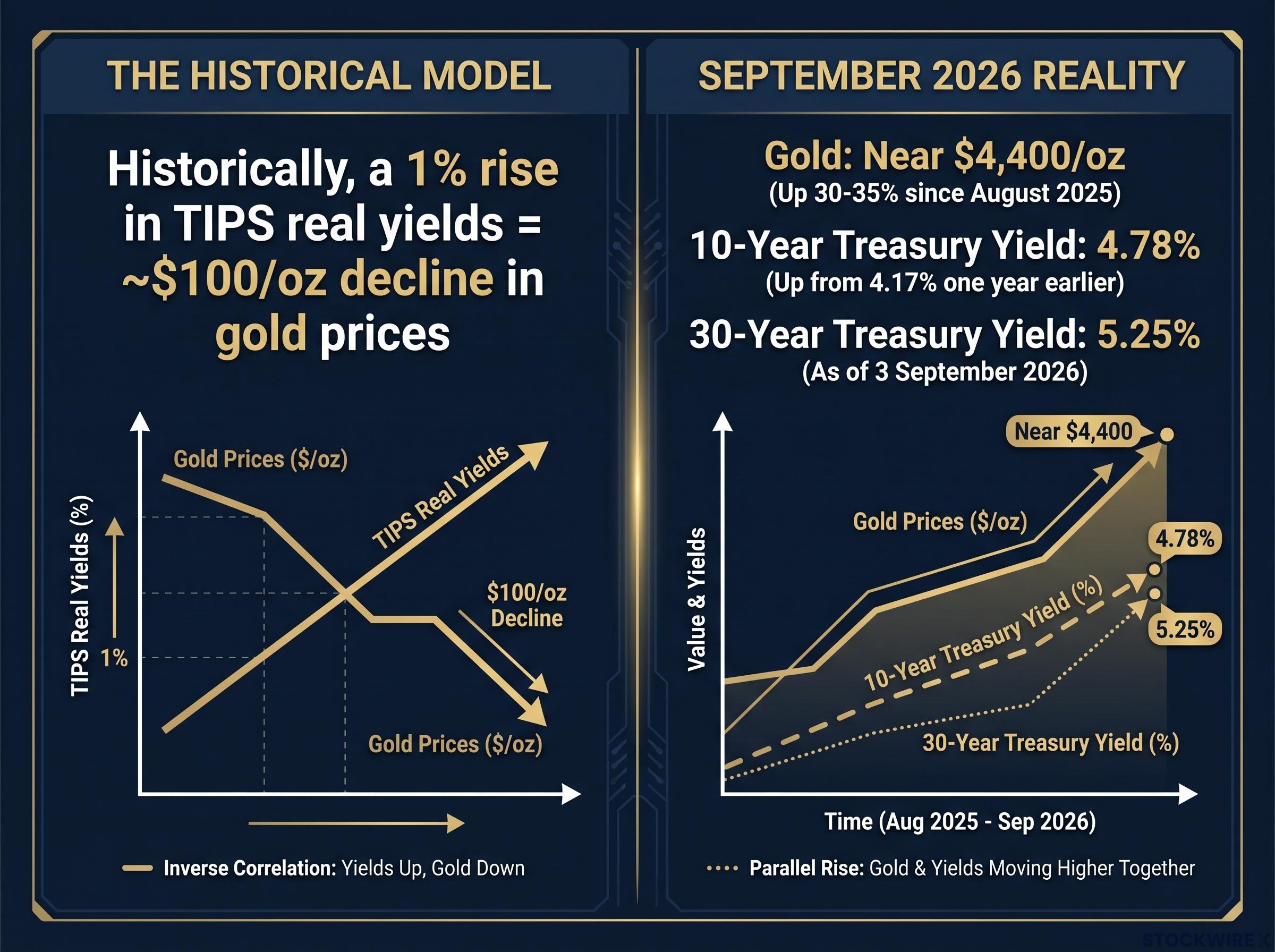
Historically, a 1% rise in TIPS real yields has corresponded to roughly a $100/oz decline in gold prices.
And the model was still working earlier this year. Through the first part of 2026, the correlation between 2-year yields and gold was near -0.6, a strong inverse reading. That confirms the relationship was fully operative at shorter maturities and within normal macro conditions. Nothing about the framework was outdated.
So the gap between what the model predicts and what the market is actually doing is not noise to wave away. It is the central question. Yields are up hard, the calibration says gold should have fallen, and instead gold is up a third. Something in the input has changed, and the rest of this analysis is about what.
When big ASX news breaks, our subscribers know first
What changes when yields rise for the wrong reason
Here is the hinge the whole thing turns on: the reason yields are rising matters as much as the level they reach.
There are broadly two engines that push long-term yields higher. The first is growth. When investors expect stronger real economic expansion, they price in higher rates, and that environment is genuinely bearish for gold, exactly as the conventional model predicts. The second engine is fiscal stress. When investors demand more compensation because they are less confident in the government’s ability to manage its debt, yields also rise, but the meaning is inverted. That second environment is precisely the one gold is designed to hedge.
The current move is driven by the second engine, and the evidence for that is unusually direct.
The evidence that this is stress, not strength
Federal Reserve Board staff analysis from July 2026 attributed the yield rise to a specific source. Far-forward nominal rates had climbed by roughly 200 basis points, and that increase came almost entirely from higher far-forward real risk premiums tied to future federal deficits and adverse supply shocks. In plain terms, the extra yield is compensation for fiscal risk, not a reflection of improved growth expectations.
This shows up in the term premium, the additional return investors demand for holding long-duration debt rather than rolling short-term bills. When that premium expands, it reflects eroding confidence in fiscal sustainability, which is the textbook trigger for a gold bid.
NBER research on Treasury supply shocks provides the empirical underpinning for this mechanism, finding that debt volume increases raise yields primarily by expanding term premia rather than by shifting growth expectations, which directly supports the fiscal-stress diagnosis rather than the growth-driven one.
The far-forward risk premium currently sits at its 85th percentile since 1971, within the historical range of pre-Volcker-style risk pricing.
The structural read got sharper still. In a 3 September 2026 interview, Fed Governor Christopher Waller argued that the traditional safety premium for Treasuries has largely disappeared. That is a significant statement. If U.S. government debt no longer commands a clear safety premium over other assets, the anchor beneath the dollar’s reserve-currency status starts to look less secure, and gold becomes the natural beneficiary of that doubt.
For you as a holder or prospective buyer, this is the payoff of the section: the same yield number on a screen can mean “reduce gold” in one macro environment and “increase gold” in another. What determines which is the engine behind the move.
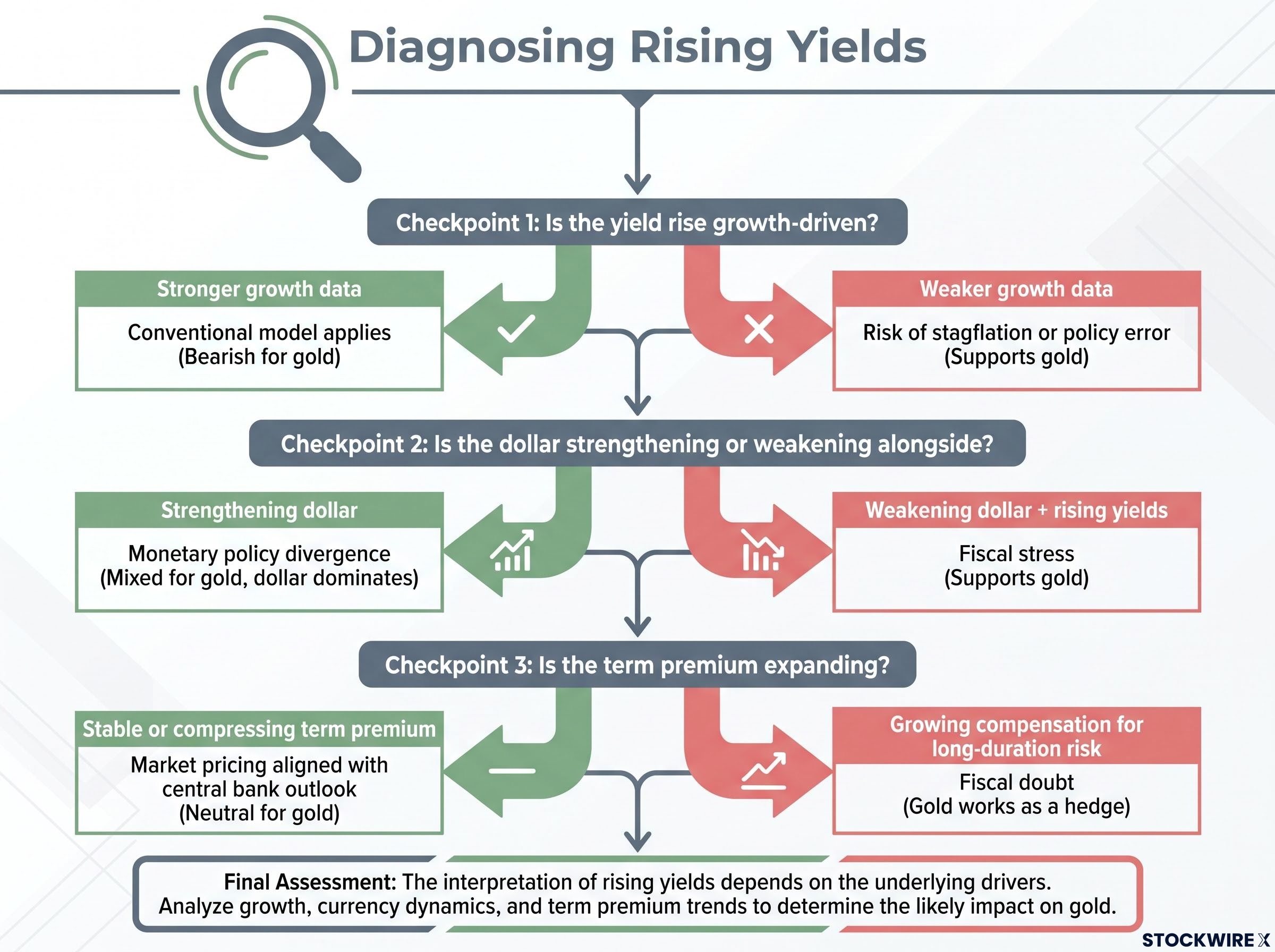
Three diagnostic questions let you tell them apart in real time:
- Is the yield rise growth-driven? If yields are climbing on stronger growth data, the conventional inverse model applies and the setup is bearish for gold.
- Is the dollar strengthening or weakening alongside? A weakening dollar rising with yields points to stress rather than strength, which supports gold.
- Is the term premium expanding? Growing compensation for long-duration risk signals fiscal doubt, the environment where gold works as a hedge.
Run those three questions before drawing a conclusion, and you replace a reflex with a diagnostic. That is the entire shift this analysis is asking you to make.
The three diagnostic questions function as more than a tactical checklist; together they surface policy regime signals that the spot price alone cannot provide, including whether the Fed’s higher-for-longer narrative retains market credibility or whether the dollar’s break from its traditional yield correlation has already begun.
The August 19 case study: one announcement, three simultaneous signals
The mechanism sounds abstract until you watch it fire in a single trading session. 19 August 2026 is that session.
That day, the U.S. Treasury announced it would double the maximum size of its liquidity-support buyback operations for the 10-to-20-year and 20-to-30-year nominal coupon buckets, lifting the cap from $2 billion to at least $4 billion per operation, across a window running 9 September through 4 November 2026. The move followed earlier expansion: effective 13 August 2025, the Treasury had already raised annual cash-management buybacks to $150 billion and lifted total quarterly liquidity buybacks to $38 billion.
The market reaction was immediate and, crucially, ran in three directions at once.
| Variable | Pre-Announcement | 19 August Reaction | Following Day |
|---|---|---|---|
| 10-to-20-year Treasury yield | Trending higher | Declined | Resumed climbing |
| U.S. Dollar Index | Firm | Weakened | Recovered ground |
| Gold spot price | Elevated | Rallied approx. 3% | Held gains |
Read the pattern. A fiscal-management announcement pushed yields down, weakened the dollar, and sent gold up roughly 3% in the same session. That is not how markets treat a confidence-restoring measure. It is how they treat a distress signal.
The Council on Foreign Relations noted the buyback expansion may function more as a market signal than a structurally significant intervention, given its small scale relative to the broader bond market.
The scale point matters because of what happened next. Yields resumed their upward march the following day. The intervention moved the tape for a session; the underlying fiscal pressure reasserted itself almost immediately. That tells you something durable about official interventions versus structural forces: buybacks can nudge, but they cannot overpower the deficit dynamics driving the term premium.
One clarification protects you from misreading further escalation. This program is a liquidity-support and debt-management tool, not formal yield curve control. It is not designed to cap or target specific yield levels. So if the Treasury expands it again, and Secretary Scott Bessent has signalled openness to exactly that, do not read it as the government seizing control of the curve. Read it as confirmation that officials are increasingly uncomfortable with long-end conditions.
That single-session 3% rally is the takeaway to carry forward. Markets are already priced to treat Treasury intervention as evidence of strain rather than reassurance, and that framing should inform how you interpret every buyback announcement from here.
Three signals that tell you stress is escalating, not receding
The case study gives you a pattern to recognise. The next question is operational: how do you tell, in real time, whether bond market stress is intensifying or simply spiking and resolving without structural damage?
Three named signals do most of the work.
- Yield curve dynamics. Watch whether 30-year yields set new highs faster than short-term yields. When the long end leads, markets are demanding extra compensation specifically for holding duration, and the escalation threshold is a fresh 30-year high that short rates do not match. Gold implication: supportive, because it confirms the fiscal-stress engine is running.
- Buyback escalation. Watch for further increases in the scale or frequency of Treasury buyback operations. Secretary Bessent’s stated openness to expansion makes this a live near-term watchpoint. Each escalation signals policymaker discomfort rather than resolution, which the market is now conditioned to read as bullish for gold.
- Gold’s relative behaviour. Watch whether gold holds or advances even as real yields stay elevated and the dollar weakens at the same time. That simultaneous combination is the tell. If gold keeps its footing through it, investors are treating the metal as protection against fiscal and monetary instability, and the thesis remains intact.
The far-forward risk premium at its 85th percentile since 1971 is the benchmark for how unusual the current stress environment is relative to post-1971 history.
For you, these three signals function as a surveillance checklist rather than a one-time read. A shift in any of them tells you whether your gold positioning thesis is strengthening or starting to require reassessment, and it gives you that read earlier than the spot price or a headline yield figure would.
When the thesis breaks: conditions that would reassert the old model
Sophisticated holders want to know what would change their mind, not just what confirms it.
Two conditions would reassert the conventional bearish-gold model. The first is a credible fiscal consolidation path, meaning a genuine reduction in the deficit trajectory that shrinks the risk premium investors are currently demanding. If that arrives, the fiscal-stress engine stalls and the opportunity-cost argument reclaims priority.
The second is a repricing of yields as growth-driven rather than risk-premium-driven. If markets come to read elevated yields as reflecting robust real economic expansion, gold’s recent resilience could reverse, and the inverse relationship snaps back into place.
One further caveat belongs alongside the bullish case. The European Central Bank’s Financial Stability Review and the IMF have both cautioned that gold can be concentrated, leveraged, and less liquid than sovereign bonds in acute stress. Leveraged positions can unwind sharply, meaning gold as a fiscal hedge carries its own tail risk. Hold that alongside the thesis, not instead of it.
What the gold-yield divergence is actually telling you about the dollar
Step back from the tactical framework, and the divergence points to something larger than a trade.
The research splits into two camps on what gold’s resilience really means, and the split is worth holding in view because it shapes how long your time horizon should be.
| Camp | Core Claim | Key Evidence | Positioning Implication |
|---|---|---|---|
| Structural shift | Gold has become a structural necessity, independent of short-term macro links | Price-insensitive central-bank demand, de-dollarization of reserves, geopolitical hedging | A durable floor supports longer holding periods regardless of yield swings |
| Regime-dependent | Gold is an episodic fiscal and liquidity hedge that reverts when credibility returns | Inverse model still active at short maturities; range-bound scenarios outside stress | Treat exposure as tactical; be ready to reduce if fiscal credibility is restored |
The structural camp points to a price-insensitive bid beneath gold. Central banks buying reserves, official de-dollarization, and geopolitical hedging do not care where the 10-year yield sits. That demand raises the floor regardless of short-term rate moves, and gold’s 30-35% advance since August 2025 is the return figure that frames it. The regime-dependent camp counters that gold could settle range-bound near $3,850-$4,000/oz if real yields and a strong dollar persist outside acute stress windows.
Waller’s vanishing-safety-premium observation sits underneath both readings. If Treasuries no longer carry a clear safety advantage over other sovereign debt, the question stops being about yield differentials and becomes about credibility itself.
Institutional trust in Treasuries has been eroding in ways that go beyond yield levels: PIMCO, BlackRock, and Schroders were actively reducing long-dated Treasury exposure even as the 30-year yield reached its highest point since 2007, a structural repositioning that compounds the fiscal risk premium the term premium data already reflects.
The WWII-era U.S. yield cap of 2.5%, imposed in the early 1940s and abandoned in the 1951 Treasury-Fed Accord after inflation exceeded 20%, shows how yield management episodes tend to end when the underlying fiscal pressure is never addressed.
Japan’s yield curve control offers the same lesson from a modern vantage: stable, low-volatility yields during the control period, then a sharp curve steepening once the policy relaxed.
So here is what the divergence is not telling you. It is not a prediction that the dollar collapses or that yields spiral to crisis levels. It is a live readout of institutional confidence in U.S. fiscal management, and gold is pricing that confidence in real time. Treat it as a simple yield-versus-opportunity-cost trade and you miss most of what the market is actually saying.
Reading the divergence correctly before the next Treasury announcement
Put the pieces together and one thesis holds them all. Gold is currently functioning as a real-time gauge of market confidence in U.S. fiscal sustainability, and that function is what makes today’s yield-gold relationship so unusual.
The three-signal framework, the 19 August case study, and the structural-versus-episodic split are not separate observations. They are three angles on the same idea: rising yields are only bearish for gold when they signal strength, and right now they signal strain.
So the next Treasury buyback announcement, the next long-yield spike, and the next dollar move each deserve to be read through the diagnostic, not through reflex. Ask the single question that matters: is this move driven by growth, or by fiscal stress?
Your ability to read the next gold-yield divergence correctly does not depend on getting a price prediction right. It depends on diagnosing the engine behind the yield move.
The timing makes this immediate. The buyback window runs 9 September through 4 November 2026, Secretary Bessent has signalled openness to further expansion, and the far-forward risk premium sits at its 85th percentile since 1971. With gold trading between its September low of $4,289 and high of $4,495, the conditions for another 19 August-style signal event are present, not hypothetical.
For investors wanting to frame the current environment within a longer holding horizon, our deep-dive into the structural gold investment thesis examines central bank reserve data, the 2021 debt refinancing wall, and the four specific conditions that would invalidate the secular bull case entirely.
This article is for informational purposes only and should not be considered financial advice. Investors should conduct their own research and consult with financial professionals before making investment decisions. Past performance does not guarantee future results, and financial projections are subject to market conditions and various risk factors.