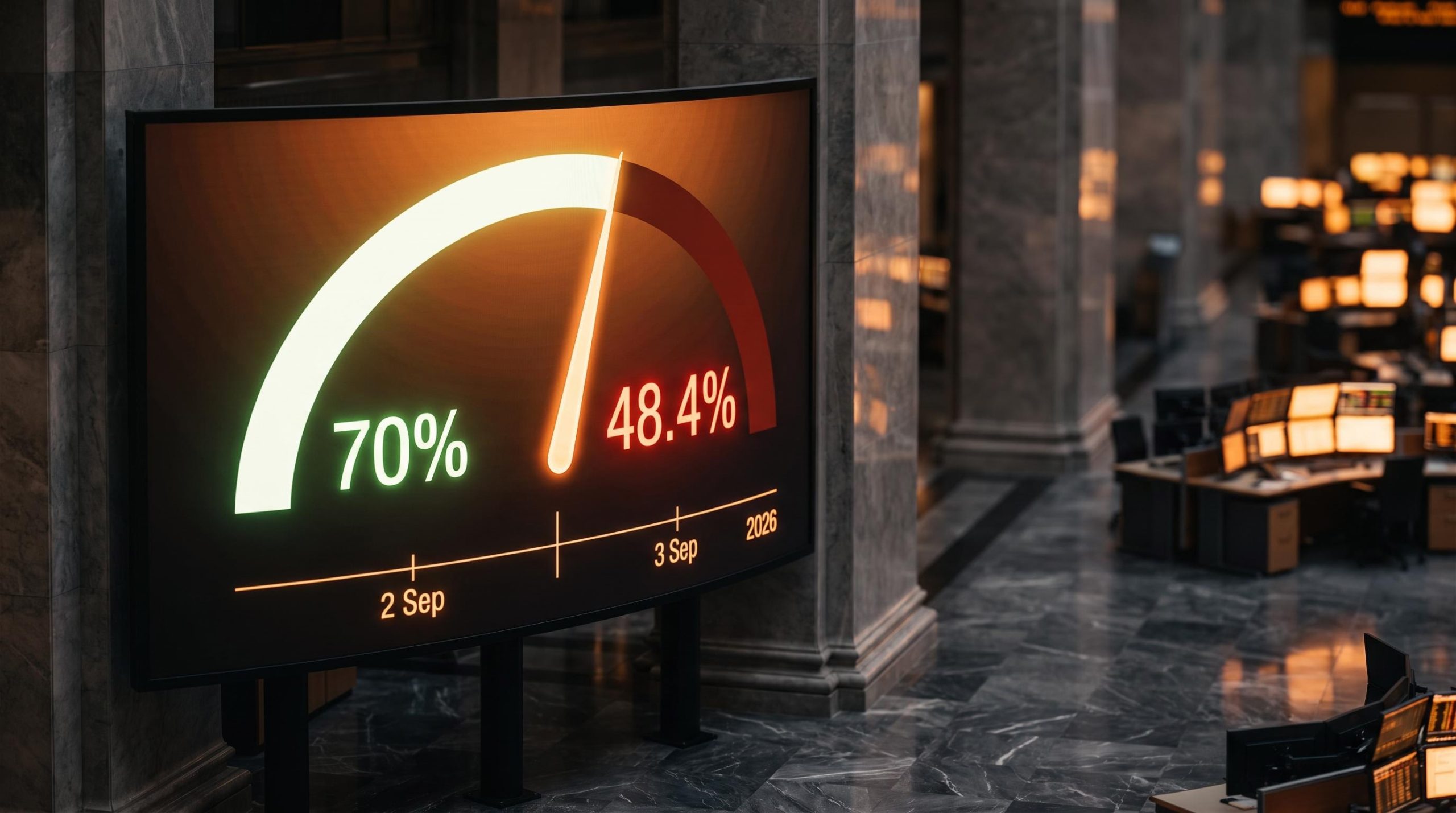
In the space of a single week, the market’s conviction about a September rate hike went from near-certainty to a coin flip. Traders had priced the odds of a 25-basis-point increase above 60%, only to watch that confidence collapse to under 50% after one Fed official spoke up.
That whiplash is the story heading into the 15-16 September 2026 Federal Open Market Committee (FOMC) meeting, one of the most closely watched policy decisions in recent memory. Resilient jobs and inflation data are colliding head-on with an intense election-season pressure campaign from the White House, and the market cannot make up its mind.
Here is a framework for reading these conflicting signals: what actually moves the odds, why the noise does not, and how to position your portfolio defensively before the announcement lands.
Mapping the wild swings in September rate pricing
Watch the numbers move day by day and you get a feel for just how contested this decision has become.
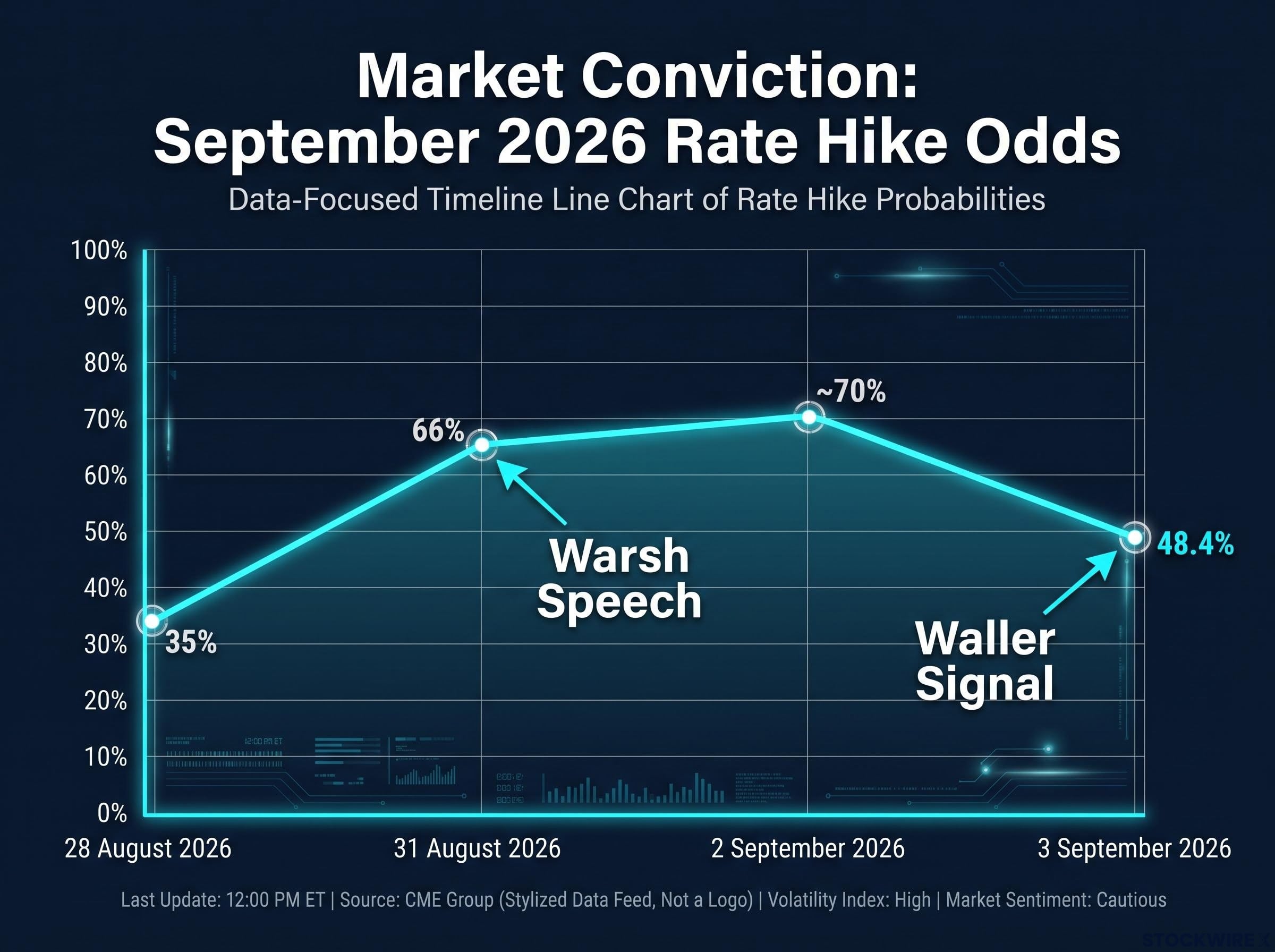
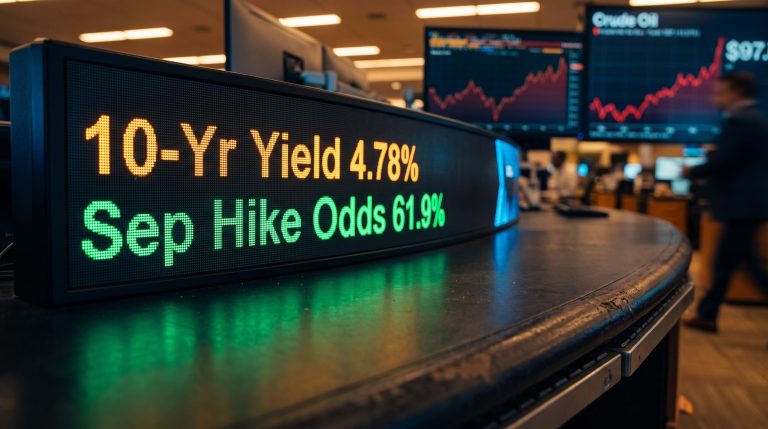
The story really took hold when the odds of a hike sat around 63% on Prime Terminal data, a figure that grabbed attention because it framed tightening as the base case rather than a tail risk. Fed Chair Kevin Warsh’s hawkish remarks at Jackson Hole on 28 August 2026 had lit the fuse, pushing implied probabilities up from roughly 35% to the low-to-mid 60s within days.
By 31 August 2026, Forbes reported CME Group’s FedWatch tool showing a 66% chance of a hike. Two days later the Wall Street Journal’s markets blog had investors pricing close to 70%, up sharply from 37% just a week earlier.
Then came the reversal. On 3 September 2026, CNBC reported hike odds had dropped to 48.4% on CME FedWatch, after Fed Governor Christopher Waller signalled he would support holding rates steady.
| Date | Implied Hike Probability | Trigger |
|---|---|---|
| 28 August 2026 | Rose from ~35% toward the 60s | Warsh’s hawkish Jackson Hole speech |
| 31 August 2026 | 66% | Sticky inflation data (Forbes / CME) |
| 2 September 2026 | ~70% | Momentum peak (WSJ / CME) |
| 3 September 2026 | 48.4% | Waller signals a hold (CNBC / CME) |
Swings this violent are unusual for a market that normally demands, and gets, clean forward guidance from policymakers before a meeting. When futures pricing lurches between 70% and a coin flip in 48 hours, it tells you institutional money is genuinely split. That matters for you, because it means no outcome is fully priced in, and your portfolio is exposed to a shock whichever way the FOMC moves.
The end of Fed forward guidance under Warsh is part of what makes these probability swings so violent: without the regime of pre-committed signalling that previously smoothed market expectations, each data print and each governor’s comment lands with full force on futures pricing rather than being buffered by a policy path the Fed has already telegraphed.
When big ASX news breaks, our subscribers know first
How market probabilities and the central bank mandate actually work
Before you react to the next headline, it helps to know exactly what those probability figures are measuring and what actually drives the decision they are trying to predict.
Those percentages come from Fed funds futures, which are contracts that let traders bet on where the central bank’s overnight interest rate will sit in a given month. Platforms like CME’s FedWatch take the prices of these contracts and translate them into a clean probability that the Fed will move at a specific meeting.
When more traders pay up for contracts implying higher rates, the tool reads that collective money as a rising chance of a hike. It is not a forecast from any single analyst; it is the aggregated view of everyone with capital on the line.
The FOMC voting structure matters here: only 12 members vote at each meeting, comprising the 7 Board of Governors, the New York Fed president, and 4 rotating regional presidents, which means a comment from a non-voting regional president carries contextual weight but no direct sway over the September outcome.
The federal funds target range, the rate the Fed actually controls, sat at 3.50%-3.75% as of late August 2026. That is the number the September meeting will decide to hold or lift.
So what governs whether they move it? By law, the Fed operates under a dual mandate, two equal jobs it must balance.
- Price stability: keeping inflation low and steady so the dollar in your pocket holds its value over time.
- Maximum employment: supporting the strongest labour market the economy can sustain without triggering runaway prices.
The critical detail is how the Fed defines price stability. It targets a 2% annual rate of inflation, measured by the Personal Consumption Expenditures (PCE) price index, which tracks what households actually pay across goods and services.
Warsh has publicly called that 2% target “firm” and “fixed”, his way of saying the goalpost does not move because equities are wobbling. This is why a falling stock market alone will not force a rate cut.
Understand this and you can safely tune out most of the media noise. The Fed is not watching the S&P 500 for permission; it is watching the labour and inflation prints. Track those same numbers yourself and you are reading the decision from the same page policymakers are.
The collision between resilient economic data and political pressure
Here is the tension defining September: the hard data keeps running hot while the political demands keep running the other way.
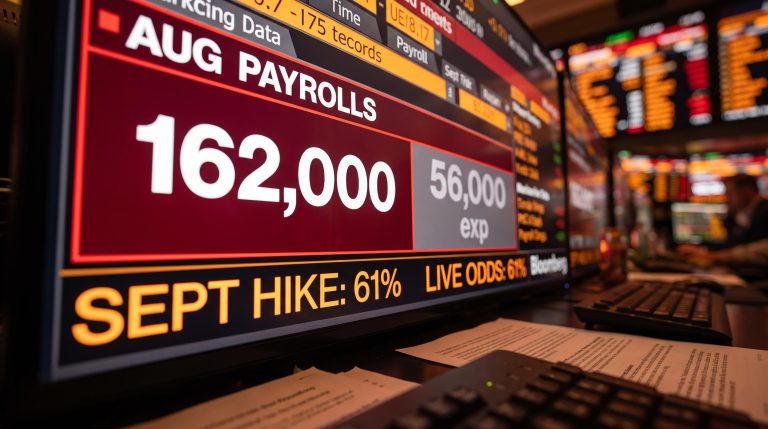
The summer numbers refused to cool on schedule. The Bureau of Labor Statistics reported on 4 September 2026 that the economy added 162,000 jobs in August, the largest gain in five months and a huge beat over the consensus forecast of roughly 53,000-56,000. The unemployment rate held steady at 4.1%.
Inflation told a similar story. July headline Consumer Price Index (CPI) came in at 3.4% year-on-year, comfortably above target, while the Producer Price Index (PPI) for final demand ran at 4.7% over the same twelve months.
| Metric | Latest Result | Consensus / Prior | Implication |
|---|---|---|---|
| August Nonfarm Payrolls | +162,000 jobs | ~53,000-56,000 expected | Labour market still resilient |
| July CPI (headline y/y) | 3.4% | Above 2% target | Inflation sticky, not tamed |
| July PPI (final demand y/y) | 4.7% | Elevated backdrop | Pipeline price pressure persists |
| Fed funds target range | 3.50%-3.75% | Little sign of restraint | Room to tighten further |
Warsh seized on exactly this at Jackson Hole on 28 August 2026, warning the Fed would “have work to do” if it was not confident inflation was heading toward 2% “clearly and at sufficient speed”. Reuters called it the closest he has come to admitting hikes may be needed.
Institutional independence in an election year
Set against that data-driven stance is an unusually loud campaign for cuts. CNBC reported on 5 September 2026 that President Trump, the Vice President, the Treasury secretary and senior advisers were all publicly urging the Fed not to raise rates, describing it as an unusually broad public pressure effort. Trump has repeatedly branded rates “artificially high”, and USA Today noted he pressed the point on the same day the Treasury flagged the national debt topping $40 trillion, a level that makes cheaper borrowing politically attractive.
The catch is that the White House cannot order a move either way. The Fed’s statutory independence means the President can influence appointments and public opinion but cannot dictate the rate itself.
Warsh has testified he never made a deal with Trump to lower rates and would not predetermine any decision. For you, the practical takeaway is simple: weight the labour and inflation prints, and treat the political headlines as noise that holds no direct sway over the September vote.
Fed independence under Warsh has been tested from the moment of his confirmation, with Trump’s documented pressure campaign on his predecessor providing the concrete historical baseline against which every Warsh policy signal is now assessed by bond markets and currency traders alike.
Positioning your portfolio for a hawkish surprise
Enough about the macro picture. Here is what you can actually do about it before the 16 September 2026 announcement.
The most exposed corner of most portfolios right now is long-duration debt. Duration measures how sensitive a bond’s price is to rate changes, and the longer the maturity, the harder the price falls when yields rise. If the Fed hikes more than the market has priced, long-dated Treasuries take the biggest mark-to-market hit, which is precisely why the strategy below leans short.
Consider three concrete adjustments:
- Shorten your bond duration. iShares’ 2026 Fed outlook suggests putting cash to work in 0-3 month Treasury bills or diversified short-duration funds if rates stay higher for longer, while trimming long-end exposure where the price damage from a hike would be greatest.
- Tilt equities toward quality. BlackRock’s rate-cycle guidance favours large caps over small caps and maintaining quality exposure. High-beta tech, the most rate-sensitive part of the market, is where the pain concentrates, while financials can benefit as higher rates lift net interest margins.
- Hold tactical cash reserves. Short-dated bills let you capture attractive yield without taking on the interest rate risk of longer maturities, giving you dry powder for any volatility.
Bond duration management in a normalising rate environment goes well beyond simply shortening maturities: institutional managers at BlackRock, PIMCO, Vanguard, and J.P. Morgan Asset Management have all converged on the 1-5 year segment of the curve as the zone where comparable yield to long bonds can be captured with materially lower rate sensitivity.
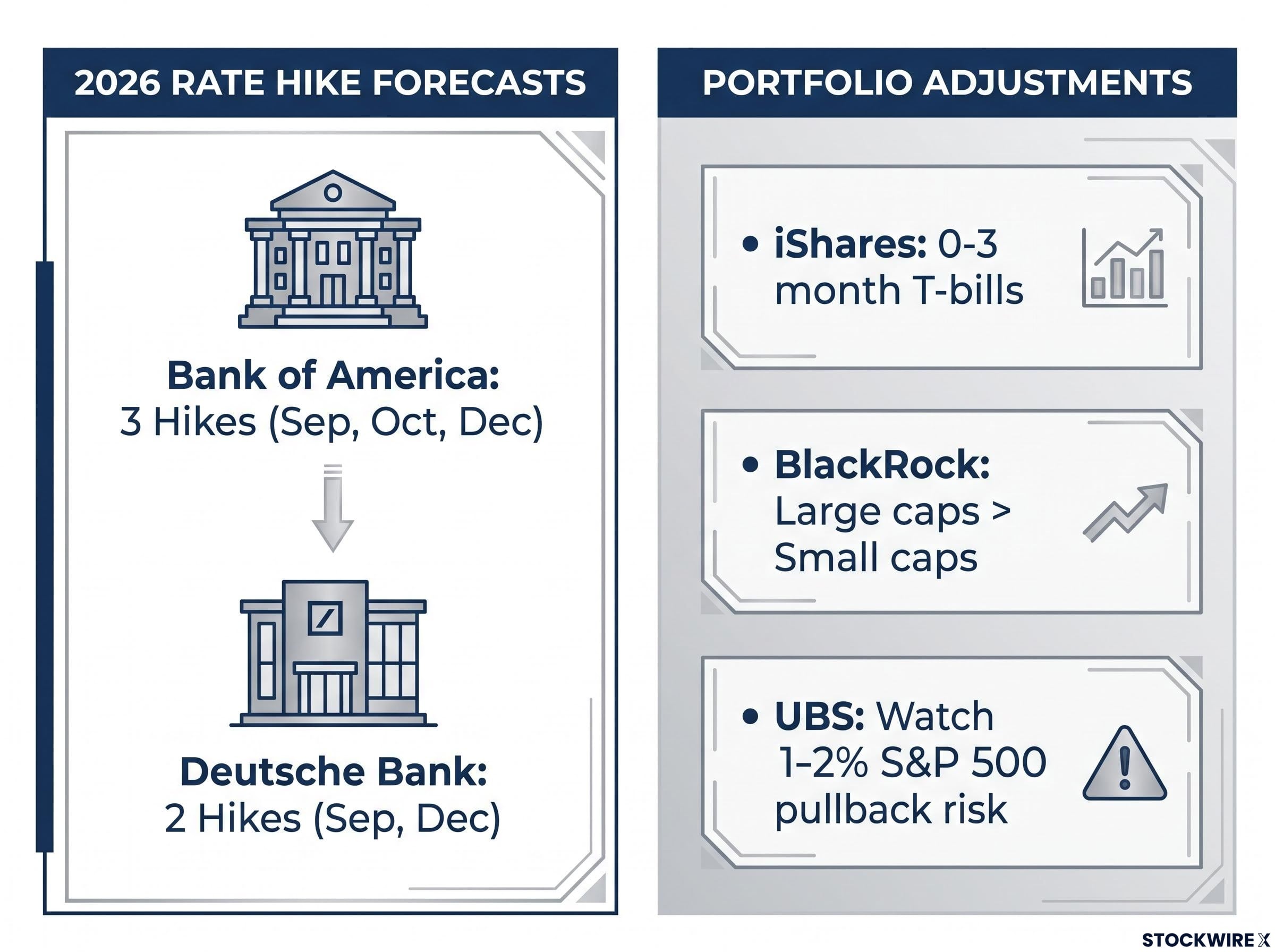
On the equity side, UBS Global Wealth Management advised on 7 September 2026 buying potential dips rather than dumping stocks on hike fears, provided earnings prospects hold up. Trading guidance around Jackson Hole flagged the risk of a 1-2% near-term pullback in the S&P 500 under a hawkish outcome, so scaling position sizes and avoiding trades right around the announcement makes sense.
The forward risk is real. Bank of America Global Research now expects three 25-basis-point hikes in 2026, in September, October and December, while Deutsche Bank forecasts two, in September and December. If either proves right, holding long-duration debt today looks like the costliest place to be.
This article is for informational purposes only and should not be considered financial advice. Investors should conduct their own research and consult with financial professionals before making investment decisions. Past performance does not guarantee future results, and financial projections are subject to market conditions and various risk factors.
Managing risk into the fourth quarter
The core tension is straightforward once you strip out the noise: a hawkish Fed chair facing an economy that is slowing but still stubbornly resilient, with inflation refusing to fall cleanly to target.
Whatever happens on 16 September 2026, remember it is one battle in a longer fight. Bank of America and Deutsche Bank both see further moves possible at the October and December meetings, so a single decision will not settle the direction of this tightening cycle.
That is the case for staying diversified rather than making a binary, all-or-nothing bet on one announcement. Keep your fixed income short, your equity exposure quality-tilted, and your cash working, and you leave yourself room to adapt as each new data print arrives.
Position for resilience, not for a guess. The reader who survives this cycle is the one who prepared for volatility instead of trying to predict a coin flip.