Three Bank of England policymakers now openly want rates higher, and the Bank’s own Chief Economist is the loudest voice among them. Huw Pill voted again this cycle for an immediate rise to 4.00%, warning that waiting risks letting wage and price dynamics entrench before the Monetary Policy Committee (MPC) can contain them.
With headline CPI climbing back to 2.9% in July 2026 on the back of a 13% surge in the energy price cap, and the 17 September 2026 MPC decision now less than two weeks away, Pill’s repeated dissents have moved from lone-hawk curiosity to a policy signal that mortgage holders, Sterling traders, and gilt investors cannot afford to ignore.
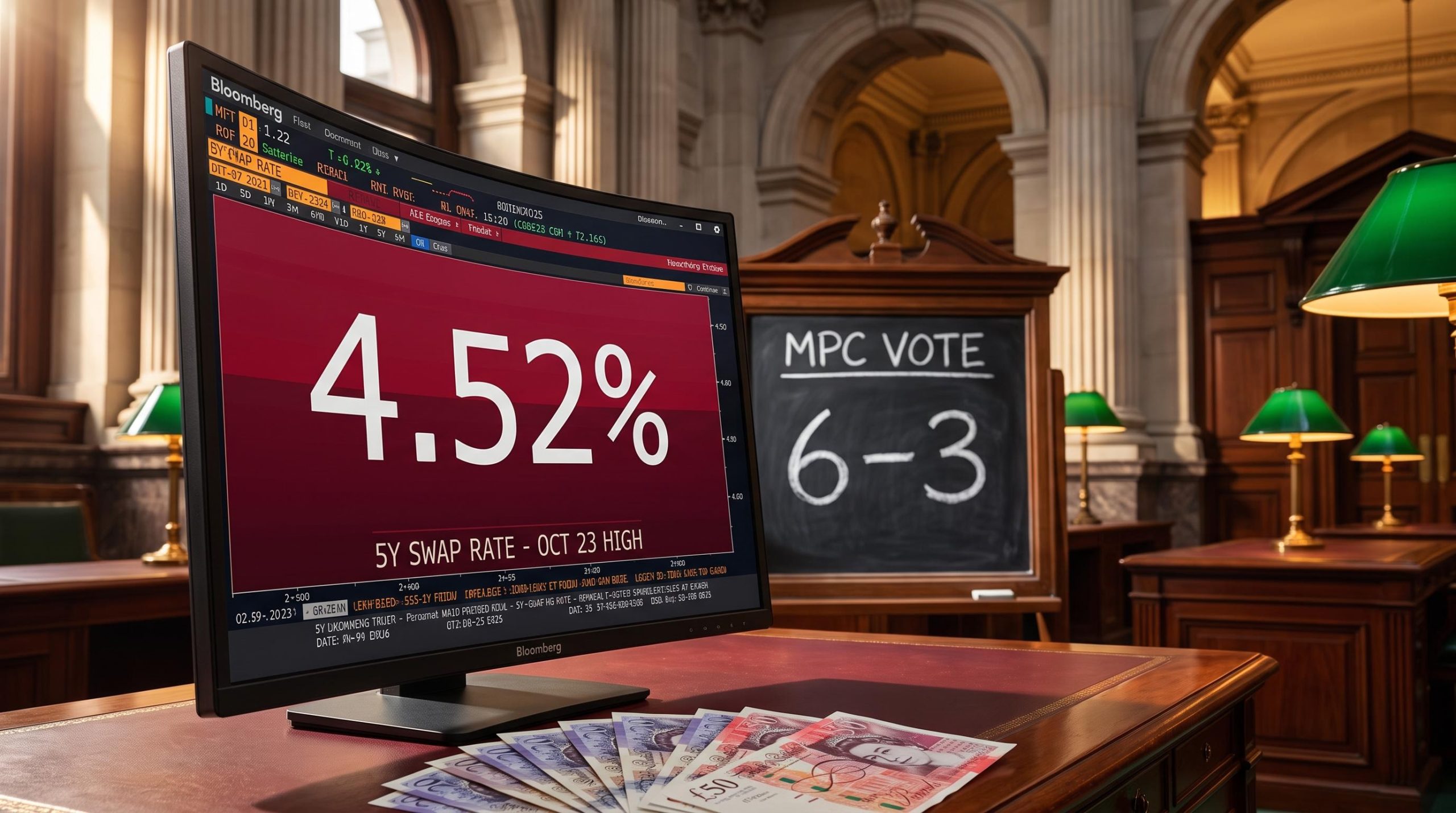
Five-year swap rates have already crossed 4.52%, the highest since October 2023, meaning the market is partly pricing a move even before the committee convenes. Here is what Pill’s argument actually rests on, where the majority pushes back, and what the September decision could mean for your mortgage rate and the pound.
Why Pill says the MPC cannot afford to wait
Pill’s case is not a hawkish instinct dressed up as analysis. It is a structured risk-management argument, and it starts with a simple observation about what happens when policymakers wait.
Waiting, in Pill’s framing, is not neutral. Sitting still while geopolitical energy price paths remain impossible to model precisely introduces a status quo bias into rate decisions, a tendency to do nothing simply because the future is unclear. His argument is that inaction carries its own risk, and that risk grows the longer the committee holds.
From there, the logic builds into three parts:
- Status quo bias: Passive waiting lets uncertainty become an excuse for inaction, when the balance of risks may already point upward.
- Signalling value: A decisive move to 4% communicates the committee’s willingness to act on upside inflation risk in a way that market noise cannot obscure.
- Pre-emption: An early hike can head off wage and price catch-up dynamics before they turn self-reinforcing, which is cheaper than unwinding them later.
The signalling point is where Pill is most direct. According to Reuters (30 July 2026), he argued that a move to 4% would deliver a clear message that the committee is prepared to act.
A move to 4% would “cut through noise in commodity and asset price developments to offer a clear and unambiguous signal of our willingness and ability to address upside risks to inflation.” (Reuters, 30 July 2026)
The pre-emption argument is the most consequential for the reader. Reuters (31 July 2026) reported Pill warning of “more slow-moving but maybe more insidious second-round effects” building as businesses and workers try to recover income lost to inflation over time.
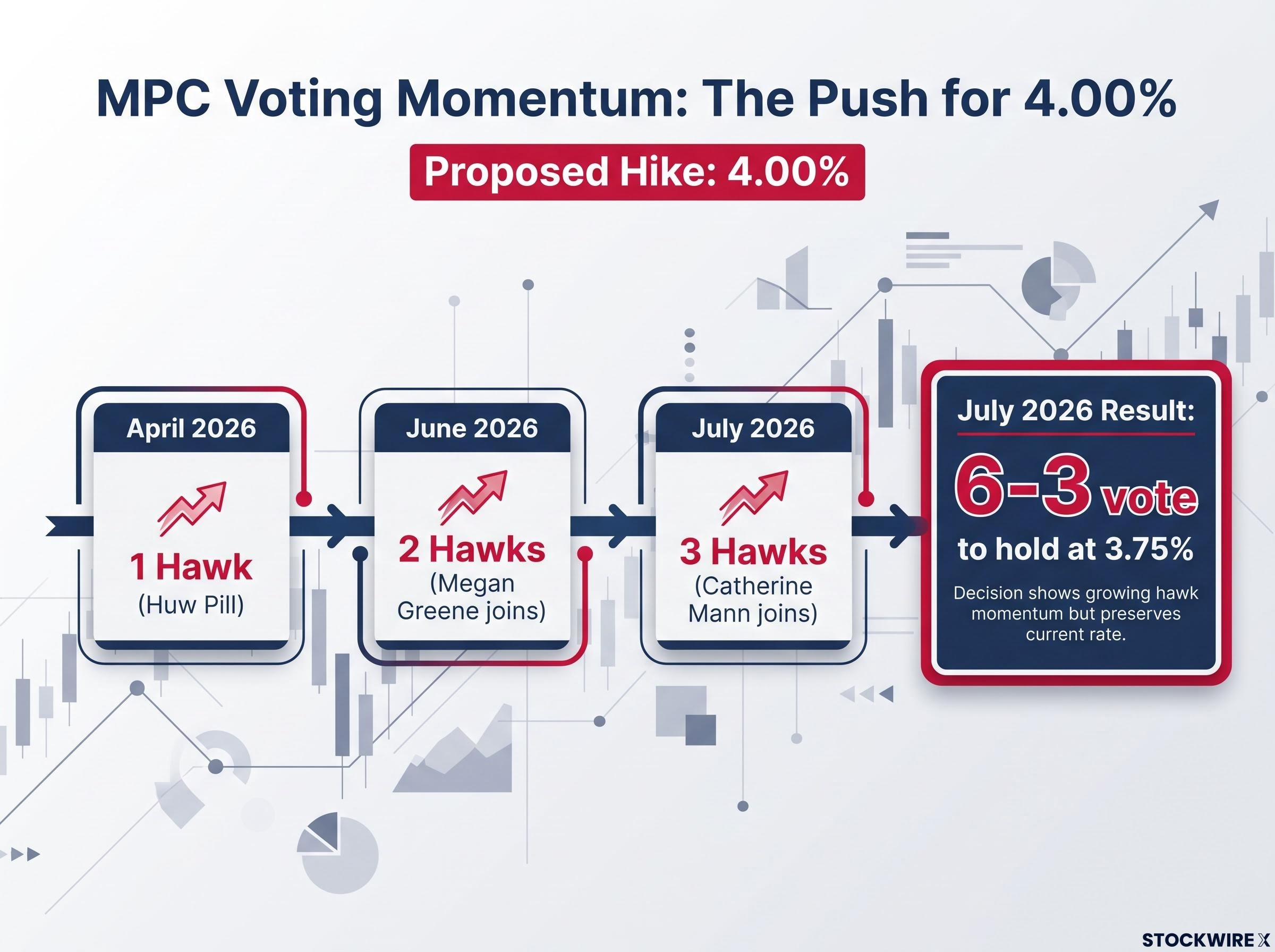
Then there is the vote count, which is the part investors should watch most closely. Pill stood alone as the sole hawk in April 2026. Megan Greene joined him in June. By July, Catherine Mann had made it three, producing a 6-3 vote to hold.
That escalation, from one hawk to three in three meetings, tells you Pill’s framing is gaining traction inside the committee. A September move to 4% is no longer a theoretical scenario. It is a live possibility, and it hinges on whether one more member can be persuaded.
When big ASX news breaks, our subscribers know first
The inflation backdrop giving the hawks their argument
The numbers are what give Pill his platform, so start with the sequence rather than the conclusion.
Headline CPI sat at 2.6% in June 2026. By July it had climbed to 2.9%, a 0.3 percentage point jump in a single month. According to the Office for National Statistics (ONS) data released on 19 August 2026, the move was driven almost entirely by energy, specifically a 13% rise in the maximum tariff energy firms can charge households, as reported by Reuters.
Here is where the July print sits against the wider picture.
The July UK inflation data confirmed the headline jump was driven entirely by the energy price cap rather than demand, with core CPI falling to 2.5% and services inflation easing to 3.4% in the same month, a divergence that sits at the heart of the majority’s case for patience.
| Indicator | Value | Date / Source |
|---|---|---|
| Headline CPI | 2.9% | ONS, July 2026 |
| Core CPI | 2.6% | ONS, July 2026 |
| CPIH | 3.1% | ONS, July 2026 |
| Prior CPI (June 2026) | 2.6% | ONS |
| Bank Rate | 3.75% | Bank of England, July 2026 |
A single-month rise of that size on an energy shock is exactly the kind of move that raises the probability of second-round wage claims. For UK workers and employers negotiating pay through autumn 2026, the September decision speaks directly to those negotiations.
How energy prices become a wage problem
Bank of England Monetary Policy Reports describe energy shocks feeding through inflation in three stages, and the current tariff rise illustrates each.
First come the direct effects: higher gas and electricity bills push the energy component of the index up immediately, which is what drove July’s jump. Second come the indirect effects, as businesses facing higher energy input costs reprice the goods and services they sell. Third, and most durable, are the second-round effects, where workers who have lost real income seek higher nominal wages to recover it, and those wage rises feed back into prices.
Pill’s specific concern is that the third stage is more likely to bite now than in the calmer years of inflation targeting. Reported around 3 September 2026, he suggested that with baseline inflation low, a temporary shock rarely altered wage-setting behaviour, but that condition no longer holds.
The reason is history. UK workers have already absorbed two major energy shocks since 2022, which Pill described in his March 2026 “Robustness” speech as significant adverse terms-of-trade shocks that weigh on real incomes. That makes wage-setting more sensitive to fresh price rises than it was pre-2022.
The Bank’s own January 2026 Forecast Evaluation Report reinforces the point, noting that past shocks have already created wage-price momentum that unwinds more slowly than it emerged. Greene put the counter-move plainly: she has argued that “a proactive hike in Bank Rate may reduce the probability that second-round effects kick in.”
Where you land on that distinction, between energy-driven direct effects and self-sustaining wage dynamics, determines whether Pill’s urgency looks justified or premature.
What the majority and external forecasters say in response
This is a genuine debate, not a fait accompli, and the six-member majority has a coherent case of its own.
Their central objection is that the economy is doing some of the work for them. Weakening activity and accumulated slack should limit how strongly second-round effects can take hold, which means a further hike risks over-restricting demand for marginal gains against inflation risk. The July minutes recorded the majority’s reading that price changes are “driven by direct and indirect energy effects, rather than second-round effects.”
The Bank of England July 2026 MPC minutes confirm the 6-3 vote to hold Bank Rate at 3.75%, with the majority’s reasoning centred on energy-driven direct effects rather than embedded wage-price dynamics, a distinction that defines the fault line between the two camps on the committee.
Their objections break down into three:
- Weak activity and economic slack should limit the strength of any second-round effects.
- The current evidence points to energy-direct inflation, not embedded wage-price dynamics.
- Premature tightening risks damaging demand and employment unnecessarily.
External forecasters largely side with patience. The International Monetary Fund’s (IMF) 2026 Article IV consultation recommended holding at 3.75% for the rest of 2026.
The IMF recommended keeping Bank Rate at 3.75% for the remainder of 2026, arguing this would preserve sufficiently tight policy to mitigate secondary effects while leaving room to cut if growth falters. (IMF 2026 Article IV consultation)
The market path tells a similar story. The Office for Budget Responsibility’s (OBR) March 2026 outlook noted that market participants expect Bank Rate to fall toward 3.3% by late 2026, with a return to around 4% not anticipated until 2030. In other words, markets see 4% as a medium-term equilibrium, not an immediate target. Goldman Sachs, cited in The Guardian (23 March 2026), went further, calling expectations of multiple 2026 hikes “overdone.”
The economist consensus on Bank Rate tells a similar story to the OBR path: a Reuters poll of 64 economists conducted in mid-August 2026 found approximately 90% expecting no change through end-2026, with every respondent treating September as a foregone hold, a baseline the hawkish dissent has so far failed to shift.
Put together, the majority’s “active hold” and the OBR path tell you the institutional consensus is not that 4% is wrong, but that it is premature. That distinction matters for anyone positioning in Sterling or UK rate-sensitive assets, because it means the hawks’ case rests entirely on whether autumn data show second-round wage effects actually materialising.
What a move to 4% would cost UK borrowers and markets
Step away from the committee room, and the debate becomes a number on a remortgage offer.
Two cohorts are most exposed. According to a July 2026 Bank of England-linked report, a typical owner-occupier rolling off a fixed-rate deal in the next two years is likely to see monthly bills rise, while a separate group faces a much sharper jump.
- Typical roll-off cohort: roughly £45 more per month as they move onto current fixed rates.
- Sub-3% rate cohort: nearly 750,000 households leaving deals below 3% during 2026, facing increases of around £170 a month.
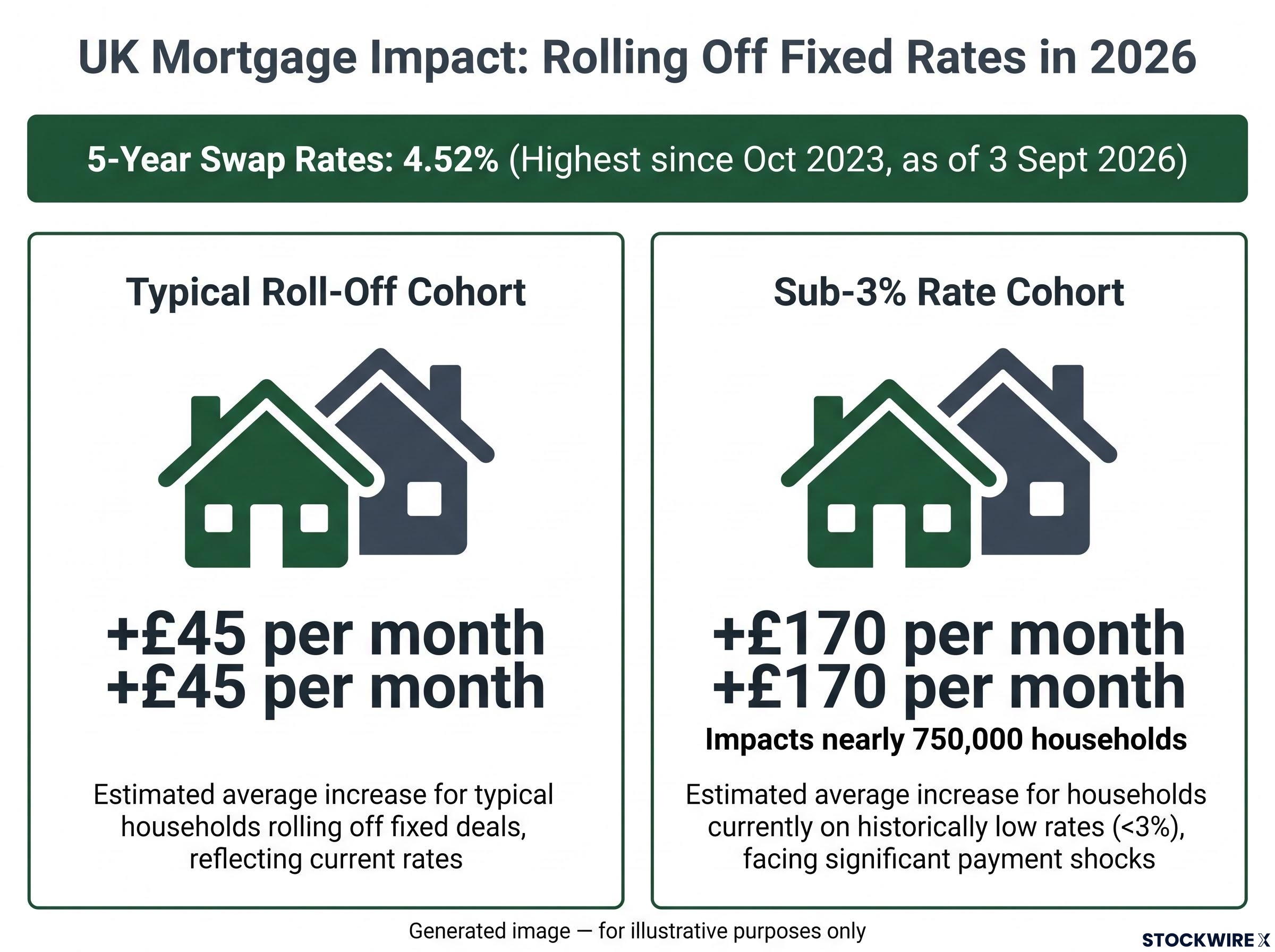
The market is not waiting for the committee to confirm anything. The Guardian reported on 3 September 2026 that a global bond sell-off had pushed UK five-year swap rates above 4.52%, the highest since October 2023, already feeding through into fixed mortgage pricing.
UK five-year swap rates pushed above 4.52% as of 3 September 2026, the highest level since October 2023, with the move expected to translate into higher fixed mortgage rates. (The Guardian, 3 September 2026)
For a homeowner with a fixed deal maturing in the next 12 months, that swap-rate move is the point. Borrowing costs are already climbing regardless of what the committee formally decides on 17 September, and the official vote will only reinforce or soften a trend that is already under way.
How markets are pricing the September decision
Sterling has become a barometer for rate expectations through 2026. Reuters reported the currency trading near a six-month high in late August 2026 on firm rate-hike bets, then slipping as investors pared those bets and pushed anticipated moves into 2027. That volatility makes the September decision a binary catalyst for the pound: a hike would likely lift it, a hold would likely soften it.
The GBP/USD response to the July CPI print saw sterling reach its strongest level since February 2026 before an RSI reading above 70 signalled near-term pullback risk, a pattern that captures exactly the binary catalyst dynamic the September decision is now replicating at a higher voltage.
The bond market is sending the same mixed signal. Swap rates are elevated and feeding into mortgage pricing, yet the OBR path still implies easing rather than tightening over the near term, leaving the two markets telling slightly different stories.
The hawkish bloc is what has kept a September move in play. With Pill, Greene, and Mann now voting together, commentators have read the shift from one hawk to three as raising the probability of a move to 4%, even as the majority and most external forecasters remain unconvinced. For anyone positioned in rate-sensitive assets, the lesson is that the market transmission is running ahead of the official decision, not behind it.
What the September vote hinges on
Rather than waiting for 17 September to arrive, the more useful question is what could flip a fourth vote to the hawks between now and then.
Two swing conditions stand out. In priority order:
- The August CPI print, due before the meeting. A further upside surprise would strengthen the pre-emption case and pressure undecided majority members.
- Evidence of accelerating wage settlements, particularly any autumn pay deals responding to the energy cap rise, which would be the clearest sign that second-round effects are moving from risk to reality.
Pill’s own framing keeps this short of an emergency. He has been careful to note that longer-term inflation expectations have not become unanchored, which is what separates his position from a crisis response. Mann’s reasoning was more specific: she cited the collapse of the US-Iran Memorandum of Understanding and the associated energy price volatility as her trigger for joining the hawks.
Importantly, a vote for 4% is not a promise of more.
Supporting a rise to 4% does not imply a commitment to a prolonged or aggressive series of further hikes. Pill has framed it as a positioning move to leave the committee well-placed to address the uncertainties ahead. (Bank of England, July 2026)
That makes the September decision a genuine fork. A hold locks in the majority’s “active hold” narrative, while a rise to 4% would mark the most significant hawkish shift of the current cycle. If you are watching this from a mortgage, currency, or investment angle, treat the August inflation release as the single most important data point between now and the vote, because it is the most likely lever on the undecided majority.
For readers wanting to understand how MPC votes translate into market moves before prices adjust, our dedicated guide to reading MPC decisions walks through the vote-split mechanics, SONIA curve positioning, and the specific CPI and wage variables the committee has flagged as conditioning its next step.
This article is for informational purposes only and should not be considered financial advice. Investors should conduct their own research and consult with financial professionals before making investment decisions.
Past performance does not guarantee future results. Financial projections are subject to market conditions and various risk factors. Forward-looking statements about the September decision are speculative and subject to change based on incoming data and committee deliberations.