

PYC-001 data takes centre stage at NOSA 2026 in Melbourne
In data presented at the Neuro-Ophthalmology Society of Australia (NOSA) Annual Scientific Meeting in Melbourne between 3 and 5 September 2026, Dr. Clare Fraser outlined early clinical findings for the lead Autosomal Dominant Optic Atrophy (ADOA) programme of PYC Therapeutics (ASX: PYC).
The headline was clear. Treated eyes showed improved low-contrast visual acuity (LCVA) alongside a favourable safety profile in a progressive, irreversible blinding disease that currently has no approved treatment options.
ADOA affects 1 in 35,000 people and leads to progressive vision loss with no approved therapies available. The candidate at the centre of the presentation, PYC-001, is a peptide-conjugated oligonucleotide administered by intravitreal injection (directly into the eye).
PYC-001 is progressing through a global Phase 1/2 Multiple Ascending Dose (MAD) study with the objective of establishing clinical proof-of-concept prior to progression into a global registrational trial directed towards supporting a New Drug Application (NDA) in ADOA.
When big ASX news breaks, our subscribers know first
What is ADOA — and why the OPA1 gene matters
Autosomal Dominant Optic Atrophy is a progressive and irreversible blinding eye disease with onset in childhood. It is caused by mutations in the OPA1 gene, and the visual profile of a typical patient deteriorates markedly from childhood into adulthood.
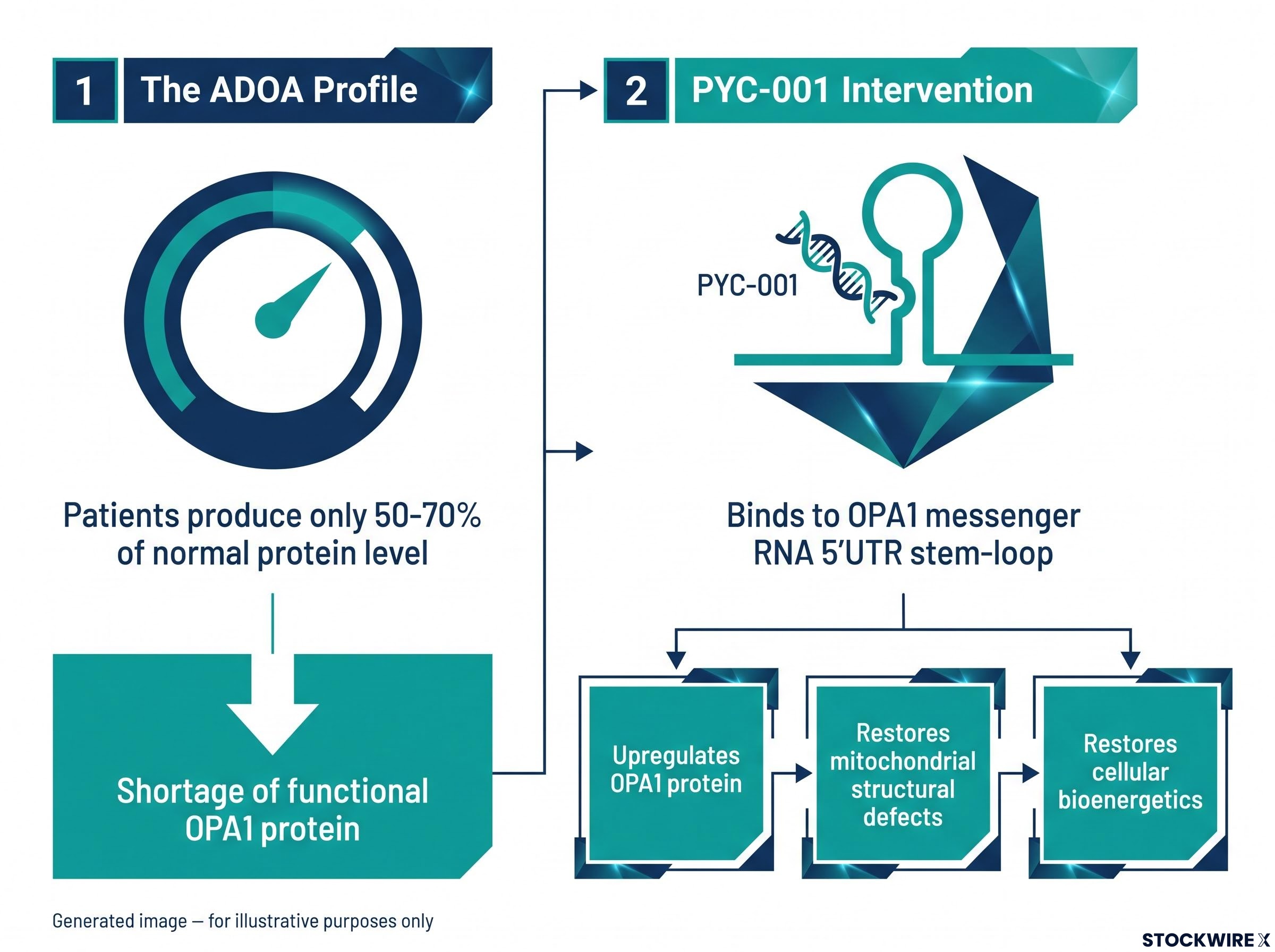
The underlying problem is a shortage of functional OPA1 protein. ADOA patients carry a haploinsufficiency, meaning they produce only around 50–70% of the normal protein level. This impairs mitochondrial health within retinal ganglion cells (the nerve cells that carry visual signals from the eye to the brain), driving vision loss.
PYC-001 is designed to address that root cause. The OPA1 messenger RNA contains a stem-loop structure in its 5′ untranslated region (5’UTR) that hinders protein translation. PYC-001 binds to this structure, disrupting it and facilitating more efficient ribosomal access, which allows for augmented OPA1 protein production.
In ADOA patient-derived induced pluripotent stem cell models (iPSC-RGC), PYC-001 has been reported to:
-
Upregulate OPA1 protein in a mutation-agnostic manner
-
Restore mitochondrial structural defects
-
Restore cellular bioenergetics
For investors, a disease-modifying mechanism in an indication with zero approved therapies sits at the core of the investment case.
Early clinical results: visual acuity gains and safety
The presentation detailed two headline clinical findings: an efficacy signal in visual acuity and a clean safety record to date.
On efficacy, LCVA data from MAD patients meeting proposed registrational trial inclusion criteria showed clinically meaningful changes in treated eyes across both the >10 and >15-letter thresholds, with a greater mean change from baseline compared to untreated fellow eyes. A >10-letter change is considered clinically meaningful, while a >15-letter change has become a standard outcome measure in clinical trials.
A further correlation was reported: reduced macular stress, measured via flavoprotein fluorescence, correlated to improved LCVA in treated eyes, while untreated fellow eyes showed a relatively flat relationship.
On safety, the presentation set out the dose-by-dose profile observed to date.
| Dose of PYC-001 | Patients dosed | Treatment-Related SAEs |
|---|---|---|
| 3 mcg | 3 | 0 (0%) |
| 10 mcg | 8 | 0 (0%) |
| 30 mcg | 10 | 0 (0%) |
| 60 mcg | 5 | 0 (0%) |
As at 1 September 2026, PYC reported no Treatment-Related Serious Adverse Events (TR-SAEs) and no Treatment-Related Adverse Events (TR-AEs) in any subject dosed with PYC-001 to date, including patients who have received multiple doses. A total of 23 ADOA patients have received PYC-001.
The presentation noted that these safety outcomes may be subject to change following future Safety Review Committee (SRC) review of data collected over the course of the ongoing clinical studies.
Preclinical support: a durable 2-fold protein boost
Updated non-human primate (NHP) research presented at NOSA reinforced the clinical story. According to the data, a single dose of PYC-001 sustained a 2-fold increase in OPA1 protein expression through 4 months in the NHP retina.
The increase in OPA1 signal in the treated group was described as statistically significant at Day 113 (Month 4) following a single 15 mcg dose. For investors, a durable single-dose effect supports the case for infrequent dosing consistent with a disease-modifying approach.
Alongside the protein durability signal, earlier trial data had already prompted PYC to review and amend its clinical protocol to pursue an extended dosing interval beyond the current 2-3 month schedule, with NHP data supporting a greater than 4-month gap between doses.
The regulatory runway and path to approval
The presentation outlined several US Food and Drug Administration (FDA) special designations intended to accelerate the path to approval, which may act as de-risking factors for the programme.
| FDA Designation | Status | Key benefit |
|---|---|---|
| Orphan Drug | Granted (OPA1-associated vision loss) | Potential for 7 years market exclusivity post-approval |
| Rare Pediatric Disease | Granted (OPA1-associated vision loss) | Eligible for a Priority Review Voucher on approval |
| Fast Track | Potentially eligible | Accelerated Approval / Priority Review eligibility |
| Breakthrough | Potentially eligible | Intensive FDA development guidance |
The Orphan Drug and Rare Pediatric Disease designations have both been granted for OPA1-associated vision loss, while Fast Track and Breakthrough designations are described as potentially eligible only.
The clinical roadmap set out in the presentation runs as follows:
-
Phase 1a SAD study — progressed across the 3, 10, 30 and 60 mcg cohorts
-
Phase 1b MAD study — ongoing, with early human safety and efficacy data now in hand
-
Phase 2/3 registrational study — planned for 2027, directed towards supporting a New Drug Application (NDA)
PYC also noted it may engage with regulatory authorities to discuss the potential for an open-label extension of the Phase 1b MAD study, to provide longer-term dosing data ahead of initiating the registrational trial.
Why NOSA 2026 matters for the investment case
The NOSA presentation drew together the strands of the ADOA programme: a disease-modifying mechanism, an early clinical efficacy signal in visual acuity, a clean safety record to date, durable preclinical data, and a supportive FDA regulatory framework.
Presenting to the specialist neuro-ophthalmology community builds clinical credibility and awareness ahead of a planned registrational trial.
ARVO 2026 conference data presented in Denver in May provided an earlier cross-programme view, with PYC-001 showing low-contrast visual acuity improvements extending beyond 60 weeks in ADOA patients and a 1.6-fold increase in OPA1 protein expression in non-human primates, alongside clean safety results for VP-001 in the RP11 programme.
From the presentation conclusions
“PYC-001 is a drug candidate with first in indication potential for the treatment of ADOA.”
PYC describes PYC-001 as the most advanced drug candidate with disease-modifying potential in clinical development for ADOA, based on publicly available information. On that footing, the company is preparing to progress PYC-001 into a registrational trial aimed at supporting the first approval in ADOA.
Don’t Miss the Next ASX Healthcare Breakthrough
Big News Blast delivers FREE breaking ASX healthcare news and in-depth analysis directly to your inbox within minutes of release. Join 20,000+ subscribers already staying ahead of market-moving announcements. Click the “Free Alerts” button at StockWire X to start receiving alerts the moment news breaks.