Goldman Sachs published research on 29 August 2026 concluding that American inflation expectations have held firm, with households and businesses keeping their long-run price outlook broadly stable despite more than five years of above-target inflation. The finding directly challenges the concern held by some Fed officials that prolonged above-target inflation has reshaped, in a durable way, how households and businesses form their views on future prices.
The question of whether expectations remain anchored is not abstract. When households and firms believe inflation will stay elevated, they demand higher wages and raise prices pre-emptively, creating the very conditions they anticipated. Goldman’s research argues that this self-reinforcing loop has not taken hold in the United States, and explains why that assessment diverges from what raw consumer survey readings might suggest.
Here is what Goldman’s conclusion means for Fed policy flexibility, why the firm’s modelling approach produces a more reassuring picture than headline survey numbers, what specific forces are projected to pull inflation back toward 2% by late 2027, and which corners of the market are most directly affected by whether that story holds.
Goldman’s conclusion and what it challenges at the Fed
Goldman analyst Abhay Duggirala put forward a view that separates the firm from several Federal Reserve officials who have raised alarms about a durable, structural change in how price expectations are formed. The conclusion is blunt: household and business expectations have risen only mildly, and the risk of a genuine unanchoring remains low.
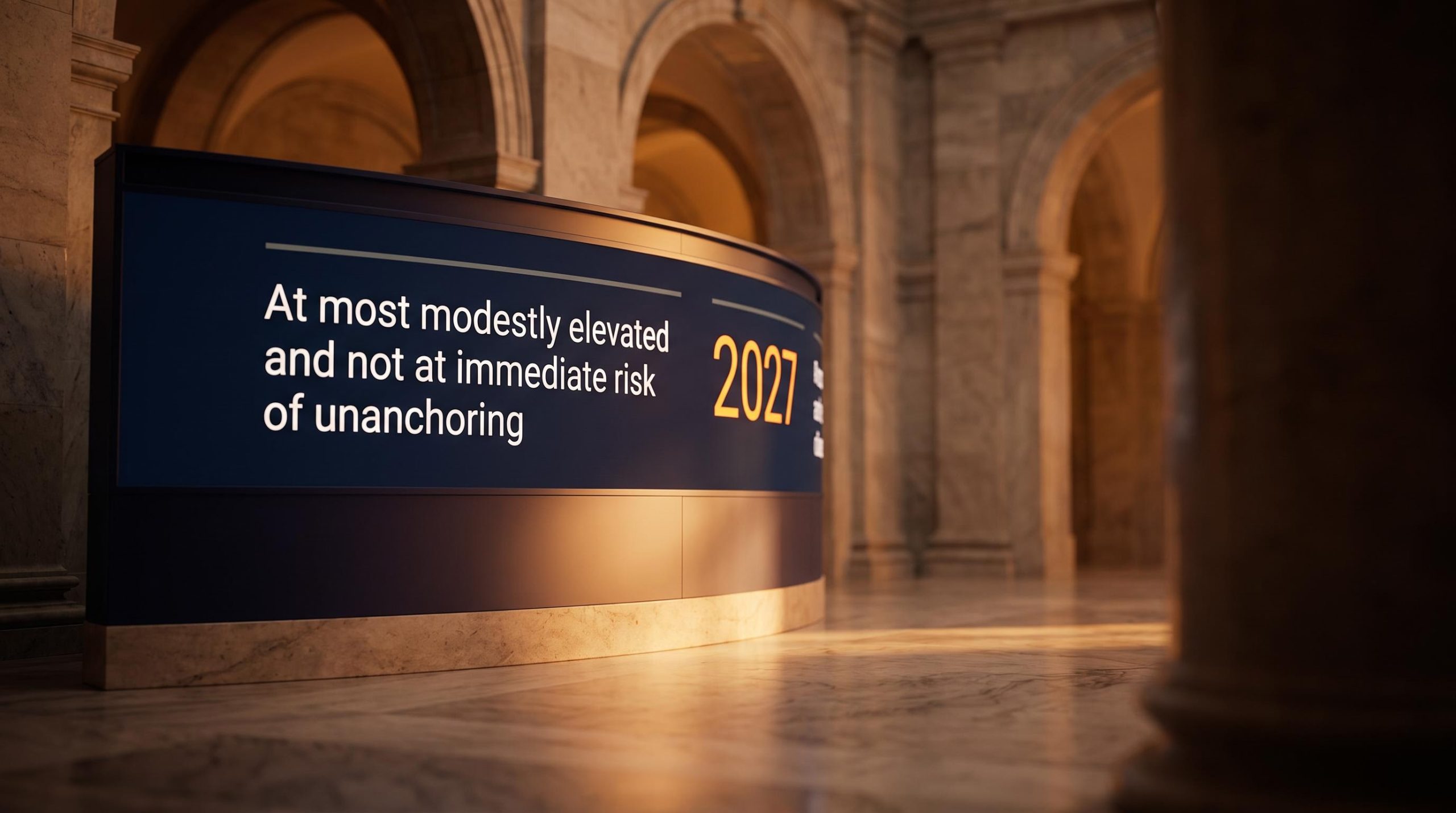
“At most modestly elevated and not at immediate risk of unanchoring.”
That formulation carries weight because it reframes the policy conversation. If Duggirala is right, the Fed retains the flexibility to respond to labour-market or growth weakness without triggering a credibility crisis in bond markets. If expectations had genuinely unanchored, the playbook would look closer to what Paul Volcker deployed in the early 1980s: aggressive, painful tightening aimed at reasserting control over inflation psychology regardless of the economic cost.
Goldman’s argument rests partly on structural history. The extended run of below-2% inflation before 2020 built up a cushion in expectations that helped absorb the subsequent price surge. Long-run household expectations are now roughly back around mid-2000s levels, even though short-term readings remain somewhat elevated. The gap between Goldman’s assessment and the concern expressed by some Fed officials is not a minor analytical disagreement. It has direct consequences for whether the central bank can cut rates in a slowdown without markets reading the move as capitulation on inflation.
The contrast Goldman draws with the 1980s playbook is made sharper by Volcker-era fiscal constraints that no longer apply in the same direction: federal debt has risen from roughly 31% of GDP in 1981 to approximately 122% today, meaning a Volcker-scale rate campaign would impose fiscal costs on the government four times faster than it did then.
When big ASX news breaks, our subscribers know first
Why Goldman’s model tells a different story than the surveys
The natural question is why Goldman’s reading is more sanguine than the raw survey data. The answer starts with the surveys themselves.
The University of Michigan 5-to-10-year inflation expectations reading stood at 3.3% at the time of the report. Goldman traces part of that elevated figure to shifts in how the survey is conducted and to increasing partisan divergence among those responding, factors that together distort the picture and exaggerate how much underlying expectations have actually moved. The Federal Reserve Bank of New York’s Survey of Consumer Expectations (SCE) tells a different but related story: the recent bout of elevated inflation drew younger demographic cohorts, those who had spent their adult lives knowing only cheap prices, into closer alignment with older generations who lived through periods of more pronounced inflation.
| Survey Source | Raw Reading | Goldman’s Interpretation | Key Distortion Factor |
|---|---|---|---|
| University of Michigan (5-10 year) | 3.3% | Overstated relative to true expectations shift | Methodology changes; political polarisation |
| New York Fed SCE | Elevated across cohorts | Younger cohorts converging with older, not unanchoring | Cohort alignment from shared lived experience |
| Goldman memory-based model | Marginally above 2% baseline | Sensitivity only slightly above a world of steady 2% since 2009 | Weights lifetime experience; fades older shocks |
In order to work past those survey distortions, Goldman constructed a memory-based model drawing on academic frameworks and historical survey microdata. The model weights inflation episodes across a person’s lifetime, placing heavier emphasis on recent experience while allowing older shocks, such as the 1970s era, to fade. Applying that model to the present situation, with ten-plus years of low pre-2020 inflation, the subsequent price shock, and a diminishing imprint from 1970s-era inflation, produces a result showing that aggregate price sensitivity sits only a fraction above what would be expected in a world where inflation had remained at a steady 2% throughout the period since 2009.
The NBER experience-based learning framework developed by Malmendier and Nagel establishes that individuals form inflation expectations almost entirely from their personal lifetime history of realised prices, which is the academic foundation Goldman’s memory-based model draws on when weighting recent price shocks against older episodes.
That gap between the 3.3% Michigan headline and Goldman’s model-adjusted picture tells you that raw survey data overstates how unmoored expectations actually are. If you are reading Fed communications that cite those raw readings as evidence of a problem, Goldman’s work suggests the underlying picture is considerably less alarming.
Goldman distils three core lessons from the broader economic research base:
- Near-term inflation expectations feed directly into wage negotiations and business pricing decisions, making them the most operationally consequential measure.
- How people have experienced prices, across both the recent past and their broader lifetime, drives expectations with far greater force than anything a central bank says.
- Fed communications carry limited weight on their own; what does the anchoring work is a sustained, observable fall in actual inflation.
Forecasting inflation’s return to target by 2027
Goldman’s expectation that psychology will heal rests on a specific inflation forecast, not just a model assumption. The firm projects core Personal Consumption Expenditures (PCE) inflation, the Fed’s preferred gauge, at approximately 3% for 2026, lifted by tariffs, AI-related measurement and demand effects, and energy price passthrough.
By late 2027, Goldman expects those forces to fade. Core PCE is projected to ease toward roughly 2-2.2%, contingent on two specific conditions.
The core PCE trajectory through July 2026, with the headline measure holding at 3.3% year-over-year for a second consecutive month, is precisely the kind of incremental disinflation Goldman’s memory-based model requires to accumulate before long-run expectations can fully normalise.
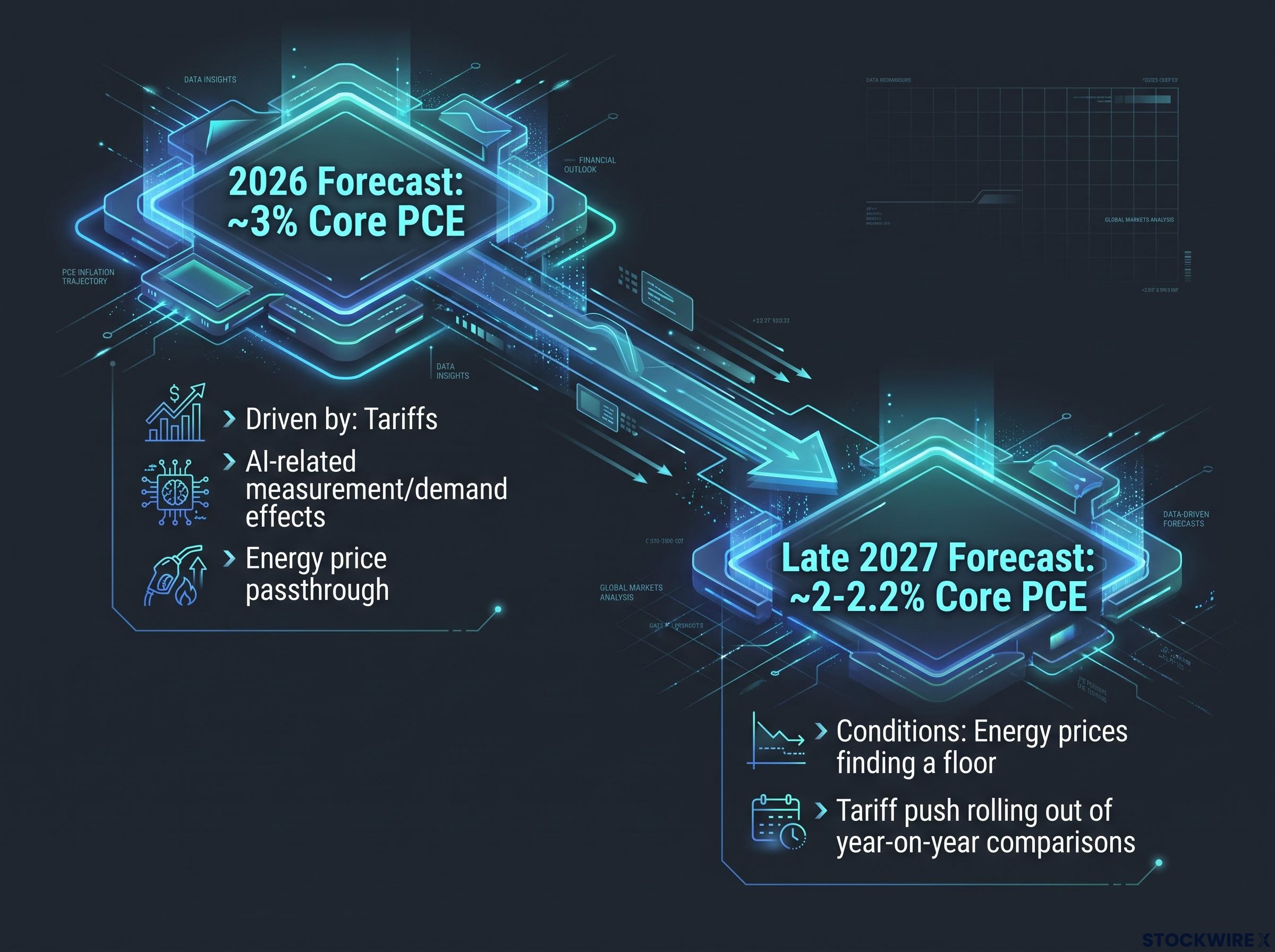
The path back to target depends on energy prices finding a floor and the one-time upward push from tariffs rolling out of year-on-year comparisons.
That conditionality matters. Goldman is not forecasting a mechanical return to 2% regardless of circumstances. The firm is identifying the specific forces holding inflation above target and arguing they are transitory rather than structural.
How memory dynamics reinforce the path back to target
The memory-based model adds a layer beyond the headline forecast. Each additional year of lower, more stable inflation mathematically reduces the influence of the 2020-2024 shock on expectations. This mechanism operates independently of Fed communications. It does not require the central bank to successfully persuade households through speeches or forward guidance. It requires actual disinflation to accumulate in lived experience, which is precisely what Goldman projects will happen between now and the end of 2027.
What anchored expectations mean for rates, bonds, and consumer spending
Goldman’s anchoring conclusion is not a single-channel story. It hits three distinct corners of the market, each with different mechanics.
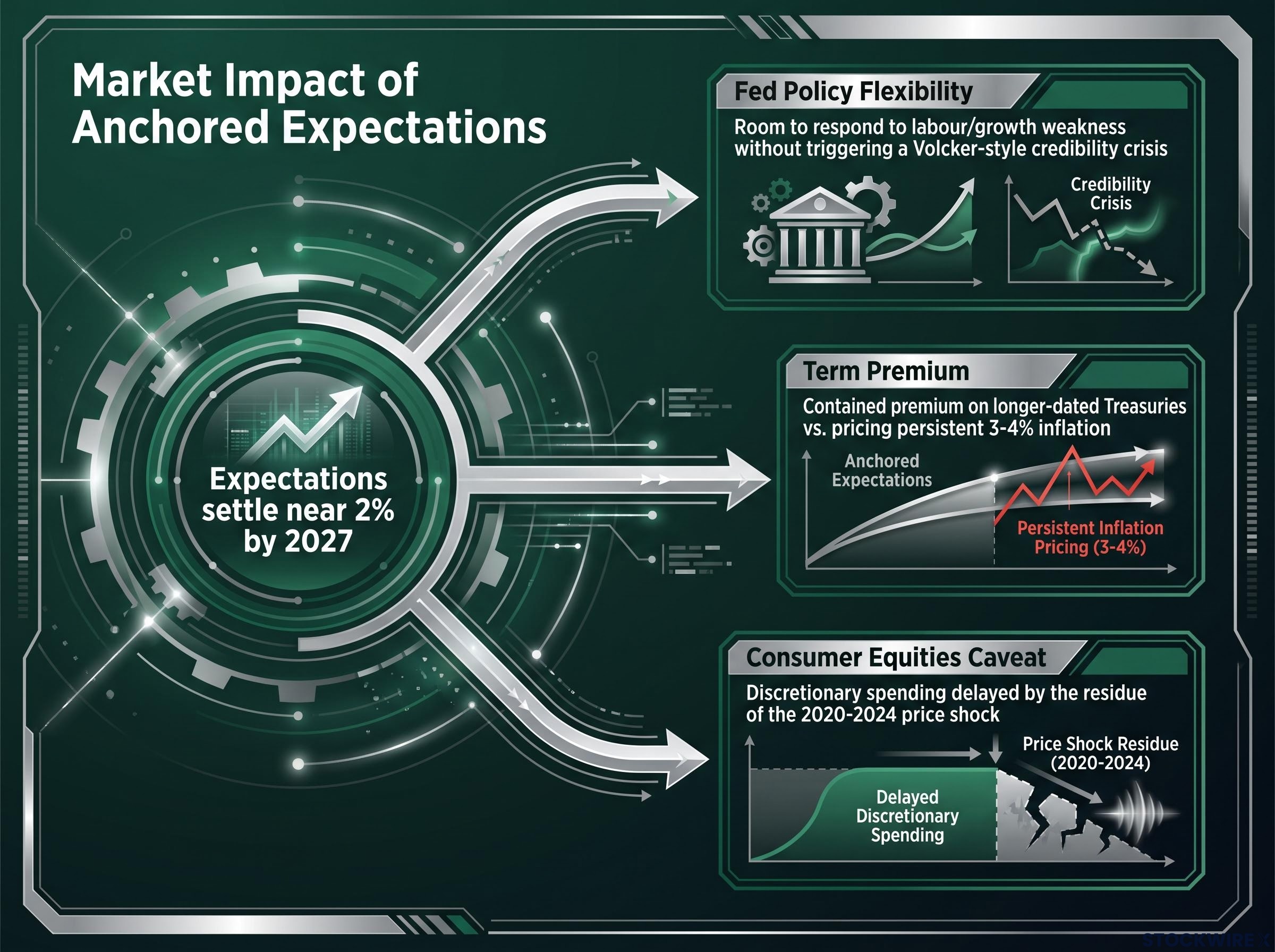
- Fed policy flexibility: Anchored expectations give the Fed room to respond to labour-market or growth weakness without triggering a credibility crisis. In a world where expectations had unanchored, any rate cut would risk being read as the central bank abandoning its inflation mandate, forcing Volcker-style tightening with significantly more severe market consequences.
- Term premium and yield curve shape: If bond investors broadly accept that inflation will settle near 2% by 2027, the term premium on longer-dated Treasuries (the extra yield investors demand for holding bonds over longer time horizons) should remain more contained than in a world pricing persistent 3-4% inflation. That has direct implications for mortgage rates, corporate borrowing costs, and the relative attractiveness of duration-sensitive assets.
- Consumer-facing equities caveat: This is the part of Goldman’s analysis most likely to be missed. Even with anchored long-run expectations, households that have endured several years of elevated prices may remain cautious in discretionary spending. The memory of high prices can outlast the peak in inflation itself. Assets priced on a snap-back in consumer confidence may be ahead of the psychological reality, because the residue of the 2020-2024 price shock will linger in spending patterns even as headline inflation normalises.
That consumer caveat deserves particular attention. Anchored expectations are good news for the macro picture and for rate-sensitive assets. They are not an automatic green light for consumer discretionary positioning, where the lived-experience channel operates on a longer delay.
Consumer sentiment deterioration adds a further layer to Goldman’s consumer-spending caveat: with the August 2026 Michigan index tracking near 54.5 against a backdrop of the first nonfarm payrolls contraction of the cycle, the psychological residue of elevated prices Goldman identifies is being compounded by a separate and simultaneous confidence shock.
What the Goldman finding changes, and where the uncertainty lives
Goldman’s work strengthens the case that the United States has most likely avoided a 1970s-style break in inflation psychology. The structural buffer built by more than a decade of sub-2% inflation prior to 2020, combined with the memory-fading dynamics of the model, explains why long-run expectations have not unmoored despite the severity of the recent inflation episode.
That conclusion is conditional, not definitive. It rests on crude oil prices remaining broadly stable, the one-time lift from tariffs fading out of annual comparisons, and continued disinflation accumulating in lived experience. None of those are guaranteed. The next 12-18 months of realised inflation data are the actual test of whether expectations stay anchored or begin to drift.
Goldman’s conditional optimism sits in direct tension with the structural inflation regime thesis, which holds that 13 simultaneous reversals of the forces that drove four decades of disinflation make a sustained return to 2% historically unlikely within any single investment cycle.
The research’s central policy implication is that actual disinflation, not Fed communication, is what does the anchoring work. Households pay little sustained attention to central bank messaging when prices are behaving, which means official guidance cannot substitute for real-world disinflation. Goldman projects that anchoring process to reach completion by end of 2027, giving investors a clear forward marker against which to assess incoming data rather than a binary verdict on whether expectations are safe.
This article is for informational purposes only and should not be considered financial advice. Investors should conduct their own research and consult with financial professionals before making investment decisions. These statements are speculative and subject to change based on market developments and company performance.