
A business that charges a toll on the global economy’s cash flow, earns operating margins approaching 60%, and takes no credit risk sounds like a thought experiment. Mastercard is not a thought experiment. It is a $450 billion company processing trillions of dollars annually, and the very profitability that makes the model exceptional is what attracts the most credible long-term threats.
The timing matters. Surcharging regulation has stripped the invisibility from card costs at the point of sale, and stablecoin frameworks in the EU, Hong Kong, Singapore, and the United States have pulled blockchain payment rails into the regulatory mainstream as of 2025-2026. These are not future-tense threats. The regulatory infrastructure enabling them is already law in major jurisdictions.
If you have held Mastercard for years, you understand the bull case. The harder question is whether the two most credible structural pressures change the calculus, and over what timeframe. Here is a clear-eyed map of where the moat holds, where it may not, and what signals to watch before either verdict hardens.
Why Mastercard earns margins most companies cannot imagine
The widespread assumption that Mastercard is in the business of lending money is understandable but wrong. The company has no loan book, carries no credit exposure, and holds no physical inventory. Credit risk sits entirely with the issuing banks. What Mastercard does is operate the network infrastructure through which transactions travel, earning a fee at each step. The business is structured as a toll road across global commerce, not as a financial institution bearing lending risk.
That distinction matters because it explains why the economics look the way they do. At sufficient network scale, each new transaction passing through adds revenue with almost no corresponding incremental cost. And the scale is self-reinforcing: merchants accept Mastercard because consumers carry it, and consumers carry it because merchants accept it. That two-sided network effect creates a barrier to replication that very few businesses in any industry can match.
Two-sided network moats share a common structural property across industries: displacing them requires simultaneous migration of both sides, a coordination problem that has historically protected scaled incumbents even when challenger economics look compelling on paper.
The financial profile reflects exactly what you would expect from a scaled, asset-light toll booth:
- No credit risk: the issuing bank holds the loan, not the network
- Two-sided network effect: each side reinforces the other, compounding the barrier to entry
- Asset-light cost base: no inventory, no branches, no physical distribution infrastructure
Mastercard’s reported operating margin reached 57.63% for fiscal year 2025, with adjusted figures as high as 59.2% and recent quarterly margins ranging between 58.7% and 60.2%. This is materially higher than the commonly cited 50% approximation and suggests the competitive position has, if anything, strengthened over the past decade.
That near-60% margin is not just a number to admire. It tells you that any investor evaluating the moat should start from that baseline before assessing threats. The margin has widened, not compressed, which means the structural forces working in Mastercard’s favour have been outrunning the pressures working against it. The question is whether that continues.
When big ASX news breaks, our subscribers know first
How surcharging exposes the embedded costs consumers never saw
For most of the card network era, acceptance costs were structurally hidden from buyers. Card scheme rules prevented merchants from itemising payment processing fees separately, so interchange costs were absorbed into shelf prices and distributed uniformly across every customer, whether they paid by card or cash. A shopper using a credit card never encountered the roughly 3% cost that card acceptance carried; it was folded invisibly into the retail price they would have paid regardless.
When implicit becomes explicit
Changes to those scheme rules across many jurisdictions have since altered that structure fundamentally. Merchants now have the ability in numerous markets to break out card acceptance costs as a separate checkout line item, converting a concealed expense into something a customer can see and react to. That visibility carries real psychological weight: encountering a 3% card fee as an explicit surcharge on a receipt lands very differently than the same cost embedded silently in the headline price, even though the net financial outcome for the consumer is the same.
Adoption, however, has been uneven. Surcharging is concentrated in specific verticals: travel, government payments, and professional services, where transaction sizes justify the friction. In everyday retail, many merchants have concluded that frictionless checkout matters more than marginal fee recovery. Three factors limit the structural impact:
Surcharging regulation is advancing fastest in jurisdictions where regulators have moved to standardise disclosure at the point of sale: Australia’s RBA finalised card payment reforms effective 1 October 2026 that ban surcharging on domestic Mastercard and Visa transactions while simultaneously lowering interchange fee caps, a regulatory combination that compresses interchange revenue from both directions.
- Regulatory caps: many jurisdictions restrict surcharges to the merchant’s actual acceptance cost and mandate disclosure, capping both magnitude and prevalence
- Fragmented merchant adoption: everyday retail merchants frequently absorb the cost rather than risk checkout abandonment
- Consumer rewards offset: when consumers perceive rewards as neutralising the surcharge, the incentive to switch payment methods weakens
For investors, the practical signal from surcharging is not that consumers will stop using credit cards. It is that the richness of rewards programmes may face structural compression as cost transparency increases. That affects the issuer economics that indirectly support interchange revenue. Surcharging is a pressure valve on rewards first and the network itself only under far more extreme adoption scenarios.
Why stablecoin payment rails now belong in the investment risk calculus
For years, the standard dismissal was simple: crypto is speculative, volatile, and irrelevant to real payment infrastructure. That framing no longer holds. The shift that matters is not technological; it is regulatory.
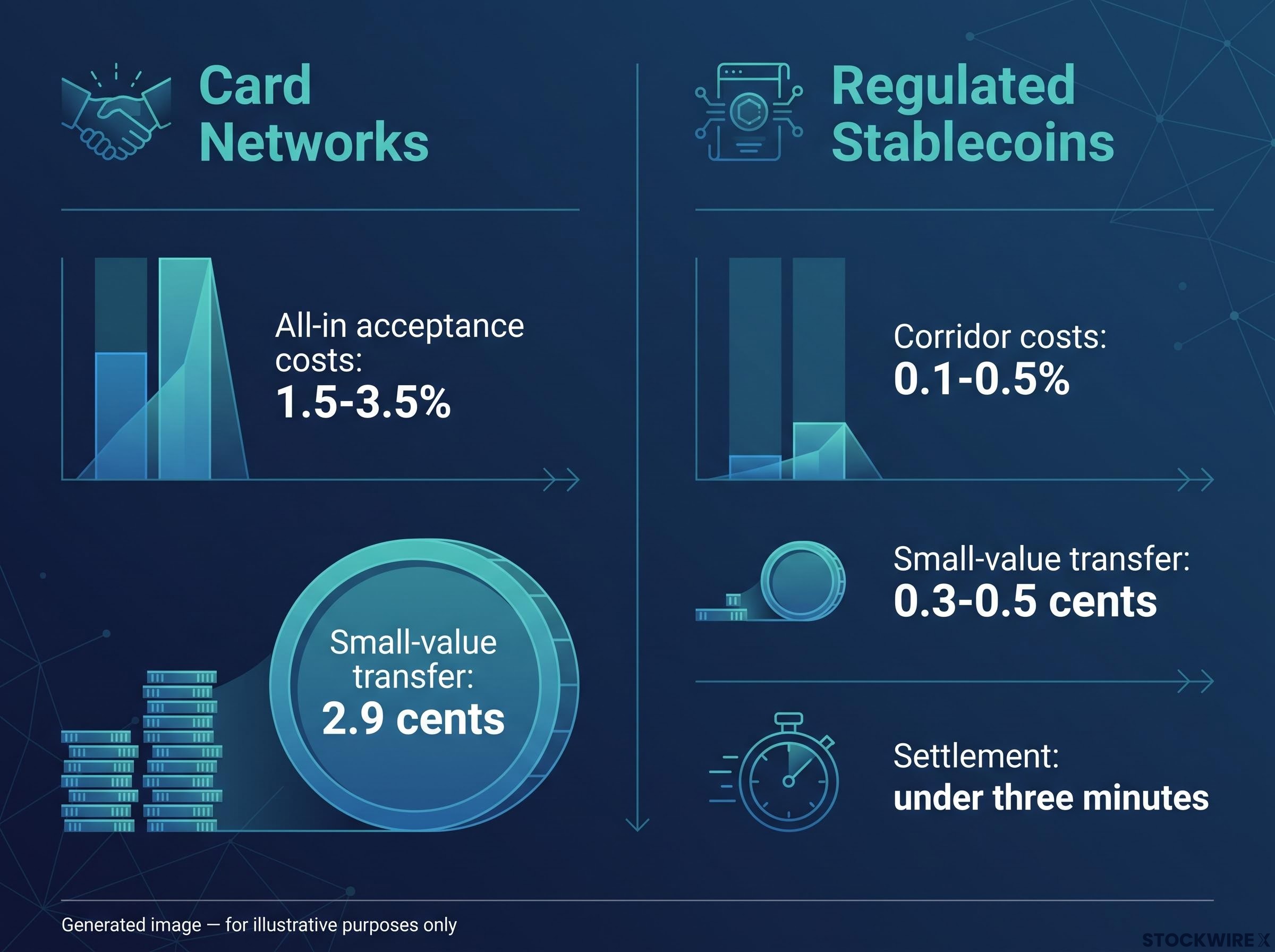
Card network all-in acceptance costs typically run 1.5-3.5% of transaction value. Regulated stablecoin corridors have demonstrated costs of 0.1-0.5% with settlement in under three minutes in documented implementations. On a per-transaction basis for small-value transfers, the comparison is roughly 2.9 cents for cards versus 0.3-0.5 cents on permissioned blockchains (noting that blockchain fees vary with network congestion).
The cost advantage is real but has been real for several years. What changed is that major economies have now enacted stablecoin-specific legal frameworks, treating fiat-backed stablecoins as regulated payment instruments rather than speculative crypto assets.
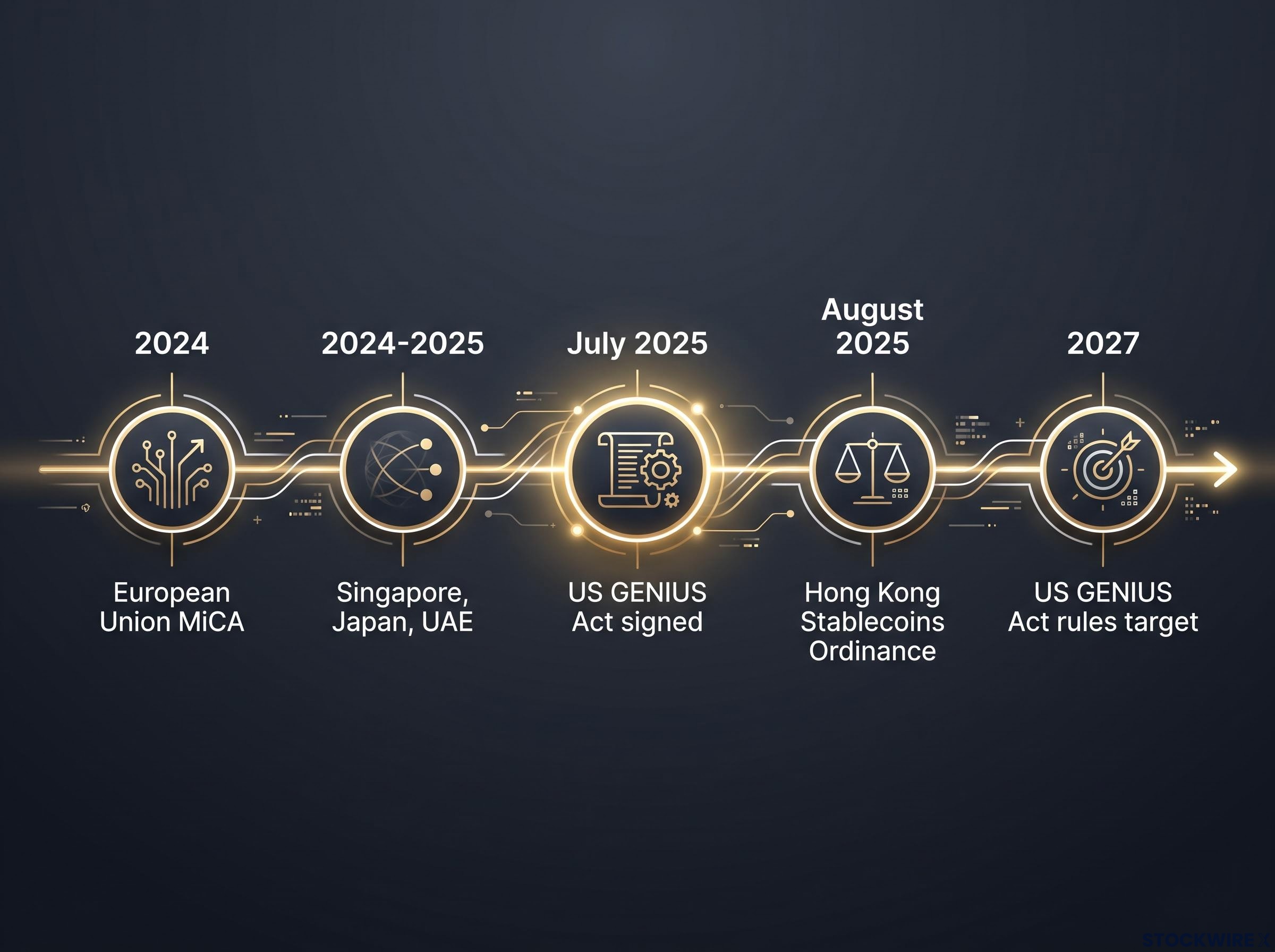
| Jurisdiction | Framework | Status | Effective date |
|---|---|---|---|
| European Union | MiCA | Fully in force | 2024 |
| Hong Kong | Stablecoins Ordinance | Effective | August 2025 |
| Singapore / Japan / UAE | Dedicated frameworks | Enacted or finalised | 2024-2025 |
| United States | GENIUS Act | Signed; rules finalising | July 2025 (target 2027) |
The cross-border beachhead
The use case where displacement is most credible and most near-term is cross-border B2B payments and treasury operations. Lower marginal costs, faster settlement, and regulatory legitimacy make these corridors the natural starting point. Domestic consumer-facing payments, where fraud protection and dispute resolution matter most, sit further down the migration timeline.
The enterprise migration timeline finds its clearest near-term expression in wholesale markets: tokenised settlement infrastructure for repo and Treasury transactions is already advancing toward production deployment in 2026, with the DTCC targeting a full service launch in October 2026, well ahead of any consumer-facing stablecoin product reaching comparable scale.
The signing of the GENIUS Act in July 2025 is the signal that stablecoin payment rails are not theoretical. They are a regulated payment infrastructure the US government has formally sanctioned. If you hold card network equity, the GENIUS Act implementation timeline is the most concrete marker of when volume migration may begin in the world’s largest economy.
The moat within the moat: fraud protection, dispute resolution, and the rewards lock-in
The cost comparison favours stablecoins. The consumer experience comparison does not, and this asymmetry is the reason mass consumer migration will lag far behind enterprise adoption.
Three components form what amounts to an inner moat:
- Fraud protection and chargebacks: card networks provide structured consumer protections, including the ability to contest and reverse unauthorised or disputed transactions, that blockchain-based payment systems cannot yet replicate at comparable scale. Transfers recorded on-chain are final by design, with no mechanism equivalent to a bank dispute or chargeback.
- Consumer dispute resolution: the infrastructure for resolving contested transactions, from billing errors to merchant fraud, is deeply embedded in card network operations. No blockchain payment product offers a comparable overlay as of 2026.
- Rewards programme lock-in: consumer-perceived value from rewards partially neutralises the incentive created by merchant surcharges. Even as costs become more visible, the card ecosystem captures loyalty through this compounding psychological mechanism.
The absence of a standardised consumer dispute mechanism on blockchain rails is the single most important reason consumer migration will lag far behind enterprise B2B migration. These are two different timelines, and investors should weight them separately rather than treating them as the same threat.
Paradoxically, stablecoin regulation may reinforce Mastercard’s position rather than undermine it. Because most frameworks restrict issuance to licensed institutions with full reserve backing and redemption obligations, the ecosystem tilts toward integration with existing banks and card network partners, not outright disintermediation. The most probable medium-term outcome is hybridisation: stablecoin settlement operating behind the scenes while consumer-facing card experiences remain intact.
For investors wanting to see how the hybridisation model works in practice at the issuer level, our full explainer on regulated stablecoin deployment examines how Klevo’s KLVAUD stablecoin operates as a settlement layer within an existing Mastercard-powered loyalty and wallet infrastructure.
Five signals that will tell you how the value is actually shifting
If you are monitoring only Mastercard’s quarterly earnings, you are watching the lagging indicator. The leading indicators sit in adoption data, regulatory implementation, and sector-level behaviour. Here are the five most specific signals, ranked by analytical priority:
- Merchant surcharging penetration beyond travel and government. Watch for surcharging expanding into everyday retail verticals: grocery, fuel, general merchandise. If surcharging remains confined to travel, government payments, and professional services, the pressure stays marginal. If it reaches everyday checkout, rewards compression accelerates.
- Enterprise stablecoin volumes in regulated corridors. Track measurable migration from correspondent banking and cross-border card rails to tokenised settlement in jurisdictions where frameworks are in force (EU, Hong Kong, Singapore, Japan, UAE). Rising volumes here signal the beachhead is expanding.
- Consumer-grade dispute mechanisms for stablecoin payments. The emergence of a standardised chargeback or dispute overlay for on-chain consumer payments would remove the single largest barrier to mass consumer migration. Until it exists, the inner moat holds.
- Regulatory evolution linking interchange, rewards, and financial inclusion. Watch whether major-market regulators begin connecting surcharging policy, rewards economics, and financial inclusion objectives in ways that structurally reshape the interchange model. This is a slower-moving but potentially more consequential shift.
- GENIUS Act implementation progress. The 2027 target date for US stablecoin payment rules taking effect is the most concrete near-term calendar marker. The pace of rule finalisation, licensing, and early volume data from 2027 onward will tell you whether the US market is genuinely opening to alternative rails or whether implementation friction delays the migration.
A durable compounder facing slow erosion, not sudden collapse
The two structural timelines operate on very different clocks. Surcharging pressure works through rewards economics over years before it approaches network viability. Blockchain displacement operates over a 10-20 year horizon, beginning in cross-border B2B corridors and only later reaching domestic consumer payments.
Mastercard’s fiscal year 2025 operating margin of 57.63% (adjusted margins reaching 59.2%) tells you the moat is not yet compressing. It is widening. The compounding engine is intact for the foreseeable investment horizon, even as both threats are real and advancing.
The most realistic medium-term outcome is hybridisation: stablecoin and blockchain settlement operating beneath the surface of consumer-facing card experiences, with incumbent networks capturing a portion of the economics from that layer as well. Mastercard has historically absorbed new payment capabilities rather than being displaced by them, and the regulatory architecture being built around stablecoins favours that pattern repeating.
The question for a long-horizon holder is not whether these forces will matter eventually. It is whether the erosion will be slow and partial enough that the compounding engine generates significant value through the transition. The evidence as of August 2026 points toward yes, but with a clear caveat: that verdict requires active monitoring, not passive conviction.
This article is for informational purposes only and should not be considered financial advice. Investors should conduct their own research and consult with financial professionals before making investment decisions. Past performance does not guarantee future results. Forward-looking statements regarding stablecoin adoption timelines, regulatory implementation, and margin trajectories are subject to change based on market developments and regulatory outcomes.