Nvidia posted one of its strongest earnings beats on record on 27 August 2026, and the stock surged 8.74% to close at $227.98. On the same day, the Wall Street Journal reported that the company had quietly paused an internal financing programme because its own employees raised antitrust concerns. The number Wall Street celebrated does not contain the risk that matters most right now.
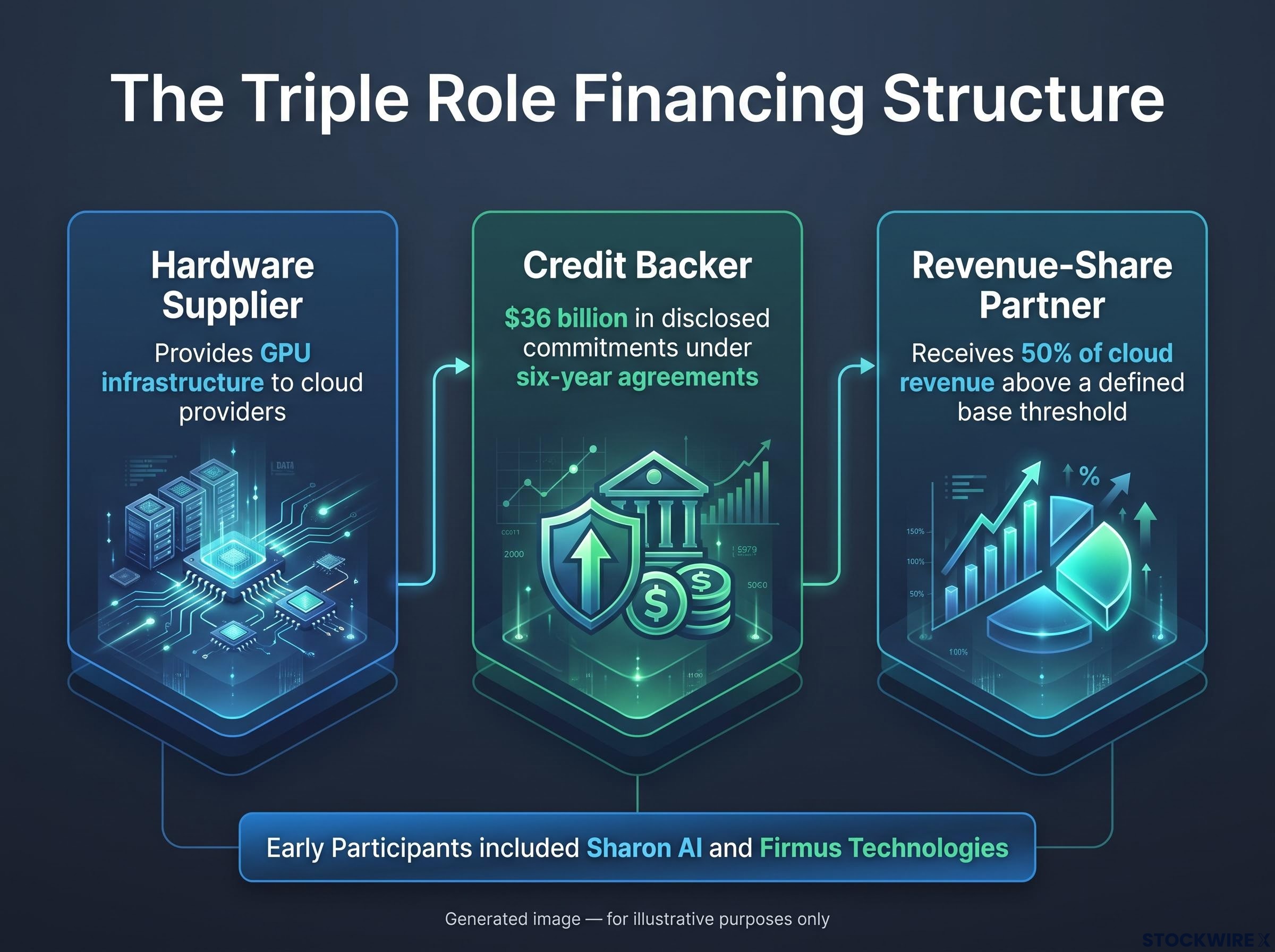
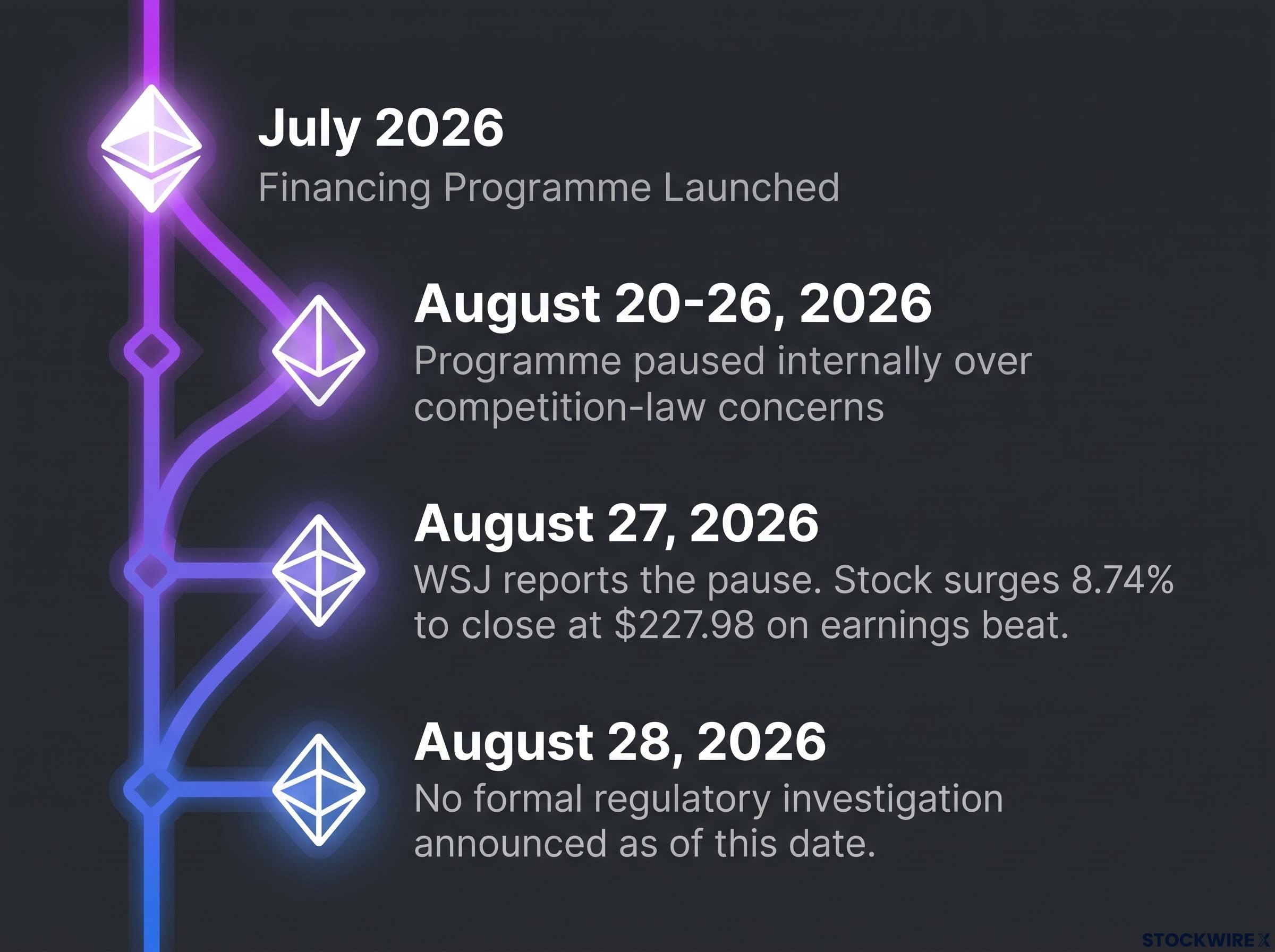
The paused programme was not a minor operational experiment. Launched in July 2026 and paused approximately 20-26 August, it placed Nvidia simultaneously in the roles of hardware supplier, credit backer, and revenue-share partner to the same AI cloud customers, with $36 billion in disclosed commitments under six-year agreements. That scope, combined with the fact that the antitrust worry originated inside the company rather than from any regulator, is what elevates this story beyond the stock price.
Here is a framework for separating the earnings headline from the structural risk underneath it, so you can assess whether Nvidia’s regulatory exposure is manageable noise or a genuine constraint on its long-term business model.
Nvidia was financing its own customers: here is how the programme worked
The programme targeted smaller AI cloud providers and startups. Sharon AI and Firmus Technologies were among the early participants. Under the arrangement, these companies could acquire Nvidia GPU infrastructure with credit support from Nvidia itself, drawing on a token credit mechanism that let capital-constrained AI developers access GPU capacity without paying large upfront compute bills. Nvidia then recouped value through a share of downstream cloud or product revenue.
The revenue share was not modest. Nvidia receives 50% of cloud revenue above a defined base threshold covering costs. That structure meant the company was not simply selling chips; it held a direct financial stake in which customers succeeded and how much cloud revenue they generated.
Three roles, one company. Nvidia was the hardware supplier selling GPUs. It was the credit backer providing capital and guaranteeing purchase of unused capacity. And it was the revenue-share partner taking half of cloud revenue above threshold. That triple position is what transforms a financing programme into something competition lawyers are trained to examine.
“Is still in place and continues to evolve due to high demand.” — Nvidia spokesperson
CEO Jensen Huang has publicly defended the model, contending that the capital requirements facing AI startups are far greater than those in conventional technology sectors. The programme ran for fewer than two months before the pause.
| Role | What Nvidia does | Potential conflict |
|---|---|---|
| Hardware supplier | Sells GPUs to cloud providers | Preferential access for financed customers |
| Credit backer | Provides capital and guarantees unused capacity | Self-funding demand for its own products |
| Revenue-share partner | Takes 50% of cloud revenue above threshold | Financial stake in customer competitive outcomes |
The 50% revenue share above threshold is not a passive royalty arrangement. It gives Nvidia a direct financial interest in which AI cloud customers win, and that is precisely what transforms a financing programme into a potential competition-law problem.
When big ASX news breaks, our subscribers know first
Why this structure is exactly what antitrust regulators are trained to examine
The threshold question in any antitrust analysis is market power. The same conduct that is benign for a small supplier becomes legally consequential when the supplier holds a dominant position. Nvidia is widely viewed as holding a very high share of the advanced AI accelerator market used for training and inference. That market position means financing arrangements, equity stakes, and revenue-share structures attract a level of scrutiny that would pass without comment from a smaller competitor.
Once market power is established, the programme’s features activate several distinct competition-law concerns, not just one.
Export control constraints on Nvidia’s Asian buyer list, which were cut by more than half in a July 2026 regulatory sweep, establish that government agencies are already applying structural limits to how Nvidia accesses its most important growth markets, providing context for why the internal antitrust pause carries weight beyond a single programme.
The four competition-law theories regulators are most likely to apply
- Tying and leveraging: If access to Nvidia’s financing is conditioned in practice on using Nvidia GPUs rather than rivals’ chips, regulators could characterise this as leveraging chip dominance into adjacent markets such as cloud services and AI platforms.
- Self-preferencing: Nvidia’s direct financial stake in financed customers raises the question of whether those customers receive allocation priority, better pricing, or product roadmap access that disadvantages non-financed rivals. Reporting by Gardizy and Jin in the Wall Street Journal noted restrictions on approved renters and a preference for distributing capacity to multiple smaller firms, details that speak directly to how allocation decisions were being made.
- Demand creation via financial engineering: If a meaningful portion of visible AI infrastructure demand is being underwritten by Nvidia’s balance sheet, competition economists could argue the company is using financial engineering to amplify and entrench platform dependence in ways rivals cannot match.
- Pattern of conduct: The paused programme does not exist in isolation. Nvidia has acquired ownership stakes in AI startups that later emerge as significant buyers of its GPUs. A competition authority would examine whether these equity stakes, credit arrangements, and revenue shares together create a web of dependencies that forecloses rival chipmakers over time.
An important caveat: no formal regulatory investigation had been announced as of 28 August 2026, and antitrust outcomes turn on specific contract terms and demonstrated market effects. But the structure is exactly the sort that attracts formal inquiries from agencies already focused on AI markets. Understanding these specific theories tells you which contract details and market disclosures to watch for, because those are the facts that would determine whether a formal inquiry ever develops.
What the internal pause actually tells you
The pause originated internally. Nvidia employees raised competition-law exposure concerns before any public investigation or external regulatory pressure materialised. The timing matters: the pause occurred approximately one week before the 27 August 2026 Wall Street Journal report, placing it around 20-26 August, fewer than two months after the July 2026 launch. A WSJ reporter publicly characterised the story as a scoop, meaning the pause was not a company-announced development.
What this signals about Nvidia’s own legal and policy teams is significant. They viewed the competition-law risk as non-trivial in the programme’s current form, and management was willing to accept near-term growth trade-offs to avoid setting up a regulatory test case. A company with Nvidia’s legal resources does not pause a programme generating commercial momentum unless its internal advisors have concluded the exposure is real enough to act on.
Clarity on what the pause does not mean is equally important. The programme has not been permanently scrapped. Nvidia’s spokesperson confirmed it continues to evolve, and the company may revamp it or fold it into another initiative.
No formal regulatory investigation had been announced as of 28 August 2026.
For you as an investor, the internal origin of the pause is more informative than the pause itself. It indicates Nvidia’s own advisors believe the programme’s structure, at its current design, crosses an internal competition-law threshold. That is a materially different signal than a company pausing because regulators called. It suggests the exposure was assessed as real enough to act on without external prompting, which raises rather than reduces the significance of the underlying risk.
The regulatory risk layer investors are not pricing from the earnings beat
The near-term financial impact of the paused programme is limited. It was nascent and quickly paused. The real risk lies in authorities using this and similar arrangements to justify broader constraints on Nvidia’s ability to combine finance, equity stakes, and supply relationships within the AI ecosystem.
The paused programme is one instance of a broader strategic posture: Nvidia has been positioning itself as a capital partner in AI infrastructure across multiple simultaneous transactions, including a reported $3 billion equity stake in SoftBank’s SB Energy and credit backstop arrangements tied to a 10-gigawatt Ohio campus.
The types of remedies that would constitute structural constraints on Nvidia’s growth model go well beyond fines. They include limits on revenue-sharing structures, constraints on customer funding or equity stakes, behavioural neutrality requirements on allocation and pricing, and non-exclusivity commitments. These are restrictions on how the business operates, not penalties that get absorbed into a quarterly earnings line item.
There is also a reputational and political dimension. Nvidia now sits at the centre of AI infrastructure policy debates in Washington and Brussels. A financing programme that its own employees flagged as a competition-law concern feeds concentration narratives that can drive congressional and parliamentary attention even without a formal investigation. The $36 billion in commitments under six-year agreements illustrates the scale of financial entanglement Nvidia has built with its customer base, and that figure will feature in any policy discussion about market concentration.
Nvidia closed up 8.74% at $227.98 on 27 August 2026. That gap between market sentiment around the earnings beat and the regulatory risk narrative is itself worth tracking.
Four indicators to track as the regulatory picture develops
- Preliminary inquiries: Whether U.S. (FTC or DOJ) or non-U.S. authorities open preliminary inquiries into Nvidia’s customer financing, investment, or revenue-sharing practices.
- Successor programme structure: How Nvidia structures any replacement, for example whether it introduces arm’s-length finance partners, reduces direct revenue sharing, or includes explicit non-exclusivity commitments.
The successor programme structure will likely determine whether regulators treat the pause as a genuine course correction or a cosmetic redesign; a third-party financing architecture involving institutions such as Apollo, BlackRock, and KKR would separate Nvidia’s role as technology supplier from any demand-creation function, which is the structural distinction Morgan Stanley identified as central to its $288 price target thesis.
- Counterparty disclosures: Whether AI cloud providers and startups disclose terms suggesting de facto exclusivity or strong steering toward Nvidia’s stack.
- SEC filing language: Customer disclosures in SEC filings or earnings calls regarding the terms of their arrangements with Nvidia, which could reveal the degree of financial entanglement.
The earnings beat and the financing programme pause are not separate stories. They are two readings of the same company at the same moment, and if you are only tracking the stock price, you are missing the structural risk that could constrain Nvidia’s business model before the next major earnings cycle.
What the pause changes about the Nvidia investment thesis, and what it does not
The pause does not change the demand picture. Nvidia’s chip demand is structurally robust, the earnings beat was real, and no formal investigation exists as of 28 August 2026. The programme may be revamped rather than scrapped.
What the pause does change is the risk map. The financing programme episode reveals that Nvidia has been building a financial architecture around its hardware dominance that its own legal teams view as competition-law sensitive. That architecture, encompassing $36 billion in disclosed commitments, is now a known variable in the investment thesis. The regulatory treatment of AI-era financing structures of this kind remains unsettled law.
For investors wanting to calibrate how regulators have historically reshaped Nvidia’s market access, our dedicated guide to the China export control collapse covers how U.S. policy eliminated approximately $6 billion in annual data centre revenue and what the precedent implies for other jurisdictions where government intervention is accelerating.
The outstanding uncertainties, including the exact pause rationale, successor programme structure, and potential regulatory interest, mean the appropriate posture is active monitoring rather than either dismissal or alarm. The four indicators above give you a specific, actionable framework for tracking how the regulatory picture develops. The central question you should carry forward is not whether Nvidia is in legal trouble today, but whether the business model it has been building around financing its own customers is sustainable under the regulatory environment that is taking shape around AI infrastructure.
This article is for informational purposes only and should not be considered financial advice. Investors should conduct their own research and consult with financial professionals before making investment decisions. These statements are speculative and subject to change based on market developments and company performance.