Woolworths just delivered underlying profit growth of 15%, its strongest result in years. EBIT climbed 12.7% on sales growth of just 3.6%. By most measures, the business is firing on all cylinders.
And yet Morningstar says the shares are trading 23% above fair value.
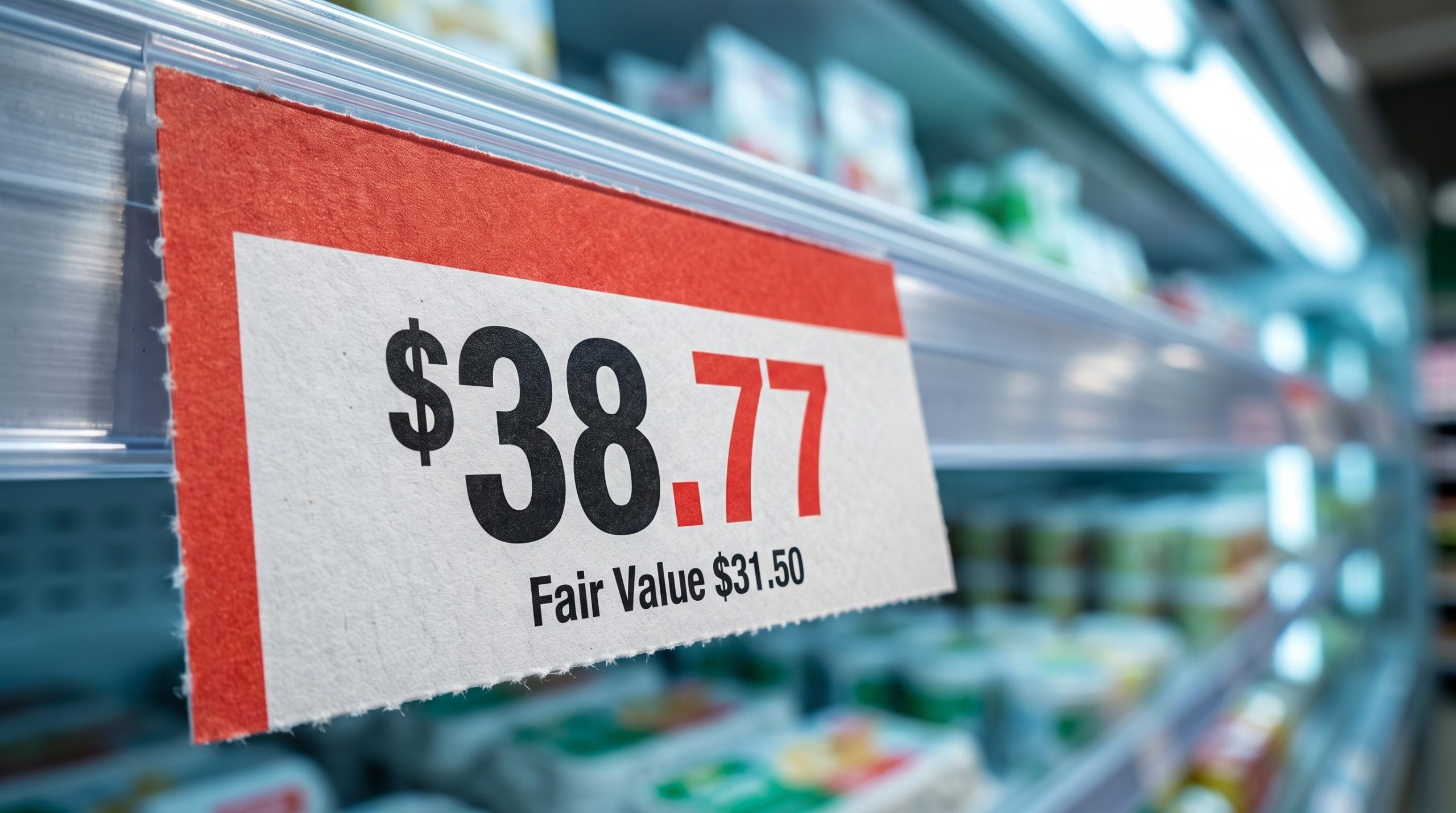
That is the tension at the centre of the Woolworths share price debate right now: a company executing at a level that justifies confidence, priced at a level that may not justify entry. The stock closed at $38.77 against Morningstar’s fair value estimate of $31.50. Here is what the numbers actually say about whether WOW belongs in your portfolio at $39, what margin outcome the market is betting on, what Morningstar considers realistic, and which investor profile the stock suits at today’s price.
Woolworths delivered one of its strongest profit results in years
The number that matters most in the FY2026 result is not the headline profit figure. It is the gap between profit growth and sales growth.
EBIT rose 12.7% while sales grew just 3.6%. That divergence is the clearest evidence of real operating leverage, not revenue volume, driving Woolworths’ earnings higher.
Group sales came in at $71.5 billion. EBIT before significant items reached $3.1 billion. The group’s underlying net profit after tax reached $1.6 billion in FY2026, a year-on-year improvement of 15%. The full-year ordinary dividend rose to $0.97 per share, up mid-teens, with a final dividend of $0.52 per share.
The Australian supermarkets division remains the engine room, with its earnings share sitting at close to 90% of total group profit. In FY2026, domestic food sales crossed $50 billion, a figure that translates to roughly 12% of all Australian retail sales. Price reductions drove a pickup in food sales momentum through the year, with the second half delivering growth of 6% year on year against 4% in the first half, a pace that has continued into FY2027.
Big W added a layer the market had stopped expecting. The business returned to profit, with its recovery accounting for 4 percentage points of the group’s 13% year-on-year EBIT gain. Revenue volumes edged up just 1%, yet the unit’s earnings profile improved substantially. What had been a persistent earnings drag became a net contributor.
| Metric | FY2025 | FY2026 |
|---|---|---|
| Group Sales | ~$69B | $71.5B (+3.6%) |
| EBIT (before significant items) | ~$2.75B | $3.1B (+12.7%) |
| Underlying NPAT | ~$1.39B | $1.6B (+15%) |
| Full-Year Dividend | ~$0.84/share | $0.97/share (mid-teens growth) |
For investors assessing whether this earnings story is durable, the source of the profit growth matters more than its size. A business growing profit through operating leverage and a recovering subsidiary is structurally more interesting than one growing through price increases alone. That 12.7% EBIT growth on 3.6% sales growth tells you Woolworths is squeezing meaningfully more profit from each dollar of revenue it generates, exactly the kind of efficiency story that often precedes a re-rating debate.
When big ASX news breaks, our subscribers know first
Why the gap between the current share price and analyst fair value matters
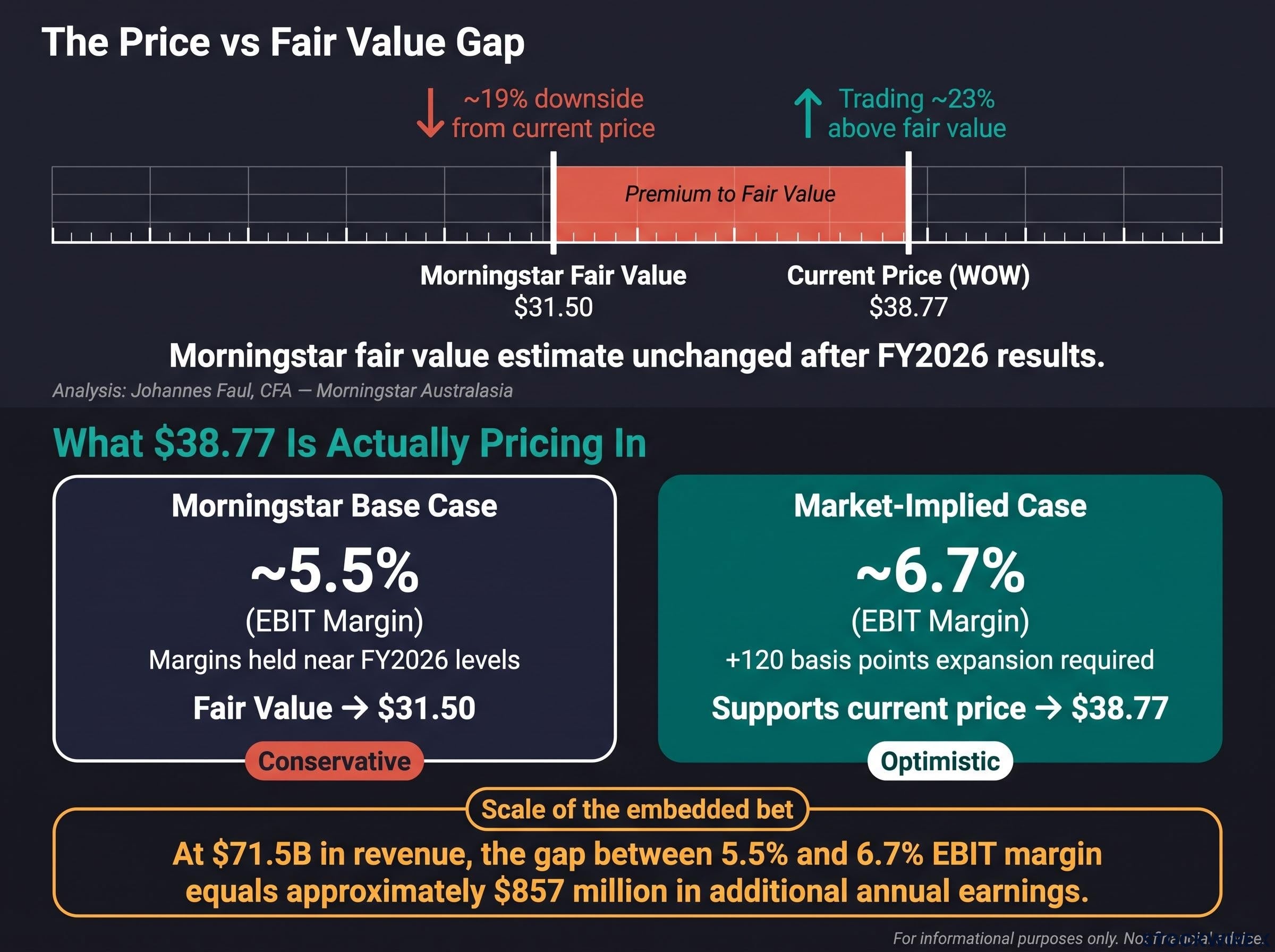
At $38.77, Woolworths trades approximately 23-25% above Morningstar’s fair value estimate of $31.50. That gap did not appear overnight, and the FY2026 result did not close it.
Morningstar’s fair value estimate remained unchanged after the results. The reason is straightforward: the FY2026 numbers broadly aligned with prior forecasts. The premium is not the product of an earnings surprise the market has not yet absorbed. It is structural. The market is pricing in something Morningstar’s model does not.
The WOW share price rally through 2026 compressed the yield relative to its five-year average while broker upgrades from JPMorgan, Bell Potter, and Goldman Sachs widened the analyst consensus range to A$31.50-A$39.00, a span that itself encodes the margin expansion disagreement now embedded in the FY2026 result.
That something is margin expansion.
| Scenario | EBIT Margin Assumption | Valuation Implication |
|---|---|---|
| Morningstar base case | ~5.5% (held at FY2026 levels) | Fair value $31.50 |
| Market-implied case | ~6.7% (+120bps expansion) | Supports current price of $38.77 |
The 120-basis-point bet the market is making
At $71.5 billion in revenue, the difference between a 5.5% and 6.7% EBIT margin is not a rounding error. It is approximately $857 million in additional annual earnings before interest and tax. That is the scale of the bet embedded in today’s share price.
Morningstar’s view, according to analysis by Johannes Faul, CFA, Director at Morningstar Australasia, is that productivity gains are more likely to be redirected into consumer price reductions than retained as margin expansion. Woolworths’ own behaviour during FY2026 supports that reading. The company ran explicit price reduction initiatives throughout the year. Those initiatives successfully reignited food sales momentum, but they also demonstrated an active management preference for passing efficiency gains to consumers rather than banking them.
Coles and Aldi reinforce the ceiling. Australian supermarket competition is intense, and discounters regularly deploy price as their primary competitive weapon. The 120 basis points of margin expansion the market is pricing in is not a trivial assumption for a business operating in that environment. If you are buying at $39, you are making a specific structural bet, whether you realise it or not.
The Coles vs Woolworths valuation divergence through FY2025 and into H1 FY2026 reinforces the competitive ceiling argument: Coles delivered supermarkets EBIT growth of 14.6% and margin expansion to 5.8%, demonstrating that the duopoly environment rewards discipline but does not reliably allow one player to expand margins while the other contests pricing.
The case for and against the premium: where the market and Morningstar diverge
The bull case for paying up rests on three concrete pillars:
- Defensive earnings profile and wide moat. Food and everyday needs dominate the revenue mix. Domestic food sales topped $50 billion in FY2026, equating to around 12% of the entire Australian retail market, a figure that illustrates the practical scale of the moat in concrete terms.
- Proven operating leverage. FY2026 demonstrated that efficiency and digital initiatives are translating into real profit growth, not just cost savings on paper.
- Yield plus growth. A near-full payout of rising dividends, with the full-year ordinary dividend at $0.97 per share and mid-teens growth, gives income and defensive investors a blend they are consistently willing to pay a premium for.
The bear case rests on equally concrete foundations:
- Competitive pressure caps margins. Coles and Aldi are well-established, and Woolworths’ own history shows a pattern of reinvesting efficiency gains into sharper prices to defend market share rather than retaining them as permanent margin expansion.
- The wide moat is already priced in. Morningstar explicitly recognises Woolworths’ wide moat and still arrives at a fair value of $31.50. The moat justifies the business quality; it does not justify the premium above fair value.
- Asymmetric risk at the current entry point. If margins stay near 5.5%, valuation compresses toward $31.50 with meaningful downside. If margins reach 6.7% and hold, the current price is justified but upside from here is limited.
The asymmetric risk in numbers: buying at $39 with fair value at $31.50 means approximately 19% downside if the market re-rates toward Morningstar’s estimate, with limited upside unless the 6.7% margin assumption is validated.
Morningstar is not arguing Woolworths is a bad business. It is arguing that the market is paying for a version of Woolworths that does not yet exist and may not materialise. For Australian investors who treat Woolworths as a safe, almost bond-like holding, that distinction reframes the risk entirely. The question is not whether the business is solid. It clearly is. The question is whether the premium to fair value offers an acceptable risk-adjusted return at today’s entry point.
Buy, hold, or sell: what the FY2026 result changes for different investors
| Investor Profile | Likely Stance at $39 | Key Consideration |
|---|---|---|
| Long-term defensive / income holder | Hold; consider trimming if oversized | FY2026 reinforces the thesis, but locking in gains on an outsized position is rational portfolio management |
| Value investor | Avoid adding at current levels | Wait for a pullback toward or below $31.50; 23% premium offers no margin of safety |
| Momentum / quality-growth investor | May hold while momentum persists | Second-half sales acceleration and FY2027 trajectory support holding, but the margin expansion assumption must be acknowledged |
If you already own Woolworths for its defensive qualities and dividend income, the FY2026 result reinforces the core thesis. The business is executing, the food-to-merchandise balance is improving, and the moat remains intact. Trimming an oversized position after a strong run is a rational portfolio management decision, not a vote of no confidence.
For Australian resident investors, the gross yield after franking credit uplift lifts the headline 4.18% to approximately 5.97%, a materially different income outcome that changes the calculus for SMSF pension-phase holders who receive the full credit as a refundable tax offset and who are the most likely cohort to treat Woolworths as a bond-like holding at today’s entry price.
If you are a value-oriented investor looking to enter, the current setup is unattractive on a margin-of-safety basis. The 23-25% premium to Morningstar’s fair value and approximately 19% downside to $31.50 quantify the risk clearly. Waiting for a pullback is the disciplined response.
If you hold for momentum and quality-growth reasons, the operational trajectory gives you grounds to stay. Australian supermarket food sales growth hit 6% in the second half of FY2026 and that momentum has carried through into FY2027. But you should know exactly what you own at this price: an implicit bet on structural margin expansion that history and competition do not obviously support.
The unchanged Morningstar fair value estimate tells you something specific: the FY2026 result was good, but it did not move the needle on long-term intrinsic value. Any re-rating from here depends entirely on whether the market’s margin expansion thesis materialises.
This article is for informational purposes only and should not be considered financial advice. Investors should conduct their own research and consult with financial professionals before making investment decisions. Past performance does not guarantee future results.
What to watch before reconsidering WOW at a higher conviction level
Three signals will determine whether the market’s thesis or Morningstar’s proves correct:
- Margin trajectory. The FY2027 interim result is the most important near-term data point. If EBIT margins begin moving convincingly toward 6% and beyond, that would be the first empirical signal that the expansion thesis has merit. The current gap sits between 5.5% and the market-implied 6.7%.
- Competitive dynamics. Any evidence that Aldi or Coles is ceding ground on price or market share would structurally change the ceiling on Woolworths’ long-term margin assumptions. Without that shift, the competitive environment continues to cap expansion.
- Big W contribution trend. The return to profitability could modestly lift group margins over time, though Big W represents a small share of group earnings. Sustained improvement here adds incrementally to the bull case.
Why entry price still matters for a wide-moat stock
Wide-moat status narrows the range of business outcomes. It does not eliminate valuation risk. Morningstar’s $31.50 fair value already reflects the wide moat in full; the quality of the franchise, the loyalty ecosystem, the supply chain advantages are all priced in at that level.
The relationship between entry price and long-term returns is a recurring theme across high-quality ASX franchises: businesses with durable competitive advantages frequently trade at premium multiples, yet the FY2026-to-FY2030 compounding outcome for a Woolworths buyer at $39 is structurally different from one who enters at $31.50, even if the underlying business performs identically.
Paying 23% above that number is paying for something the moat alone does not deliver. It is paying for margin expansion. For an investor sitting on the sidelines at $39, the next Woolworths interim result will either begin to validate that bet or confirm Morningstar’s more conservative reading of the business’s structural economics. Knowing which signals to watch converts a static valuation opinion into an active monitoring framework, and that is what separates a disciplined entry from chasing a premium.