
Australian Vintage returns to positive cash flow as FY26 turnaround takes hold
In its FY26 full year results presentation delivered in August 2026, Australian Vintage detailed a return to positive free cash flow, marking a decisive inflection point in the wine group’s multi-year turnaround strategy.
Management outlined that the company generated +$2M in free cash flow (excluding one-off strategic investments), its first positive year since FY22 and a +$35M turnaround from FY23. Revenue held broadly flat at $258M (+$1M), while net debt finished at $89M, ahead of the company’s $90M guidance.
The presentation framed FY26 as a year of transformation, one that lays the foundations for growth in FY27. With an average internal rate of return (IRR) of 69% on its strategic investments, the company positioned itself as inflecting from cash-burn towards cash-generation.
When big ASX news breaks, our subscribers know first
FY26 financial results — the turnaround by the numbers
The results rested on four financial pillars: revenue, free cash flow, inventory, and net debt/finance. Management noted that revenue would have grown +5% without shipping delays linked to war impacts and a stronger Australian dollar. Encouragingly, second-half revenue came in 2% higher than the prior year and roughly 8% higher than the first half.
The company recorded a $27M impairment of legacy inventory, which management described as a deliberate move to accelerate storage and handling efficiency initiatives rather than an operational failure. No further material inventory impairments are forecast.
Renewed banking finance was secured for the next two years, aligning the group’s finance arrangements with its turnaround strategy.
The AVG refinancing facility, secured at $128 million and extended through to March 2028 with an option to 2029, was announced ahead of the full year results and provided the balance sheet runway that underpins the FY27 growth commitments.
| Metric | FY26 | Movement | Why it matters |
|---|---|---|---|
| Revenue | $258M | +$1M | Flat headline; +5% underlying excluding FX and shipping impacts |
| Free cash flow (ex-investments) | +$2M | +$35M vs FY23 | First positive since FY22 |
| Operating cash flow | +$4M | Positive | First positive since FY22 |
| Net debt | $89M | Better than $90M guidance | Refinancing secured for two years |
A word on strategic investments
The company incurred $16M in one-off strategic investments during FY26, in line with prior guidance. Management emphasised these were growth investments, not losses, delivering an average IRR of 69%. The components included:
-
Global MadFish acquisition
-
Another vineyard lease exit
-
Installation of the Poco Vino production line in Australia
-
Inventory build and restructuring costs
Second-half cash generation reached +$21M, representing a +$23M year-on-year improvement.
Three strategic pillars driving growth — hold the core, expand premium, innovate fast
Management structured AVG’s growth strategy around three pillars, balancing the defence of established brands with the acceleration of premium additions and fast-moving innovation.
Hold the core
McGuigan remains the #3 Australian wine brand in the UK by value, with performance in line with the broader Australian wine segment. In Australia, the brand is now flat while outperforming the category, strengthened by its sponsorship of Cricket Australia.
McGuigan Zero continues to lead the non-alcoholic wine category, up +19% in Australia and holding the #1 zero still wine brand position in the UK at 21% share by value.
Expand premium/light
The brand acquisition of MadFish and distribution of Graham Norton are expected to contribute an annualised net sales run rate of more than +$12M in FY27. MadFish delivered +25% sales growth across the latest 26 weeks, while Graham Norton remains category leader in Ireland and grew +16% in Tesco.
Grow fast via innovation
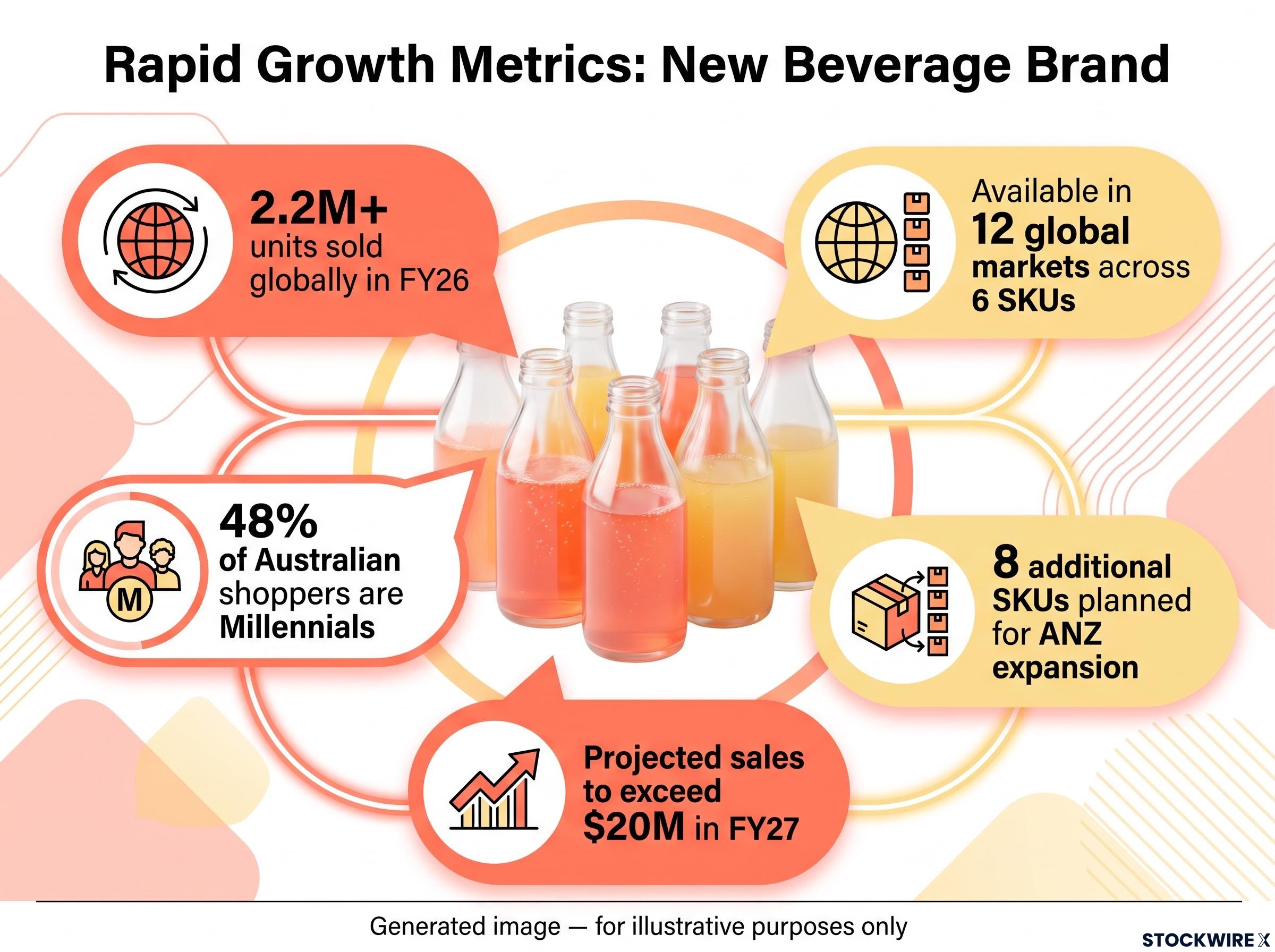
Lemsecco delivered strong momentum, with Australian scan sales up 116% year-on-year and distribution building across the USA and China. Poco Vino sold 2.2M+ units globally in FY26 across six SKUs, with an 8-SKU expansion confirmed in ANZ. The brand ranked as the #1 fastest-growing glass-format minis brand (latest quarter, UK), selling across 12 global markets and recruiting younger drinkers, with 48% of Australian shoppers being Millennials.
Poco Vino spotlight — targeting $20M+ in FY27
Poco Vino emerged as the standout innovation growth engine, with the presentation projecting sales to exceed $20M in FY27. Management detailed three expansion vectors underpinning that target:
-
New markets and retailers: Performing well across Asia (Hong Kong, Thailand, Singapore, Malaysia), with a China launch in progress.
-
New products and moments: Momentum in prosecco, spritz, and gifting occasions, alongside more than 8 additional SKUs planned for ANZ.
-
New channels: On target to launch into Global Travel Retail with its core and premium ATLAS range.
This provides a concrete forward revenue driver with a stated dollar target, anchoring the FY27 growth thesis.
Understanding the wine turnaround — why inventory and cash flow matter
Wine businesses are inherently capital-intensive because inventory ties up capital for years while bulk wine ages. Converting that bulk wine inventory into cash frees up working capital, which is why inventory management sits at the centre of AVG’s turnaround.
Management noted that reduced inventory drives operational efficiencies, and that AVG’s vintage intake is now in balance from V27, with sourcing running in deficit to sales. Bulk wine inventory was reduced to a record low, closing FY26 at approximately 90 million litres.
The $27M impairment should be understood as a strategic clean-up to clear legacy inventory rather than a red flag, creating greater flexibility to realise operational efficiencies. Positive free cash flow, in turn, signals a business funding itself rather than burning cash. Management indicated any excess capital will be swiftly recycled into growing its innovative portfolio of brands and repaying debt in FY27.
For investors assessing the FY27 outlook, this shift from cash consumption to cash generation is central to the turnaround narrative.
Industry recognition validates the strategy
FY26 was marked by industry recognition, which management framed as third-party validation of AVG’s innovation and execution capability, setting up FY27 growth. Key rankings included:
-
4th Overall Liquor Supplier
-
1 Wine Supplier
-
1 Product Innovation
-
1 Trade & Shopper Marketing
-
1 Supplier in BWS
-
Best New Product Innovation in Wine
Retailer commentary
“Australian Vintage delivered what was probably the gold standard for releasing a new product. Best in class in terms of the planning and innovation.”
Outlook — FY27 set to deliver net positive cash and debt reduction
Management framed FY27 as the payoff year following FY26’s transformation. AVG expects to deliver a net positive cash position for the full financial year FY27, measured in terms of total free cash flow net of remaining investment payments and planned inventory sales.
The company outlined an intention to reduce debt for the first time in years while accelerating the growth of key profitable parts of the portfolio. On the balance sheet, management highlighted over $100M in cumulative tax losses available to offset future planned profits, despite the derecognition of a $5M deferred tax asset.
Key FY27 forward commitments outlined in the presentation include:
-
Positive free cash flow
-
Debt reduction
-
Accelerated brand growth
-
Poco Vino sales projected to exceed $20M
With these foundations established, management positioned AVG as a stronger, more agile business, moving from a period of transformation towards a stated ambition of sustainable growth and improved profitability in the years ahead.
Don’t Miss the Next ASX Consumer Sector Turnaround
Big News Blast delivers FREE breaking ASX news straight to your inbox within minutes of release, complete with in-depth analysis already done for you. Join 20,000+ investors who stay ahead of market-moving announcements the moment they drop. Click the “Free Alerts” button at Big News Blast to start receiving alerts today.