
Outlook revised to stable as S&P affirms TPG Telecom’s BBB rating
On 12 October 2026, S&P Global Ratings revised its outlook on TPG Telecom to stable from negative and affirmed its ‘BBB’ long-term credit rating on the company. TPG lodged the report with the ASX on the same day.
S&P attributed the revised outlook to mobile growth following the business reset and improved cash flow. In S&P’s view, a credible deleveraging strategy following recent business transformations underpins TPG’s creditworthiness.
S&P expects earnings growth and a lower capital intensity to drive the company’s S&P Global Ratings adjusted debt-to-EBITDA ratio to below 2.75x from fiscal 2027 onward. It forecasts the measure will fall closer toward 2.5x from fiscal 2027.
Fiscal 2026 is a transition year. S&P expects adjusted debt to EBITDA of about 2.8x in fiscal 2026 (ending 31 December 2026), slightly above its current rating trigger of 2.75x, reflecting what it describes as a transition period as TPG consolidates transactions completed in fiscal 2025.
S&P Global Ratings
“A credible deleveraging strategy following recent business transformations underpins TPG’s creditworthiness, in our view.”
When big ASX news breaks, our subscribers know first
Balance sheet repair behind the upgrade in outlook
Transformation steps that cut debt
S&P pointed to major changes to the business model:
- A multi-operator core network (MOCN) agreement with Singtel Optus Pty Ltd that commenced in January 2025.
- The sale of TPG’s fixed enterprise, government and wholesale business, and the sale and leaseback of its fibre assets (A$4.7 billion in net proceeds) to Vocus in July 2025. This includes the transmission and wholesale fibre access agreement (TAWFA) that TPG has implemented with Vocus.
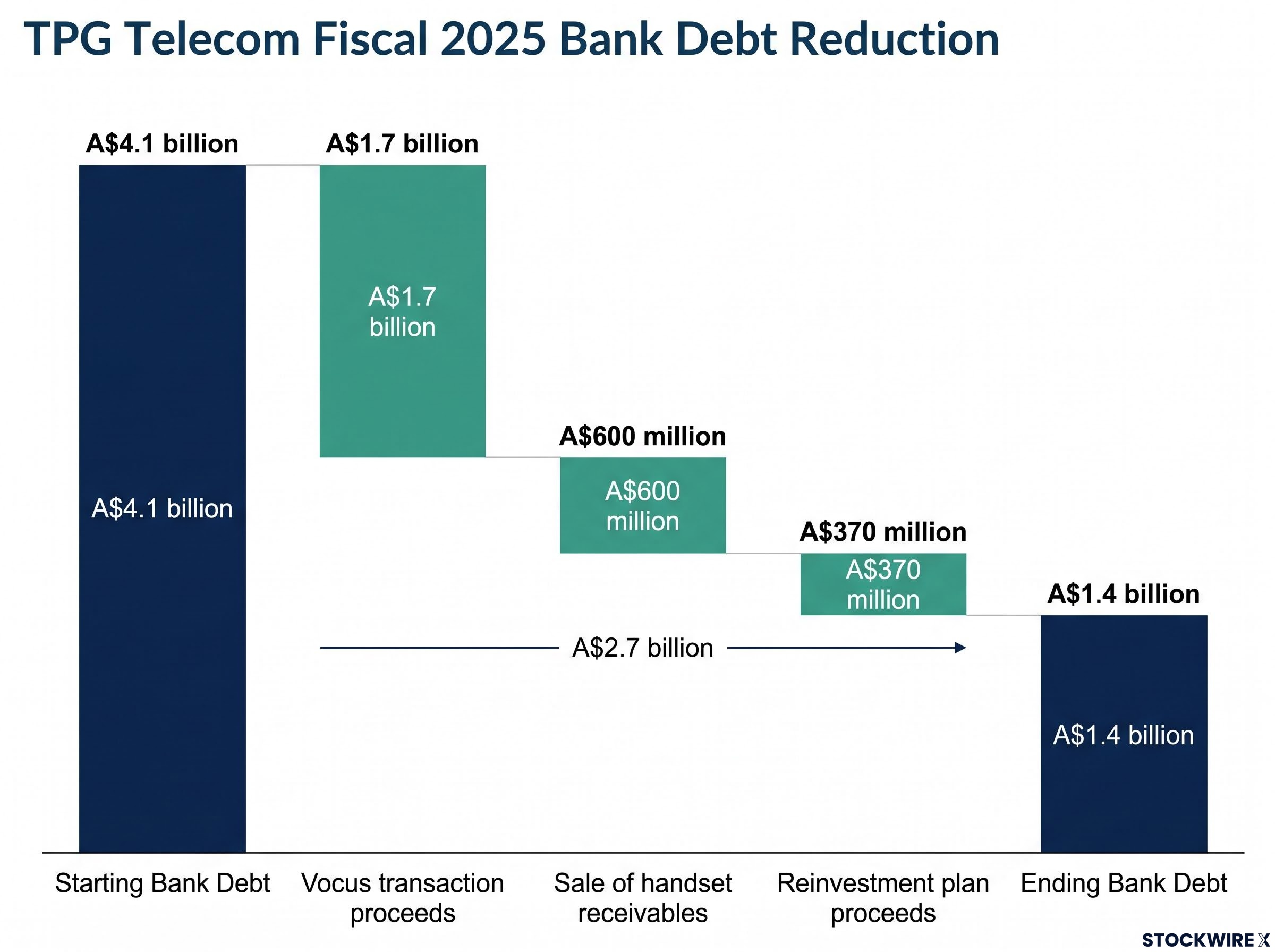
TPG reduced its bank debt by approximately A$2.7 billion in fiscal 2025, bringing the total balance down to A$1.4 billion from A$4.1 billion. Key drivers were the Vocus transaction proceeds of A$1.7 billion, the sale of the handset receivables financing program at A$600 million, and A$370 million from the company’s reinvestment plan proceeds.
S&P believes management will operate with a capital structure and financial policies consistent with the ‘BBB’ rating. It expects TPG to build on its balance sheet headroom to manage upcoming capital expenditure (capex), including significant spectrum renewal costs, alongside shareholder returns.
For readers wanting to see how the balance sheet repair is flowing through reported earnings, our detailed coverage of TPG’s 1H26 half year results covers the return to statutory profit, the 11.1% interim dividend increase and mobile subscriber growth to 5.8 million.
Capex and spectrum
S&P expects capex to moderate to A$550 million-A$650 million annually as the 5G rollout and major transformation programs conclude. That compares with a A$1.2 billion peak in fiscal 2024.
The company estimates upcoming material spectrum relicensing at A$2.1 billion from fiscal 2028 to fiscal 2032. A front-loaded A$840 million payment is due in fiscal 2028 and A$570 million in fiscal 2029.
Understanding credit outlooks and why they matter
A credit rating is an opinion on a borrower’s ability to meet its debt obligations. An outlook indicates the direction a rating may move over time, with “negative” signalling downward pressure and “stable” indicating S&P does not currently expect a change.
Debt-to-EBITDA compares a company’s debt with its earnings before interest, tax, depreciation and amortisation. A lower ratio generally indicates a lighter debt load relative to earnings.
For investors, a stable outlook is one input into how lenders assess a company, which can bear on borrowing costs and capital management flexibility. S&P states its opinions are not recommendations to purchase, hold or sell any securities.
S&P also noted that approximately 70% of TPG’s S&P Global Ratings adjusted debt comprises long-dated lease commitments. The remainder is drawn debt, which S&P expects to be about A$1.4 billion in fiscal 2026.
Earnings forecasts and market position
S&P forecast snapshot
The table below shows S&P Global Ratings adjusted figures in millions of Australian dollars, unless stated. 2025 is actual (a), 2026 is an estimate (e), and 2027 and 2028 are forecasts (f). These are S&P’s projections, not TPG guidance.
| Metric | 2025a | 2026e | 2027f | 2028f |
|---|---|---|---|---|
| Revenue | 4,179 | 4,240 | 4,380 | 4,570 |
| EBITDA | 1,621 | 1,670 | 1,770 | 1,890 |
| Capex | 891 | 750 | 650 | 1,470 |
| Debt/EBITDA (x) | 3.0 | 2.8 | 2.5 | 2.6 |
| EBITDA margin (%) | 38.8 | 39.5 | 40.4 | 41.3 |
S&P’s base case assumes an EBITDA margin of about 39%-40% over the next two years, driven by tight control of operating expenses and an increase in average revenue per user (ARPU). It also assumes annual dividends of A$360 million-A$380 million over the next 12-24 months.
The source notes capex of about A$750 million for fiscal 2026, with spectrum payments to commence in 2028. The 2028 capex forecast of 1,470 in the table sits alongside that spectrum payment timing, though the source does not explicitly attribute the figure to spectrum costs.
Competitive position
S&P stated TPG maintains the No. 3 position in Australian mobile services and holds a No. 2 position in the national broadband network (NBN) fixed broadband wholesale market with an 18% market share, trailing Telstra’s No. 1 position of 37%.
As of 31 December 2025, TPG had approximately 5.7 million mobile subscribers, about 50% of which were post-paid customers. It also had approximately 2.0 million consumer broadband subscribers.
In S&P’s view, the MOCN agreement with Singtel Optus has significantly enhanced TPG’s mobile business proposition, enabling it to close network coverage gaps compared with key competitors.
Liquidity, upside triggers and what to watch
S&P assesses TPG’s liquidity as adequate. It expects sources of liquidity, including cash, to exceed uses by 1.2x or more over the next 12 months, and anticipates net sources will remain positive even if EBITDA declines by 15% from its forecasts.
S&P outlined the following rating triggers:
- Upside: S&P could raise the rating if TPG adopts a more conservative financial policy stance, including an adjusted debt-to-EBITDA ratio below 2.0x on a sustained basis. An upgrade would also rely on successful execution of its growth strategy.
- Downside: Downward pressure could emerge if the fully adjusted debt-to-EBITDA ratio exceeds 2.75x on a sustained basis. This could occur through more aggressive financial policies such as unduly shareholder friendly actions, or adverse changes in access to and sharing of infrastructure under the MOCN agreement with Singtel Optus and the TAWFA with Vocus.
S&P also flagged risks. TPG faces periodic competitive pressure from larger competitor Telstra Group Ltd, and its network-sharing arrangements carry substantial contractual commitments that S&P treats as debt. While those arrangements support a capital-light model, they expose the company to contract renewal risks in the longer term.
Spectrum payments from fiscal 2028 remain the next key test of the balance sheet headroom S&P expects TPG to build.
Stay Ahead on Telecom News Before the Market Moves
Telecommunications and tech investors get FREE breaking ASX news delivered to their inbox within minutes of release, complete with in-depth analysis and the full announcement. Join 20,000+ subscribers by clicking the “Free Alerts” button at Big News Blast and see market-moving news the moment it breaks.