Taiwan’s exports are at record levels. Its current account surplus is substantial. Its semiconductor industry sits at the centre of the global AI buildout. So why is the Taiwan Dollar sitting almost exactly where it started the year?
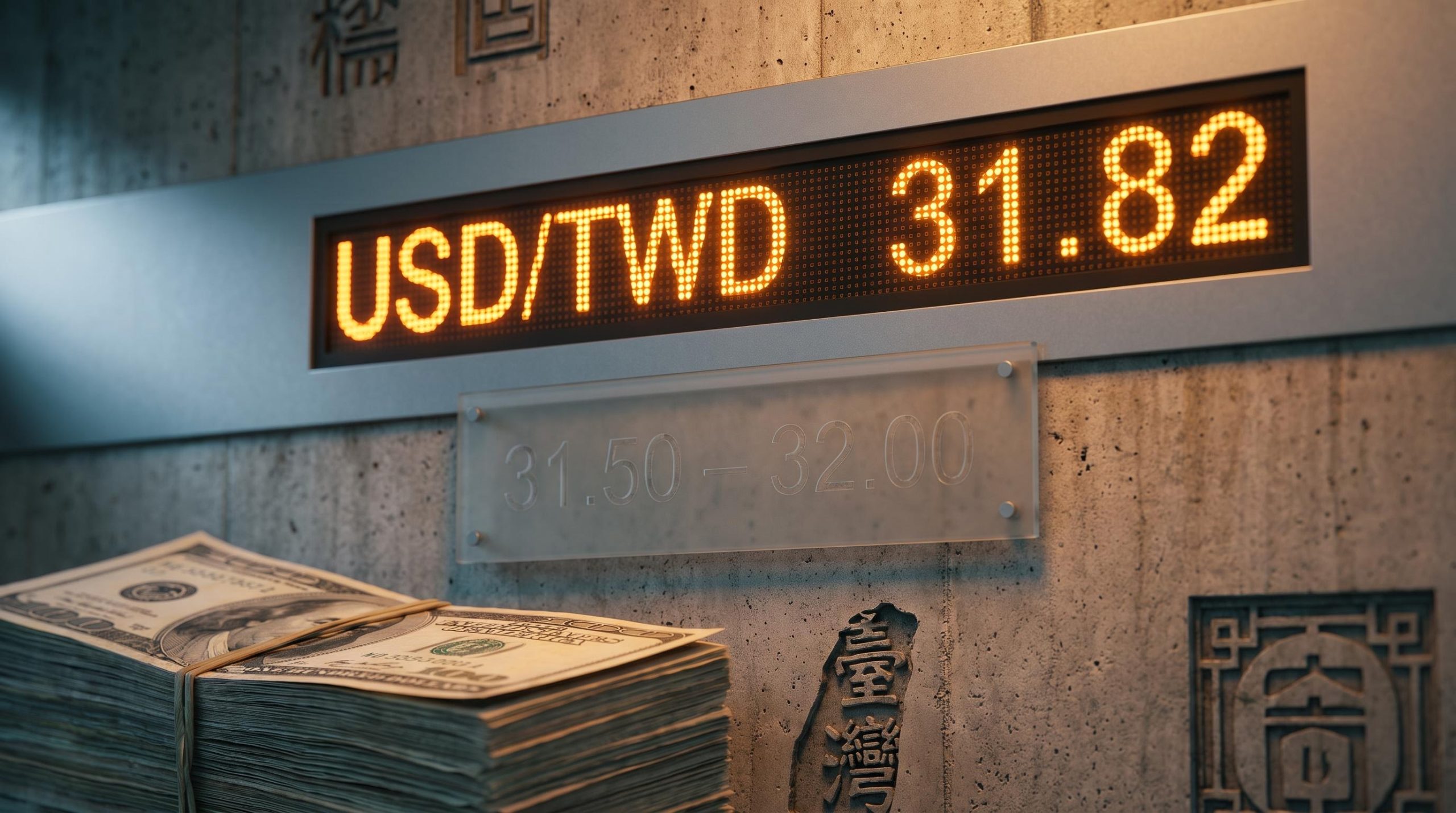
The answer is not hiding in the trade data. USD/TWD trades around 31.82-31.86 as of late August 2026, after briefly pushing above 32.40 earlier in the year. Commerzbank analysts project the pair to consolidate within a 31.50-32.00 range in the near term. On a year-to-date basis, the TWD has made virtually no ground against the US dollar.
That flatline is not a market failure. It is the intended output of an institutional framework most investors never look at closely enough. Here is what that framework actually is, how it constrains the currency, and what it means for any position you hold with Taiwan Dollar exposure.
Why Taiwan’s record exports are not lifting its currency
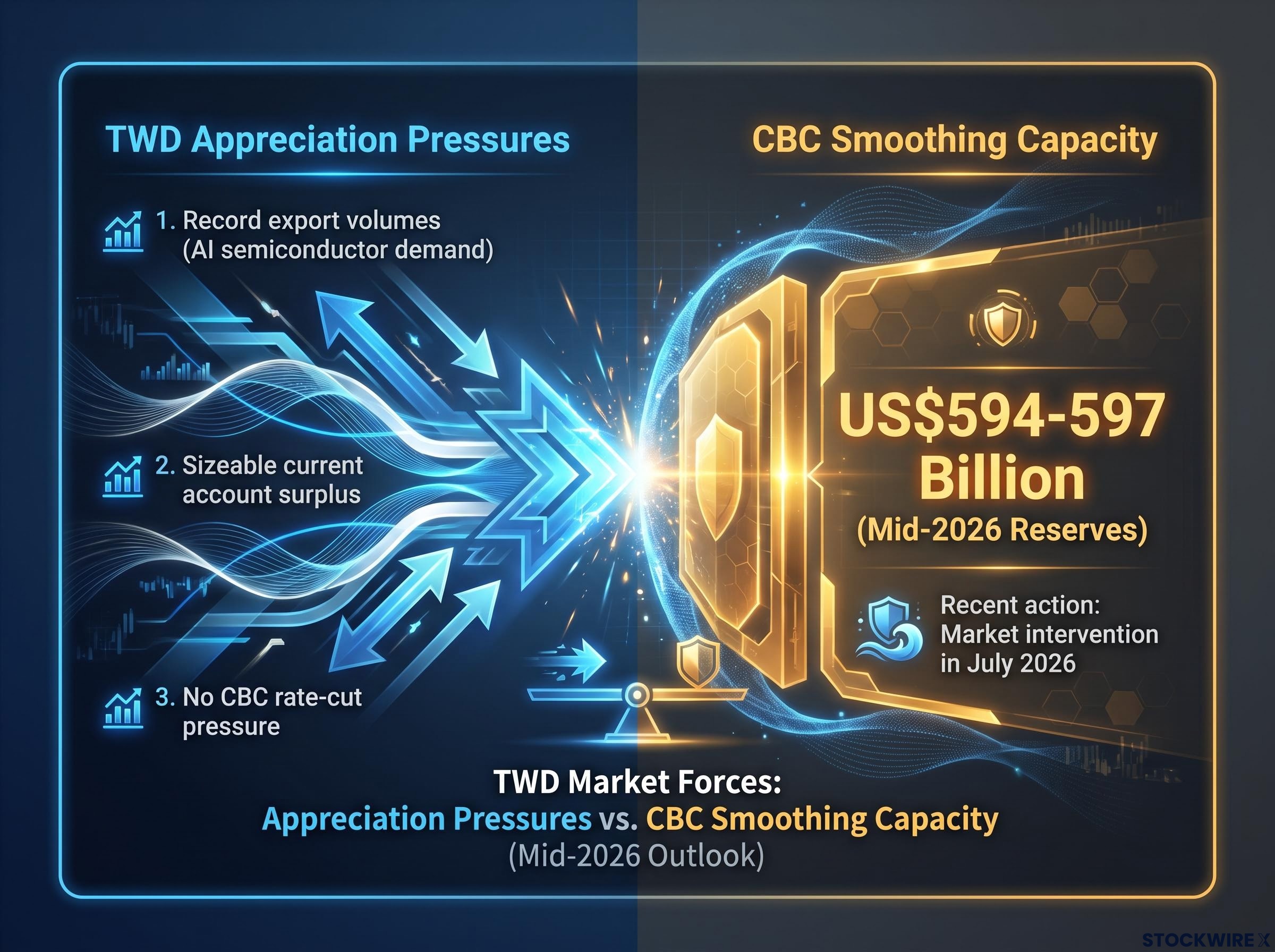
Under a free-floating exchange rate regime, Taiwan’s current economic profile would be generating sustained appreciation pressure on the TWD. Three conditions are in place simultaneously:
- Record export volumes, driven overwhelmingly by AI-related semiconductor demand
- A sizeable current account surplus, channelling persistent capital inflows
- No rate-cut pressure from the Central Bank of the Republic of China (CBC), the country’s central bank, removing one common source of currency weakness
Any one of those conditions, in a freely floating currency, would support a stronger TWD. All three together would typically produce a clear upward trend.
They have not. The missing variable is not in the data. It is in the institutional layer sitting above it.
The CBC has an explicit mandate to maintain “orderly foreign exchange market” conditions. In practice, this means the bank intervenes whenever the pace or scale of TWD appreciation exceeds its comfort threshold. Academic research documents this as a “leaning-against-the-wind” approach, meaning the CBC pushes back harder against moves it dislikes, with an asymmetric bias that specifically caps rapid appreciation even when the fundamental picture is strong.
Commerzbank analysts Dr. Henry Hao and Charlie Lay describe the macro backdrop as strongly supportive of the TWD, pointing to exceptionally robust export activity and a substantial current account surplus as the key underpinnings.
The year-to-date flat performance against that backdrop tells you something specific: the CBC, not the trade balance, is the primary price-setter for TWD right now. Any position you build purely on fundamentals is missing the dominant variable.
When big ASX news breaks, our subscribers know first
How the CBC’s currency smoothing actually works
The CBC frames its intervention publicly as “market stabilisation” against irregular or seasonal factors that disrupt orderly trading. The language is carefully chosen. It positions the bank as a stabiliser, not a manipulator, and avoids the formal designation of currency manipulation that could trigger US Treasury scrutiny.
IMF scrutiny of intervention adds a further layer of constraint that Taiwan avoids by framing its CBC activity as market stabilisation rather than sustained targeting, a distinction that Japan has found considerably harder to maintain given the scale and frequency of its yen-buying operations.
In practice, the distinction between “disorderly appreciation” and normal market-driven strengthening is defined by the CBC’s own assessment. When capital inflows accelerate or exporters’ margins come under FX pressure, the bank steps in. The CBC acknowledged in its own communications that it stepped into the market during July 2026 to dampen the volatility created by surging capital flows.
The capacity behind this framework is not symbolic. Taiwan’s foreign exchange reserves stood at approximately US$594-597 billion as of mid-2026, one of the largest reserve positions in the world. When the CBC signals it will smooth appreciation, nearly US$600 billion in firepower stands behind that signal. You should treat any trade thesis that ignores this capacity as structurally incomplete.
Taiwan’s approach in a regional context
Taiwan’s approach is not an outlier. It fits within a broader East Asian template where export-oriented economies use managed-float regimes to protect competitiveness.
A managed float sits between two better-known extremes. In a free-float regime (think the Australian dollar or the euro), the exchange rate is determined almost entirely by market forces. In a hard peg (think Hong Kong’s link to the US dollar), the rate is fixed by policy. Taiwan occupies the middle ground: market forces set the general direction, but the central bank actively manages the speed and magnitude of moves.
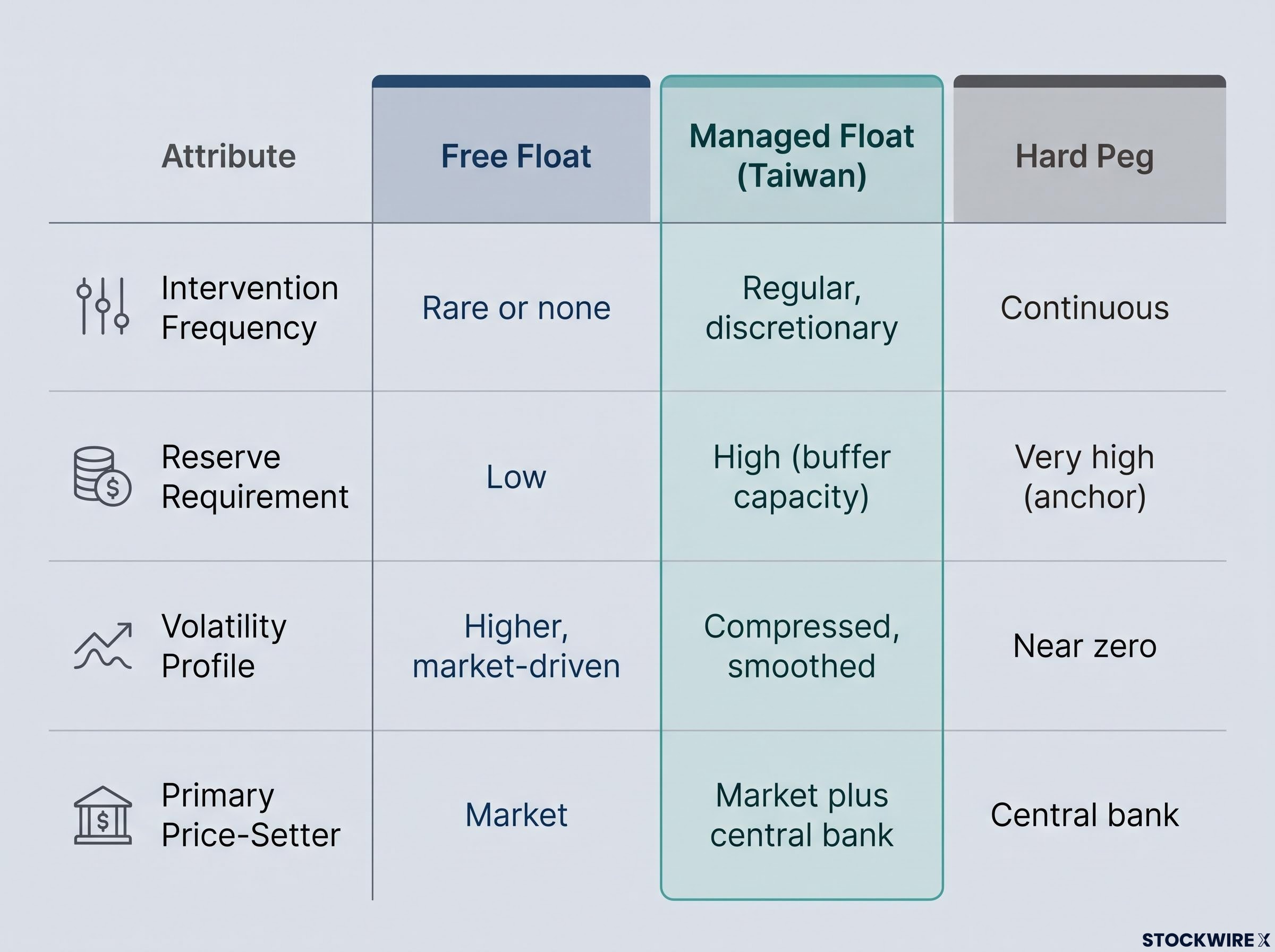
| Attribute | Free float | Managed float (Taiwan) | Hard peg |
|---|---|---|---|
| Intervention frequency | Rare or none | Regular, discretionary | Continuous |
| Reserve requirement | Low | High (buffer capacity) | Very high (anchor) |
| Volatility profile | Higher, market-driven | Compressed, smoothed | Near zero |
| Primary price-setter | Market | Market plus central bank | Central bank |
China’s management of the RMB follows a structurally similar playbook: heavy reserve accumulation, discretionary intervention against appreciation pressure, and a policy framework designed to keep export competitiveness intact. The shared motivation across the region is the same. When your growth model depends on exports, you do not let a surging currency erode your manufacturers’ margins.
China’s yuan management follows a structurally similar playbook: a daily central parity rate published before trading opens, a hard band capping intraday moves, and a countercyclical adjustment factor that lets the PBOC override pure market inputs when policy priorities demand a firmer or weaker fix.
What the 31.50-32.00 range means in practice
According to Commerzbank, USD/TWD is expected to hold within a 31.50-32.00 band over the near term, with the balance of risks pointing modestly towards the lower end of that range (implying a slightly stronger TWD). The current spot around 31.82-31.86 sits comfortably within that band.
Commerzbank analysts Dr. Henry Hao and Charlie Lay place the near-term USD/TWD trading band at 31.50-32.00, noting that the risks lean modestly towards TWD strength, particularly if the broader US dollar continues to soften.
The bounds of this range are not formally announced. They are a policy reaction function, a term that describes the specific levels and speeds at which the CBC responds. The upper bound on TWD strength is the appreciation pace at which the CBC begins buying USD and selling TWD. The lower bound (where TWD is weaker) is the point where the appreciation pressure eases on its own or the CBC faces a rising-cost trade-off between accepting more strength or escalating its intervention.
The pair traded above 32.40 earlier in 2026. The move down to the current level shows the range in action: fundamentals pulled the TWD stronger, and the CBC smoothed the speed of that move without blocking it entirely.
Three scenarios could break the range, ordered by near-term plausibility:
- Sustained broad USD weakness. A multi-month downturn in the US dollar, driven by shifting Federal Reserve policy, fiscal concerns, or capital rotation, would push USD/TWD toward and potentially below 31.50. The CBC would face a trade-off: accept a stronger TWD or escalate intervention at rising cost. This is the most plausible near-term trigger for a range break, and its direction favours TWD strength.
- A shock to Taiwan’s export engine. A meaningful slowdown in global semiconductor demand or heightened geopolitical risk in the Taiwan Strait would erode the fundamental case for a stronger TWD. USD/TWD could drift above 32.00 without the CBC needing to change its framework, because the appreciation pressure simply dissipates. The direction here favours TWD weakness.
- A deliberate CBC regime shift. A move away from active smoothing toward a more freely floating TWD would open the door to larger, faster moves in either direction. Current CBC communications point firmly toward continuity. This is the lowest-probability scenario in the near term.
The “modestly downside-biased” skew from Commerzbank tells you that the path of least resistance runs toward a slightly stronger TWD. But that path requires broad USD weakness as the external catalyst. Without it, the range holds by institutional design.
US dollar dynamics are the primary external variable in the CBC’s reaction function: because the Fed’s rate decisions and balance sheet changes transmit directly into global dollar strength or weakness, a sustained multi-month shift in USD direction is the most plausible force capable of pushing USD/TWD outside the current range.
What this means for investors with TWD exposure
The mechanics above convert into a specific set of positioning decisions. The managed-float regime compresses realised volatility structurally, which means the environment is poorly suited to aggressive directional bets anchored purely in Taiwan’s economic data.
Here is the practical framework:
- Treat CBC behaviour as a core input to any TWD trade, not a background consideration. The institutional layer is the binding constraint.
- Assume compressed volatility and capped appreciation while the current regime persists. Size your positions accordingly.
- Anchor any TWD view in a clear USD thesis. Without a view on where the US dollar is heading, your TWD view is incomplete.
- Favour tactical positioning over aggressive directional bets. The range-bound, low-volatility environment does not reward large, long-horizon trades anchored only in fundamentals.
- For TWD asset holdings, expect FX to be a minor contributor to total return. Focus on the underlying asset’s performance rather than anticipating meaningful currency alpha.
Carry trades (borrowing in a low-rate currency to invest in a higher-rate one) and trend-following strategies both struggle in this regime. Stable rates plus a range-bound currency mean carry earns limited extra return, and trend systems cannot capture the large directional moves they need.
For holders of TWD-denominated assets
If you hold Taiwanese equities or bonds, the practical message is straightforward: the FX hedge decision matters less than usual right now. The CBC is effectively providing a low-cost smoothing service that compresses currency volatility on both sides.
That means limited FX drag or uplift should be expected while the smoothing regime persists. Your risk and return will be determined by the underlying asset, whether that is a semiconductor stock, a government bond, or a broader Taiwan index position. The currency is not where the action is.
When the paradox resolves, and what to watch for
The TWD’s range-bound behaviour is not a temporary anomaly. It is a structural feature of a managed-float regime backed by approximately US$594-597 billion in reserves and a central bank that confirmed its willingness to intervene as recently as July 2026. That regime will persist as long as the CBC’s policy incentives remain aligned with stability over appreciation.
But durable is not permanent. Three specific signals are worth monitoring:
- The trajectory of the broad US dollar. This is the primary variable. A sustained, multi-month decline in the USD index is the most plausible catalyst for pushing USD/TWD below the 31.50 floor of the current range.
- Taiwan’s semiconductor export volumes and forward guidance. Any material downturn in global chip demand or a shift in TSMC’s capital expenditure guidance would erode the fundamental case for TWD strength and ease the appreciation pressure the CBC currently manages.
- Language shifts in CBC post-meeting statements. Watch for any change in the bank’s characterisation of “orderly market conditions” or any signal that it is willing to tolerate faster appreciation. This would be the lowest-probability but highest-impact indicator of a regime shift.
For readers wanting to assess the durability of Taiwan’s export engine from the equity side, our deep-dive into semiconductor stocks and AI capex examines the 18-24 month lag between hyperscaler spending commitments and the revenue that ultimately flows to chipmakers.
The Commerzbank 31.50-32.00 range remains the near-term anchor. Knowing how to read CBC intervention signals and USD cycle dynamics gives you a meaningful analytical edge over anyone treating the TWD purely as a data-driven currency.
This article is for informational purposes only and should not be considered financial advice. Investors should conduct their own research and consult with financial professionals before making investment decisions.
These statements are speculative and subject to change based on market developments and central bank policy decisions.
—