
A $20 billion contract sounds like the kind of number that settles a debate about a company. For Cerebras Systems, the multi-year compute agreement with OpenAI does the opposite. It validates the technology and, in the same document, introduces every structural risk that could unwind the business.
This is a deal worth interrogating closely. Cerebras filed its S-1 and subsequent SEC disclosures, giving investors unusually detailed access to the contract’s real terms: tranche structures, pass-through revenue mechanics, a $1 billion customer-funded loan, and acceleration clauses that most headline coverage never mentions. The gap between what this deal looks like and what it actually commits both parties to is where the investment thesis lives.
Here is what this analysis gives you: the specific numbers inside the contract worth scrutinising, the clauses that introduce binary risk, and a reusable framework for evaluating any company whose growth story depends on a single transformative agreement. Every claim is grounded in Cerebras’s own filings.
What the OpenAI contract actually commits to, and what it does not
The Master Relationship Agreement (MRA), effective 24 December 2025, commits OpenAI to purchase 750 megawatts of Cerebras-powered AI inference compute capacity. That capacity arrives in three tranches:
The Cerebras IPO debut, which priced at $185 and surged 68% to imply a $95 billion market capitalisation, established the valuation baseline against which every clause in the OpenAI contract must now be measured; the 186x trailing sales multiple leaves no room for execution shortfalls on data centre delivery.
| Tranche | Capacity (MW) | Target delivery | Cumulative MW |
|---|---|---|---|
| 1 | 250 MW | End of 2026 | 250 MW |
| 2 | 250 MW | End of 2027 | 500 MW |
| 3 | 250 MW | End of 2028 | 750 MW |
Compute delivery commenced in Q1 2026. OpenAI also holds an option for an additional 1.25 gigawatts of capacity, deployable in tranches through 2030, which could bring total deployment to roughly 2 GW if exercised. That option is contingent, not contracted.
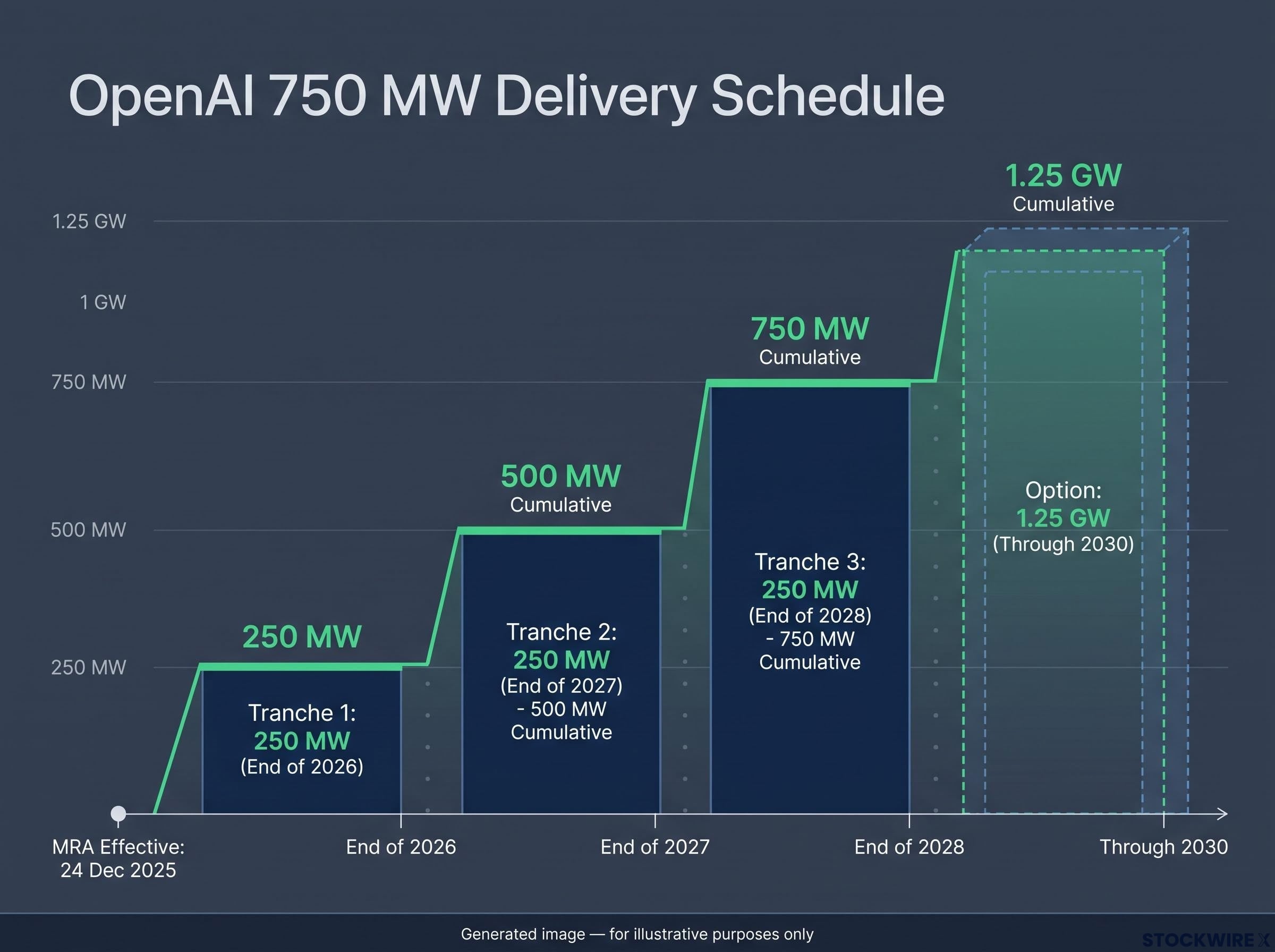
Remaining performance obligations as of 31 December 2025: $24.6 billion. This is the committed contract value. It does not include the expansion option, which is separate and conditional.
The detail that changes how you should read this deal: Cerebras, not OpenAI, is responsible for building or leasing the data centres, populating them with hardware, and delivering the capacity as a cloud-style service. That reframes the economics. This is not a chip sale with delivery milestones. It is a multi-year infrastructure development contract, and the execution risk of building hundreds of megawatts of data centre capacity sits squarely on Cerebras’s balance sheet.
When big ASX news breaks, our subscribers know first
The revenue that looks bigger than it is
The most impressive number in Cerebras’s financials is also the most misleading one if you do not strip it apart.
Under the MRA, Cerebras bills OpenAI for data centre buildout and infrastructure costs on a cost-plus basis with a 3% markup. Those charges are classified as pass-through revenue in SEC filings. The dollar figures are large. The gross margin contribution is negligible.
That distinction matters enormously when you are trying to measure how fast this business is actually growing. Pass-through construction billing and core chip and inference service revenue are fundamentally different economic activities:
- Pass-through revenue: Low margin, cost-plus at 3%, construction-linked, classified separately in filings, reflects infrastructure billing rather than product demand
- Core revenue: Chip-level and service-linked, higher margin, reflects the differentiated wafer-scale technology that earned Cerebras its valuation premium
A retail investor who sees top-line revenue surging without separating these two lines is measuring the wrong thing. The economic engine of this business is chip and inference service margin. Conflating it with construction billing produces a materially distorted growth narrative.
Infrastructure deal evaluation frameworks based on ARR conversion and capex payback ratios reveal why the 3% markup on Cerebras’s pass-through construction billing is economically thin: a capex-to-ARR ratio calibrated to genuine service margin, rather than reimbursed buildout cost, produces a materially different picture of the contract’s value creation.
A recent earnings call disclosure underscores the execution pressure: Cerebras temporarily leased back its own systems from an existing customer, a sign of how tightly the operational timeline is running.
Why concentration figures flatter the picture
Cerebras’s customer concentration was already extreme before OpenAI entered the picture. In 2024, a single client represented 85% of total revenue. In 2025, Mohamed bin Zayed University of Artificial Intelligence (MBZUAI) accounted for approximately 62% of revenue, with G42 providing another 24%, for a combined UAE-linked exposure of roughly 86%.
Both are related-party entities whose commercial ties mean they constitute a single consolidated exposure from a risk-assessment standpoint.
The comparison that matters: Nvidia’s top three direct customers collectively accounted for approximately 54% of revenue in its most recent quarter, with no single customer exceeding roughly 21%. By any reasonable diversification benchmark, Cerebras remains far outside comfortable territory.
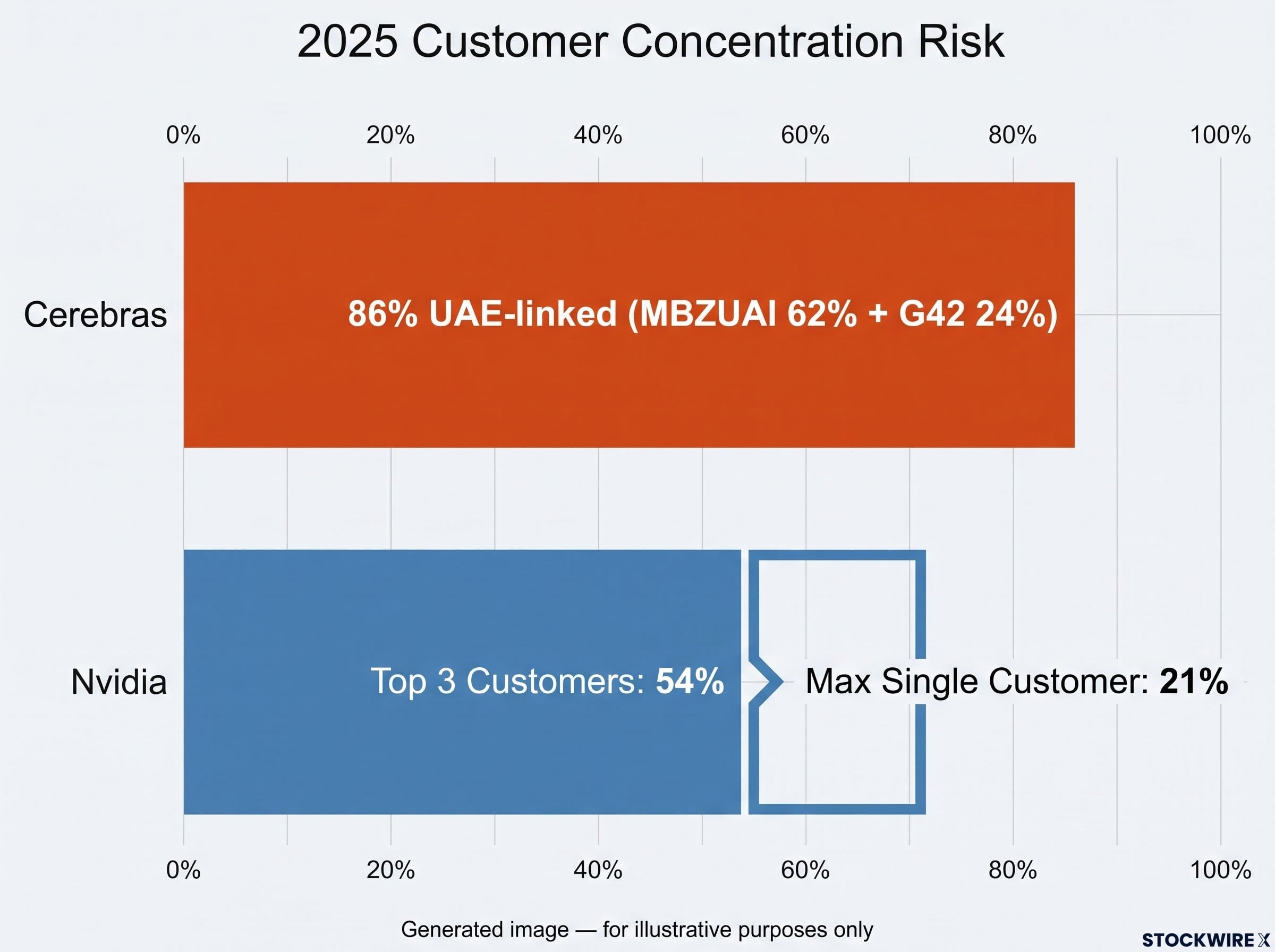
Bringing OpenAI into the mix introduces a third large exposure without unwinding the existing two. Headline concentration percentages may appear to improve as pass-through revenue swells the denominator, but once that low-margin construction billing is stripped out, look-through concentration remains severe. The apparent diversification flatters the picture without reflecting the underlying reality.
The $1 billion loan inside the revenue contract
Most investors evaluate a contract by its revenue potential. Institutional investors look at something else first: the structural leverage one counterparty holds over another.
OpenAI funded a secured working-capital loan of approximately $1 billion to Cerebras in January 2026, designed to accelerate engineering scale-up, manufacturing, and data centre expansion. The key terms:
Counterparty dependency risk is not unique to Cerebras: Oracle’s $300 billion OpenAI contract creates a structurally analogous situation in which a single customer’s revenue trajectory must more than double to honour implied annual compute obligations, raising questions about backlog durability that apply across the sector.
- Principal: Approximately $1 billion, secured by assets
- Maturity: No later than 31 December 2032
- Interest rate: 6% annually, waived to the extent repaid through delivery of compute capacity or services
- Repayment mechanism: Delivery of contracted compute capacity offsets interest obligations
- Security: Secured working-capital facility
The loan is not a sidecar financing arrangement. It is structural proof that Cerebras lacked the internal capital to fulfil the very contract underpinning its growth story.
OpenAI also holds warrants for approximately 33.4 million shares of non-voting Class N common stock at a nominal exercise price, plus rights to acquire Cerebras shares at a discounted price, vesting in tranches tied to loan milestones and capacity delivery. That is significant equity-linked upside layered on top of already favourable financing terms.
The acceleration clause: If the MRA is terminated for reasons other than OpenAI’s material uncured breach, the approximately $1 billion loan can become immediately due and payable. This converts a commercial dispute into a potential liquidity event, triggered at exactly the moment Cerebras would be least able to absorb the repayment demand.
What this tells you is that OpenAI holds both the commercial relationship and a financial lever. If execution slips badly enough to trigger MRA termination, the loan acceleration does not wait for a recovery period. It compounds the operational problem with a liquidity shock.
A framework for evaluating any “single big contract” story
The structural layers of the Cerebras deal are not unique to Cerebras. Any high-growth company whose near-term trajectory depends on a single transformative contract presents the same analytical surface. Here is a five-step framework, grounded in the specific data points from this case:
- Separate pass-through from core revenue. Identify any cost-plus or reimbursed infrastructure lines and evaluate them separately. Cerebras’s 3% markup construction billing inflates the top line without contributing meaningful margin. Treat it as overhead recovery, not growth.
- Calculate customer concentration on a look-through basis. Combine related parties into a single economic exposure. Recalculate concentration after stripping out pass-through revenue. Cerebras’s UAE-linked entities (MBZUAI and G42) represent a single 86% exposure that headline figures can obscure.
- Scrutinise the financing terms and acceleration clauses. Look for customer loans, prepayments, and equity-linked incentives. Cerebras’s $1 billion loan with a termination-linked acceleration trigger is the specific mechanism through which an operational stumble becomes a liquidity crisis.
- Assess whether the contract pushes the company outside its core competency. Cerebras designs wafer-scale AI chips. The MRA requires it to build and operate hundreds of megawatts of data centre capacity. That is a strategically different business with different failure modes.
- Model downside scenarios before upside options. Treat “up to $X billion” and “options to expand” as contingent, not base case. Spend equal or greater time on what happens when execution slips.
OpenAI’s custom chip programme with Broadcom, which produced the first internally developed AI accelerator reported in mid-2026, is precisely the kind of alternative silicon development that could reduce OpenAI’s dependency on Cerebras hardware and leave expansion options unexercised.
Three downside scenarios illustrate how these risks could materialise:
| Scenario | Trigger | Financial impact |
|---|---|---|
| OpenAI slows or staggers deployments | Capital constraints, product roadmap shifts, or model evolution delays | Revenue recognition lags while fixed costs and debt service persist, compressing margins and cash flow |
| OpenAI diversifies or builds own chips | Alternative silicon becomes competitive; internal chip programme matures | Expansion options not exercised, leaving infrastructure stranded and sized for a trajectory that no longer materialises |
| Execution problems activate loan covenants | Significant delays or performance shortfalls on data centre delivery | $1 billion loan acceleration at worst-moment liquidity conditions, potentially forcing emergency capital raises or asset sales |
An investor who applies this checklist is not being pessimistic. They are doing the work that converts a high-conviction narrative into a position with a defensible risk-adjusted thesis, which is the standard institutional investors apply before committing capital.
What the contract proves, and what it cannot guarantee
The deal is real validation. A $24.6 billion remaining performance obligation from one of the most capital-backed AI companies in the world is not routine for a hardware company at Cerebras’s stage. The inference performance case for its wafer-scale architecture is substantiated by a sophisticated counterparty’s willingness to commit at this scale.
That validation coexists with four structural vulnerabilities that the filings themselves make visible:
- Pass-through revenue inflation that flatters top-line metrics without creating equivalent economic value
- Extreme look-through customer concentration across OpenAI, MBZUAI, and G42, with the deal layering in a further large exposure on top of the two that already existed
- A $1 billion customer-funded loan with 6% interest and acceleration provisions tied to contract continuity
- Strategic drift toward data centre operations and away from the chip-level innovation that earned the valuation premium
You can still build a bullish thesis on Cerebras. The technology is validated, the contracted demand is unprecedented, and the inference performance advantage is genuine. But the bullish case must account for execution risk on data centre delivery across three annual 250 MW tranches, concentration on counterparties that collectively represent nearly all of the company’s revenue, and a loan structure that gives the anchor customer a financial lever activated at precisely the moment it would hurt most.
The investor who holds this position should be able to articulate not just why the deal could be company-making, but exactly which operational trigger would force a thesis revision, and at what point the loan acceleration clause stops being theoretical.
For investors who already hold Cerebras and are weighing how the OpenAI contract changes their position sizing, our full explainer on managing AI stock concentration risk covers a five-strategy framework, including single-name caps and rebalancing triggers, for staying exposed to the AI buildout without letting a single earnings catalyst dominate portfolio outcomes.
This article is for informational purposes only and should not be considered financial advice. Investors should conduct their own research and consult with financial professionals before making investment decisions. Forward-looking statements regarding Cerebras’s contract performance, revenue trajectory, and operational execution are subject to change based on market developments and company performance.