Turkey’s central bank just handed carry traders a 300 basis point yield cut, and the market response was relief, not alarm.
The Central Bank of the Republic of Türkiye (CBRT) announced this weekend that it will restart one-week repo operations, ending a five-month period in which Turkish banks were forced to fund entirely through the 40% overnight lending window. That window opened in early March 2026, when the outbreak of US-Iran hostilities triggered a shift to crisis-mode operations. The move back to the 37% policy rate is not a loosening of monetary policy. It is a return to standard operating procedure, and understanding the difference is what this entire piece turns on.
After reading, you will know how to read a central bank’s funding channel choice as a policy signal, and what that signal means for the carry trade risk-reward calculation. The CBRT episode is a concrete, real-time illustration of mechanics that apply across every emerging market currency, not just the lira.
What the CBRT actually changed, and what it did not
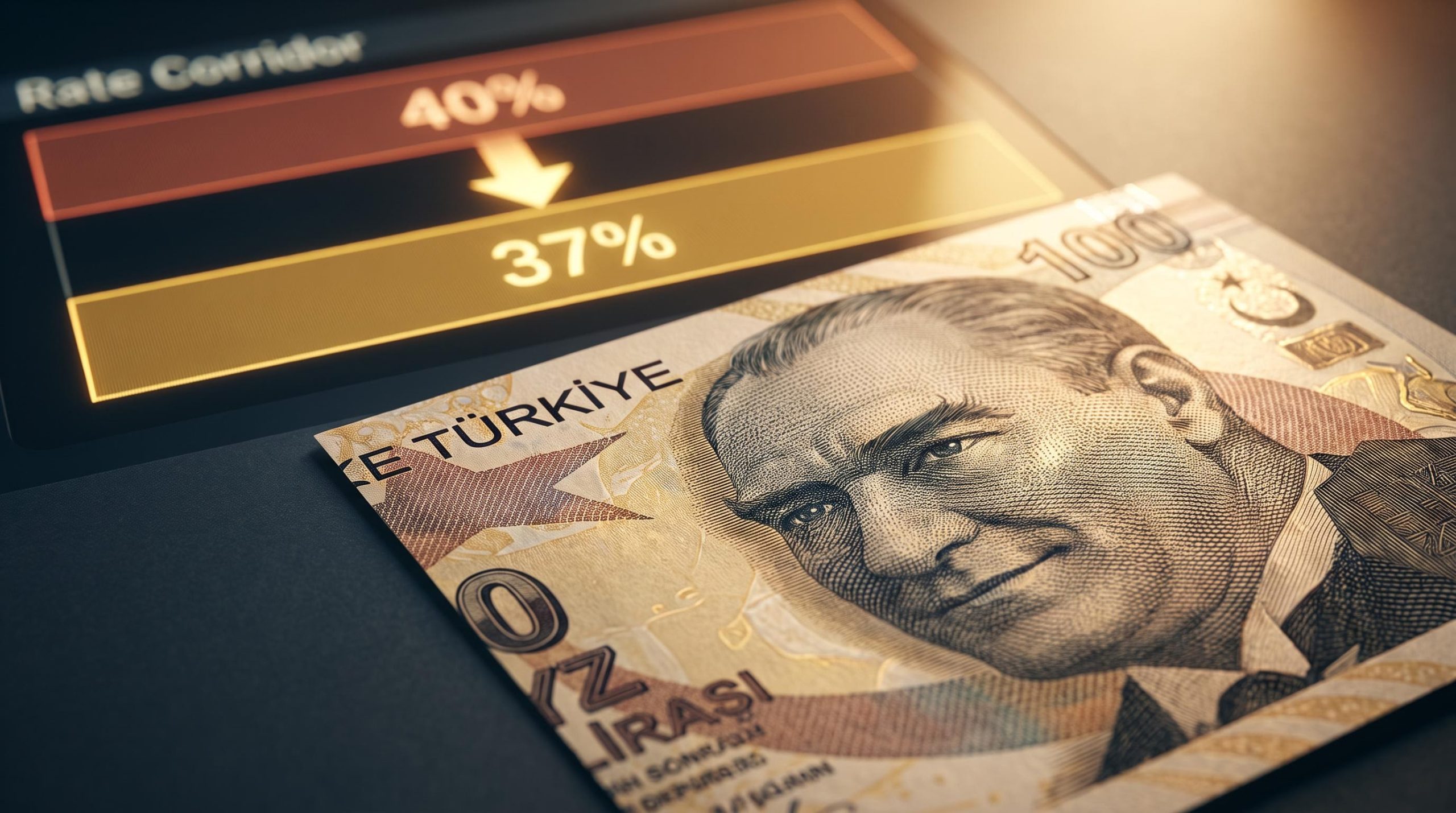
Two numbers tell the story. The CBRT’s one-week repo rate sits at 37%. Its overnight lending rate, the ceiling of the interest rate corridor, sits at 40%. The gap between them is 300 basis points, and for the past five months, that gap has been the entire cost of doing business in Turkish lira funding markets.
How the interest rate corridor works in practice
An interest rate corridor is the range within which a central bank manages short-term borrowing costs. The floor is the deposit rate (what banks earn for parking cash with the central bank), the benchmark is the policy rate (the target cost of standard funding), and the ceiling is the overnight lending rate (the most expensive emergency borrowing window). Which window banks actually fund through determines the real cost of money in the system, regardless of what the headline policy rate says.
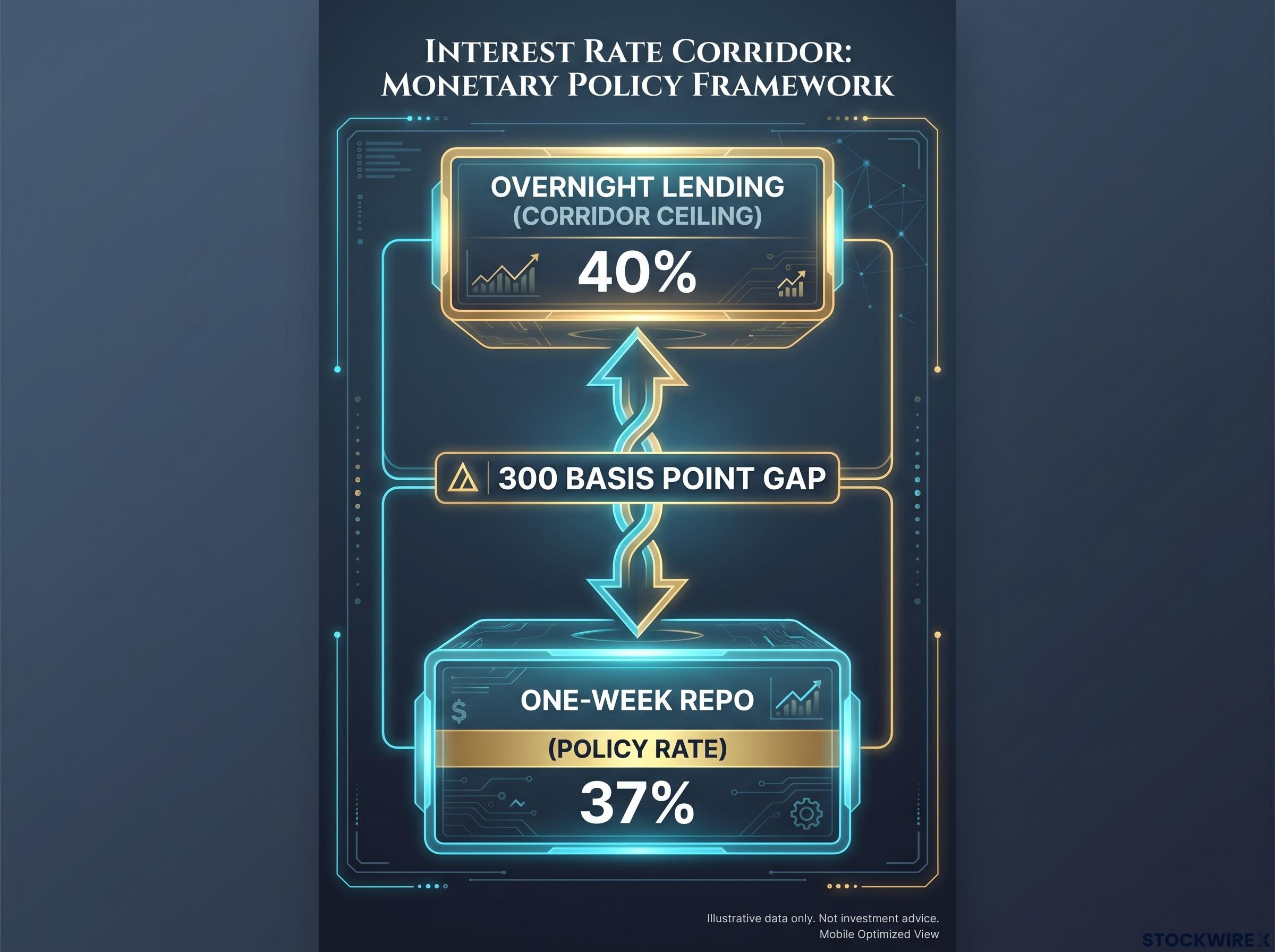
When the CBRT suspended one-week repo operations in early March 2026, following the eruption of US-Iran hostilities in late February, it closed the standard funding window entirely. Turkish banks had no choice but to borrow at the 40% overnight ceiling. The policy rate never moved from 37%. The CBRT achieved a de facto 300bp stealth tightening without a single formal announcement.
Reopening the repo window, announced over the weekend of 23-24 August 2026, redirects funding back toward the 37% benchmark. Mechanically, that is equivalent to a 300bp easing of effective funding costs.
| Rate type | During suspension (March-August 2026) | After restart (August 2026) | Change |
|---|---|---|---|
| One-week repo (policy rate) | 37% (suspended, not available) | 37% (active) | No change to rate; access restored |
| Overnight lending (corridor ceiling) | 40% (primary funding channel) | 40% (emergency backstop) | No change to rate; no longer primary channel |
| Effective funding cost | 40% | 37% (directed toward benchmark) | -300bp |
The gap between 37% and 40% is not an accounting detail. It tells you whether the CBRT was operating in normal mode or crisis mode, and that distinction changes everything about how to read the lira’s risk profile.
When big ASX news breaks, our subscribers know first
Why suspending repo operations was a crisis configuration, not a routine choice
Central banks resort to the ceiling of the interest rate corridor when they need to tighten conditions rapidly without the signalling cost of a formal rate announcement. The typical triggers are sharp capital outflows, acute currency stress, or both. Forcing banks to the most expensive funding window is not a routine calibration. It is a crisis configuration, and the market reads it as one.
The conditions that prompted the CBRT’s shift were severe. US-Iran hostilities beginning in late February 2026 generated immediate pressure on emerging market currencies with energy exposure. The CBRT responded by shutting the standard repo window, forcing the entire banking system onto the 40% overnight rate. That configuration held for approximately five months, from early March through late August 2026.
Geopolitical shock transmission into monetary policy operates faster than most investors expect, and the Hormuz standoff that began the current cycle of EM currency stress shows how a single supply disruption can simultaneously move energy prices, complicate central bank mandates across multiple jurisdictions, and reset the risk calculus for carry positions built on pre-shock yield differentials.
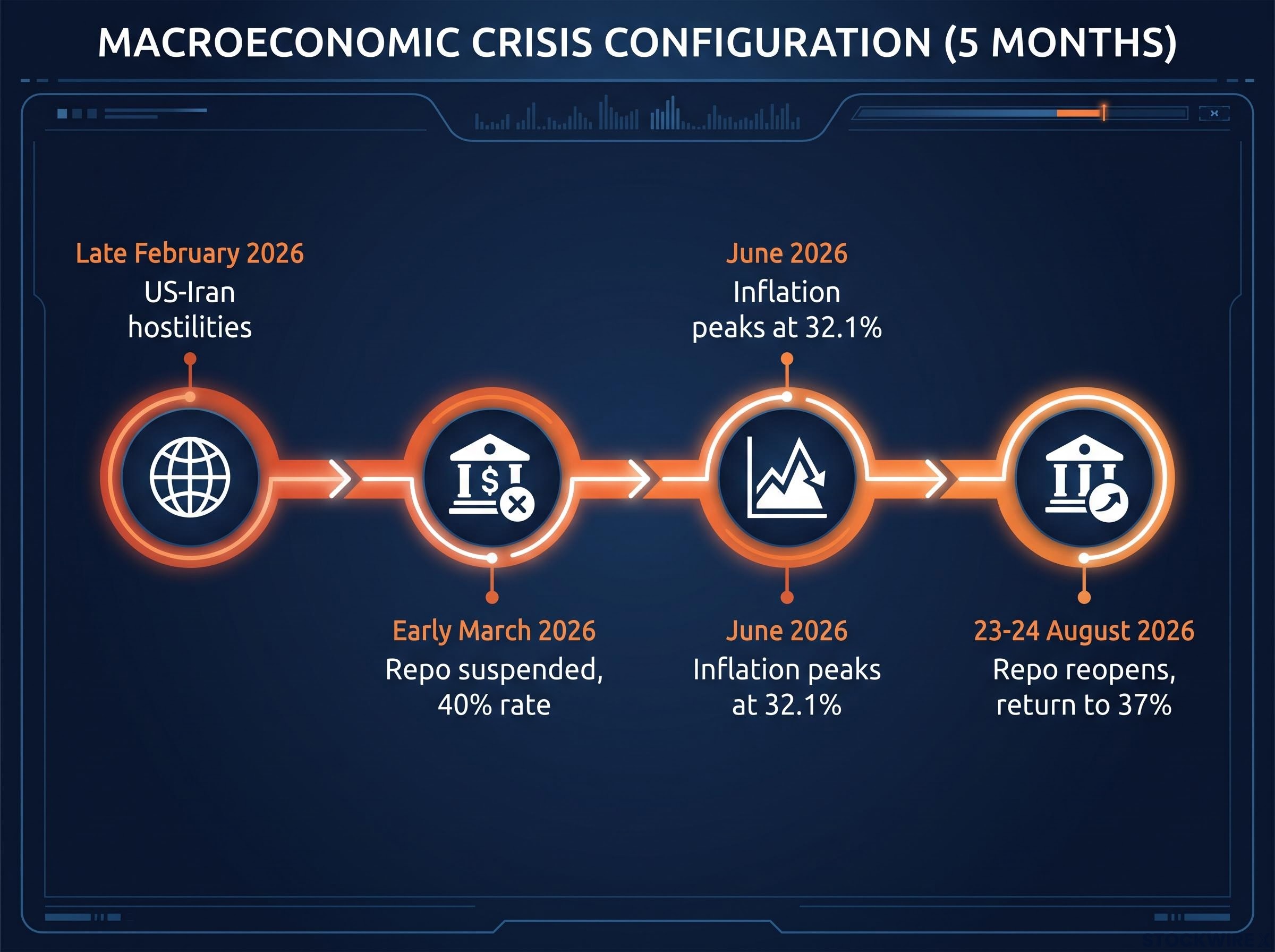
During that period, Turkish headline inflation peaked at 32.1% in June 2026, compounding the pressure on monetary authorities already managing a geopolitical shock through an operational tool rather than a formal policy response.
ING analyst Chris Turner characterised the repo restart as an unwinding of the prior stealth 300bp tightening, noting that the CBRT moved once conditions had stabilised sufficiently to restore normal funding operations.
The conditions that typically force a central bank to the corridor ceiling include:
- Acute capital outflow pressure requiring an immediate increase in the cost of shorting the domestic currency
- Sharp currency stress that risks becoming self-reinforcing if funding costs remain at standard levels
- Systemic liquidity concerns that demand a visible, if informal, tightening signal to the market
The five-month duration tells you the CBRT was managing a genuinely severe episode. That is precisely why the restart carries weight as a confidence signal rather than a routine operational adjustment. Knowing the difference between a crisis-mode central bank and a normalising one is the single most important input when you assess the carry trade’s risk-reward profile.
How carry trades actually work, and why the funding channel is the key variable
A carry trade, at its simplest, is a bet on the gap between two interest rates. You borrow in a currency that costs very little to hold, convert the proceeds into a currency that pays a high yield, and pocket the spread, provided the high-yielding currency does not depreciate enough to wipe out your gains. The concept is straightforward. The execution is where the complexity lives.
NBER research on carry trade risk premia documents that the outsized yields available in emerging market currencies reflect compensated risk rather than free arbitrage, a finding that directly supports the carry-to-volatility framing at the core of how experienced investors evaluate TRY positioning.
The basic mechanics involve three steps:
- Borrow in a low-yielding funding currency (typically USD, EUR, or JPY, where short-term rates are materially lower than Turkish rates)
- Convert the proceeds into Turkish lira and invest at the prevailing short-term yield
- Manage your foreign exchange exposure, because a sharp lira depreciation can eliminate months of accumulated carry in a single session
In the Turkish lira case, the practical attractiveness of the trade depends not just on the headline yield but on the perceived probability of a disorderly lira move. A sharp, uncontrolled depreciation eliminates carry gains faster than any rate differential can compensate. This is why the funding channel matters so much: an extremely high effective funding cost driven by emergency operations is not a pure carry opportunity. It is a warning of elevated tail risk, and experienced carry traders read it as such.
The carry-to-volatility framework that clarifies the CBRT episode is the same one that applies to yen-funded positions, where carry trade risk assessment requires distinguishing between episodic stress driven by speculative unwinding and the rarer structural breakdown that triggers cascading losses across global asset classes.
During the suspension period, the effective TRY yield sat at 40% on the short end. After the restart, it is directed toward the 37% benchmark. The nominal yield dropped. So why would carry traders view this as an improvement?
Reading carry attractiveness through a carry-to-volatility lens
Nominal yield alone is an incomplete measure of carry trade attractiveness. The more useful metric is the ratio of carry (the yield you earn) to expected foreign exchange volatility (the risk of losing it). A 40% yield means nothing if the currency is priced for a potential 15% disorderly move. A 37% yield in a stable, predictable policy environment can deliver a better carry-to-volatility ratio than the higher number ever could.
Carry volatility signals that appear muted during periods of apparent market calm can be the most misleading inputs in the carry-to-volatility ratio, as compressed implied volatility often reflects crowded positioning and reduced liquidity rather than any genuine reduction in the probability of a disorderly unwind.
The CBRT’s return to standard operations reduces the volatility denominator in this ratio. Even as the numerator (the nominal yield) declines by 300bp, the overall ratio may improve because the probability of a sudden, crisis-driven lira collapse falls meaningfully when the central bank signals it no longer needs emergency tools.
Turner’s analysis supports this reading: the compression in short-dated implied yields is likely to hold existing carry positions in place, as it reinforces a picture of orderly, managed depreciation rather than the kind of abrupt currency stress that forces rapid unwinding. The counterintuitive takeaway is the one that most clearly separates experienced emerging market investors from newcomers: a yield number does not mean the same thing when it is produced by a crisis measure as it does when it is produced by a policy rate. The CBRT episode makes that distinction impossible to miss.
This article is for informational purposes only and should not be considered financial advice. Investors should conduct their own research and consult with financial professionals before making investment decisions.
What the repo restart means for TRY positioning, and what risks remain
The restart is a policy normalisation, not a dovish pivot. It improves the Turkish lira carry trade’s risk-reward profile by reducing crisis premium while retaining one of the highest nominal yields in the emerging market universe at 37%.
The thesis underpinning most TRY carry positions is that the lira will depreciate more slowly than forward rates imply, allowing investors to harvest the spread between high local yields and cheaper funding costs. The CBRT’s shift to managed, predictable operations supports this thesis directly. Turner notes that investors running TRY carry strategies should find the adjustment supportive of continued positioning, given that it points toward a controlled FX trajectory rather than the kind of disruptive operational shift that typically precedes forced exits.
Three ongoing risk factors require active monitoring if you hold or are considering TRY carry exposure:
- Inflation persistence: Turkish headline inflation peaked at 32.1% in June 2026, and any stalling or reversal in the disinflationary trajectory would pressure the CBRT to tighten further or erode the real return on carry positions
- Geopolitical shock potential: The March-August 2026 episode is a direct illustration of how quickly a single geopolitical event can force the CBRT back into crisis configuration, erasing months of accumulated carry gains in the process
- Policy reversal risk: The credibility signal the restart has generated is only as durable as the CBRT’s willingness to maintain consistent, predictable operations; a premature rate cut or a return to unconventional funding channels would undermine that signal rapidly
32.1%: Turkish headline inflation peaked in June 2026, a reminder that the real rate environment still has considerable distance to travel before carry returns are fully insulated from inflationary erosion.
For investors already holding TRY carry positions, the restart is a signal to stay rather than exit. For those considering entry, it is a prompt to assess whether the improved policy clarity justifies accepting a structural inflation differential that still runs materially above regional peers.
Past performance does not guarantee future results. Financial projections are subject to market conditions and various risk factors.
The principle the CBRT episode makes permanent
The central lesson of the March-August 2026 episode is transferable to every emerging market currency you will ever assess: the highest yield is not always the best yield, and the funding mechanism producing it is the variable that distinguishes a genuine opportunity from a warning signal.
The CBRT’s corridor management over this period is a template for how any emerging market central bank can tighten or loosen effective conditions without changing its headline rate. If you track only the policy rate, you miss the operational layer where the real signal lives. The five-month suspension demonstrated that a 40% effective yield was not an invitation to increase carry exposure; it was the market price of elevated tail risk. The return to 37% through standard repo operations is, paradoxically, the more constructive environment for the trade.
Emerging market rate holds carry a different analytical weight depending on whether they follow a defensive tightening sprint or represent settled policy, and the Bank Indonesia case from July 2026, where 100 basis points of cumulative tightening gave way to a credibility-building pause, illustrates how the sequencing of central bank actions reshapes the risk premium on local currency assets.
Turkey’s lira remains one of the more attractive emerging market carry candidates on a nominal basis. The 37% policy rate, held since a January 2026 cut from 38%, still towers above funding currency rates. The credibility conditions have improved. But the trade remains structurally dependent on the CBRT maintaining consistent, predictable policy as inflation continues its descent from the June peak of 32.1%.
The practical takeaway for your analytical toolkit: monitor the CBRT’s funding channel choice, not just its policy rate. The channel is the more sensitive early-warning instrument for detecting the next stress episode before it shows up in spot FX moves. That principle holds whether you trade Turkish lira directly or simply want to read the next emerging market central bank decision with greater precision.