Alibaba has completed a record-breaking equity placement on the Hong Kong Stock Exchange, offloading 710 million shares priced at HK$112.70 apiece to generate roughly $10.2 billion in gross proceeds. The entire sum has been directed toward artificial intelligence.
The timing is not incidental. AI infrastructure spending across global mega-cap tech has entered what market participants describe as a super-cycle phase, with Alphabet and Intel having already executed major AI-driven equity raises in 2026. At the Hong Kong Stock Exchange, the placement stands as the venue’s biggest-ever deal of its kind, and ranks third among all primary follow-on transactions worldwide so far this year.
Here is how the deal was structured, why sovereign wealth funds drove it above its initial size, and what the transaction reveals about Alibaba’s capital strategy and competitive positioning in AI. This is the context you need to interpret what the deal actually signals, not just what it is.
How the deal was structured and what it cost existing shareholders
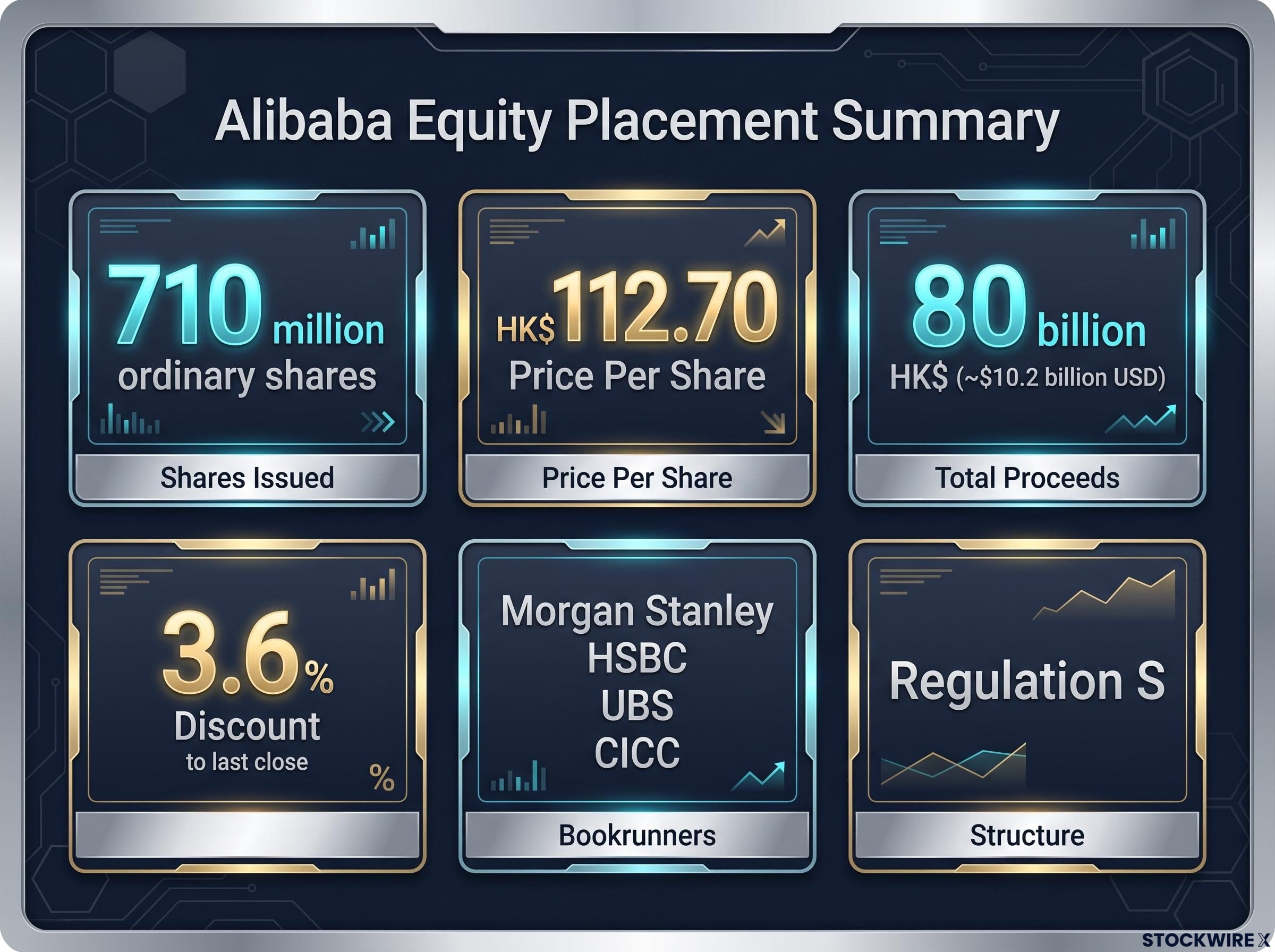
The numbers first. Alibaba sold approximately 710 million ordinary shares at HK$112.70 apiece, raising total proceeds of roughly HK$80 billion, or approximately $10.2 billion at an exchange rate of around HK$7.84 per U.S. dollar.
Deal scale: HK$80 billion (approximately $10.2 billion USD), the largest-ever primary follow-on equity raise on the Hong Kong Stock Exchange.
Shares were priced at a 3.6% haircut relative to the last closing price. That discount tells you something about the balance of power in this transaction. In a weak deal, issuers offer steep discounts to attract reluctant buyers. A 3.6% discount signals that institutional demand was strong enough that Alibaba did not need to give much away. Buyers were competing for allocation, not the other way around.
The four banks leading the book were Morgan Stanley, HSBC, UBS, and CICC. The placement was structured under Regulation S, an offshore framework that keeps the transaction outside U.S. securities registration requirements, with the consequence that U.S.-based investors could not take part.
The Regulation S offshore exemption rules under 17 CFR Part 230 establish the legal basis for equity placements conducted outside the United States without Securities Act registration, which is precisely why U.S.-based investors were excluded from participating in this transaction.
| Deal Term | Detail |
|---|---|
| Shares Issued | 710 million ordinary shares |
| Price Per Share | HK$112.70 |
| Total Proceeds (HKD) | HK$80 billion |
| Total Proceeds (USD) | Approximately $10.2 billion |
| Discount to Last Close | 3.6% |
| Bookrunners | Morgan Stanley, HSBC, UBS, CICC |
| Structure | Regulation S (offshore; U.S. investors excluded) |
When big ASX news breaks, our subscribers know first
Sovereign wealth funds and the oversubscription that expanded the deal
The deal did not stay at its initial size. Banks received indications of interest that exceeded the original offering, and the placement was upsized to its final HK$80 billion figure as a result.
What matters here is who drove that oversubscription. According to individuals familiar with the transaction, sovereign wealth funds and global long-only investors were the key buyers.
- The offering was oversubscribed, triggering an upsizing to the final deal size
- Sovereign wealth funds were identified as particularly active buyers
- Global long-only institutional investors provided additional demand depth
- No specific sovereign wealth fund names have been disclosed
Why sovereign wealth fund participation matters
Sovereign wealth funds are not momentum chasers. They are among the largest, most patient pools of capital in global markets, typically allocating to decade-long structural themes rather than near-term trading opportunities. Their appetite for this placement tells you that at least some of the world’s biggest institutional investors have made a directional bet on Alibaba’s AI positioning.
That distinction matters for existing shareholders. This is not hot money cycling through a short-term trade. The demand profile suggests institutions are treating the deal as a referendum on Alibaba’s AI roadmap, absorbing dilution willingly because they view the infrastructure buildout as a multi-year value driver.
What Alibaba is buying with $10.2 billion and why it needs equity to buy it
Every dollar of net proceeds has been ring-fenced for AI infrastructure, with no carve-outs for other uses. The company has described its ambition in terms of building “full-stack” AI capabilities, a phrase that covers ownership across the entire technology layer rather than reliance on external suppliers. Three broad investment categories sit beneath that commitment:
- Chips and silicon: Custom AI processors designed for Alibaba’s specific workloads
- Cloud and data-centre infrastructure: The physical computing capacity that AI models require to train and run at scale
- AI models and deployment services: The software layer, including large language models and enterprise-facing AI products
Alibaba has stated the raise will fund “global AI leadership” and the buildout of full-stack AI capabilities.
The question sophisticated investors are asking is why Alibaba is tapping equity markets at all. This is a cash-generative business. Recent financials, however, show a sharp drop in net profit alongside heavy capital expenditures driven by AI-related spending. The decision to raise external equity rather than wait for operating cash flow to accumulate is itself a signal: Alibaba’s AI capex ambitions are large enough and fast enough that self-funding would cost competitive ground. Equity capital preserves balance-sheet flexibility while allowing the company to move at the pace the AI infrastructure race demands.
Hyperscaler capital expenditure is projected to consume approximately 94% of operating cash flow in 2026, a compression that contextualises why even cash-generative companies like Alibaba are tapping equity markets to fund the AI capital cycle rather than relying on earnings alone.
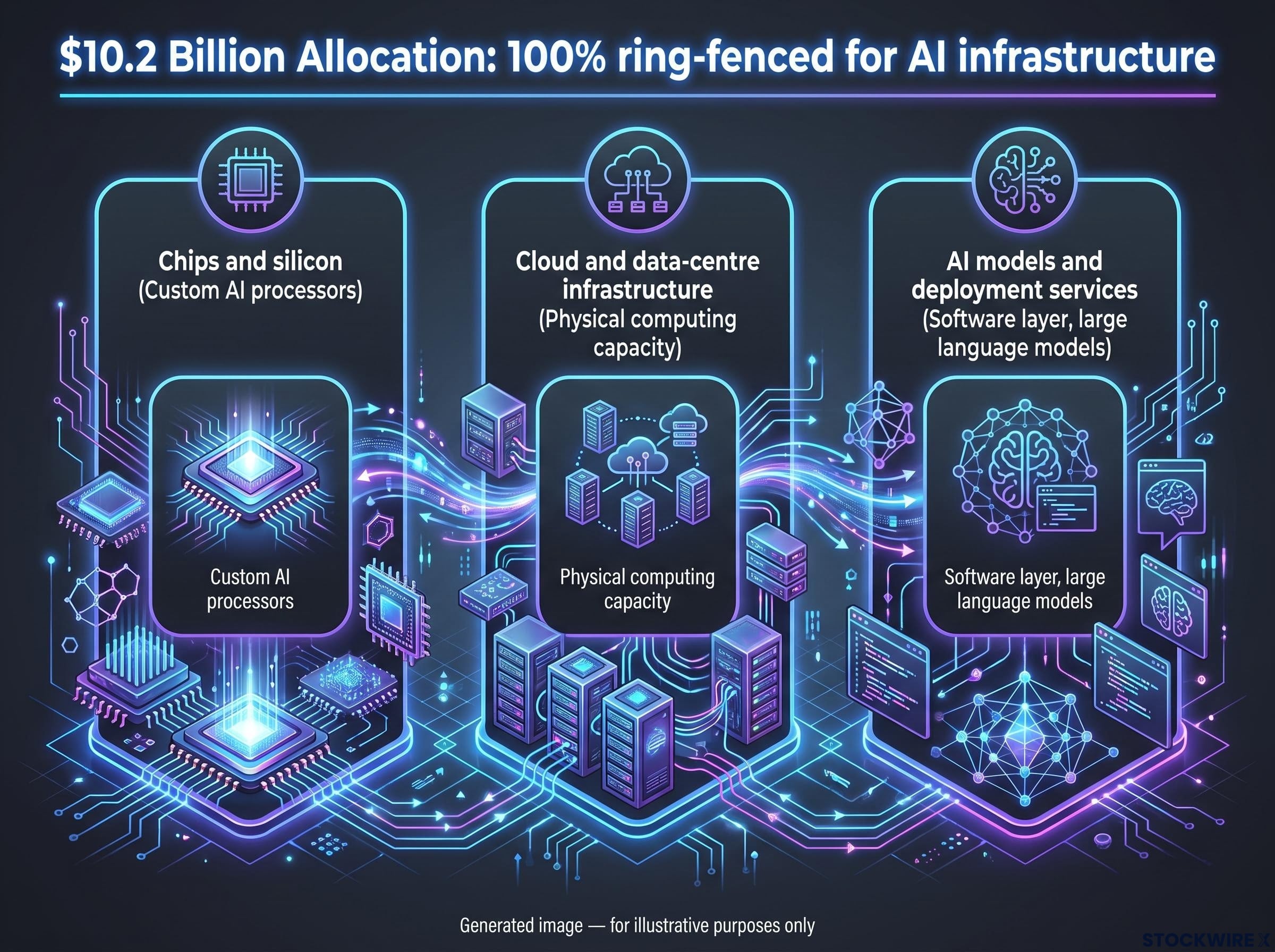
For shareholders, the 100% ring-fencing is an unusually clean commitment. There is no “general corporate purposes” language to dilute accountability. Investors can hold management to a specific mandate and track whether the capital is being deployed against it.
A record for Hong Kong and a signal for the global AI capital cycle
This deal sets a record. No primary follow-on equity raise in the history of the Hong Kong Stock Exchange has matched its size, a milestone that underscores the exchange’s continued relevance as a capital-raising venue for Chinese technology companies despite persistent geopolitical and regulatory friction. The Regulation S structure, which excluded U.S. investors from direct participation, is part of that geopolitical backdrop.
Where this ranks globally in 2026
Among all primary follow-on transactions completed worldwide in 2026, Alibaba’s raise occupies third place, sitting behind the year’s two larger deals from Alphabet and Intel. All three were AI-driven capital raises.
| Company | Exchange | Approximate Proceeds | Stated AI Purpose |
|---|---|---|---|
| Alphabet | NASDAQ | Largest in 2026 | AI infrastructure and cloud |
| Intel | NASDAQ | Second-largest in 2026 | AI chip manufacturing and foundry |
| Alibaba | HKEX | ~$10.2 billion | Full-stack AI (chips, cloud, models) |
The pattern is the point. Three of the largest equity raises globally in 2026 have all been AI infrastructure plays. This is not speculative capital chasing early-stage bets. It is productive capital funding the physical and computational layer that AI services will run on. The distinction matters for how you think about exposure: the capital cycle suggests AI infrastructure buildout is intensive enough that even the most cash-rich companies in the world cannot fund it at competitive pace from earnings alone.
The scale of the shift is visible in macroeconomic data: US IT spending has reached 4.9% of GDP in Q1 2026, surpassing every prior technology investment peak including the dot-com era, providing the structural backdrop that the AI infrastructure super-cycle narrative behind this placement is drawing on.
What the deal leaves open for Alibaba investors
What the deal confirms
- Institutional confidence is real: sovereign wealth funds and global long-only investors oversubscribed the offering and absorbed a modest 3.6% discount
- Alibaba has made a clear strategic bet on full-stack AI, funded by the largest Hong Kong equity raise in history
- The 100% proceeds ring-fencing gives shareholders a specific mandate against which to measure execution
What it leaves open
- Whether “full-stack” AI generates the revenue and margin uplift that justifies the capital intensity and the dilution from 710 million new shares
- Whether Chinese AI competitors or global players close the gap before Alibaba’s infrastructure investments compound into market share
- Whether enterprise adoption of Alibaba Cloud AI services scales fast enough to convert infrastructure spending into earnings growth
The honest read for Alibaba shareholders is that this raise buys time and scale, but not certainty. The proceeds fund the infrastructure race entry fee. What happens next depends on model performance, enterprise adoption, and competitive dynamics that $10.2 billion cannot guarantee.
Alibaba’s infrastructure bet is anchored in a market position that is already moving in its favour: the company leads Chinese enterprise AI deployment at 41% preference share among CIOs surveyed by Morgan Stanley, up 9 percentage points in a single survey cycle as DeepSeek’s position collapsed.
The deal is a starting gun, not a finish line. The capital is committed, the institutional endorsement is clear, and the mandate is specific. Execution against competitors, including domestic Chinese tech rivals and global players like Alphabet, still determines whether the investment thesis pays.
Alibaba’s Qwen distribution advantage extends beyond its own cloud platform: Qwen is embedded at the operating system level across all four Apple platforms following CAC approval of Apple Intelligence in July 2026, giving Alibaba a channel into hundreds of millions of Chinese iPhones that no app-layer partnership could replicate.
This article is for informational purposes only and should not be considered financial advice. Investors should conduct their own research and consult with financial professionals before making investment decisions. These statements are speculative and subject to change based on market developments and company performance.