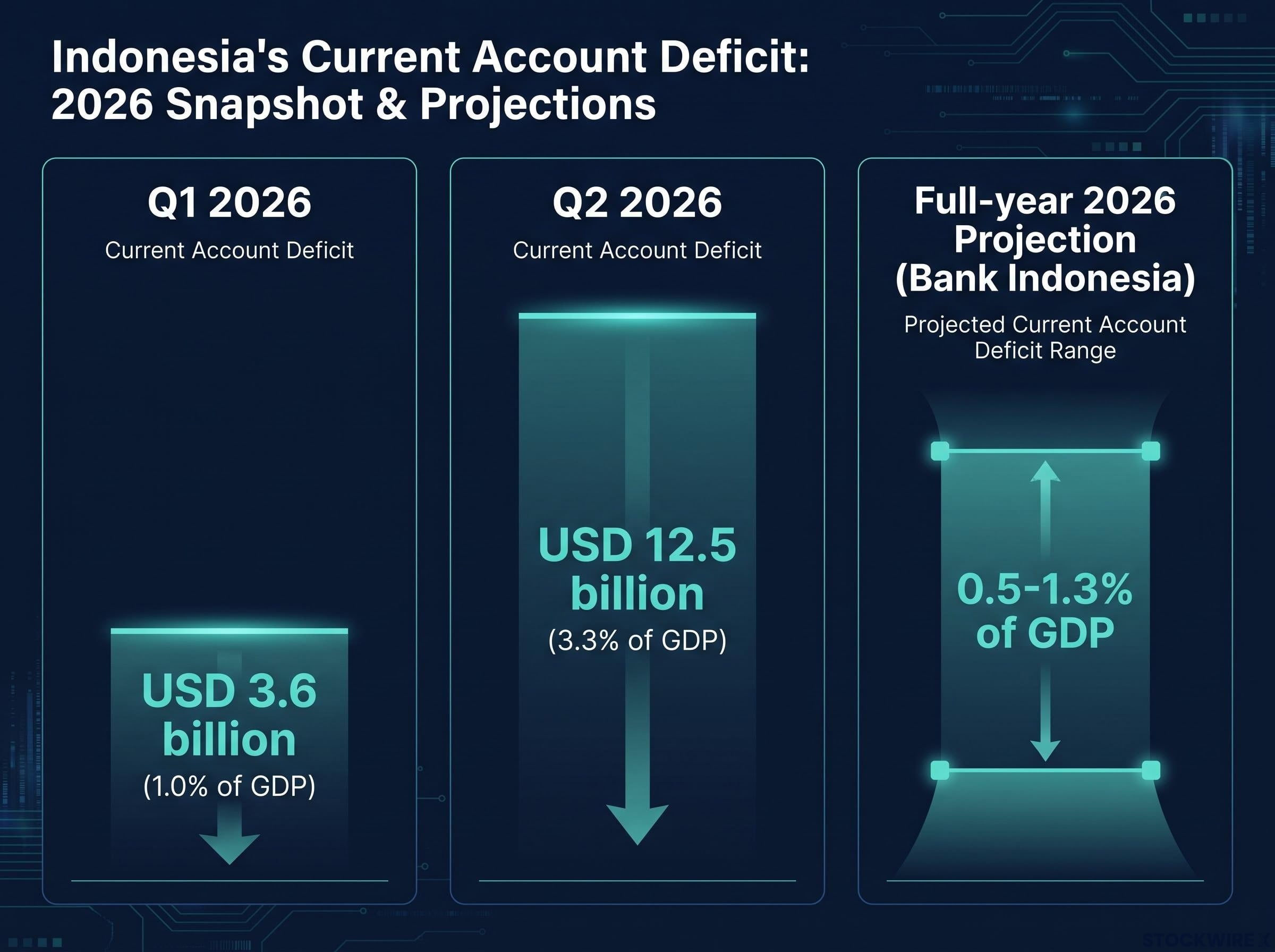
Indonesia’s Q2 2026 current account deficit came in at roughly USD 12.5 billion, a figure representing 3.3% of GDP. That is the worst quarterly print on record, more than triple the USD 3.6 billion deficit recorded in Q1.
The currency went up anyway.
In a world where markets routinely punish economies for deteriorating trade data, the Indonesian Rupiah’s behaviour in August 2026 is a live case study in how foreign exchange pricing actually works when multiple macro forces converge simultaneously. The deficit number made headlines. The Rupiah’s response contradicted every one of them.
Here is what that contradiction actually tells you. This piece walks through the four forces that explain why the Rupiah strengthened into the teeth of a record deficit, why the deficit number alone is the wrong signal to anchor on, and what specific variables to watch if the current equilibrium starts to crack.
What the deficit number is actually telling you
The scale of the deterioration is real. Indonesia’s current account deficit widened from USD 3.6 billion (1.0% of GDP) in Q1 2026 to approximately USD 12.5 billion (3.3% of GDP) in Q2. That is not a rounding error. It is a quarterly swing large enough to rattle any emerging market currency on its own terms.
| Period | Deficit (USD billions) | % of GDP |
|---|---|---|
| Q1 2026 | 3.6 | 1.0% |
| Q2 2026 | ~12.5 | 3.3% |
| Full-year 2026 (Bank Indonesia projection) | N/A | 0.5-1.3% |
The principal cause was a sharp jump in energy imports, as elevated oil prices triggered by conflict in the Middle East drove the import bill sharply higher. Indonesia is a net importer of refined petroleum products, and when crude prices spike, the import bill absorbs the shock directly. This was not a structural collapse in export demand. It was an energy cost shock concentrated in a single quarter.
Bank Indonesia characterises the Q2 print as a pronounced but temporary quarterly shock within a manageable full-year trajectory, projecting the full-year 2026 current account deficit at just 0.5-1.3% of GDP.
That gap between the quarterly shock and the full-year projection is where the real signal sits. Markets are pricing a temporary spike, not an open-ended deterioration. That distinction explains much of the Rupiah’s composure, and it is the framing you need before any of the mechanics that follow make sense.
When big ASX news breaks, our subscribers know first
How currency markets actually price a current account deficit
Most people carry a simple mental model of how current account deficits affect currencies: a deficit means more money is leaving the country through trade than is entering, so the currency should weaken. In a textbook-simple world, that logic holds. More rupiah being sold to pay for imports than being bought to pay for exports creates selling pressure on the currency.
But currency markets do not operate in a textbook-simple world.
The current account is only one half of a country’s balance of payments, the full accounting ledger that tracks all money flowing in and out of an economy. The balance of payments has two sides:
The balance of payments is the full accounting ledger that tracks all money flowing in and out of an economy across both the current account and the capital account, and the gap between the dollar’s 57% reserve share and its 89% share of daily FX turnover illustrates why currency pricing is never reducible to a single flow category.
- Current account: Tracks trade in goods and services, income flows, and transfers. A deficit here means the country is spending more abroad than it earns from abroad.
- Capital account (including financial account): Tracks investment flows, both foreign investment coming into the country and domestic investment going out. A surplus here means foreign investors are buying more domestic assets than domestic investors are buying foreign ones.
When the capital account surplus is large enough, it can fully offset or even overwhelm a current account deficit. The net effect on the currency depends on which side is bigger. This is not a theoretical possibility; it is exactly what happened in Indonesia in Q2 2026.
Indonesia’s ledger in Q2 2026
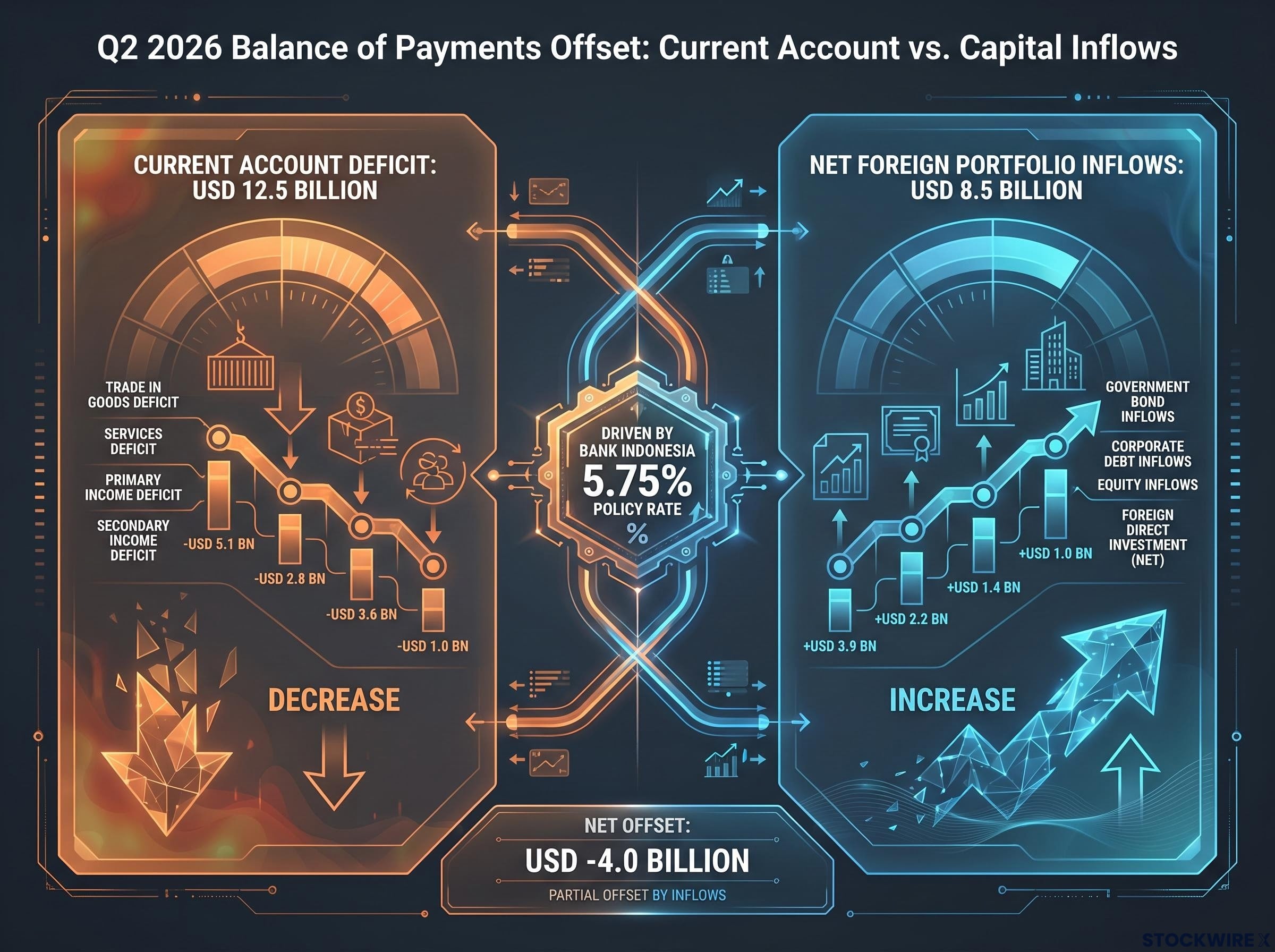
During the same quarter that Indonesia posted its record current account deficit, the capital account received USD 8.5 billion in net foreign portfolio inflows, according to Bank Indonesia. These inflows went primarily into government securities and Bank Indonesia instruments, reflecting deliberate yield-seeking behaviour rather than speculative short-term positioning.
For you as a global investor assessing any emerging market currency, the lesson is direct: a current account number in isolation is almost always an incomplete signal. The capital account’s response to that deficit is what determines the direction of the exchange rate.
The USD 8.5 billion offset that most headlines missed
The abstract mechanism just became concrete. While the current account was haemorrhaging USD 12.5 billion, foreign portfolio investors were simultaneously pouring USD 8.5 billion into Rupiah-denominated assets in Q2 alone.
Bank Indonesia reports net foreign portfolio inflows of USD 8.5 billion in Q2 2026, directed primarily into government securities and Bank Indonesia instruments.
Bank Indonesia’s July 2026 policy statement confirms the BI-Rate held at 5.75%, reports net foreign portfolio inflows of USD 8.5 billion in Q2, and sets out the full-year current account deficit projection of 0.5-1.3% of GDP that underpins the market’s confidence in a temporary rather than structural deterioration.
What drew these flows? Bank Indonesia’s relatively high policy rate, reported at 5.75% after cumulative hikes since May 2026, creates a positive interest-rate differential that makes Indonesian government bonds and central bank instruments attractive to yield-seeking foreign investors.
The mechanism behind this is called the carry trade. A carry trade is when investors borrow in a currency with low interest rates and park the money in assets denominated in a higher-yielding currency, pocketing the difference. Indonesia’s rate environment makes it a natural carry trade destination: foreign investors can earn significantly more holding Rupiah-denominated bonds than comparable instruments in lower-rate economies.
Carry trade dynamics operate similarly across emerging market currencies: Japan’s record surplus has not saved the yen from weakness because the interest-rate differential with the Fed still overwhelms the trade flow signal, the same structural logic that is currently working in Indonesia’s favour rather than against it.
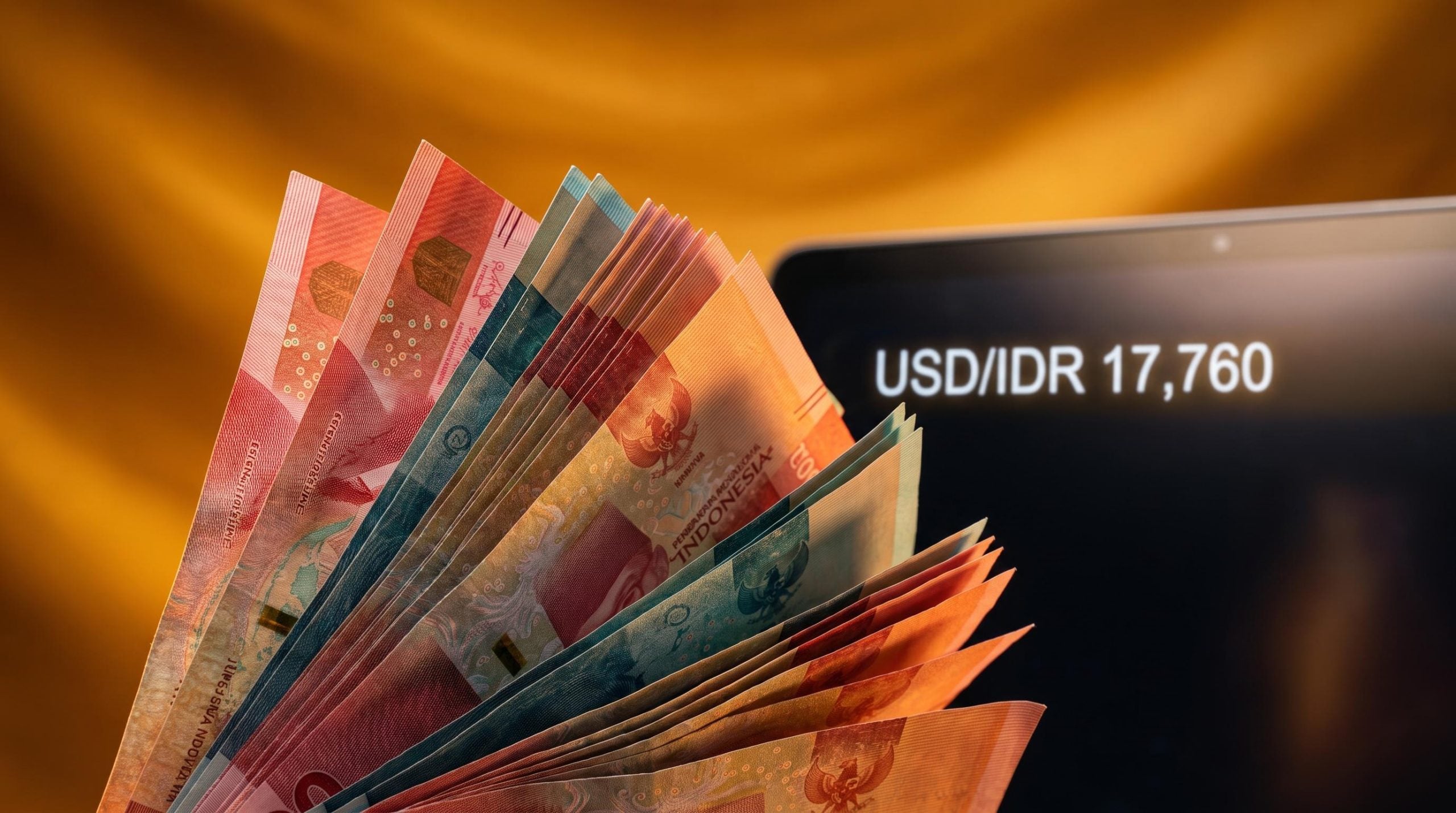
The result is visible in the exchange rate. By 21 August 2026, the USD/IDR pair had settled around 17,760 during Asian trading, having retreated from levels closer to 17,900-18,000 seen earlier in the month, with the Rupiah gaining ground across each of the preceding three sessions even as the record deficit dominated the headlines.
Here is the two-sided picture you need to hold simultaneously:
- What the inflows explain: The Rupiah’s current firmness. Portfolio capital arriving at scale offsets the trade deficit’s downward pressure on the currency.
- What the inflows signal as risk: Reversal vulnerability. Portfolio flows that arrive for yield reasons can exit faster than they entered if global risk appetite shifts. The same USD 8.5 billion that stabilises the currency today defines the size of the potential exit tomorrow.
That dual reality is the most important thing to understand about the Rupiah’s current position.
Why signals from Beijing matter for the Rupiah
China is Indonesia’s largest trading partner, and the connection runs directly through commodities. Coal, nickel, and palm oil are Indonesia’s primary export exposures to Chinese demand. When Chinese industrial and consumer activity accelerates, Indonesia sells more of what it digs up and grows. When it decelerates, the trade position deteriorates.
This is why a fiscal signal from Beijing can move the Rupiah in Jakarta before a single additional tonne of coal crosses the border. The transmission chain works in a specific sequence:
- Chinese fiscal signal: Senior Chinese officials, including Vice Finance Minister Liao Min, signal continued fiscal support for growth and economic activity.
- Market expectation of sustained Chinese demand: Investors update their forward view of Chinese industrial output and commodity consumption.
- Improved forward outlook for Indonesian commodity exports: Higher expected Chinese demand means higher expected Indonesian export revenues in coming quarters.
- Positive sentiment effect on the Rupiah: Currency markets price the expectation now, even though the trade data confirming it would not appear until subsequent quarters.
The distinction between sentiment effects and trade effects matters here. Sentiment effects are immediate: they are priced into the exchange rate today. Trade effects are lagged: they would materialise in Q3 or Q4 current account data if Chinese activity actually follows through. The Rupiah is currently benefiting from the sentiment channel, which means markets are pricing the expectation, not the confirmed outcome.
The follow-through risk
Stimulus signalled by Beijing may end up being smaller, slower, or more domestically focused than markets currently expect. If that gap between signal and execution widens, it removes one of the four stabilising forces currently supporting the Rupiah. The China channel is a genuine tailwind, but it remains contingent on actual delivery.
Bank Indonesia’s role as a credibility anchor
The three forces covered so far, the interest-rate differential, the portfolio inflows, and the China demand channel, all depend on something less visible but arguably more load-bearing: institutional credibility.
Bank Indonesia’s monetary policy stance is not purely about controlling inflation. It is a deliberate Rupiah-stabilisation strategy. The high policy rate generates the interest-rate differential that attracts foreign capital. Keeping rates on hold for a second meeting running signals firm commitment to sustaining that differential. The tightening accumulated since May 2026 sends a clear message to global investors that Rupiah defence takes priority, even where that means accepting tighter domestic financial conditions.
Communication quality matters independently of the rate decision itself. Clear forward guidance lowers the risk premium investors attach to Rupiah-denominated assets by reducing uncertainty about where policy is heading next. When investors can model their expected carry trade returns with confidence, they are more willing to commit capital.
Bank Indonesia’s rate plateau at 5.75% and the forward signals from acting governor Destry Damayanti’s post-meeting communication are the most actionable near-term inputs for investors monitoring whether the interest-rate differential that is currently attracting portfolio inflows will be sustained through the remainder of 2026.
Bank Indonesia explicitly links Q2 portfolio inflows to investor confidence in domestic financial assets, framing the USD 8.5 billion as evidence that its policy framework is working as intended.
The USD/IDR pair’s move to around 17,760 across three consecutive sessions of Rupiah gains stands as the market’s live verdict on that credibility.
Here are the four reinforcing forces operating simultaneously:
- Interest-rate differential: A high policy rate creates carry trade incentives that attract yield-seeking foreign capital.
- Portfolio inflows: USD 8.5 billion in net Q2 inflows directly offset the current account gap on the balance of payments ledger.
- China demand expectations: Positive fiscal signals from Beijing support forward-looking commodity demand and Rupiah sentiment.
- Institutional credibility: Clear communication and a track record of prioritising Rupiah stability lower the risk premium on Indonesian assets, reinforcing all three preceding forces.
These four do not operate in isolation. Credibility makes the carry trade feel lower-risk, which draws the inflows, which offsets the deficit, which validates the credibility. Remove any one of them and the others weaken.
What would need to change for this equilibrium to break
The Rupiah’s current position is stable, not invulnerable. Three specific variables could shift the balance, and each has a clear transmission mechanism you can monitor.
| Risk factor | Transmission mechanism | Observable indicator |
|---|---|---|
| Oil price escalation (Middle East tensions) | Widens import bill, deepens current account deficit beyond BI’s full-year projection | Brent crude sustained above current conflict-premium levels; BI revising full-year deficit forecast upward |
| Global risk-off event | Reverses portfolio inflows as carry trade positions unwind; the USD 8.5 billion Q2 inflow becomes the exit risk | Sudden widening in EM credit spreads; net foreign selling of Indonesian government bonds |
| Chinese stimulus underdelivery | Removes the forward commodity demand expectation supporting Rupiah sentiment | Chinese PMI readings below consensus; actual fiscal disbursement lagging announced targets |
The asymmetry of the portfolio inflow risk deserves particular attention. The USD 8.5 billion that arrived in Q2 was portfolio capital, meaning it is invested in tradeable securities that can be sold and repatriated quickly. This is fundamentally different from foreign direct investment, which involves building factories or acquiring companies and cannot leave overnight. In a sharp global risk-off episode, portfolio flows can reverse faster than they accumulated.
Carry reversal risk is not evenly distributed across the calendar: Bank of America’s analysis found no statistical support for the idea that summer months reduce carry volatility, with thin liquidity concentrating rather than dampening the scale of unwind moves when a macro shock materialises.
Bank Indonesia projects the full-year 2026 current account deficit at 0.5-1.3% of GDP, implying significant narrowing in the second half of the year. If that narrowing materialises, it reduces the structural vulnerability that makes the equilibrium contingent in the first place.
If you hold Indonesian government bonds or track the Rupiah for trade exposure purposes, these three variables are your watchlist. Not a vague warning about emerging market volatility, but a specific set of signals with identifiable transmission mechanisms.
Four forces, one currency, and a deficit that markets chose to look past
The Indonesian Rupiah’s strength through a record quarterly current account deficit is not a market malfunction. It is the balance of payments working exactly as it does when four reinforcing forces converge: a high interest-rate differential drawing capital in, USD 8.5 billion in portfolio inflows offsetting the trade gap, supportive signals from Beijing anchoring commodity demand expectations, and a credible central bank tying the whole structure together.
The current account is a lagging and partial signal. What matters for exchange rate pricing in real time is the balance of payments in its entirety, weighted by market expectations about which forces are durable and which are fragile.
That equilibrium is not fragile by design, but it is contingent. Oil prices, global risk appetite, and Chinese stimulus follow-through are the three variables worth tracking as August 2026 gives way to the next data cycle. The deficit told one story. The Rupiah told another. The balance of payments explains why.
This article is for informational purposes only and should not be considered financial advice. Investors should conduct their own research and consult with financial professionals before making investment decisions. Past performance does not guarantee future results. Financial projections are subject to market conditions and various risk factors.