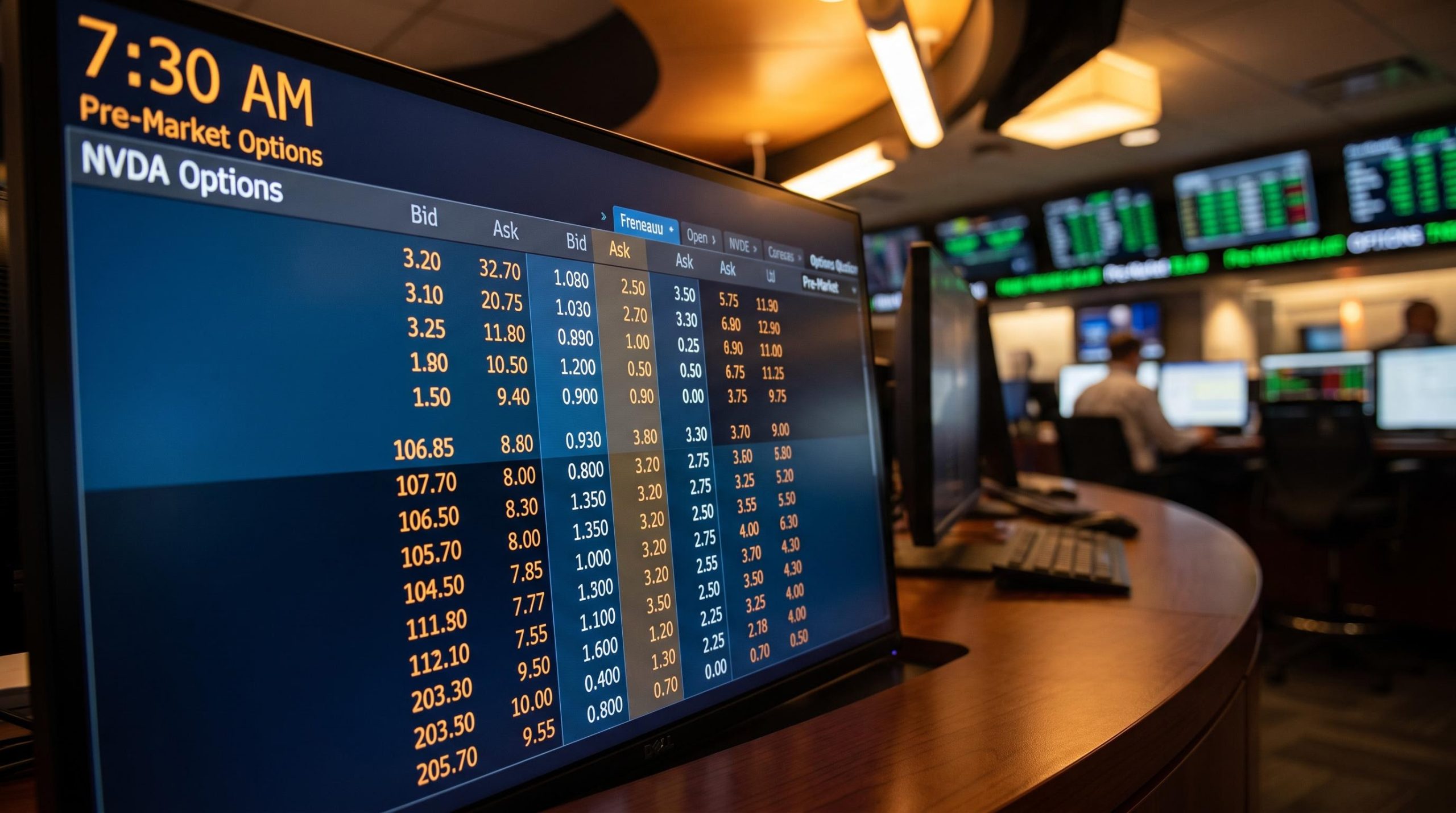
For years, options traders have watched the same frustrating sequence play out. NVDA reports earnings at 6:30 a.m. ET, the stock gaps 8% in pre-market equity trading, and by the time options open at 9:30 a.m., the move is already baked in. The window to act with options, to hedge, to express a view, to adjust a position, has been closed during the most volatile hours of the trading day.
Cboe‘s extended-hours single-stock options programme is the structural answer to that gap. The framework received SEC approval in late May 2026, originally targeted a 13 July launch, revised to 17 August, and as of 21 August 2026, carries a start date listed as TBD. The programme is imminent but not yet confirmed live.
Here is the complete operational picture: how the sessions are structured, which 21 stocks qualify, what changes for earnings-driven strategies, how to verify whether your brokerage account is actually enabled, and the specific risks that come with trading options before the equity market opens.
What Cboe has actually approved and why the start date is still uncertain
The regulatory framework is fully approved. The session architecture, eligible symbols, and eligibility criteria are all defined. What remains outstanding is a confirmed go-live date, and the timeline tells you why that distinction matters.
| Event | Date |
|---|---|
| SEC Approval | Late May 2026 |
| First Launch Target | 13 July 2026 |
| Revised Launch Target | 17 August 2026 |
| Current Status | TBD (as of 21 August 2026) |
Henry Schwarz, VP of Market Intelligence at Cboe, has discussed the programme publicly, and the exchange’s most recent official notice lists “Start Date: TBD” with no replacement date announced. Two postponements from a fully approved programme tell you this is real and moving forward, not speculative. But they also tell you to verify live status directly with your broker rather than assuming the programme launched on any previously announced date.
When big ASX news breaks, our subscribers know first
How the new trading sessions are structured hour by hour
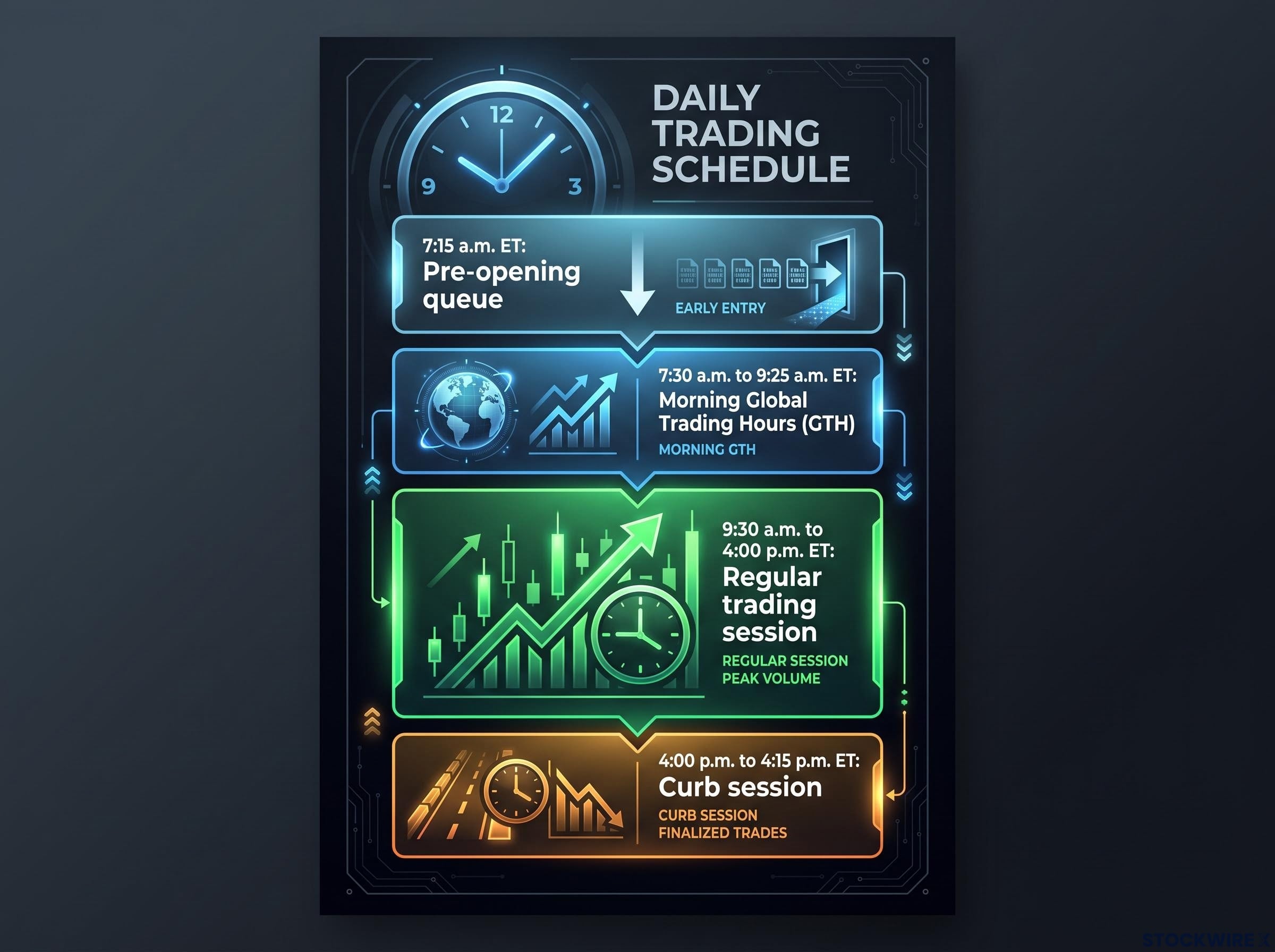
When the programme goes live, the trading day for eligible single-stock options will extend well beyond the current 9:30 a.m. to 4:00 p.m. ET window. Here is the full session schedule in chronological order:
- 7:15 a.m. ET: Pre-opening queue. Orders are accepted and queued but not executed.
- 7:30 a.m. to 9:25 a.m. ET: Morning Global Trading Hours (GTH) session. Active trading in eligible single-stock options.
- 9:30 a.m. to 4:00 p.m. ET: Regular trading session. Standard options hours, unchanged.
- 4:00 p.m. to 4:15 p.m. ET: Curb session. Brief post-close window for final trades.
The morning GTH session is the centrepiece. It opens 60 minutes before the equity market does, which means options are trading against an underlying stock that is itself only available in the thinner pre-market equity session.
Why limit orders only
Extended sessions are expected to restrict trading to limit orders only. The logic is straightforward: with fewer participants active and thinner order books, market orders could execute at prices far from where the underlying is actually trading. Limit orders force you to specify the price you are willing to pay, which protects execution quality when liquidity is sparse.
This is not a wholly new concept for Cboe. SPX index options already operate under a Global Trading Hours regime that runs from roughly 8:15 p.m. ET until 9:25 a.m. ET the next morning. The single-stock sessions plug into the morning portion of that existing framework, extending it to individual names rather than indices alone.
The 21 stocks eligible for extended-hours options and how they were chosen
Not every optionable stock qualifies. Cboe‘s SEC filing sets three strict eligibility thresholds, all of which a stock must meet simultaneously:
– Average daily options volume of at least 150,000 contracts over the prior six months – Underlying equity market capitalisation of at least $50 billion – Underlying average daily equity volume of at least 10 million shares
Those thresholds are designed to ensure that only the most liquid names participate, supporting viable price discovery during hours when fewer traders are active. If you are wondering whether your preferred mid-cap name will be added anytime soon, the bar is deliberately high.
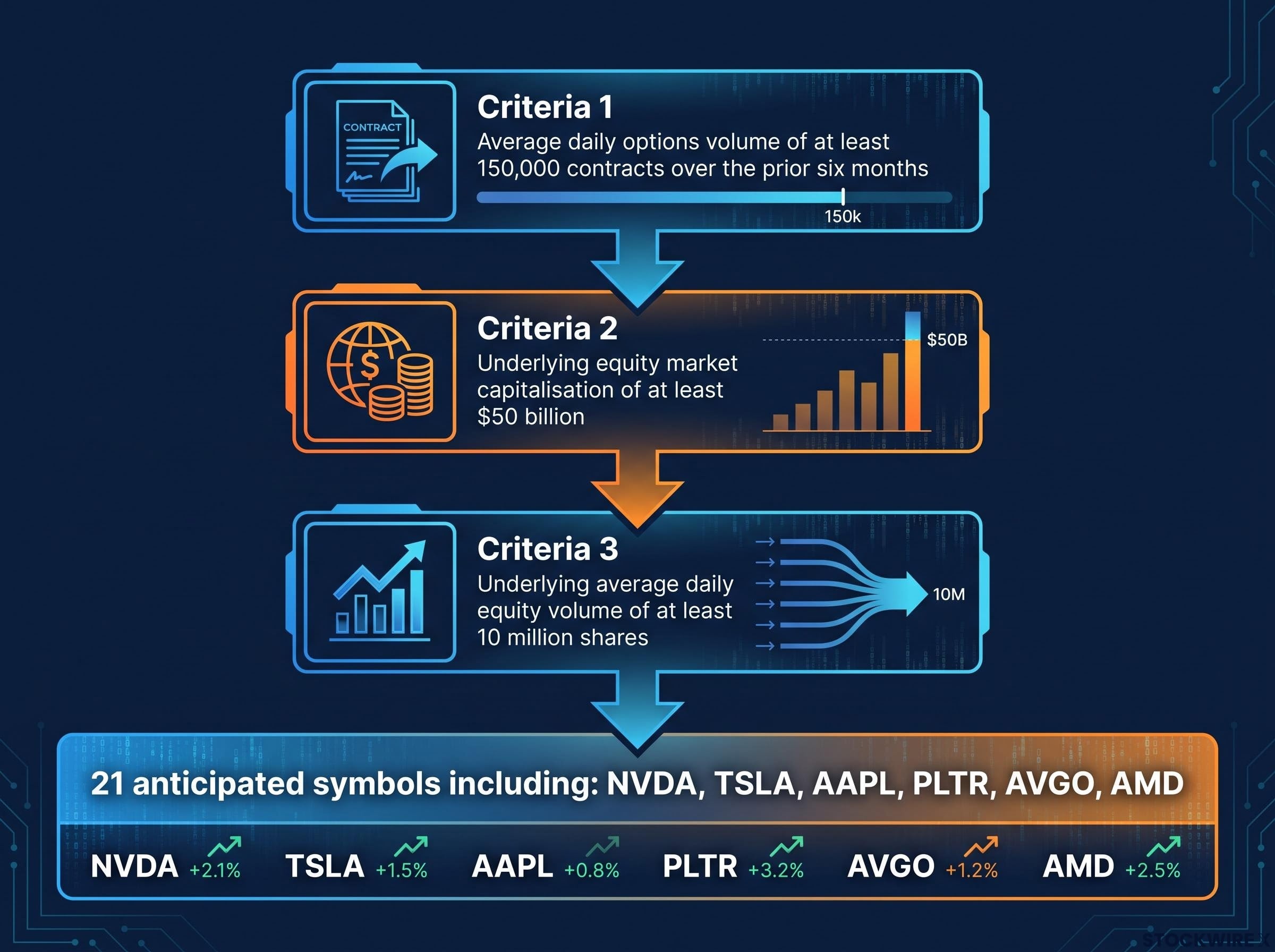
The approximately 21 anticipated symbols are:
- AAPL, AMD, AMZN, AVGO, BABA, BAC, GOOG, GOOGL, HOOD, INTC, META, MSFT, MU, NFLX, NOK, NVDA, ORCL, PFE, PLTR, TSLA, TSM
Among these, the names that matter most to retail traders are the ones known for large pre-market earnings moves: NVDA, TSLA, AAPL, PLTR, AVGO, and AMD. For companies that report results before the regular open, options on these names will continue trading through the announcement itself, a capability that was simply unavailable under prior extended-hours arrangements.
What this actually changes for traders reacting to pre-market earnings
Consider the before-and-after. Before these sessions, a trader holding NVDA options into an earnings report released at 6:30 a.m. ET could watch the stock gap in pre-market equity trading but had no way to adjust the options position until 9:30 a.m. By then, the initial reaction, often the sharpest move of the day, was already reflected in options pricing.
Post-earnings options positioning in NVDA has historically produced surprising outcomes: the stock ended the week following earnings lower in seven of the last eight quarters even when results beat estimates, a pattern that extended-hours access does not eliminate and that traders adjusting positions at 7:30 a.m. will still need to account for.
With a live 7:30 a.m. options session, three specific use cases open up:
- Earnings position adjustment. If a pre-market earnings surprise sends the stock sharply in one direction, you can adjust or close options positions within the first hour rather than waiting through the gap.
- Overnight risk hedging. When news breaks before the open in high-beta names like TSLA or AMD, you can hedge with options rather than relying on stock-only pre-market trades.
- Directional or volatility expression. Instead of being limited to buying or selling shares in pre-market, you can use options to express a view on both direction and implied volatility during the immediate post-catalyst window.
International access
The 7:30 a.m. ET session also expands accessibility for traders outside the United States. The window aligns with evening hours in Asia, making these instruments available during normal waking hours for traders in that region who previously had no practical access to U.S. single-stock options outside regular hours.
What to check with your broker before placing a single trade
Cboe operates the exchange, but whether you can actually trade in these sessions depends entirely on your brokerage. Some retail platforms have committed to day-one support. Others may restrict access initially or require additional account-level permissions.
Broker access to extended-hours single-stock options is not automatic. Account-level permissions, risk disclosures, or additional approvals may be required before you can trade.
Before placing a single order, confirm these four items with your broker:
- Whether extended-hours single-stock options are enabled on your account.
- Which order types are permitted (expect limit orders only; some brokers may impose further restrictions).
- Any margin, risk approval, or disclosure requirements specific to pre- and post-market options activity.
- Whether the programme is currently live on their platform, given the TBD launch status as of 21 August 2026.
The limit-order-only expectation carries a practical implication beyond exchange rules: if you are accustomed to market orders during regular hours, every extended-session trade requires you to build in explicit limit pricing. The same trade intention can produce very different outcomes depending on platform, and the trader who assumes uniform access is the one most likely to hit a wall at the moment they want to act.
The risks that come with thinner markets and what to watch before committing capital
Extended-hours options trading introduces a distinct risk profile. None of these risks are disqualifying, but they require calibration.
- Wider bid-ask spreads. Fewer participants and thinner order books mean market makers quote wider spreads to compensate for inventory risk. A wider spread is not just a transaction cost; it tells you how confident market makers are in their pricing at that moment. In an early-stage extended session, that confidence will be lower than what you are accustomed to.
- Elevated implied volatility. The underlying stock’s pre-market price is derived from relatively narrow liquidity pools. Options pricing models relying on less stable reference prices tend to produce higher implied volatility and more conservative quoting.
- Broker-specific restrictions. Different platforms may impose different limits on contract types, position sizes, and risk management tools, especially while the programme is new. Your broker’s extended-hours functionality may not mirror regular-hours options trading in any respect.
- The 60-minute gap. Single-stock options open at 7:30 a.m. but equity markets do not open until 9:30 a.m. During that window, you are pricing options against a thinly traded underlying, compounding the uncertainty in every greek your model produces.
Options pricing models relying on less stable reference prices during pre-market hours tend to produce elevated implied volatility, a dynamic that compounds every Greek output on the chain and shifts delta, theta, and probability estimates simultaneously from their regular-hours baselines.
Peer-reviewed research on price discovery and trading after hours shows that liquidity constraints outside regular sessions produce less efficient pricing, a finding that underpins the rationale for restricting early-session options trades to limit orders.
Whether spreads tighten and depth improves as the programme matures will only become clear after it goes live and participants settle into new routines. The limit-order discipline is both an exchange-level requirement and, practically, your primary defence against poor fills in these conditions.
A structural shift still finding its footing, but worth watching closely
Cboe‘s extended-hours single-stock options programme represents a genuine, SEC-approved structural change to how retail traders can manage risk around pre-market events. The TBD launch status means the right posture is preparation, not immediate action.
The two steps worth taking now: verify live status with your broker, and check whether the next earnings date for any of the 21 eligible names falls on your calendar. That is the moment this programme becomes operationally relevant.
The broader direction is clear. SPX and other index products already trade under Global Trading Hours regimes covering most of the week. Extending pre-market and curb sessions to high-volume single-stock options is the next step toward near-continuous options access, built to match a market that increasingly never sleeps.
Cboe product expansion in 2026 extends beyond single-stock extended hours: the exchange also received listings approval for S&P 500-linked binary options in partnership with Charles Schwab, reflecting a broader strategic push to bring previously inaccessible derivatives structures to retail platforms.
This article is for informational purposes only and should not be considered financial advice. Investors should conduct their own research and consult with financial professionals before making investment decisions.
—