You know the feeling. You find a business with a strong track record, durable advantages, and management you trust. Then you look at the price and realise the market already knows everything you know, and has priced most of it in.
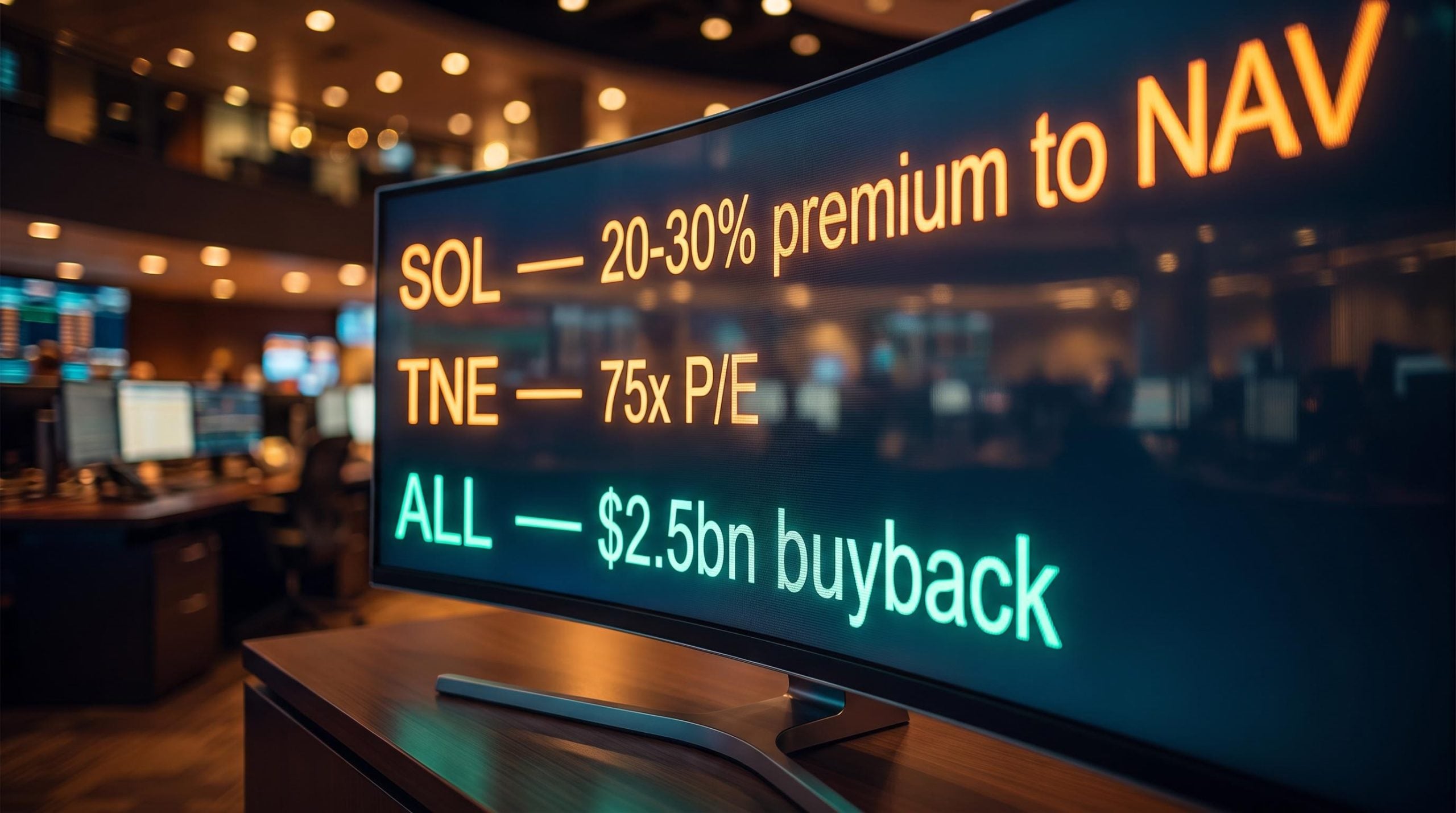
That tension between quality and price is not theoretical. Right now, three ASX-listed companies sit at three distinct points on the quality-versus-valuation spectrum, and professional analysts disagree sharply about whether the price is right on each. Washington H. Soul Pattinson (ASX: SOL) trades at a 20-30% premium to its net asset value. Technology One (ASX: TNE) commands a trailing price-to-earnings ratio north of 75x, roughly 1.5 times the peer average. Aristocrat Leisure (ASX: ALL) sits in the low-to-mid-20s on the same metric, with a $2.5 billion buyback programme reinforcing the case.
Same market, same week, three completely different valuation questions. Here is a framework you can run on any stock where the quality is clear but the price question is not, illustrated with three ASX names where that question is live right now.
Why paying too much for a great business is still a mistake
There is a seductive logic to quality investing. Great businesses tend to stay great. Strong competitive positions compound over time. If the business keeps delivering, the price will eventually catch up to whatever you paid.
That logic has a flaw. Your future returns are not determined solely by business quality. They are determined by the gap between what you pay and what that quality is actually worth at the moment you buy. A company can grow earnings at 10% a year for a decade and still deliver mediocre returns to an investor who entered at twice its intrinsic value.
This is the concept of being “priced for perfection.” When a stock trades at a level that already assumes the best-case scenario, there is no room for anything to go slightly wrong. A single quarter of slower growth, one missed target, or a modest shift in market sentiment can compress the valuation sharply, because the price was built on assumptions that had no cushion.
The gap between the price you pay and your estimate of what the business is actually worth is your margin of safety. Even for high-quality companies, that gap is what separates a great business from a great investment.
The margin of safety concept formalises this logic: terminal value assumptions alone typically drive 60-80% of a discounted cash flow model’s implied intrinsic value, which is precisely why small differences in growth assumptions produce enormous differences in what a fair entry price looks like.
The three stocks examined in this guide, Soul Pattinson, Technology One, and Aristocrat Leisure, span this spectrum from stretched to reasonable. Before you look at any of the numbers, the principle worth carrying into each case study is simple: a wonderful business bought at the wrong price is not a wonderful investment.
When big ASX news breaks, our subscribers know first
What NAV premium actually tells you (and what it does not): Soul Pattinson as the test case
Soul Pattinson is a diversified investment holding company with a long track record of compounding capital. For businesses structured this way, the primary valuation lens is net asset value (NAV), which is the total value of everything the company owns, divided by the number of shares on issue. It tells you what each share would be worth if you could liquidate every holding at its current value.
The question for you as an investor is straightforward: how much more than NAV per share are you paying when you buy on the open market, and is that premium justified?
| Metric | Value |
|---|---|
| NAV per share | $36.41 |
| Share price range | $44.35-$46.50 |
| Premium to NAV | 20-30% |
| Dividend yield | 2.5%, fully franked |
| NAV growth rate | Approx. 11% p.a. over 3 years |
Some premium above NAV is rationally justified. Management has compounded NAV at roughly 11% annually over the past three years, outpacing the ASX 200 total return index. You are paying extra for demonstrated capital allocation skill, and that skill has a track record.
The problem is degree. NAV per share has grown from $32.84 to $36.41, yet the share price has drifted to a range where the premium sits at 20-30%, meaningfully above the low-single-digit premiums or discounts that have characterised the stock at other points in its history. At this entry point, the margin of safety has thinned considerably.
Reading the yield as a valuation signal
The 2.5% fully franked dividend yield is not just an income figure. It is a valuation signal. As a stock re-rates higher, its yield falls even if the underlying dividend grows. A yield that is low relative to history tells you the market has already embedded significant future outperformance into the price.
For Soul Pattinson at 2.5%, the market is effectively betting that NAV growth will continue at or above the rate of the past three years. Any slowdown would likely compress both the premium and the share price materially. You can apply this same yield-as-signal logic to any dividend-paying stock: when the yield is near historical lows despite a growing payout, the price has probably run ahead of the fundamentals.
Using yield as a valuation signal requires distinguishing between two different sources of yield movement: a rising yield driven by dividend growth signals improving fundamentals, while a rising yield driven by a falling share price often signals the market is pricing in a coming cut.
Understanding the building blocks of quality investing
Before applying the framework to the next two case studies, it helps to be precise about what “quality” actually means in an investment context. A business is not high quality simply because it is well known or large.
Quality investing screens systematically for high return on equity, stable earnings growth, and low financial leverage, criteria that are worth mapping onto any individual stock thesis to check whether the quality case is genuine or primarily a narrative built on brand recognition and past share price performance.
Genuinely high-quality businesses tend to share a specific set of characteristics:
- Durable competitive advantages that prevent competitors from easily replicating the business model
- Recurring or predictable revenue streams that provide visibility into future earnings
- High returns on invested capital, meaning the business generates strong profits relative to the money it has deployed
- Pricing power, the ability to raise prices without losing customers
When you evaluate a stock’s price, you are asking whether the premium the market charges for those characteristics is proportionate to the advantage they provide. A peer comparison multiple, which measures how a stock’s price-to-earnings ratio or other valuation metric compares to similar companies, is one of the most practical tools for answering that question.
The distinction that matters is this: a stock can trade at a premium because its quality genuinely exceeds peers, or because momentum has pushed the multiple beyond what the fundamentals support. The numbers tell you which. Your intuition, without numbers, does not. This peer comparison approach is exactly what you will see applied to Technology One in the next section.
When the premium is the whole argument: Technology One’s valuation challenge
Technology One has genuine quality credentials. It delivers enterprise resource planning (ERP) software, which is software that manages core business operations, to government and education clients. It has strong annual recurring revenue, expanding margins, and is one of the more transparent ASX-listed technology firms integrating artificial intelligence into its products. Unlike Xero, it carries no international expansion risk, and unlike WiseTech, it is free of the corporate governance concerns that have weighed on that stock. The quality case is real.
The valuation case is where the conversation gets uncomfortable.
| Metric | Technology One (TNE) | Peer average |
|---|---|---|
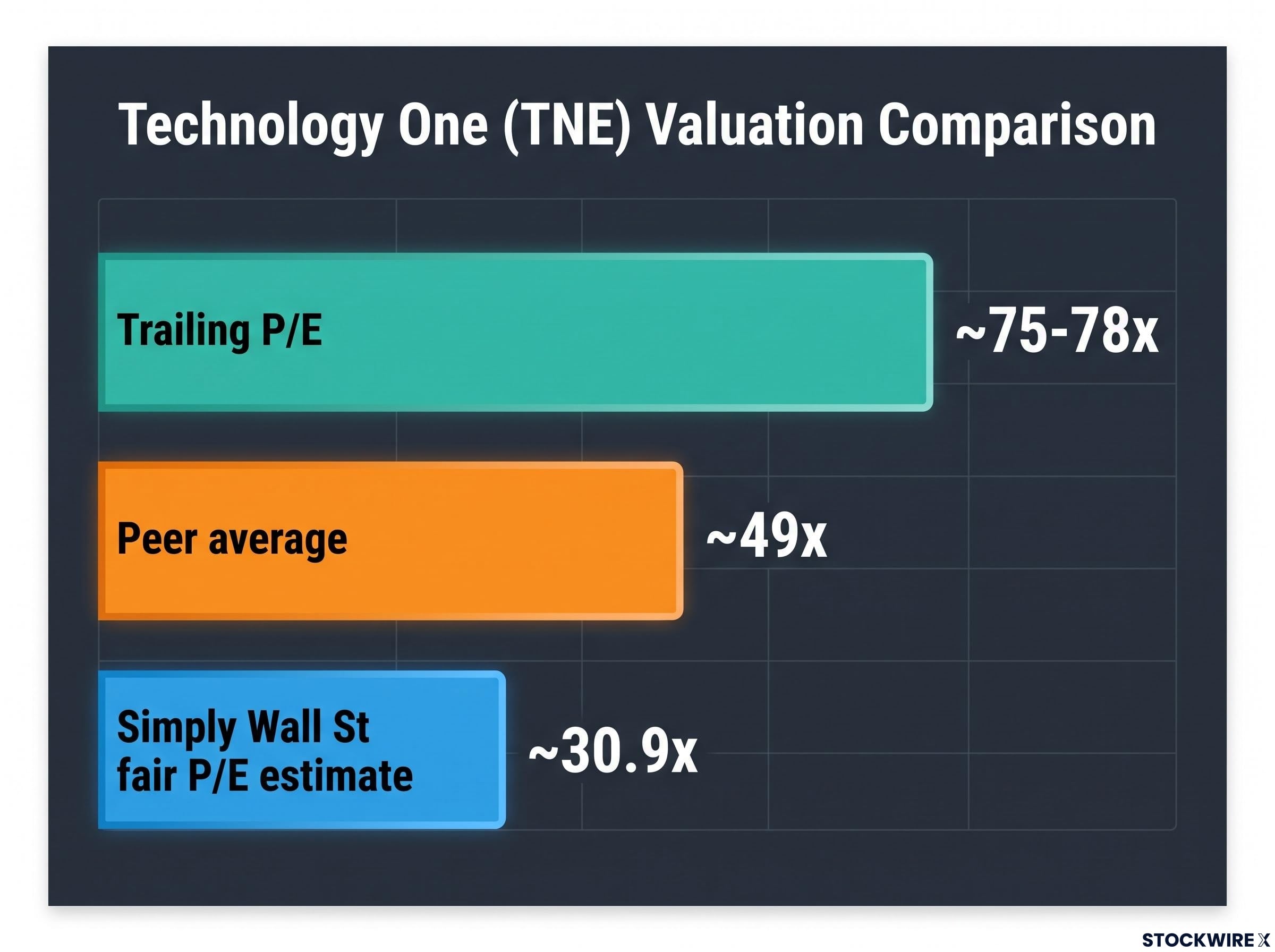
| Trailing P/E | ~75-78x | ~49x |
| Simply Wall St fair P/E estimate | ~30.9x | N/A |
At 75-78x trailing earnings, Technology One trades at roughly 1.5 times the broader peer average of approximately 49x. Against a narrower peer group, the premium is more extreme. Simply Wall St estimates a fair P/E of approximately 30.9x, implying meaningful overvaluation on that methodology. The stock experienced a significant share price decline earlier in 2026 before partially recovering to current levels.
The heroic assumption test in practice
Here is a practical way to think about what the current price requires. If you buy Technology One at 75-78x earnings and a peer investor buys a comparable software business at 49x, your investment needs Technology One’s earnings to grow dramatically and persistently faster than that peer to deliver comparable returns over a five-year horizon. Not slightly faster. Dramatically faster, every year, without interruption.
Before you pay a premium multiple for any stock, write out explicitly what you must believe to be true for the current price to be justified. If the list reads like a best-case scenario with no margin for error, you have identified a heroic assumption, and the burden of proof rests on you, not the market.
That does not mean Technology One cannot deliver. It means the price has already priced in delivery. At 75-78x, you are not buying the current business. You are buying a highly specific prediction about future earnings growth, and the gap between the current multiple and any reasonable fair value estimate is wide enough that the burden of proof sits firmly with the bull case.
What “quality at a fair price” actually looks like: Aristocrat Leisure as the contrast
Aristocrat Leisure makes the contrast tangible. Where the previous two cases force you to confront uncomfortable assumptions, Aristocrat presents a different picture: a business where quality credentials and current pricing both point in the same direction.
The quality case is strong. Aristocrat’s land-based gaming division is a highly cash-generative franchise with a dominant market position. The US market, rather than the domestic Australian market, is the primary growth driver. The company has been delivering double-digit earnings growth, and multiple valuation services estimate fair value above the current share price, suggesting modest undervaluation.
On valuation, the numbers require no heroic assumptions. The trailing P/E sits in the low-to-mid-20s. The forward P/E is in the high-teens to low-20s. Compare that to Technology One’s 75-78x or even Soul Pattinson’s stretched NAV premium, and the difference in what you are being asked to accept at entry is stark.
Aristocrat has allocated an aggregate $2.5 billion to its on-market buyback programme, running through May 2027, following completion of a prior $1.85 billion programme. More than $1.38 billion has been spent on more than 24 million shares. When management deploys capital at this scale to repurchase stock, it signals their own assessment that the shares are undervalued, and the mechanics of the buyback, reducing share count and boosting per-share metrics, provide a concrete tailwind to your returns.
ASIC’s share buy-back rules govern on-market programmes like Aristocrat’s, requiring companies to stay within the 10/12 limit and meet continuous disclosure obligations, which is why a buyback of this scale carries a credibility signal that a simple earnings forecast does not.
The structural risks are real, and you should not ignore them:
- Digital competition eroding the land-based gaming advantage
- Regulatory and social licence risk around gambling
- The interactive gaming segment remains unproven at scale
- Emerging competition from predictive markets
On current valuation data, however, Aristocrat sits much closer to “quality at a fair or slightly cheap price” than to “priced for perfection.” Identifying this alignment, where quality and price both tilt risk-reward in your favour, is the practical target of the framework.
Putting the three cases together: your repeatable quality-versus-price checklist
The three case studies map to three distinct valuation archetypes. Seeing them side by side makes the trade-offs concrete.
Choosing the right valuation metric for the business type is not a minor technical detail: dividend yield suits mature, cash-generative businesses where earnings are stable, while price-to-sales is more informative for growth companies where near-term earnings are an unreliable guide to underlying value.
| Company | Valuation archetype | Key metric | Current signal |
|---|---|---|---|
| Soul Pattinson (SOL) | NAV premium vehicle | 20-30% premium to NAV | Margin of safety has thinned |
| Technology One (TNE) | Peer-comparison multiple | ~75-78x vs ~49x peer average | Heroic assumptions embedded |
| Aristocrat (ALL) | Quality at reasonable price | Low-to-mid-20s P/E plus $2.5bn buyback | Quality and price aligned |
The pattern across all three is consistent: entry price matters even for genuinely high-quality businesses. Soul Pattinson illustrates that even a proven compounder can reach a price where the margin of safety is thin. Technology One illustrates that a genuine quality business can embed heroic growth assumptions in its multiple. Aristocrat illustrates that quality and a reasonable price can coexist.
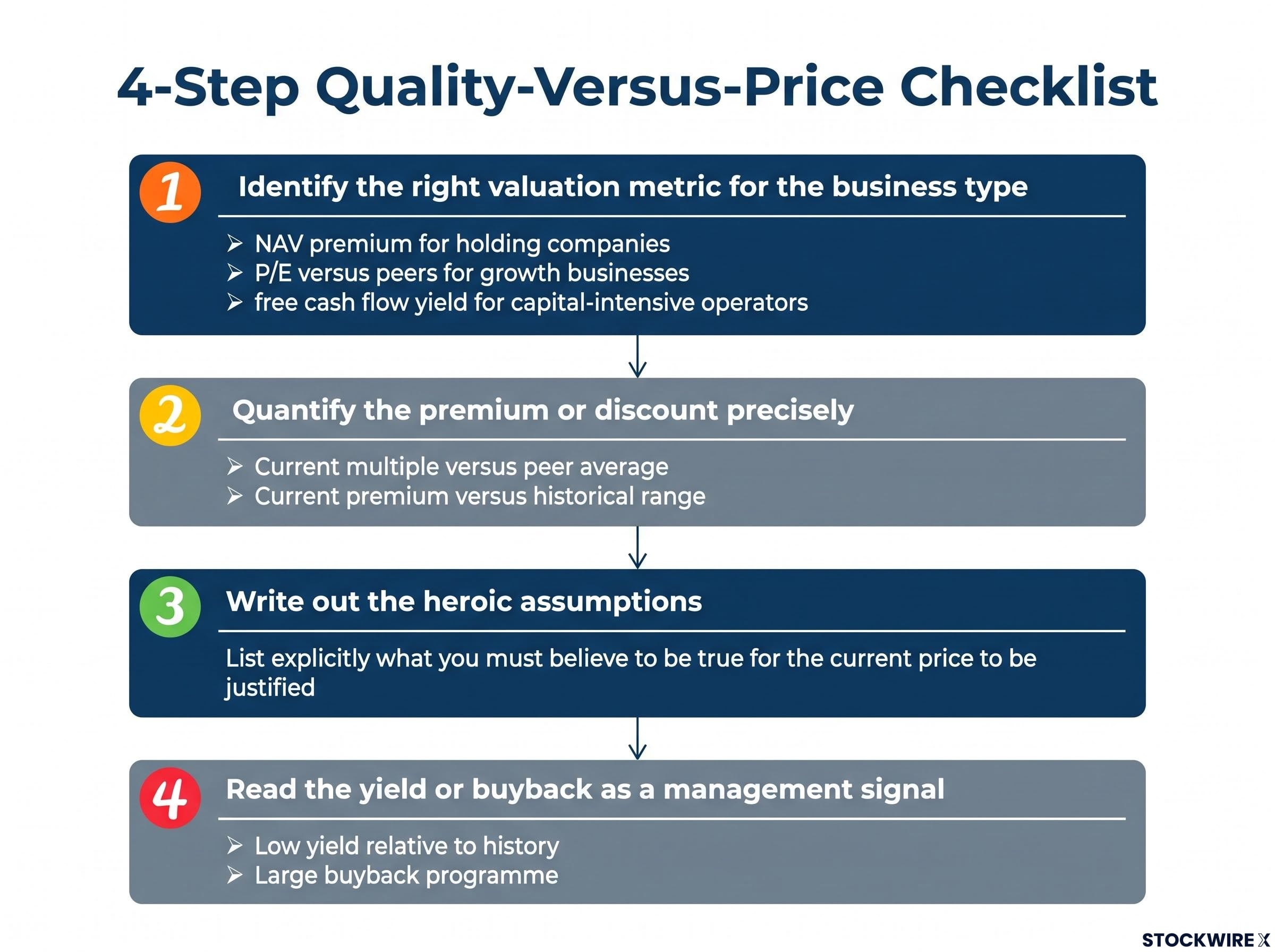
You can convert this pattern into a portable four-step process to run on any ASX stock where quality is the primary investment thesis:
- Identify the right valuation metric for the business type. NAV premium for holding companies, P/E versus peers for growth businesses, free cash flow yield for capital-intensive operators. The metric must match the business model.
- Quantify the premium or discount precisely. Do not rely on a general sense that a stock “looks expensive” or “seems cheap.” Put the numbers side by side: current multiple versus peer average, current premium versus historical range.
- Write out the heroic assumptions. List explicitly what you must believe to be true for the current price to be justified. If the list requires flawless execution, no competitive disruption, and no multiple compression, you have identified a price built on optimism rather than evidence.
- Read the yield or buyback as a management signal. A low yield relative to history tells you the price has run ahead of fundamentals. A large buyback programme tells you management believes the shares are undervalued. These are not guarantees, but they are data points from the people with the best information.
This is not a one-off exercise. Valuations move. Revisit the checklist periodically as prices shift, because a stock that fails the test today may pass it at a lower entry point next quarter.
When quality earns its premium and when it does not
Quality earns its premium when three conditions hold: the premium is modest relative to the demonstrated advantage, the growth assumptions embedded in the price are achievable rather than heroic, and the yield or buyback signal confirms management’s own view of value. When all three align, as they do with Aristocrat at current prices, the risk-reward tilts in your favour. When one or more break down, as they do with Soul Pattinson’s stretched NAV premium and Technology One’s extreme multiple, you are paying for a prediction, not a position.
The framework does not produce certainty. No framework does. What it produces is clarity about what you are accepting when you pay a given price. Explicit assumptions are better than unexamined ones, and a bad entry price is one of the few investment mistakes that even a great business cannot fix.
The goal is not to avoid quality stocks. The goal is to pay a price that leaves room for reality to disappoint slightly without destroying your investment thesis.
Before your next ASX purchase where quality is the primary thesis, run the four-step checklist. The numbers will tell you whether you are paying for quality or paying for perfection.
This article is for informational purposes only and should not be considered financial advice. Investors should conduct their own research and consult with financial professionals before making investment decisions. Past performance does not guarantee future results. Valuation estimates and financial projections are subject to market conditions and various risk factors.