In a region where a softer US dollar ought to lift every currency, it is not doing so. The Korean won is pulling ahead of its neighbours, and the gap is widening. That divergence is the story.
The broader backdrop looks straightforward enough: US Treasury yields are easing, the dollar index has softened, and capital is rotating toward Asia. But the gains are concentrated, not broad. Commodity-sensitive and geopolitically exposed currencies are stalling or declining even as the won and the Taiwan dollar extend their runs. Generic regional exposure misses the point entirely. The question is not whether Asia FX benefits from dollar weakness; it is which currency captures the most durable version of that benefit.
Here is a structured framework for understanding why the won stands out, what its structural drivers look like over the medium term, and what near-term caution actually means for someone considering an expression of this view. The aim is analytical clarity and actionable awareness, not a directional call.
Why Asia FX is moving selectively, not as a bloc
Softer US Treasury yields and a weaker dollar index have created a supportive regional backdrop, but the currency moves across Asia tell a story of concentration, not uniformity. Lloyd Chan, FX Strategist at MUFG, has framed this dynamic explicitly: not all Asian currencies are sharing equally in the dollar softness, with gains flowing toward currencies backed by genuine structural support while those without it are being passed over.
Dollar index dynamics at the 100 level concentrate option strikes, stop-loss clusters, and algorithmic triggers in a way that amplifies whichever macro catalyst arrives first, and the Fed’s hawkish posture holding rates at 3.50-3.75% remains the structural ceiling on how far the current dollar softness can extend without a decisive shift in US rate expectations.
The two groups are worth naming directly:
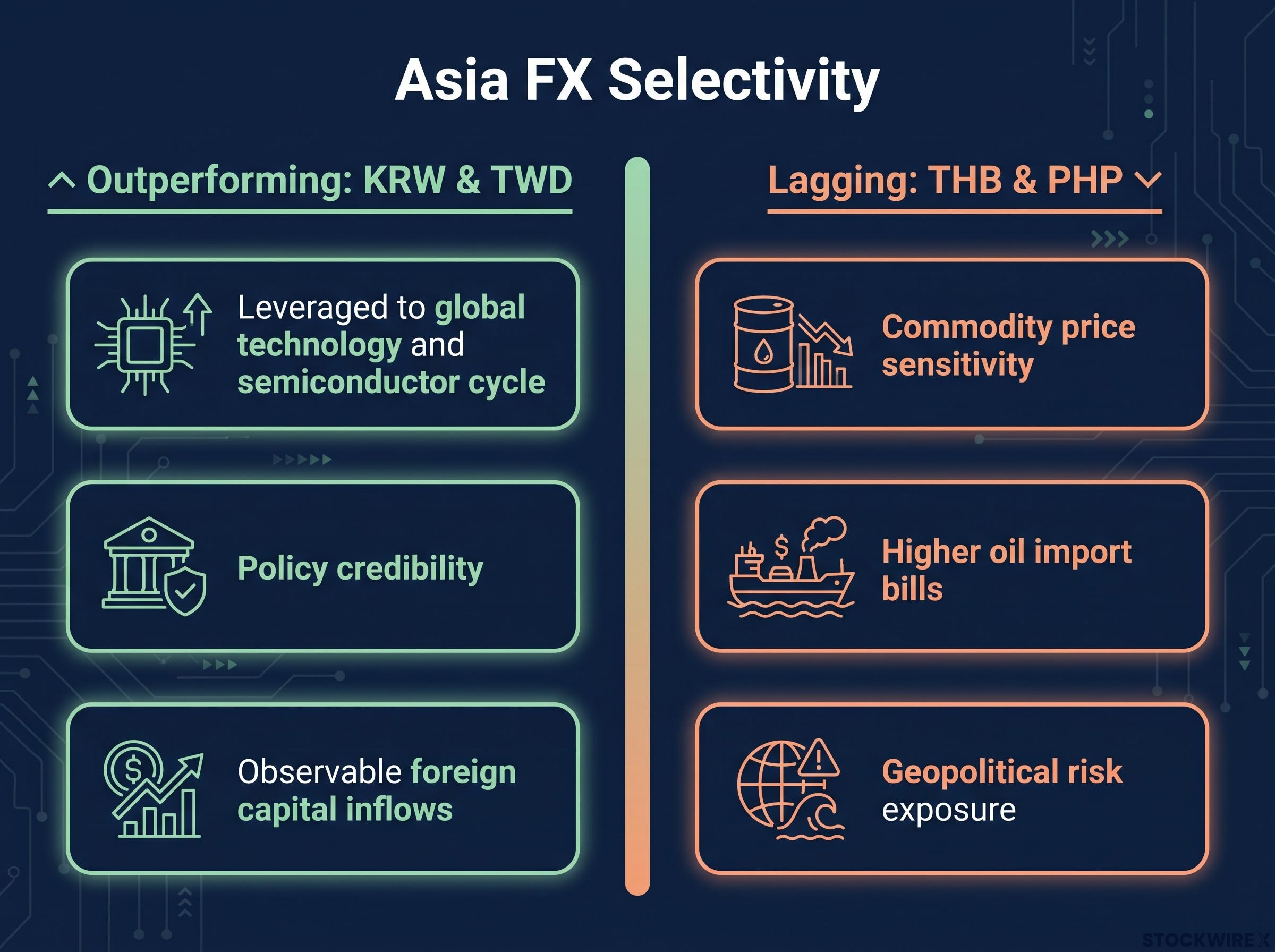
- Outperforming: KRW and TWD, both leveraged to the global technology and semiconductor cycle, with policy credibility and observable foreign capital inflows supporting the bid.
- Lagging: THB and PHP, weighed down by commodity price sensitivity, higher oil import bills, and geopolitical risk exposure that has kept foreign investors cautious.
That selectivity pattern tells you something actionable. A generic long-Asia-FX position would dilute returns by averaging in currencies without the structural tailwinds the won carries. Currency selection, not regional beta, is the analytical challenge here.
When big ASX news breaks, our subscribers know first
What makes the Korean won structurally different from its regional peers
The won’s outperformance is not a single-factor story. Three reinforcing structural advantages are at work simultaneously, and most regional peers cannot replicate the combination. Understanding each pillar matters if you are trying to distinguish a durable position from a momentum trade chasing recent price action.
Technology and semiconductor cycle linkage
Samsung Electronics and SK Hynix anchor global supply in memory chips and advanced semiconductors. That is not a generic export story. These two companies sit at the centre of the AI and data centre buildout that is driving capital expenditure commitments across the world’s largest technology firms.
In June 2026, Seoul announced more than 1,000 trillion won (approximately $650 billion) in planned AI and chip-related investment through 2035, with roughly 800 trillion won earmarked from Samsung and SK Hynix for new fabrication plants and related infrastructure. Those commitments reinforce expectations of sustained export earnings and capital expenditure flows, which attract foreign portfolio investment into Korean equities and bonds.
The record foreign portfolio inflows into Korean equities on 31 July 2026, when overseas investors channelled approximately 7.2 trillion won into the KOSPI in a single session, illustrate precisely how equity market momentum and currency demand reinforce each other within the same structural cycle.

The FX demand channel this creates is structural, not speculative. Foreign investors must buy won to purchase Korean assets, generating recurring currency demand that persists as long as the investment cycle does.
Policy credibility and capital flow mechanics
In July 2026, the Bank of Korea delivered its first interest rate hike in over three years, raising the policy rate by 25 basis points to 2.75%. Markets read the decision, and the central bank’s openness to further tightening, as a signal of commitment to currency stability and inflation control.
USD/KRW slipped toward the mid-1,480s immediately after the hike. For a reader evaluating won exposure, the policy dimension matters because it provides a backstop that several regional peers lack. Some other Asian central banks are perceived as slower to act or more constrained by domestic growth concerns, which limits their ability to defend their currencies when conditions shift.
The Bank of Korea’s July 2026 rate decision, published on the central bank’s official monetary policy board page, confirmed the 25 basis point hike to 2.75% alongside forward guidance that markets interpreted as openness to further tightening if conditions warranted.
Lloyd Chan at MUFG views the Korean won as one of the most preferred ways to gain exposure to Asian currency strength in a less supportive dollar environment.
For someone considering where to express a dollar-weakness view within Asia, the won offers a layered structural thesis rather than a single-factor bet. That layering improves the risk-adjusted logic of the position.
Reading the valuation backdrop: catch-up or overshoot?
The won’s recent appreciation did not emerge from a position of strength. USD/KRW briefly traded above 1,560 earlier in 2026, levels not seen since the global financial crisis era. That prior weakness is the context against which the current rally needs to be measured.
The 2026 range data puts the move in perspective.
| Metric | Level | Significance |
|---|---|---|
| 2026 high | ~1,562 | Peak dollar strength; won at crisis-era weakness |
| 2026 low | ~1,414 | Strongest won level this year prior to August |
| 2026 average | ~1,482 | Midpoint anchor for the year’s range |
| Post-BoK hike (July 2026) | Mid-1,480s | Rate hike arrested prior weakness |
| Mid-August 2026 | High-1,300s | Current level; ~5% one-month USD/KRW decline |
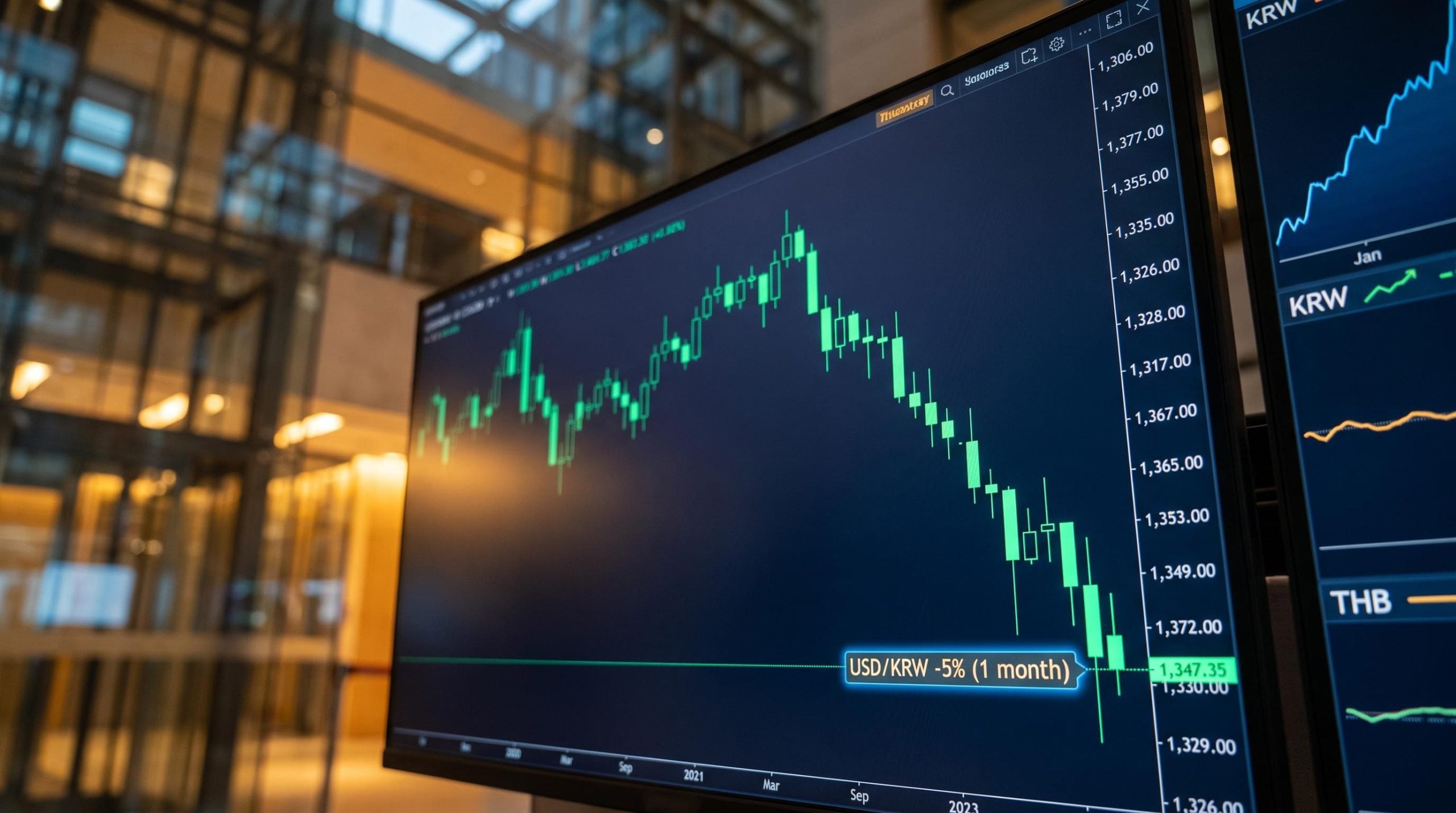
USD/KRW has fallen roughly 5% over the past month and approximately 2% over the current month, measures of notable won strength in a compressed window. Yet the gap separating the 2026 peak near 1,562 from current levels in the high-1,300s indicates that the years of accumulated underperformance have only been partially unwound.
For strategists who see Korea’s export competitiveness and investment pipeline as under-reflected in prior FX pricing, the recent gains look more like catch-up than excess. That distinction matters for whether this trade feels crowded or still has room on the medium-term thesis.
Where the near-term risks sit and why they matter for entry
The structural case may be intact, but the pace of the move introduces friction. Believing the medium-term thesis and knowing when to express it are two different problems, and the near-term picture argues for caution on timing.
Three risk factors deserve specific attention, ranked by immediacy:
- Momentum overextension. A roughly 5% one-month decline in USD/KRW is sizable for a major Asian currency. According to MUFG, the pair has moved into oversold territory and the risk of a consolidation phase or partial pullback has risen materially, as short-term traders reassess positions. Market history suggests that moves of this speed are rarely sustained in a straight line.
- Yen cross-currency sensitivity. MUFG analysis shows that KRW’s responsiveness to the Japanese yen has increased over the past two years, with KRW standing out as the most responsive Asian currency to JPY strength scenarios. That linkage cuts both ways: if yen strength reflects risk-off sentiment rather than orderly dollar decline, KRW can be pulled into volatile cross-currency swings tied to regional positioning.
Yen cross-currency dynamics are particularly relevant here because KRW has become the most responsive Asian currency to JPY strength scenarios over the past two years, and the structural trap the Bank of Japan faces, where rising debt-servicing costs compete with currency defence imperatives, means yen volatility can arrive from policy directions that have nothing to do with Korean fundamentals.
- Commodity and geopolitical shock risk. Oil price spikes and geopolitical tension episodes can activate dollar safe-haven demand and temporarily overwhelm even fundamentally sound currency positions. Korea’s exposure to cyclical equities and global trade makes KRW vulnerable in those moments, regardless of its structural merits.
Lloyd Chan has cautioned that spikes in geopolitical tension and higher oil prices can push several Asian currencies to new lows and force local authorities to respond, even when the fundamental story remains intact.
The near-term overextension signal does not invalidate the medium-term thesis. But chasing current levels without accounting for a consolidation phase could mean entering at the worst point of a near-term pullback. That is the difference between a structural conviction and a well-timed position.
Building a positioning framework: KRW versus a generic Asia FX basket
The analytical case sharpens when measured against the alternative. A generic long-Asia-FX approach averages in currencies without the structural tailwinds KRW carries, diluting returns and adding exposure to commodity and geopolitical risks that the won’s sector linkage helps offset.
Four criteria distinguish KRW from the broader basket:
| Criteria | KRW | Generic Asia FX basket |
|---|---|---|
| Technology cycle linkage | Deep, multi-year semiconductor and AI connection | Mixed; most peers lack direct tech-cycle leverage |
| Policy credibility | BoK demonstrated willingness to hike rates | Uneven; some central banks perceived as constrained |
| Macro dependency (dollar backdrop) | Requires soft dollar; necessary condition | Same dependency, but less structural offset if dollar firms |
| Regional outperformance evidence | Leading Asia FX in recent months | Average diluted by THB, PHP underperformance |
Lloyd Chan at MUFG has specifically identified KRW as the standout vehicle for capturing Asia FX upside in an environment where the dollar is losing ground. For the commercially-oriented reader, this section translates the analytical case into a positioning lens: what to own, what conditions to monitor, and why a concentrated view outperforms a diversified one in this specific macro configuration.
The persistently supportive dollar backdrop is not guaranteed. It is the single most important external dependency the bullish won thesis requires, and it must be monitored actively.
The dollar index breakdown below 98.80 in mid-August 2026, where every prior support level has rotated into resistance, is the proximate macro condition the bullish won thesis is currently riding, and the Jackson Hole symposium on 27-29 August carries a clear expiry date for that technical configuration.
What the medium-term thesis requires to hold, and what would break it
The structural case for the won is conditional, not directional. Treating it as a monitoring framework rather than a fixed view is the most durable way to hold the position.
Conditions that support the thesis:
- The dollar index remains soft and US yields do not re-accelerate sharply
- The semiconductor and AI capex cycle continues to generate Korean export earnings and foreign portfolio inflows
- The Bank of Korea maintains its policy credibility with a willingness to act on rates
- Cross-currency dynamics (particularly yen movements) remain orderly rather than risk-off driven
Signals that would break or materially weaken it:
- A reassertion of dollar strength driven by renewed Federal Reserve hawkishness or a shift in rate expectations
- A reversal in the global technology cycle that compresses semiconductor demand and Korean export earnings
- A geopolitical escalation on the Korean peninsula that reprices sovereign risk
- A sharp yen weakening episode that reverses the supportive cross-currency dynamic KRW has benefited from
Earlier episodes in 2026 showed what a thesis break looks like in price action: when US yield re-acceleration pushed Asian currencies, including the won, under renewed pressure, the structural story did not protect against the short-term drawdown. Knowing what would break the thesis is as important as understanding why it is compelling; it gives you the monitoring framework to distinguish between a temporary setback and a structural reversal.
The structural case is intact. The near-term entry requires patience. And among regional peers, the Korean won remains the most direct expression of the Asia FX dollar-weakness thesis, provided the conditions that support it continue to hold.
This article is for informational purposes only and should not be considered financial advice. Investors should conduct their own research and consult with financial professionals before making investment decisions. Past performance does not guarantee future results. Financial projections are subject to market conditions and various risk factors.