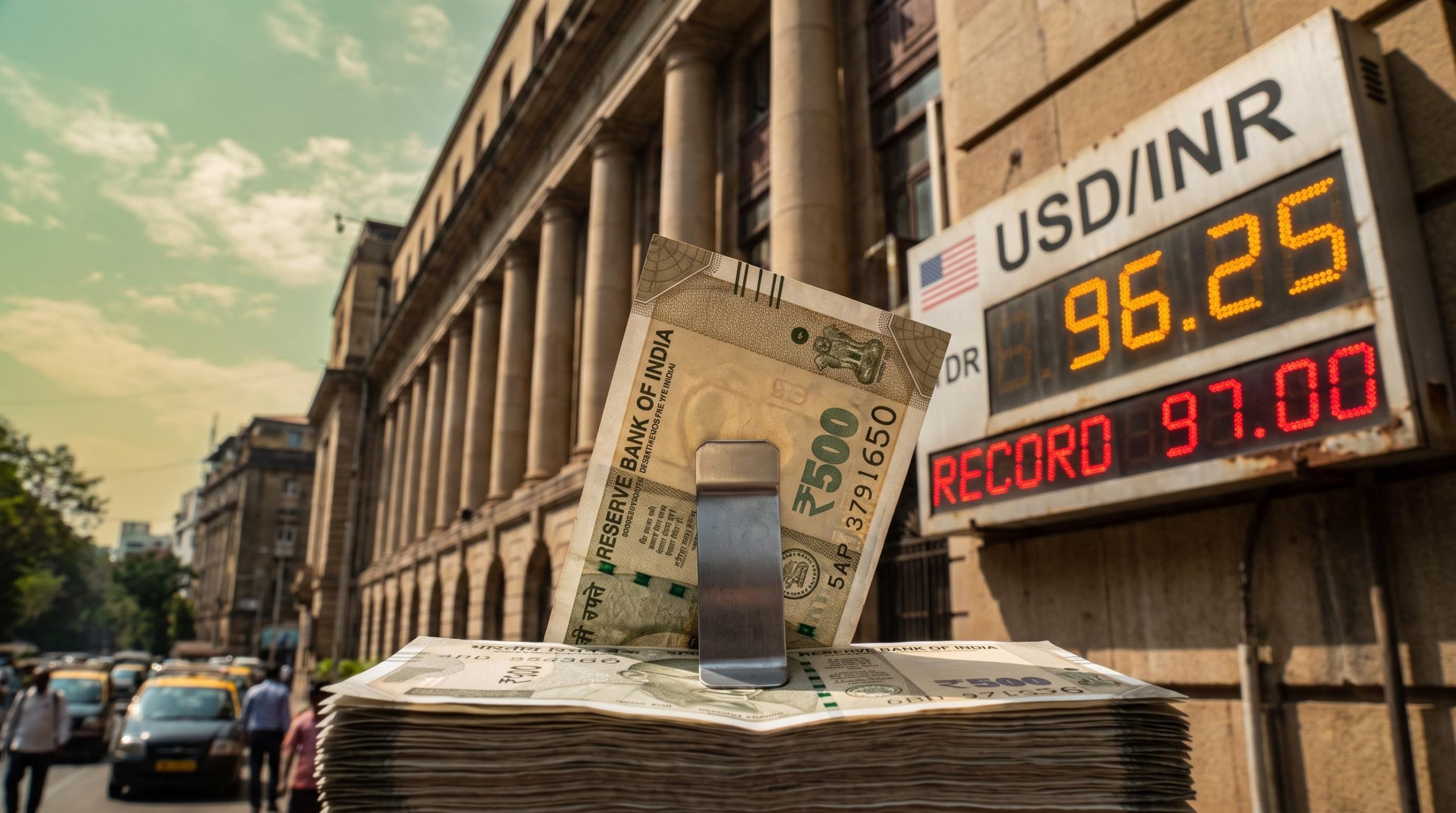
The Reserve Bank of India held its repo rate at 5.25% this month and kept its stance at neutral. That was the headline. The minutes, released on Wednesday 19 August 2026, tell a different story. Deputy Governor Poonam Gupta made clear she sees no case for rate reductions in the near term. The MPC split showed four of the six members adopting a position ranging from neutral to outright cautious. Governor Sanjay Malhotra put on record that a shift toward broad-based tightening would be warranted should inflation continue to build. The projected Q3 FY27 inflation print of 5.9% sits just 10 basis points below the upper bound of the RBI’s tolerance band.
The timing matters. These minutes landed this week, several weeks after the early-August meeting, into a market still pricing relative calm on Indian rates. Central bank minutes routinely reveal more than the headline decision, and this instance is a particularly clear case of that gap between the reassurance and the reality.
Here is what the minutes actually reveal about the RBI’s inflation outlook, and what it means for how you read Indian bonds, equities, and the rupee from here.
The gap between the RBI’s public message and its internal stance
The announcement was designed to reassure. Repo rate unchanged at 5.25%. Neutral stance, unanimous. Growth described as resilient. Headline inflation characterised as within the 2-6% tolerance band with core pressures still modest. Governor Malhotra framed inflation as largely supply-driven. Nothing to see here.
Then the minutes arrived, and the tone shifted.
- Public stance: Unanimous hold, neutral, data-dependent, growth resilient
- Internal stance: Four of six members neutral-to-cautious; Deputy Governor Gupta making plain that rate cuts are off the table; Governor Malhotra naming the specific conditions under which tightening would be warranted
- Conditional language: Multiple members noted a “case for a hike may emerge” if inflation becomes persistent or broad-based
Deputy Governor Poonam Gupta took the hardest line on the committee, ruling out any prospect of near-term rate reductions and standing as the most explicitly hawkish voice on a panel that publicly projects calm neutrality.
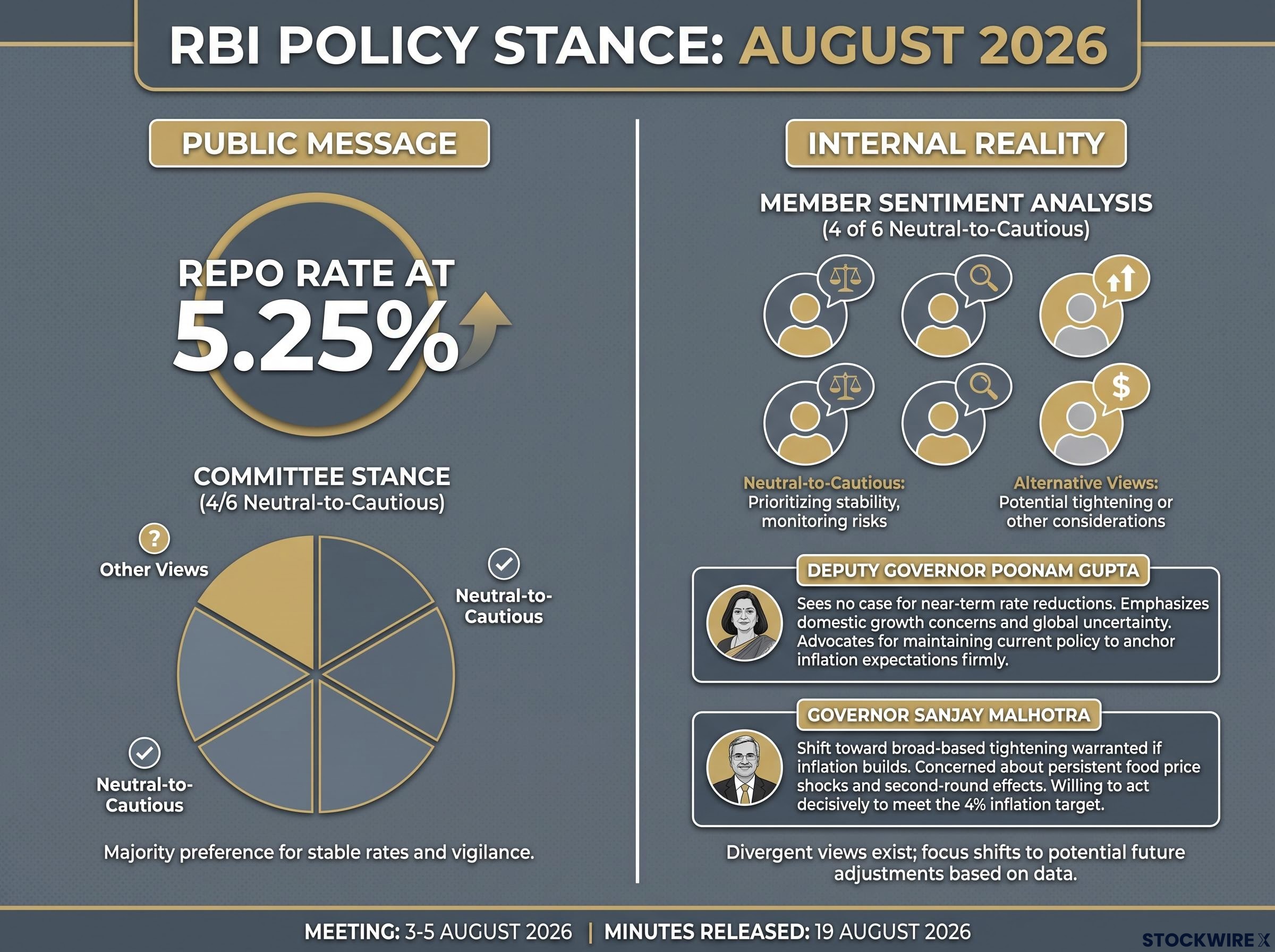
A committee that signals continuity in its press release while naming tightening triggers in its minutes is not a committee sitting on the fence. It is a committee with a directional bias it has chosen not to advertise. If you are pricing an early rate cut cycle into Indian assets, you are making a direct bet against the conditional logic the committee has put on the record.
When big ASX news breaks, our subscribers know first
What the quarterly inflation profile actually reveals
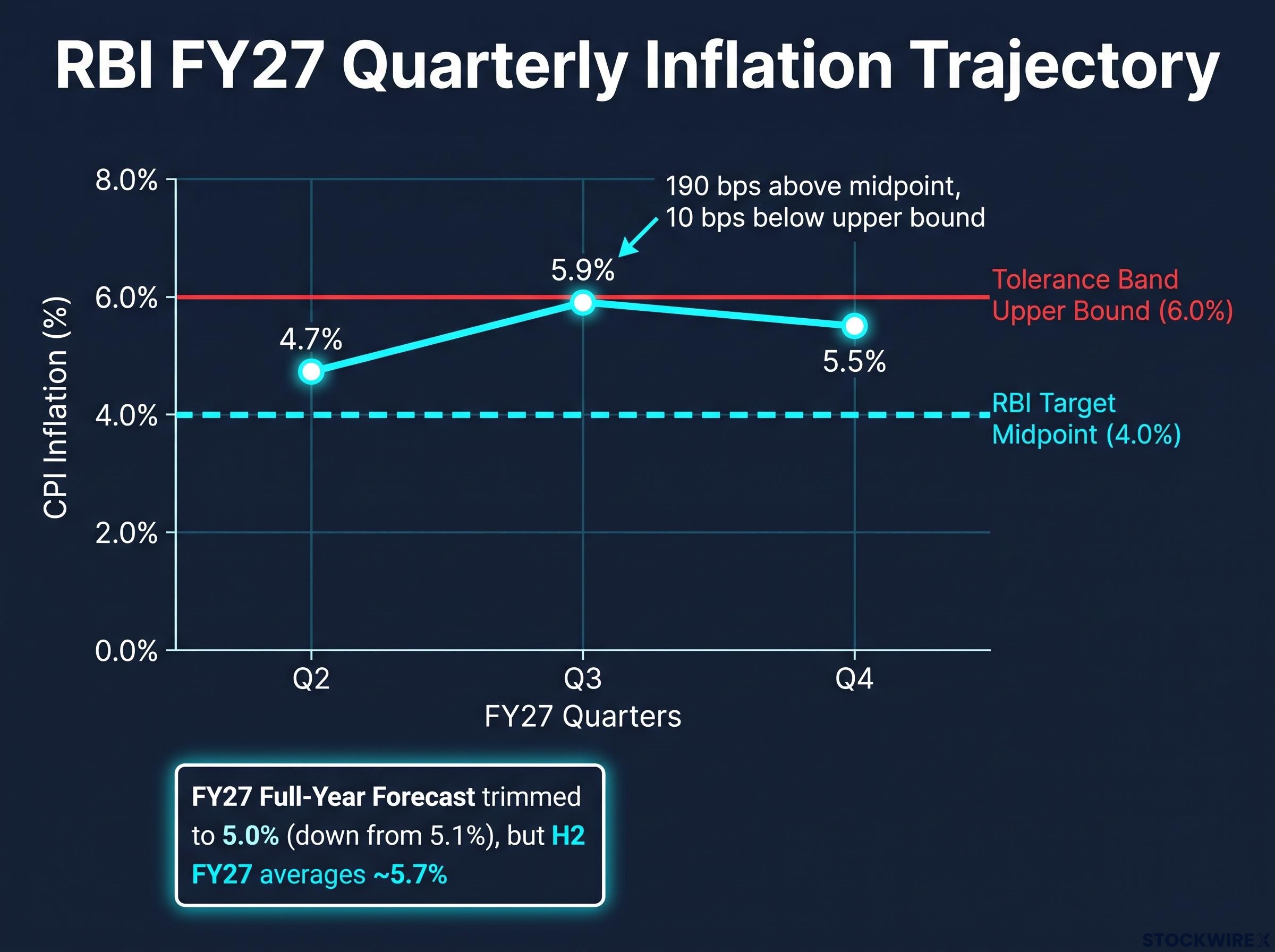
The RBI trimmed its full-year FY27 CPI forecast to 5.0%, down from 5.1%. That sounds manageable. It is the quarterly path underneath that headline that changes the picture.
| Quarter | CPI Forecast (approx.) | RBI Target Midpoint | Distance from Midpoint |
|---|---|---|---|
| Q2 FY27 | 4.7% | 4.0% | +70 bps |
| Q3 FY27 | 5.9% | 4.0% | +190 bps |
| Q4 FY27 | 5.5% | 4.0% | +150 bps |
| H2 FY27 Average | ~5.7% | 4.0% | +170 bps |
The annual average of 5.0% flatters what is happening in the second half. H2 FY27 averages approximately 5.7%, running near the top of the official tolerance band. That is a materially different signal about where policy pressure will concentrate, and the timing of that pressure is what matters most for asset pricing.
Why the tolerance band ceiling matters more than the annual average
The RBI’s 2-6% tolerance band is not a target range. The target is the 4% midpoint. The band exists as a boundary; proximity to the 6% ceiling triggers a formal explanation requirement from the central bank to the government and increases political and institutional pressure to act.
Q3 FY27 at 5.9% is 190 basis points above the target midpoint and only 10 basis points below the upper bound. That makes it the single most policy-relevant data point in the entire quarterly profile. If you focus on the full-year average, you miss the distribution problem. The quarterly path is where the policy risk lives.
The three risk clusters driving the hawkish bias
The committee did not identify a list of disconnected threats. It identified three risk channels that feed into each other, and that interconnection is what makes the tightening bias structural rather than speculative.
- Food and monsoon risk: The inflation assessment was tied explicitly to how the monsoon season develops and whether El Niño conditions emerge. Food inflation is the primary current driver of headline CPI, and repeated food shocks risk triggering second-round effects on wages and expectations, which would be far harder to dismiss as transitory.
- Oil and global energy risk: India is a major energy importer, and the committee named oil price risk and second-round effects as a specific concern. Pass-through from global crude prices to domestic CPI is a structural feature of the Indian economy, not a temporary one.
- Geopolitical and external uncertainty: The committee characterised the global environment as “uncertain,” encompassing geopolitical tensions, global growth risks, and their potential spillover into commodity prices and financial conditions. The minutes flagged that cost pressures were already showing signs of filtering through to a wider range of spending categories.
Oil price pass-through into headline inflation is frequently underestimated because energy costs embedded in imported goods, airfares, and logistics appear in goods and services categories rather than the headline energy line, a measurement gap that is relevant to the RBI’s assessment of second-round effects from global crude prices.
In their deliberations, members tied the inflation trajectory directly to monsoon performance and the possibility of El Niño weather patterns taking hold, drawing a clear line between domestic agricultural conditions and the path of headline CPI.
For you as an investor, the interconnected nature of these clusters means a negative surprise in any one of them does not stay contained. A poor monsoon raises food prices. Higher oil compounds the cost pressure. A geopolitical escalation pushes both simultaneously. Each shock increases the probability of the broad-based pressure the committee has explicitly identified as the tightening trigger.
How central bank minutes diverge from policy announcements (and why it matters)
Central bank announcements and minutes serve different institutional purposes. The announcement is designed for market management: avoid unnecessary volatility, preserve optionality, signal continuity. The minutes are the record of actual deliberation, where members name their concerns, state their conditions, and reveal the range of views the headline decision compressed into a single sentence.
Conditional language in policy statements has a precise institutional function: it allows committees to signal directional bias without committing to it, preserving optionality while still shaping market expectations, and the documented history of guidance expansion and contraction at the Fed illustrates how that language shifts when committees face elevated uncertainty.
The lag between the meeting and the minutes release amplifies this. The RBI met on 3-5 August 2026. The minutes landed on Wednesday 19 August. That gap means the minutes arrive in a different market environment and can move prices if they diverge materially from what markets assumed after the announcement. In this case, they did: Governor Malhotra’s “wait for more certainty” language is considerably more informative than the headline rate decision.
For anyone positioned in Indian assets or watching emerging market central banks more broadly, the analytical habit is straightforward:
- Identify the gap between the announced decision and the internal tone. Is the committee more cautious than the headline suggests?
- Locate the conditional language that names the specific triggers for tightening or easing. These conditions are the committee’s own stated thresholds.
- Assess whether current market pricing reflects the conditional scenario or only the baseline. If markets are pricing the benign case alone, the minutes may be telling you the tail risk is underpriced.
This framework applies to every central bank, not just the RBI. The minutes are where the conditional logic lives, and the conditional logic is what drives medium-term positioning decisions.
Asset class implications of a conditional tightening bias
The minutes do not signal an imminent hike. They signal something more nuanced: a committee that has defined what a tightening trigger looks like and left it on the record. For portfolio positioning, the question is whether current market pricing reflects that defined tail or ignores it.
Government bonds face the most direct exposure. The inflation trajectory, with 5.9% projected in Q3 FY27, makes early or aggressive rate cuts implausible. Long-duration bonds are exposed to upward yield pressure if the market reprices from “cuts coming” toward “higher for longer” or, in the tail scenario, a late-cycle hike.
Equities require sector-level differentiation. Rate-sensitive names in real estate, infrastructure, and highly leveraged firms face a less supportive backdrop if borrowing costs stay elevated or move higher. Banks and well-capitalised financials sit in a different position, potentially benefiting from a prolonged period of positive real rates and stable net interest margins, provided inflation does not overshoot. Consumer-facing sectors face margin risk from persistent food and energy cost pressures, particularly firms with limited pricing power.
The rupee has traded in a contained range against the dollar, with sellers emerging each time USD/INR has pressed toward the 96.0 level. The one-month implied volatility measure has eased back through August, having reached its peak back in June 2026. That surface calm reflects the pause, not the conditional risk beneath it. A scenario of higher global energy prices or tighter US financial conditions would compound the domestic inflation picture and shift the RBI’s calculus further toward tightening.
| Asset Class | Baseline Scenario | Tightening Scenario | Key Risk Factor | Positioning Consideration |
|---|---|---|---|---|
| Government Bonds (long duration) | Yields stable, range-bound | Yield curve steepens, long end reprices higher | H2 FY27 CPI prints above forecast | Duration exposure carries asymmetric downside risk |
| Rate-Sensitive Equities | Elevated borrowing costs persist | Further tightening compresses margins | Broad-based cost pressures spreading | Less supportive backdrop than market may assume |
| Bank / Financial Equities | Positive real rates support NIMs | Benefits if inflation stays contained below 6% | Inflation overshooting tolerance band | Relative outperformer if pause extends |
| Indian Rupee | Contained volatility, range-bound near 96.0 | Downward pressure if global energy spikes | Oil prices, US rate trajectory | Latent tail risk higher than realised vol suggests |
The risk distribution is asymmetric. The minutes have defined what a tightening trigger looks like. Positioning that assumes only the benign baseline is carrying tail risk that current market pricing may not reflect.
The broader global capital reallocation underway in 2026, with nearly $800 billion flowing into equities and $600 billion simultaneously into fixed income, has been concentrated in emerging markets and Asia, meaning the RBI’s conditional tightening bias could intersect with a crowded positioning trade at a moment when investors have reduced their margin for error in India-exposed funds.
What the data needs to show before the RBI’s calculus changes
The committee has effectively told you what it is watching. The next two to three months will either validate the cautious baseline or force the tightening conversation from conditional to active. Here is the specific monitoring framework:
Monsoon and food prices:
- Tightening signal: Monsoon shortfall materialises in agriculture output data; food inflation broadens beyond seasonal vegetable spikes
- Extended pause signal: Monsoon tracks to normal; food inflation remains concentrated in volatile categories
Oil and global energy:
- Tightening signal: Crude prices move decisively higher on supply disruption or geopolitical escalation
- Extended pause signal: Global energy prices stabilise or decline; no major supply shock materialises
Core inflation broadening:
- Tightening signal: Evidence of cost pressures spreading into wages and non-food, non-fuel categories, the threshold the committee has explicitly named
- Extended pause signal: Core inflation holds near 4.3%; Q3 FY27 CPI prints closer to 5.5% than 5.9%
Governor Malhotra emphasised the need to “wait for more certainty” on the inflation trajectory before recalibrating the policy rate, framing the next few inflation prints as the decisive period for the committee’s assessment.
The Q3 FY27 CPI releases are the most important near-term calendar dates for India-exposed portfolios. Those prints will either confirm the committee’s baseline or activate the tightening conditional it has placed on the record.
Pricing the tail, not just the baseline
The RBI minutes reveal a committee that expects inflation to run near the top of its tolerance band through H2 FY27 and has explicitly named the conditions under which it would tighten. The neutral stance is a conditional pause, not a signal of impending ease.
Markets pricing an Indian easing cycle in the near term are betting against the committee’s own stated logic. The minutes provide the factual basis for reassessing that bet. The risk distribution is not symmetric: the benign scenario delivers a continued hold, while the adverse scenario delivers a hike that few are positioned for.
The Q3 FY27 CPI prints and monsoon outcome data are the nearest-term resolution points for the uncertainty the minutes have surfaced. Those are the releases that will determine whether the conditional tightening bias stays theoretical or becomes operational. Watch them accordingly.
For readers wanting to stress-test the broader argument that less explicit committee communication can still produce well-anchored market expectations, our dedicated guide to decoding committee silence as a policy signal examines the Warsh Fed case in detail, including the 10-year Treasury yield reaction data that contradicts the credibility-crisis framing dominant in financial commentary.
This article is for informational purposes only and should not be considered financial advice. Investors should conduct their own research and consult with financial professionals before making investment decisions. Past performance does not guarantee future results. Financial projections are subject to market conditions and various risk factors.
—