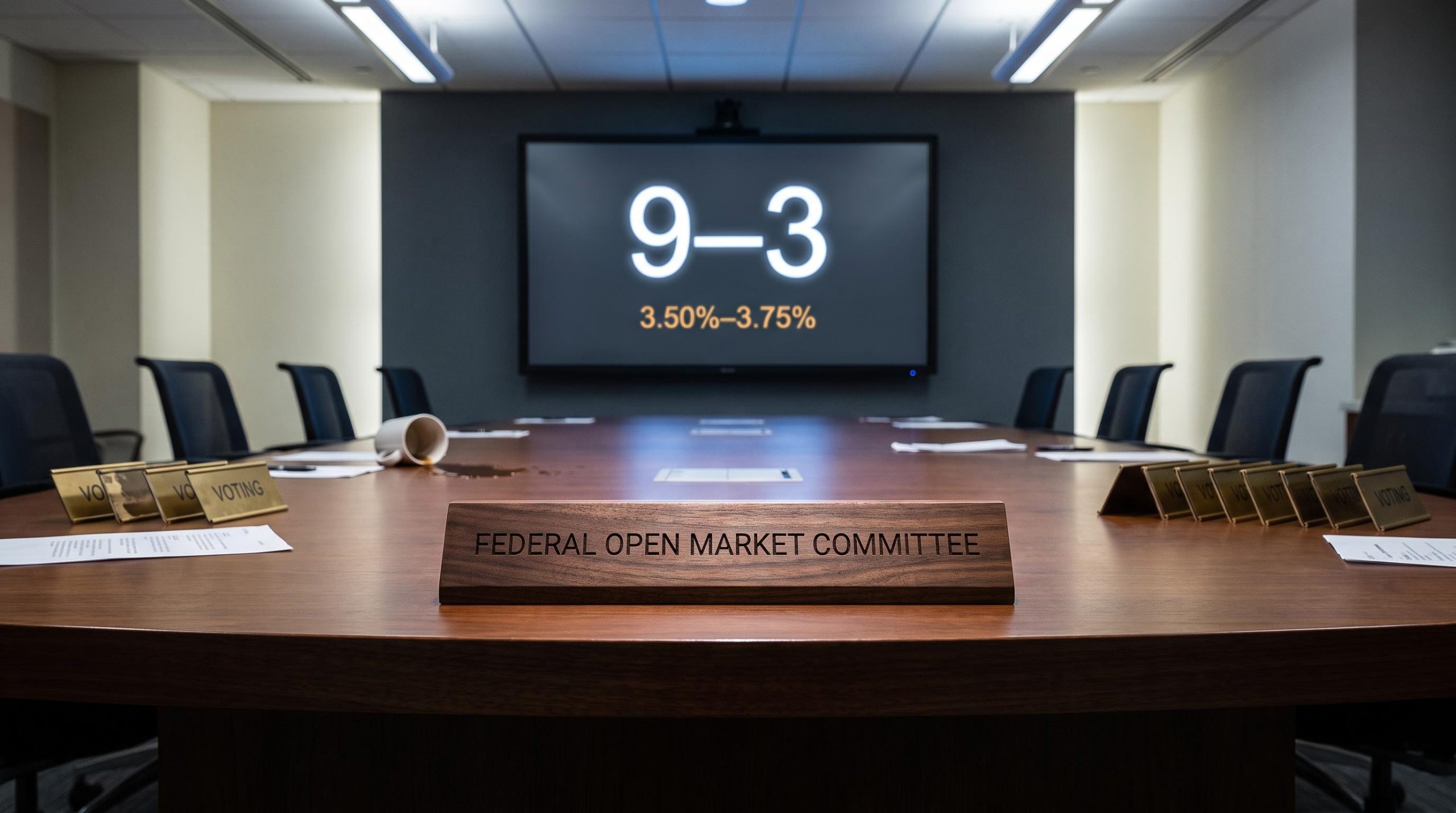
The Federal Reserve held rates for the fifth consecutive meeting at its July 28-29 gathering, and three of its members wanted to raise them instead. The 9-3 vote to maintain the 3.50%-3.75% target range, with every dissenter pushing for a 25 basis point hike, is the detail that matters most inside the July FOMC minutes. No member voted for a cut. No easing language appeared anywhere in the document.
That split is not routine disagreement. It is the most hawkish cluster of dissents since 2016, and it reframes what looked like a steady hold into something closer to a contested truce within the committee itself. The debate inside the room was not whether to ease or hold; it was whether to hold or tighten.
Here is what the minutes actually reveal about where this committee is heading, and what that means for how you read the next inflation print, the next labour market report, and the positioning assumptions baked into front-end rates.
A 9-3 hold that reads like a warning, not a pause
The headline from the July meeting is a hold. The signal beneath it is pressure.
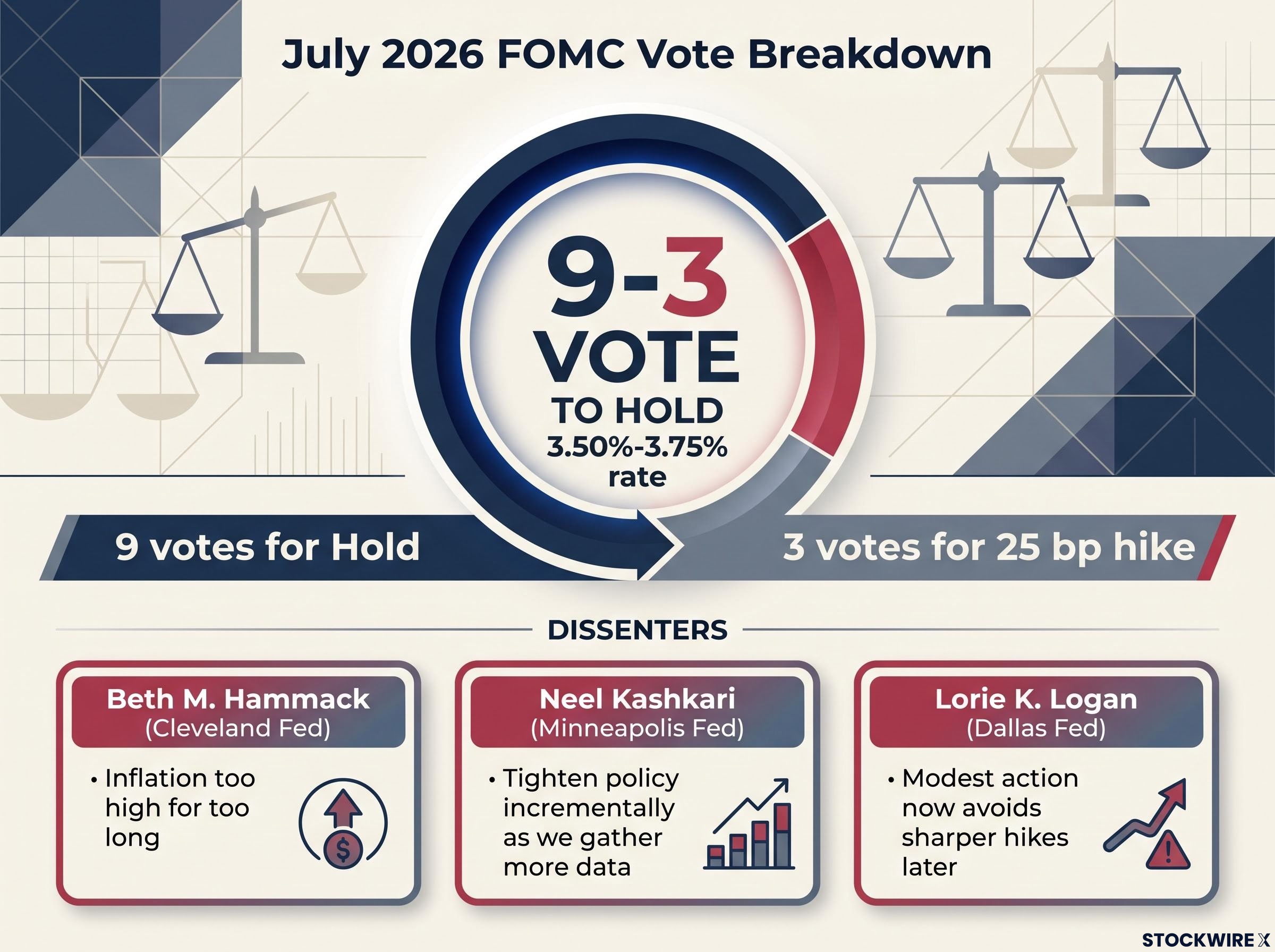
The Federal Open Market Committee (FOMC), the Fed’s rate-setting body, voted 9-3 to keep the federal funds rate at 3.50%-3.75%, the fifth consecutive meeting without a change. All three dissenters preferred a 25 basis point hike, not a cut, not an alternative framework. They wanted tighter policy.
| Meeting detail | July 2026 outcome |
|---|---|
| Date | 28-29 July 2026 |
| Policy rate | 3.50%-3.75% (unchanged) |
| Vote | 9-3 (hold) |
| Dissent direction | All three favoured a 25 bp hike |
| Consecutive holds | Fifth |
The last time three FOMC members aligned in favour of tightening against a hold majority was 2016. That episode preceded a resumption of rate hikes once inflation data cooperated.
That 2016 comparison is not cosmetic. Organised hawkish pressure of this kind has historically preceded tightening cycles resuming, not fading. The hold is the outcome; the dissent bloc is the direction of travel.
The FOMC vote split has historically been the more actionable signal for rate-cycle positioning than the headline decision itself; unified same-direction dissent clusters are associated with cyclical turning points where the committee is closest to reversing its prevailing stance.
When big ASX news breaks, our subscribers know first
Who are the three dissenters, and what are they actually saying?
The three votes against holding came from influential regional Fed presidents, each articulating a distinct case for the same conclusion: policy is not tight enough.
- Beth M. Hammack (Cleveland Fed): Inflation has been “too high for too long.” Postponing action raises the eventual cost of restoring price stability.
- Neel Kashkari (Minneapolis Fed): The committee should “tighten policy incrementally as we gather more data,” a stated bias toward gradual hikes rather than waiting for a problem to force larger ones.
- Lorie K. Logan (Dallas Fed): Current rates are insufficiently restrictive. Modest action now avoids sharper hikes later.
All three preferred a 25 basis point increase at the July meeting. The differences in emphasis, entrenched inflation risk, incremental tightening, avoiding future forced action, converge on the same policy direction.
That coherence is what matters. Three individual outlier views are noise. Three aligned regional presidents articulating a shared position publicly after the meeting is an organised bloc.
What it takes to swing the majority
A shift from 9-3 to a hike majority does not require converting every centrist voter. It requires a few.
The minutes framed risk as financial conditions not being tight enough, not as overtightening risk. That framing is significant: it means the dissenters’ argument aligns with the committee’s own stated risk assessment. If a string of firm Consumer Price Index (CPI) or Personal Consumption Expenditures (PCE) prints arrives, centrist voters would be resisting their own risk framework to keep voting for a hold. A few firm inflation readings could be enough to tip the balance.
What the Fed’s silence on easing actually signals
The most telling feature of the July minutes is what they did not contain. Three things were entirely absent:
- No cut votes. Not one member favoured easing.
- No easing language. The minutes and statement included zero discussion of conditions under which policy might be loosened.
- No overtightening risk framing. The committee discussed the risk of not being restrictive enough, never the risk of having gone too far.
That bounded debate, hold versus raise with cuts entirely off the table, is itself a policy communication. The committee is telling you the direction of its internal pressure, and it points one way.
The asymmetry in how inflation data gets read inside this committee is stark: good inflation news sustains the hold, bad inflation news strengthens the case for tightening, and no current data path opens the door to easing.
If you hold positions in front-end Treasuries or futures contracts that embed rate cuts by late 2026, the July minutes are a direct communication that the committee’s internal debate is not pointing in your direction. Inflation has remained above the 2% target for more than five years, and nothing in these minutes suggests the committee views that trajectory as grounds for relief.
Inflation above the 2% target has now persisted for more than five consecutive years, and the May 2026 print of 4.2% headline CPI, driven by a 40.5% annual surge in gasoline prices tied to the Iran conflict, illustrates why the dissenters frame delay as a compounding credibility risk rather than a cautious pause.
Kevin Warsh, fewer meetings, and what that means for how markets work
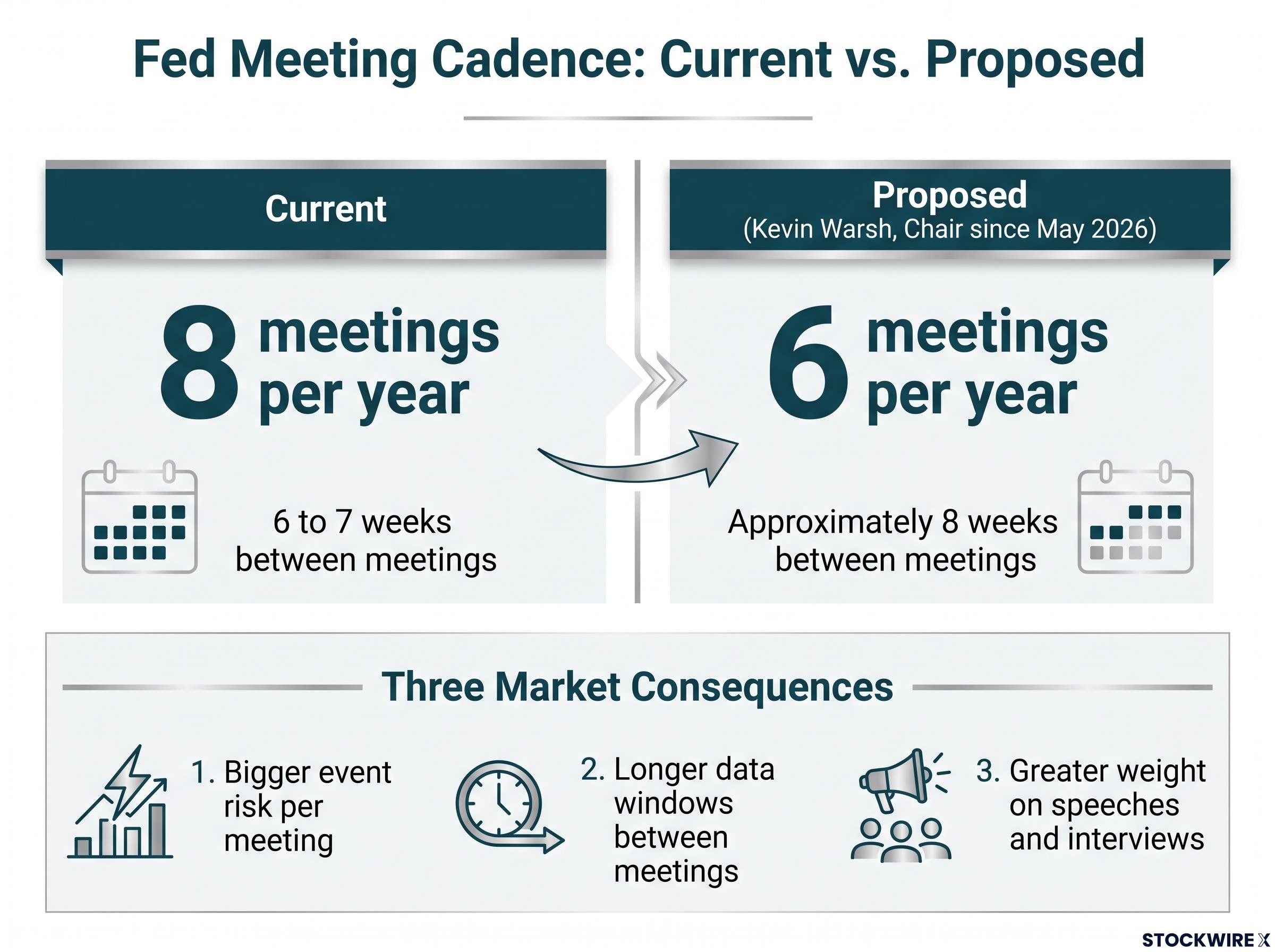
Kevin Warsh, appointed Fed chair in May 2026, has already signalled a preference for giving markets fewer explicit signals about the next policy move, a departure from the detailed forward guidance style of recent predecessors. That philosophical stance now extends to a structural question: whether to reduce the number of annual monetary policy meetings from eight to six.
Warsh’s dismantling of the forward guidance regime has structural consequences that extend well beyond meeting cadence: every data release now lands on unanchored expectations, meaning the gap between an inflation surprise and a market pricing response is shorter and less signposted than at any point in the past two decades.
The proposal is under discussion, not formalised. The 2026 meeting schedule remains unchanged at eight meetings. But if adopted in future years, the shift from roughly six to seven weeks between meetings to approximately eight weeks would change how market participants interact with the Fed calendar.
Three consequences stand out if a six-meeting cadence is eventually adopted:
- Bigger event risk per meeting. More data accumulates between fewer decision points, increasing the information content and market impact of each outcome.
- Longer data windows between meetings. Single releases like CPI or non-farm payrolls would swing expectations more forcefully in the interim, because there is more time for positioning to build before the next resolution.
- Greater weight on speeches and interviews. Intermeeting communication, Fed speeches, congressional testimony, and media appearances, would become the primary channel for managing market expectations between decisions.
How this changes the communication playbook
With fewer scheduled decision points, qualitative signal-reading would carry more weight than data-calendar-driven positioning frameworks. Warsh’s stated preference for less forward guidance compounds this: not only would there be fewer meetings, but the guidance around each one would be less explicit.
For anyone who structures macro positions around FOMC dates, via Fed-dated overnight index swaps (OIS), rate options, or volatility strategies, this would mean fewer but higher-stakes inflection points and a premium on interpreting what policymakers say between meetings, not just what they do at them.
How the July setup reprices across rates, equities, credit, and FX
The analytical threads from these minutes, the organised dissent, the easing silence, the asymmetric inflation read, converge on specific repricing risks across four asset classes.
| Asset class | July minutes implication | Key risk to watch |
|---|---|---|
| Rates | Front-end curves embedding late-2026 cuts are fighting the committee’s stated direction; right-tail hike risk is live at 3.50%-3.75% | Repricing of cut expectations if inflation stays firm |
| Equities | Long-duration growth, REITs, and utilities face persistent valuation headwinds under a higher-for-longer regime | Rotation pressure into cash-flow-focused and value exposures |
| Credit | Higher carry costs and refinancing at elevated rates compress margins; spreads may need to widen further | Leveraged issuers approaching refinancing windows |
| FX | Hawkish Fed stance relative to central banks already easing supports dollar strength | Divergence widening if peers cut while the Fed holds or hikes |
The read across these four markets is not symmetrical. The risk runs one way: pricing adjusts toward the committee’s stated direction rather than the committee adjusting toward what markets have priced. Front-end OIS and rate options skew toward further tightening that is not yet fully reflected in current positioning, and the July minutes give no signal that relief is on the way.
What changes the picture, and what would need to happen first
The base case from these minutes is a continued hold at 3.50%-3.75%, with a meaningful probability that the next move is up rather than down. Three specific scenarios frame what comes next:
- Base case (hold, skewed toward tightening): The committee continues to hold while waiting for clearer disinflation. The dissenter bloc maintains pressure. Each inflation release carries outsized weight.
- Hike scenario: A string of firm CPI or PCE prints, combined with resilient labour market data, moves centrist voters toward the dissenters’ position. The threshold is lower than a simple 9-3 margin suggests, because the committee’s own risk framework already points toward insufficient restriction.
- Cut scenario: Convincingly sub-2.5% core inflation combined with visible labour market softening. Neither condition is currently in view, and no institutional momentum behind easing exists within the committee.
The asymmetric data read is the framework to carry forward: good inflation news holds rates steady, bad inflation news raises the stakes for tightening, and no near-term data path currently opens the door to cuts.
Warsh’s preference for less forward guidance adds a layer of uncertainty around timing. The path from data to decision will have less telegraphing than markets grew accustomed to under recent chairs, which means the gap between a data surprise and a policy response could be shorter and less signposted.
The burden of proof for any dovish shift sits entirely on the data side. Every CPI and PCE release between now and the next meeting is a direct input into whether the dissenter bloc grows. That is the lens through which to interpret each upcoming print, rather than waiting for headline commentary about what the Fed might signal next.
For investors wanting to translate this rate environment into specific portfolio adjustments, our comprehensive walkthrough of defensive positioning strategies covers sector rotation, liquidity management, and equity screening criteria tailored to elevated and potentially rising borrowing costs.
This article is for informational purposes only and should not be considered financial advice. Investors should conduct their own research and consult with financial professionals before making investment decisions. Forward-looking statements about Federal Reserve policy are speculative and subject to change based on economic data and committee deliberations.