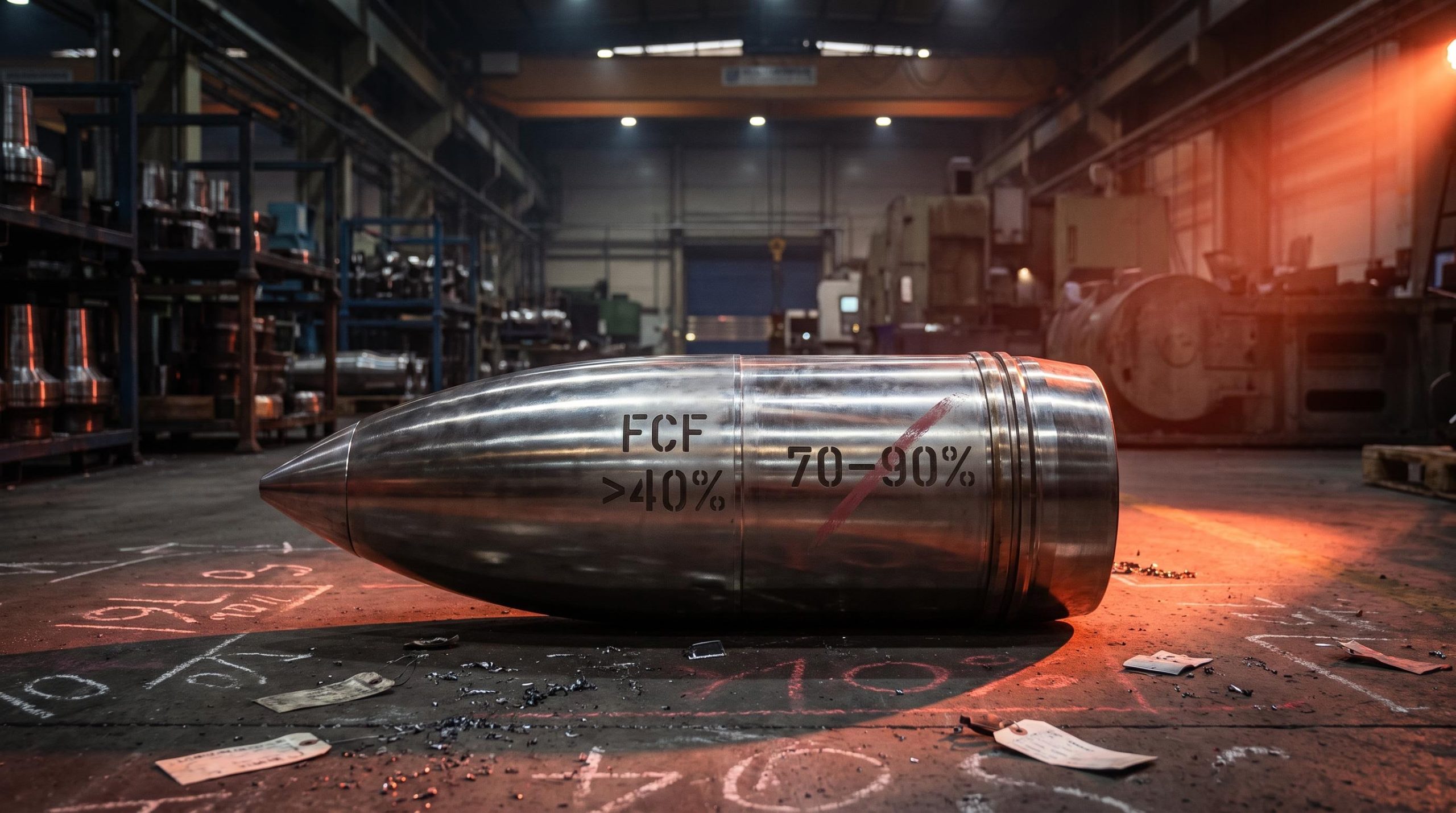
Rheinmetall guided 40-45% revenue growth for 2026 and watched its share price fall. The market had already priced the top line. What it had not priced was a free cash flow conversion guide of greater than 40%, against expectations north of 70%. Revenue expansion and cash generation are two different stories, and that gap is now the cleanest illustration of a tension running through the entire defence sector.
Three developments are reshaping the risk map simultaneously. Russian forces have closed to within approximately four kilometres of Kramatorsk. European gas storage sits at roughly 60-61% full, the lowest mid-August reading in at least five years. And the US Deputy Secretary of Defense has issued a 21-day deadline to major contractors for ammunition production ramp-up plans. Mainstream coverage has treated these as separate stories. They are not. Energy stress, battlefield momentum, and procurement urgency form a single feedback loop, and investors pricing them independently are likely underestimating the tail scenarios where they reinforce each other.
Here is what each pressure point means for the positions you may already hold, and where the asymmetric cases are starting to emerge.
Why defence stocks are recovering, and where the real constraint lies
The surface catalyst is straightforward. News that US ammunition inventories were being depleted drove a partial rebound in defence equities. A 21-day deadline was then issued by the US Deputy Secretary of Defense to leading contractors, requiring them to submit plans for scaling up production output. That directive signals acute near-term procurement urgency, not a routine budget review.
But the structural driver underneath matters more than the headline. Wars fought with consumables create sustained procurement pressure that looks fundamentally different from traditional platform demand. The distinction between the two procurement archetypes is where position selection separates from sector selection:
- Long-cycle platforms (fighters, ships, armoured vehicles): large contracts, multi-year production timelines, lumpy revenue recognition. Investment cases depend on single contract wins and budget cycle durability.
- Short-cycle consumables (ammunition, missiles, drones, sensors): high reorder rates, shorter production cycles, more durable cash flow in prolonged conflicts. Investment cases depend on throughput and production capacity, not individual contract announcements.
Ukraine’s former commander-in-chief publicly acknowledged that Russian forces consistently adapt to and neutralise each new NATO-supplied weapons system, typically within three to six months.
That adaptation cycle tells you something specific about where the cash flow sits. If every new system has a shelf life measured in months, the procurement pipeline is not driven by whether a single platform contract gets signed. It is driven by reorder frequency and consumable throughput. New Russian tanks were introduced to the battlefield requiring a minimum of 25 coordinated drone strikes to neutralise, a demonstration of how rapidly the adaptation cycle generates fresh procurement requirements. Investors treating defence as a monolithic sector bet are likely misallocating within it.
When big ASX news breaks, our subscribers know first
Russian battlefield momentum and what the map means for the timeline
Multiple Ukrainian defensive lines have been breached by Russian ground forces across several active fronts. Significant territorial gains were recorded in both the Donbas and Zaporizhzhia, including positions of considerable strategic value in the south. At the time of reporting, Russian troops had advanced to within roughly four kilometres of Kramatorsk, while Odessa faced a sharp escalation in aerial bombardment.
The cumulative picture is one of accelerating territorial momentum, contrasting with slower progress earlier in the conflict. During earlier peace negotiations, Russia’s primary condition was that Ukraine withdraw from the portions of Donbas it had not yet ceded, a demand Kyiv flatly refused.
Geopolitical shock absorption in equity markets follows a consistent pattern: price moves correlate with whether a disruption can be rerouted or offset, not with headline severity, which is why battlefield momentum near Kramatorsk has not yet produced the procurement-driven re-rating that consumption data would imply.
What the November seasonal window means for investors
Weather conditions that support ground operations are expected to deteriorate by November, effectively closing the window for sustained offensive advances toward Kramatorsk and Sloviansk, and compressing procurement timelines on both sides.
For investors, this creates a specific 8-10 week monitoring window where order intake data and production ramp signals will be most informative about the durability of the defence upcycle. The key signals to watch before November:
- Order intake announcements from ammunition, air defence, and armoured vehicle suppliers
- Contractor ramp-up confirmations following the 21-day US directive
- Peace negotiation signals that would alter the procurement timeline or reduce urgency
The battlefield map is not background colour. It is a near-term calendar that tells you when the data confirming or challenging the defence thesis will arrive.
Rheinmetall and the free cash flow problem that matters more than revenue guidance
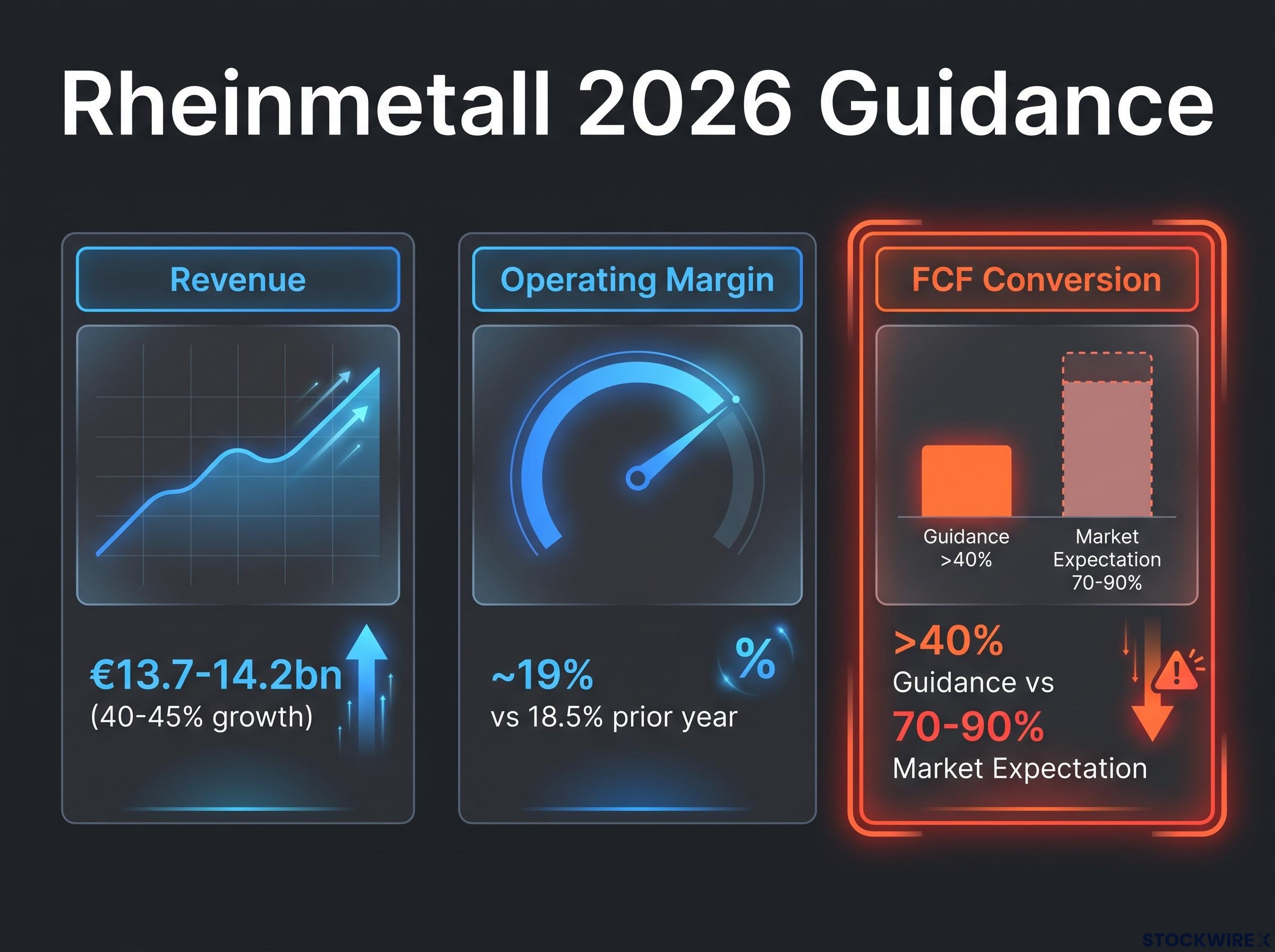
The puzzle is simple. Rheinmetall guided 2026 revenue at €13.7-14.2 billion (programme-adjusted), implying approximately 40-45% growth versus 2025. Operating margin guidance came in at approximately 19%, up from 18.5%. Both figures were strong. Shares fell anyway.
The answer sits in one number: free cash flow (FCF) conversion, the percentage of operating cash flow that converts into cash the company can actually deploy or return to shareholders. Management guided FCF conversion at greater than 40%. The market had expected 70-90%.
FCF conversion quality is the metric Morgan Stanley’s analysis identified as most predictive of post-earnings outperformance in the current reporting season, with companies showing EPS beats alongside falling free cash flow estimates underperforming peers by a measurable margin.
The key number: Rheinmetall guided free cash flow conversion at greater than 40%. Market expectations sat at 70-90%. That gap repriced the stock on the day of the announcement.
| Metric | Rheinmetall guidance | Market expectation | Gap |
|---|---|---|---|
| Revenue | €13.7-14.2bn | No pre-announced figure (~40-45% growth implied) | Broadly in line |
| Operating margin | ~19% | 18.5% (prior year baseline) | Marginal beat |
| FCF conversion | >40% | 70-90% | Significant miss |
The gap signals that scaling this fast requires higher working capital and capital expenditure than the market had modelled. The central investor question is now execution: whether a large backlog translates into strong free cash flow, or simply into higher capital consumption. That distinction applies to Rheinmetall’s peers as well. The metric to track is whether backlog converts to cash at an improving or deteriorating rate over the next two to three reporting periods. Revenue growth alone will not answer it.
Europe’s energy deficit and what it means for industrial margins
EU gas storage as of mid-August 2026 sits at approximately 60-61% full. That is the lowest mid-August reading in at least five years, roughly 9-15 percentage points below the five-year seasonal norm depending on methodology. In the week immediately before this analysis was written, European natural gas prices climbed by approximately 10%.
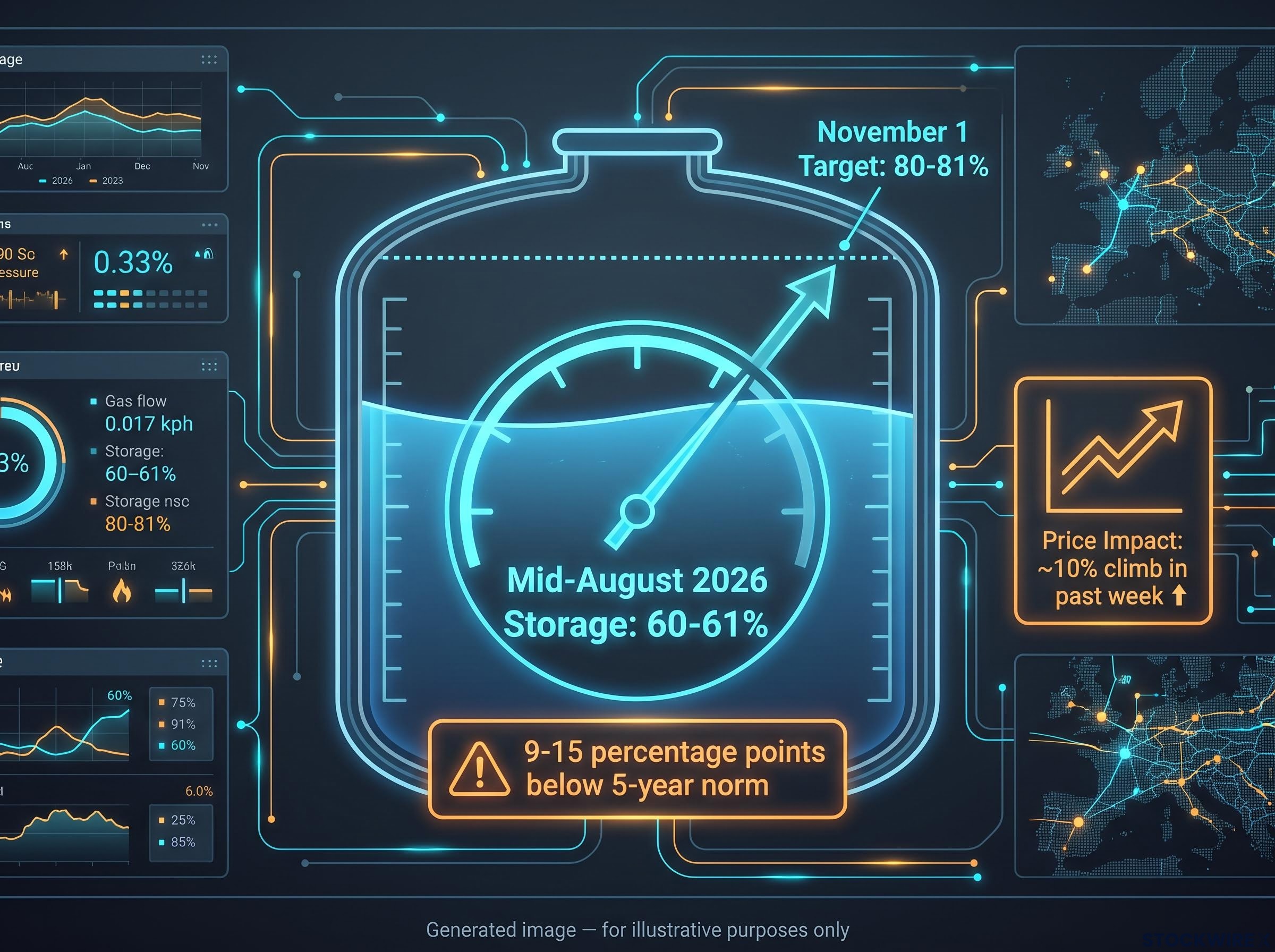
The distinction that matters here is between two types of risk. Volume risk, meaning whether Europe physically runs out of gas, looks manageable. Current injection pace is approximately sufficient to reach 80-81% by the EU’s November 1 target (relaxed from prior stricter targets). The margin is narrow, but the trajectory holds.
Price and policy risk is where the real tail scenarios sit. Sharp TTF (Title Transfer Facility, the European natural gas benchmark price) spikes, government intervention, and demand destruction in industry are all credible outcomes even if storage reaches adequate levels. Filling storage at historically low starting points means refilling at elevated prices, and those costs flow directly through to industrial margins.
Energy-driven inflation dynamics in Europe present a structurally different policy problem than demand-side overheating: rate increases cannot create gas supply or reopen disrupted pipelines, which means the ECB’s tools address the symptom of price levels while leaving the industrial margin compression the article describes entirely intact.
| Risk type | What it means | Sectors most exposed |
|---|---|---|
| Volume risk (physical shortage) | Manageable at current injection pace; narrow margin for error | Broad European equities (only if trajectory stalls) |
| Price risk (TTF spikes) | Elevated refilling costs compress industrial margins in Q3-Q4 | Power-intensive industrials, utilities, European corporate credit |
| Policy risk (government intervention) | Energy subsidies create fiscal pressure; may constrain defence budgets | Regulated sectors (utilities, telecoms, transport), defence primes |
How the drought amplifies the gas price risk
Severe drought conditions are squeezing Europe’s power system through two concurrent channels. Reduced river flows are curtailing the cooling capacity needed for nuclear plants, triggering periodic reductions in reactor output, while depleted reservoirs are limiting the contribution of hydroelectric generation. The result is that the shortfall in both nuclear and hydro supply is being covered by gas-fired thermal generation, which sits at the margin of the power system and therefore amplifies sensitivity to any tightening in gas availability.
The primary geographies affected:
- France: Nuclear river-cooling restrictions reducing output from the country’s reactor fleet
- Germany: Hydro reservoir shortfalls compounding industrial energy costs
- Alpine region: Below-average hydro levels tightening supply across interconnected grids
For investors in European power-intensive industrials or utilities, the question is not whether Europe runs out of gas. It is whether the gas price spike that allows refilling at these low levels is already large enough to compress industrial margins in Q3 and Q4 earnings.
Europe’s political drift and the feedback loop investors are not pricing
The rise of right-leaning parties in Europe is widely tracked. What is less widely modelled is how this political shift connects to the energy and defence themes above. The mechanism runs in a specific sequence:
- Energy stress (high gas prices, drought-driven power costs) fuels voter discontent and strengthens populist parties
- Populist political gains (Marine Le Pen in France, AfD in Germany) bring leaders viewed as broadly sceptical of continued Ukraine support and more amenable to renewed dialogue with Moscow
- Policy shifts threaten the defence spending commitments and sanctions regimes that underpin the procurement pipeline for defence equities
Among near-term European political events, the French presidential election carries the greatest potential to alter the investment landscape. Its outcome will directly affect Ukraine support, sanctions policy, and energy strategy.
A harsh winter or political pushback against high energy prices could re-open questions around supply sources, including potential re-engagement with Russia, or push governments to subsidise energy more heavily, creating fiscal pressure that directly constrains defence spending commitments.
Separately, EU-China trade relations present an additional compounding risk. A structured three-month negotiation period to avert a bilateral trade conflict commenced in mid-2026, with tariff escalation into autumn a credible outcome that would weigh on autos, machinery, and luxury goods exporters.
If right-leaning governments scale back Ukraine support or re-open discussions on Russian energy supply, the procurement pipeline underpinning the defence equity thesis becomes politically rather than industrially constrained. That changes the investment case entirely. Investors pricing energy stress, populist politics, and defence spending durability as independent risks are likely underestimating the scenarios where all three reinforce each other.
Where the asymmetric cases sit, and what to monitor now
The distribution of outcomes for European assets and defence equities has shifted wider. Markets are only partially pricing that in. The edge lies in distinguishing volume risk (manageable) from price, policy, and political risk (where tail scenarios remain underpriced).
Positioned for asymmetric upside:
- Ammunition and consumables suppliers with direct exposure to reorder-driven cash flow
- Adaptive defence technology firms (software-defined systems, open architectures, rapid-iteration platforms)
- Natural-gas-linked exposures (TTF futures, LNG shipping, flexible LNG suppliers) into winter
- C4ISR (Command, Control, Communications, Computers, Intelligence, Surveillance, and Reconnaissance), drone, and electronic warfare specialists in the US complex
Exposed to asymmetric downside:
- European power-intensive industrials facing margin compression from gas and power price spikes
- European corporate credit and fiscally stretched sovereigns
- China-exposed European cyclicals (autos, machinery, luxury) if trade negotiations fail
- Regulated European sectors subject to less predictable policy under populist governments
| Focus area | What to monitor | Signal that validates or breaks the thesis |
|---|---|---|
| EU gas storage | Aggregate fill rate vs. five-year norm; path to ~80-81% by 1 November | Sharp autumn TTF spikes validate the energy-risk thesis |
| European power | Hydro reservoir levels; nuclear output restrictions (France, Germany, Alpine region) | Higher thermal generation share signals margin pressure for industrials |
| Rheinmetall and defence peers | Order intake (ammunition, air defence, armoured systems); FCF conversion | FCF conversion vs. >40% guidance; backlog-to-cash translation improving or deteriorating |
| US defence complex | Munitions, air/missile defence, C4ISR and drone exposure | Production ramp-up progress following 21-day directive |
| European politics | French presidential race; German coalition dynamics | Signalling on Ukraine support, Russia re-engagement, or energy subsidy expansion |
For a reader holding European broad exposure or defence sector positions, this table is the checklist for the next 8-10 weeks. The data releases and political events listed here will confirm or refute the thesis over the next quarter.
What changes the thesis, and what does not
Not every headline that touches these themes matters equally. The analytical discipline that makes this framework durable over a 3-6 month horizon is knowing what constitutes a genuine thesis-changer versus noise.
What would change the thesis:
- A peace agreement involving meaningful territorial concessions from Ukraine, which would reduce procurement urgency structurally
- A European political realignment that substantially reduces defence spending commitments
- A mild winter that eliminates the energy price risk and removes fiscal pressure on governments
For readers wanting to map the specific sectors most compressed by the conflict period, our full explainer on European equity catalysts identifies consumer discretionary, banking, and mining as the names carrying the most accumulated short positioning and therefore the most exposed to a sharp re-rating if a de-escalation signal arrives.
What is noise:
- Short-term TTF price volatility within a normal seasonal range
- Single-week share price moves in defence names absent new order intake or FCF data
- Individual election polling shifts before a final result
The single most important distinction in this analysis is structural: this is a thesis about price, policy, and political risk, not volume risk. Volume risk, whether in gas supply or ammunition production capacity, looks manageable. The tail scenarios that markets have not fully priced sit in the interaction between energy costs, political direction, and procurement durability. Staying anchored to that distinction is what separates a positioned investor from one reacting to the next headline.
The November seasonal window is the first major checkpoint for the battlefield thesis. The French presidential election is the first major checkpoint for the political thesis. Both will arrive within the monitoring window this analysis defines.
This article is for informational purposes only and should not be considered financial advice. Investors should conduct their own research and consult with financial professionals before making investment decisions. These statements are speculative and subject to change based on market developments and company performance.
—